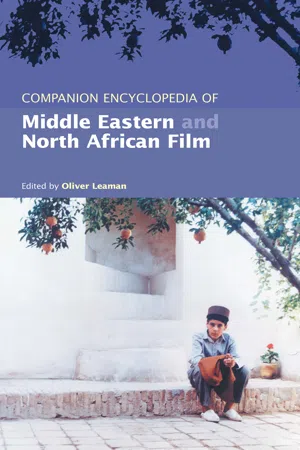
The Companion Encyclopedia of Middle Eastern and North African Film is a unique, one volume work which illuminates a fascinating variety of cinema which is little known outside its own area. The Encyclopedia is divided into nine chapters, each written by a leading scholar in the field. Each chapter covers the history and major issues of film within that area, as well as providing bibliographies of the leading films, directors and actors. The areas covered are: Central Asia, Egypt, Iran, Lebanon, Syria, Iraq, Kuwait, Libya, The Magreb, Palestine, Turkey. This Encyclopedia will be an invaluable reference tool for students and scholars of Film and Media Studies. It contains more than 60 black and white photographs of featured films, includes references and suggestions for further reading at the end of each chapter, and the volume concludes with comprehensive name, film and general indexes.
- 624 pages
- English
- ePUB (mobile friendly)
- Available on iOS & Android
eBook - ePub
Companion Encyclopedia of Middle Eastern and North African Film
About this book
Information
Israeli cinema
The beginning of Israeli cinema corresponds to the beginning of the Zionist enterprise in Palestine. This confluence of the national cinema with the nation-building process itself makes any historiography of Israeli cinema irremediably entangled with the history of Zionism. At the turn of the nineteenth century Jewish settlers in Palestine were forging a Utopian venture: a new Jewish society founded on secular values totally divorced from traditional Jewish society in Eastern and Central Europe where the settlers originated. The local cinema emerged during World War I when the first filmmaker in Jewish Palestine, Ya’akov Ben-Dov, began turning his camera, for several years recording on film the realization of the Zionist project in Palestine. Ben-Dov’s silent films were targeted at Jewish audiences in Europe and North America. Quite often institutions of the Zionist movement, such as Jewish National Fund (JNF) and the Palestine Foundation Fund (PFF), financed and otherwise assisted the production of such films and newsreels. The films were widely used as propaganda promoting Jewish immigration to Palestine, for fund-raising among Jewish communities and for political lobbying in Europe and America.
An overall corpus of hundreds of films and newsreels dedicated to the Zionist project in Palestine includes several filmic genres: newsreels, documentary films, structured short films and several feature films. Zionist cinema can be divided into three historical periods: agricultural pioneering (1918–36), Holocaust-related cinema (1945–8) and heroic-nationalist films (1948–67). The Zionist cinema prevailed until in the early 1960s when two new models of 1960s cinema emerged concurrently: popular cinema and modernistic cinema. Following the 1967 Six-Day War, Israel abandoned its Utopian Zionist discourse, a so-called ‘humanitarian civilizing mission’, and became involved in a colonialist project in the Occupied Territories. At the same time, when it became evident that films were no longer an effective tool for political indoctrination, the Israeli government finally took the long overdue decision to start up the first national television channel. As of January 1970, government television was on air, and it broadcast on a regular basis every day of the week. This date marks the end of the cinema era for local media, when moving images were expertly produced and disseminated for propaganda purposes. The first channel dominated the broadcast scene until the early 1990s when cable and commercial channels challenged its hegemony.
Zionist realism (1920s–50s)
Following Ben-Dov’s pioneering endeavours in the years after World War I, other filmmakers arrived in Palestine and developed the new medium: starting in 1927, Nathan Axelrod turned out newsreels and commercials for movie theatres, while Baruch Agadati produced newsreels intermittently in the early 1930s. Movie theatres opened in the big cities, in particular in Tel Aviv, newspapers began to publish film reviews and the British government of Palestine issued censorship regulations controlling the theatrical release of films, most of which were imported from Europe and the United States. Not until the early to mid-1930s, following the shippment of film equipment belonging to Jewish refugees from Nazi Germany who were then arriving in Palestine, did conditions mature for the production of local films for theatrical exhibition. Among the many newsreels and short documentaries that Jewish film-makers produced in 1930s Palestine, there were several long documentaries and dramas, such as Lecha’im Hadashim/Land of Promise (Juda Leman, 1934), Zot Hi Ha’aretz/This is the Land (Baruch Agadati, 1934) and Awoda (Helmar Lerski, 1935). The first fiction films produced for theatrical release were also made in the 1930s, including Oded Hanoded/Oded the Wanderer (Haim Halachmi and Nathan Axelrod, 1933), Tzabar/ Sabra (Alexander Ford, 1933) and Me’al Hachoravot/On the Ruins (Nathan Axelrod, 1938), which were successfully exhibited in the big towns.
While differing from their predecessors in genre and cinematic rhetoric, the 1920s and 1930s films repeated the same narrative of national redemption: the realization of the Zionist enterprise in Palestine. Dedicated to the ideal of reviving the land of Palestine, the films emphasized agricultural props and objects, such as ploughs, tractors, horse-drawn wagons, and abundant fruit and vegetables. Traditional Jewish symbols, such as the Star of David and the Menorah, were also used and along with agricultural activities, house- and road-construction, and the tools and objects associated with them, were often shown. Retrospectively these films constitute a comprehensive cinematic iconography of Zionism’s pioneering period. Little film time was dedicated to individual and family lif...
Table of contents
- Contents
- Illustrations
- Notes on contributors
- Preface
- Introduction
- How to use this book
- Acknowledgements
- Central Asian cinema
- Egyptian cinema
- Iranian cinema
- Israeli cinema
- Cinema in Lebanon, Syria, Iraq and Kuwait
- Cinema in Libya
- Cinema in the Maghreb
- Cinema in Palestine
- Turkish cinema
- General index
- Name Index
- Film index
Trusted by 375,005 students
Access to over 1.5 million titles for a fair monthly price.
Study more efficiently using our study tools.
Frequently asked questions
Yes, you can cancel anytime from the Subscription tab in your account settings on the Perlego website. Your subscription will stay active until the end of your current billing period. Learn how to cancel your subscription
No, books cannot be downloaded as external files, such as PDFs, for use outside of Perlego. However, you can download books within the Perlego app for offline reading on mobile or tablet. Learn how to download books offline
Perlego offers two plans: Essential and Complete
- Essential is ideal for learners and professionals who enjoy exploring a wide range of subjects. Access the Essential Library with 800,000+ trusted titles and best-sellers across business, personal growth, and the humanities. Includes unlimited reading time and Standard Read Aloud voice.
- Complete: Perfect for advanced learners and researchers needing full, unrestricted access. Unlock 1.5M+ books across hundreds of subjects, including academic and specialized titles. The Complete Plan also includes advanced features like Premium Read Aloud and Research Assistant.
We are an online textbook subscription service, where you can get access to an entire online library for less than the price of a single book per month. With over 1.5 million books across 990+ topics, we’ve got you covered! Learn about our mission
Look out for the read-aloud symbol on your next book to see if you can listen to it. The read-aloud tool reads text aloud for you, highlighting the text as it is being read. You can pause it, speed it up and slow it down. Learn more about Read Aloud
Yes! You can use the Perlego app on both iOS and Android devices to read anytime, anywhere — even offline. Perfect for commutes or when you’re on the go.
Please note we cannot support devices running on iOS 13 and Android 7 or earlier. Learn more about using the app
Please note we cannot support devices running on iOS 13 and Android 7 or earlier. Learn more about using the app
Yes, you can access Companion Encyclopedia of Middle Eastern and North African Film by Oliver Leaman in PDF and/or ePUB format, as well as other popular books in Media & Performing Arts & Film & Video. We have over 1.5 million books available in our catalogue for you to explore.