eBook - ePub
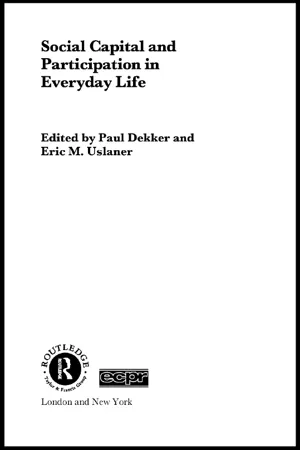
Social Capital and Participation in Everyday Life
- 224 pages
- English
- ePUB (mobile friendly)
- Available on iOS & Android
eBook - ePub
Social Capital and Participation in Everyday Life
About this book
This timely volume puts emphasis on the effect of social capital on everyday life: how the routines of daily life lead people to get involved in their communities. Focussing on its micro-level causes and consequences, the book's international contributors argue that social capital is fundamentally concerned with the value of social networks and about how people interact with each other.
The book suggests that different modes of participation have different consequences for creating - or destroying - a sense of community or participation. The diversity of countries, institutions and groups dealt with - from Indian castes to Dutch churches, from highly competent 'everyday makers' in Scandinavia to politics-avoiding Belgian women and Irish villagers - offers fascinating case studies, and theoretical reflections for the present debates about civil society and democracy.
Information
1 Introduction
Paul Dekker and Eric M. Uslaner
Social capital, political science and everyday life
The role of social trust and cooperativeness as a component of the civic culture cannot be overemphasized. It is, in a sense, a generalized resource that keeps a democratic polity operating. Constitution makers have designed formal structures of politics that attempt to enforce trustworthy behavior, but without these attitudes of trust, such institutions may mean little. Social trust facilitates political cooperation among the citizens in these nations, and without it democratic politics is impossible.
That sounds modern, almost fashionable. Let's guess: Francis Fukuyama? Bob Putnam? Someone from the World Bank's social capital group who is talking about Third World countries? A chairperson from an American civil-society NGO lecturing locals somewhere in Eastern or Central Europe? No, it is really ‘the civic culture’ mentioned in the first sentence: Almond and Verba (1963: 356–7) almost four decades ago. In their comparative work on ‘political attitudes and democracy in five countries’ they stress the importance of trust between citizens and of involvement in voluntary associations for a stable democracy.
These social bases of democracy return high on the empirical political science research agenda in the 1990s, after the analyses of Putnam (1993) of regional differences in Italy and his further elaborations of the decline of civic engagement in the United States in several articles and finally in a book, Bowling Alone (Putnam 2000). The concerns of Putnam in the 1990s–and reasons for the public and political elite interest in his work – can be summarized as the idea of ‘civic malaise’, a syndrome of declining involvement in voluntary associations and volunteering, declining trust between citizens, and declining political involvement. The concerns about apathy are different from the concerns of Almond and Verba some decades before–they were more frightened by the risks of too much participation – but the empirical elements are the same: social trust, social participation and political involvement.
‘Social capital’ is the concept that Putnam picks up from the literature and elaborates in his 1993 book on civic traditions in modern Italy to theorize about the complexities of trust and participation. In this book the concept ‘refers to features of social organization, such as trust, norms, and networks, that can improve the efficiency of society by facilitating coordinated actions’ (Putnam 1993: 167) and seven years later it ‘refers to connections among individuals – social networks and the norms of reciprocity and trustworthiness that arise from them’ (Putnam 2000: 19). The way Putnam defines social capital does not change very much over the years and neither do his positive associations of social capital with benefits for the community, for the larger society and for politics. It's only a small step from ‘networks’ to ‘networks of civic engagement’ (1993: 171) and from ‘norms of reciprocity and trustworthiness’ to ‘civic virtue’ (2000: 19).
Critics of Putnam have charged that he focuses almost exclusively on the benign macro effects of social capital. They also argue that he puts too much emphasis on face-to-face civic engagement in voluntary associations and either pays little attention to other forms of civic participation or denigrates them entirely (see the references at the end of this chapter for the main compilations and for a website of the World Bank with links to more articles and papers). It can easily be noted that Putnam more than once acknowledges that social capital is not necessarily ‘praiseworthy’, that it may have exclusively individual benefits or even negative effects for other people and society, and that there are more relevant ties and activities than the ones of civic engagement and voluntary associations. However, his empirical work clearly focuses on (‘praiseworthy’) public social capital that is embedded in involvement in voluntary associations and that has political consequences. The foundations in social capital theory may be somewhat fragile, but the idea that ‘good government comes from singing choirs and soccer clubs’ has been shown to have a lot of appeal for both political reformers and political scientists.
The links Putnam suggests between everyday cooperative attitudes and participation and high politics reflect the ones Almond and Verba (1963: 208ff.) saw 40 years ago: social trust between citizens makes their cooperation and voluntary association more alike, membership in associations strengthens political competence, social trust lowers the risks of political communication, political involvement stimulates system responsiveness and democratic performance, etc. Social trust sometimes (i.e. in some countries) translates into politically relevant trust and interpersonal cooperation sometimes translates into a propensity for political cooperation. Well-performing Italian regions show higher levels of civic involvement and social trust (Putnam 1993); stable democracies show a ‘higher incidence of social interaction outside of the more or less compulsory relationships of family and work groups’ and this voluntary social interaction for moral, recreational and social purposes probably ‘reflects feelings of confidence and safety in the social environment’ (Almond and Verba 1963: 211).
Following Almond and Verba, other analysts have confirmed positive relationships between various kinds of political and non-political participation (cf. Van Deth 1997). However, there has been less attention to testing the ‘role of social trust and cooperativeness’ that Almond and Verba thought was even more critical. The social capital vocabulary that has been (re)introduced by Putnam demands that we pay more attention to these attitudes and to the patterns of trust, participation, and social connections that arise in everyday life.
Social capital is all about the value of social networks, bonding similar people and bridging between diverse people, with norms of reciprocity. Social capital is fundamentally about how people interact with each other. So we focus primarily on the micro-level causes and consequences of social capital. Does organizational membership produce trust? If so, do organizations need to have face-to-face communications to lead to either broader civic engagement or the development of trust in other people? And do these organizations have to spring from the ground up, as much discussion of social capital assumes?
Plan of the book
The chapters in this book cover a wide range of countries – the Scandinavian nations, Germany, the Netherlands, Belgium, Ireland, the United States, Canada, Australia and India – and a wide range of phenomena: from churches to mailing-list organizations, from castes to pet groups, from factor analysis to ethnographic participation. But we hope that there is some sequential logic in the diversity. To pick up the social capital debate, Chapter 2 starts with a general introduction of the concept and its manifestations and effects, mainly illustrated with examples from developing countries. The author, Christiaan Grootaert, is an economist working for the World Bank. His concerns are not just theoretical, but also practical, as the Bank has a major Social Capital Initiative focusing on developing countries. We finish with various modes of political participation and political non-involvement of citizens in Western Europe, and in between several aspects of social trust, cooperativeness and social participation and their interrelationships are investigated.
Why have some countries had greater economic growth than others? Creating sustainable development – developing natural, physical and human capital that will be increase from one generation to the next – is central to long-term economic growth. Studies of development have only partially explained growth rates and sustainable development. Christiaan Grootaert argues in Chapter 2 that social capital is the missing link. He argues that group membership and informal organizations facilitate the sharing of information among economic agents, the coordination of activities, the development of trust, and the development of roots to one's local communities. Grootaert reviews the literature on social capital and development, surveying the meanings and measurement of social capital and summarizing both the quantitative analyses and case studies that show a strong linkage between social capital and development. He then develops a conceptual framework for the measurement of social capital, and outlines a set of policy recommendations for international agencies such as the World Bank on how to promote sustainable development through fostering social capital.
Richard Johnston and Stuart Soroka ask in Chapter 3 whether diversity is the enemy of civil society and social capital. Does ethnic diversity undercut the bond of identity that facilitates trust and support for risk pooling (as in support for social insurance and willingness to pay taxes)? Using data from the 1991 World Values Study in Canada, Johnston and Soroka inquire into regional and ethnic differences in civic participation and civic orientations. Their conclusion is that diversity is not the enemy of social capital. Ethnic differences in social capital do exist, but ‘recency of arrival and cultural distance from the traditional “core” Canadian ethnicities do not track linearly into weak associational involvement or into uncivic attitudes’. Not only the compositional argument is rejected, but also the contextual argument (the more diverse a place, the smaller its stock of social capital) is not supported: diversity of the provincial context does not seem to induce backlash among older groups.
Chapter 4 by Jenny Onyx and Paul Bullen explores social capital from a comparative empirical base. Elements of social capital according to the literature – participation in networks, reciprocity, trust, social norms, and proactive attitudes – were measured in five rural and urban areas in Australia. Factor analyses of the survey data revealed one clear general factor, summarizing eight specific factors. The three most important specific factors refer to social participation, to personal proactivity and to feelings of trust and safety. Items related to government institutions had no relationship with any social capital factor. Strong differences were found in the levels and patterns of responses across the communities. The authors finally discuss local conditions for the reproduction of social capital, in particular the role of the non-profit sector.
Ricca Edmondson discusses in Chapter 5 the current resurgence of interest in political ‘cultures’ and links it with communitarian complaints about contemporary political settings and participation. Cultures are shown to have features that inhibit their own investigation. To assess the accuracy of claims about deficits and to recognize cases of more positive behaviour, forms of qualitative research are needed. After some methodological reflections, research into community life in Western Ireland is presented. Some aspects of community life fulfil the criteria for public participation outlined by communitarians, but others do not. The notion of the inevitability of future interaction turns out to be a major constraint for fuller interaction and community life: ‘your subjective thoughts about God, love and politics are not of overwhelming public interest and should not divert you personally from what it is in general reasonable for you to do’.
Most discussions of political development start with the assumption that modernization depends upon democracy and that traditional communities which reinforce class and status divisions are inimical to democracy. Traditional communities may reinforce social inequalities and exacerbate ethnic tensions. They may make it difficult, if not impossible, for members of these communities to build bridges across social groups that is essential for developing social capital. Hans Blomkvist argues in Chapter 6 that these are real problems, but traditional societies also may have significant advantages in stimulating political participation. The caste system in India has long provided significant counterweights against kings. And the tribal loyalties of the caste system has also made it possible to organize peasants for collective action – in ways that traditional Western models of group participation might not be able to do.
Religious values emphasize the importance of serving not only God, but also one's fellow men and women. In the Netherlands and in many other societies, religious organizations have long played an essential role in getting people to volunteer their time. How important are religious values and commitments to volunteering? In Chapter 7, Joep de Hart uses time budget studies combined with surveys of attitudes and values in the Netherlands to examine this question. He finds that regular churchgoers in the Netherlands participate much more frequently in voluntary work than people who are only officially members of a church or who have no religious affiliation at all. This applies to both Catholics and Protestants.
Eric Uslaner examines in Chapter 8 ‘particularized trusters’ in the United States. Particularized trusters are people who have faith only in their own kind, as opposed to generalized trusters who place confidence in strangers, including people different from themselves. They may participate in civic organizations, but only in groups composed of people like themselves. They will withdraw from organizations with diverse memberships. Using the 1987 General Social Survey in the United States, Uslaner finds that religious fundamentalists who are active in their places of worship follow the path of particularized trusters. They are active in civic life, but only for religiously-based organizations. In contrast, people who are active in their religious communities but reject the fundamentalist label take prominent roles in secular civic life in the United States. The rise in fundamentalist identification is thus particularly threatening to secular civic engagement in the United States. Thus Uslaner's findings for the United States differ from those of De Hart in the Netherlands: religion may lead people to withdraw from widespread civic participation. The differences seem to lie in the nature of religiosity in the two countries. There are very few fundamentalists in the Netherlands, but very many in the United States.
In Chapter 9, Dietlind Stolle seeks to determine whether participation in civic associations makes people more trusting of other people. Following the arguments of Tocqueville and Putnam, she expects that membership in voluntary organizations will lead people to become more trusting of other people. She tests this thesis through surveying members of different types of voluntary associations in the United States, Germany and Sweden. She also asks people how long they have been members of the groups. Stolle expects that the longer people belong to voluntary organizations, the greater their trust should be. Alternatively, the higher levels of trust in voluntary organizations that Putnam and others have found may reflect a ‘selection bias’, where trust may be necessary to get people to join voluntary associations. Stolle finds that there is indeed a selection bias – but also that there is at least a temporary boost in trust after people have been members of voluntary associations for five to seven months. This result holds across a wide variety of types of organizations and it also holds in each of the three countries.
Per Selle and Kristin Stromsnes argue in Chapter 10 that democracy is not essential for voluntary organizations. Many such organizations are created by the state. Their supporters are not active participants. Instead, they are passive supporters. And they are not marginalized as many people might suggest. Selle and Stromsnes examine environmental organizations in Norway that have no active mass memberships. They argue that these groups may nevertheless be representative of the population. Even though these groups do not involve face-to-face communication among members, they have extensive information systems that may be of great benefit to members. And, Selle and Strømsnes suggest, we may have overestimated the extent to which people in more traditional voluntary organizations actually participate in day-to-day activities.
The popular gloomy analyses of political disengagement of Robert Putnam and others concentrate too much on official politics, and for that reason cannot see positive developments in democratic governance in society. A new phenomenon in this area – first discovered in Inner-Nørrebro by researchers of the Danish ‘Democracy from Below’ project – is the ‘Everyday Maker’ with the following constituent parts: a strong self-relying and capable individuality; a perception of politics as the concrete and direct handling of difference and diversity; a notion of commonality as solving common problems; an acceptance of democratic values and procedures in disputes in everyday life. Chapter 11 by Henrik Bang and Eva Sorensen gives a fuller description of the Everyday Maker and discusses its relevance for the transformation from democratic political government to democratic political governance, and for the reproduction of social capital.
In contrast to these politically highly competent citizens, Chapter 12 spotlights people who are not active politically, in particular groups of women and lower educated citizens, in Belgium. Based on in-depth interviews and focus groups Marc Hooghe rejects the apathy explanation of passivity: respondents and discussants showed remarkable interest for and insight into complex social problems. There is evidence for the inhibition thesis: people feel that their participation is not welcome. In line with Cilligan's research on adolescent girls, feelings of marginalization within the public realm led to a strategy of silence and passivity. The findings lead to a discussion about the democratic appeal of concepts of ‘participatory’ or ‘deliberative’ democracy.
In Chapter 13 we return to the promises of social capital research. We put the research in this volume – and elsewhere – into context and urge some caution in estimating the importance of social capital. Social capital is not just one thing. It is composed of many parts. Some aspects of civic engagement, such as volunteering and giving to charity, are clearly beneficial to society. These ‘beneficial’ types of civic engagement depend heavily upon social trust. Yet, there are different ways in which we can volunteer. Spending time with people like ourselves (volunteering at our house of worship or in our children's schools) is all to the good, but it cannot spread social trust. The key benefits of tr...
Table of contents
- Cover Page
- Routledge/ECPR Studies in European Political Science
- Title Page
- Copyright Page
- Figures
- Tables
- Contributors
- Series editor's preface
- 1 Introduction
- 2 Social capital: The missing link?
- 3 Social capital in a multicultural society: The case of Canada
- 4 The different faces of social capital in NSW Australia
- 5 Studying civic culture ethnographically and what it tells us about social capital: Communities in the West of Ireland
- 6 Traditional communities, caste and democracy: The Indian mystery
- 7 Religion and volunteering in the Netherlands
- 8 Volunteering and social capital: How trust and religion shape civic participation in the United States
- 9 ‘Getting to trust’: An analysis of the importance of institutions, families, personal experiences and group membership
- 10 Membership and democracy
- 11 The Everyday Maker: Building political rather than social capital
- 12 ‘Not for our kind of people’: The sour grapes phenomenon as a causal mechanism for political passivity
- 13 The ‘social’ in social capital
Trusted by 375,005 students
Access to over 1.5 million titles for a fair monthly price.
Study more efficiently using our study tools.
Frequently asked questions
Yes, you can cancel anytime from the Subscription tab in your account settings on the Perlego website. Your subscription will stay active until the end of your current billing period. Learn how to cancel your subscription
No, books cannot be downloaded as external files, such as PDFs, for use outside of Perlego. However, you can download books within the Perlego app for offline reading on mobile or tablet. Learn how to download books offline
We are an online textbook subscription service, where you can get access to an entire online library for less than the price of a single book per month. With over 1.5 million books across 990+ topics, we’ve got you covered! Learn about our mission
Look out for the read-aloud symbol on your next book to see if you can listen to it. The read-aloud tool reads text aloud for you, highlighting the text as it is being read. You can pause it, speed it up and slow it down. Learn more about Read Aloud
Yes! You can use the Perlego app on both iOS and Android devices to read anytime, anywhere — even offline. Perfect for commutes or when you’re on the go.
Please note we cannot support devices running on iOS 13 and Android 7 or earlier. Learn more about using the app
Please note we cannot support devices running on iOS 13 and Android 7 or earlier. Learn more about using the app
Yes, you can access Social Capital and Participation in Everyday Life by Paul Dekker,Eric M. Uslaner,PAUL DEKKER,ERIC M. USLANER in PDF and/or ePUB format, as well as other popular books in Politics & International Relations & Politics. We have over 1.5 million books available in our catalogue for you to explore.