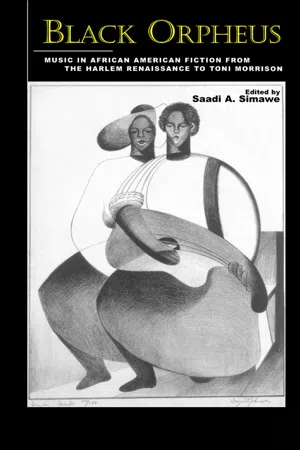
Black Orpheus
Music in African American Fiction from the Harlem Renaissance to Toni Morrison
- English
- ePUB (mobile friendly)
- Available on iOS & Android
Black Orpheus
Music in African American Fiction from the Harlem Renaissance to Toni Morrison
About this book
The legendary Greek figure Orpheus was said to have possessed magical powers capable of moving all living and inanimate things through the sound of his lyre and voice. Over time, the Orphic theme has come to indicate the power of music to unsettle, subvert, and ultimately bring down oppressive realities in order to liberate the soul and expand human life without limits. The liberating effect of music has been a particularly important theme in twentieth-century African American literature.
The nine original essays in Black Orpheus examines the Orphic theme in the fiction of such African American writers as Jean Toomer, Langston Hughes, Claude McKay, James Baldwin, Nathaniel Mackey, Sherley Anne Williams, Ann Petry, Ntozake Shange, Alice Walker, Gayl Jones, and Toni Morrison. The authors discussed in this volume depict music as a mystical, shamanistic, and spiritual power that can miraculously transform the realities of the soul and of the world. Here, the musician uses his or her music as a weapon to shield and protect his or her spirituality. Written by scholars of English, music, women's studies, American studies, cultural theory, and black and Africana studies, the essays in this interdisciplinary collection ultimately explore the thematic, linguistic structural presence of music in twentieth-century African American fiction.
Frequently asked questions
- Essential is ideal for learners and professionals who enjoy exploring a wide range of subjects. Access the Essential Library with 800,000+ trusted titles and best-sellers across business, personal growth, and the humanities. Includes unlimited reading time and Standard Read Aloud voice.
- Complete: Perfect for advanced learners and researchers needing full, unrestricted access. Unlock 1.4M+ books across hundreds of subjects, including academic and specialized titles. The Complete Plan also includes advanced features like Premium Read Aloud and Research Assistant.
Please note we cannot support devices running on iOS 13 and Android 7 or earlier. Learn more about using the app.
Information
Table of contents
- Cover Page
- Border Crossings
- Title Page
- Copyright Page
- Acknowledgments
- Series Editor’s Foreword: Border Crossings
- Introduction: The Agency of Sound in African American Fiction
- Chapter 1: Singing the Unsayable: Theorizing Music in Dessa Rose
- Chapter 2: Claude McKay: Music, Sexuality, and Literary Cosmopolitanism
- Chapter 3: Black Moves, White Ways, Every Body’s Blues: Orphic Power in Langston Hughes’s The Ways of White Folks
- Chapter 4: Black and Blue: The Female Body of Blues Writing in Jean Toomer, Toni Morrison, and Gayl Jones
- Chapter 5: That Old Black Magic?: Gender and Music in Ann Petry’s Fiction
- Chapter 6: “It Don’t Mean a Thing If It Ain’t Got That Swing”: Jazz’s Many Uses for Toni Morrison
- Chapter 7: Shange and Her Three Sisters “Sing a Liberation Song”: Variations on the Orphic Theme
- Chapter 8: Nathaniel Mackey’s Unit Structures
- Chapter 9: Shamans of Song: Music and the Politics of Culture in Alice Walker’s Early Fiction
- Contributors