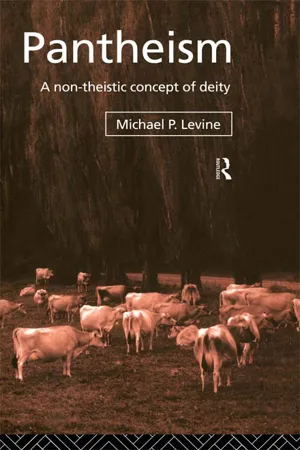
Many people who do not believe in God believe that 'everything is God' - that everything is part of an all-inclusive divine unity. In Pantheism, this concept is presented as a legitimate position and its philosophical basis is examined. Michael Levine compares it to theism, and discusses the scope for resolving the problems inherent in theism through pantheism. He also considers the implications of pantheism in terms of practice. This book will appeal to those who study philosophy or theology. It will also be of interest to anyone who does not believe in a personal God, but does have faith in a higher unifying force, and is interested in the justification of this as a legitimate system of thought.
- 400 pages
- English
- ePUB (mobile friendly)
- Available on iOS & Android
eBook - ePub
About this book
Information
1
INTRODUCTION
There are two and only two systems of philosophy that can be offered. The one posits God as the transcendent cause of things; the other makes God the immanent cause. The former carefully distinguishes and separates God from the world; the latter shamefully confounds God with the universe… The former establishes a foundation for every religious devotion and for all piety, and this the latter fundamentally overturns and takes away.1
Christoph. Wittich
There is a great deal of confusion as to what pantheism is, and so I begin by defining pantheism and distinguishing it from theism. I then argue that pantheism is not atheism. The remainder of the introduction describes the general scope and outline of the book, and some of its principal contentions.
Pantheism is a metaphysical and religious position. Broadly defined it is the view that (1) “God is everything and everything is God…the world is either identical with God or in some way a self-expression of his nature” (H.P.Owen). Similarly, it is the view that (2) everything that exists constitutes a “unity” and this all-inclusive unity is in some sense divine (A.MacIntyre).2 A slightly more specific definition is given by Owen who says (3) “‘Pantheism’…signifies the belief that every existing entity is, only one Being; and that all other forms of reality are either modes (or appearances) of it or identical with it” (p. 65).3
What is the relevant sense of “unity” in pantheism’s “all-inclusive divine unity”? What is meant by “all-inclusive”? What is meant by calling it “divine”? These issues are taken up in Part I where the meaning of pantheism is examined. Prominent misunderstandings of pantheism are discussed in section 2.1.
Theism is the belief in a “personal” God which in some sense is separate from (i.e. transcends) the world. (Theists just about always believe God to be a “person.” But few theists hold that God is completely transcendent.) Where pantheism is considered as an alternative to theism and atheism, rather than compatible with either, it involves a denial of at least one, and possibly both, central theistic claims. Pantheists usually deny the existence of a “personal” God. They deny the existence of a “minded” Being that possesses the characteristic properties of a “person,” such as having “intentional” states, and the associated capacities like the ability to make decisions. Taken as an alternative to, and denial of, theism and atheism, pantheists deny that what they mean by God (i.e. an all-inclusive divine Unity) is completely transcendent. They deny that God is “totally other” than the world. As Owen says, “although pantheists differ among themselves at many points, they all agree in denying the basic theistic claim that God and the world are ontologically distinct” (p. 65).
What does it means to say that pantheists believe that God and the world are not “ontologically distinct”—and is this really a requirement? This requirement is based on the pantheistic identification (in some sense) of God and the world. But the idea that the all-inclusive divine Unity must be ontologically identical to the world is questionable. The relevance of ontology, the question of ontological identification or distinctness, is something of a red herring as we shall see. For now, it suffices to know that pantheism denies that the divine Unity and the world are “ontologically distinct” if this is taken to mean that the Unity is “totally other” than the world. It does not mean that finite entities and the pantheistic God (i.e. the divine Unity) may not be distinct. The totality that is a divine Unity may allow for the existence of ontologically real and separate entities. In terms of the theism/pantheism contrast, where theism claims God is transcendent, pantheism claims God is radically immanent. But pantheists need not claim that there are no transcendent aspects to the divine Unity. Pantheists may maintain the divine Unity’s immanence without denying (1) that the divine Unity and finite entities are ontologically distinct or (2) that there are transcendent aspects to the pantheistic Unity.
With some exceptions, pantheism is non-theistic, but it is notatheistic. It is a form of non-theistic monotheism, or non-personal theism. It is the belief in one God, a God identical to the all-inclusive unity, but it does not believe God is a person or anything like a person.4 The fact that pantheism clearly is not atheistic, and is an explicit denial of atheism, is rather astonishingly overlooked or disputed by its critics. In his nonpantheistic phase, Coleridge claimed that “every thing God, and no God, are identical positions.”5 Owen says, “if ‘God’ (theos) is identical with the Universe (to pan) it is merely another name for the Universe. It is therefore bereft of any distinctive meaning; so that pantheism is equivalent to atheism…[pp. 69–70]…taken strictly it [pantheism] is equivalent to atheism” (p. 74). Similarly, Schopenhauer said that “to call the world ‘God’ is not to explain it; it is only to enrich our language with a superfluous synonym for the word ‘world.’”6 Schopenhauer’s view is discussed in the section on Unity.
The primary reason for equating pantheism with atheism pertains to non-personalistic types of pantheism (i.e. most types). The critic simply presupposes that there can be no such thing as non-personal theism. It is assumed that belief in any kind of “God” must be belief in a personalistic God, because God must be a person. Though not explicitly referring to pantheism here, Rudolf Otto says:
We need not dispute that the denial of personality to God is simply a disguised form of atheism, or betokens a desperate attempt to equate faith with belief in natural law and with naturalism. But it would be a huge error to suppose that anything of this kind is in the mind of the mystics when they set themselves to oppose the idea of personality in deity.7
Otto is discussing the “origin of that tendency to let the conception of personality and the personal…be submerged in… ‘nothingness’, a tendency which is in appearance so irreligious.” However, since Otto allows that in the case of mysticism the denial of personality to God is merely irreligious in appearance, then surely the same can be said of pantheists who, as non-personal theists, never equate their God (i.e. the divine unity) with the world simpliciter, simply with belief in natural law, or with mere naturalism.
If non-personal theism is assumed incoherent, then there canbe no intelligible forms of pantheism that deny the application of personalistic concepts to a pantheistic unity (God). But what reason is there, even prima facie, to make this assumption? It is question begging to assume that pantheism, or any kind of belief in “God,” must conceive of God as a person if it is to count as belief in “God.” It is a refusal to take pantheism, and other nontheistic types of belief in God, to be types of belief in God because they deny God is personal. The limitation is stipulative and unduly restricts the extent to which alternative theories of deity can be formulated. Pantheism cannot even be taken as a theory of deity on such a view. If, contrary to what most pantheists believe, pantheism has to conceive of God as a “person,” then it must be a kind of personal theism. And if there are problems, as there surely are, inherent in conceptions of God as a person, then these would exist for pantheism as well. There is little reason, however, to accept the theistic restriction on what can count as God—even for a theist.
The charge that pantheism is atheistic is as old as pantheism itself. Christopher Rowe says,
When Cicero’s Velleius describes Speusippus’ pantheism as an attempt to “root out the notion of gods from our minds”, he is echoing a charge which was commonly made against the pantheism of the earlier Greek natural philosophers… like Anaximander or Heraclitus. These tended to be identified as atheists in the popular mind; and indeed Plato himself implies a similar view…the opponents who classify them as atheists are in reality attacking them for undermining traditional beliefs about the gods—or, to borrow a phrase from the indictment against Socrates, “for not believing in the gods the city believes in”. (In Plato’s Apology, one of the prosecutors, Meleteus, is portrayed as feeling no embarrassment about accusing Socrates of being an atheist, at the same time as formally charging him with “introducing new divinities”)… The puzzling statement attributed to Thales…that “everything is full of gods” [Aristotle, Physics 203 b 10ff.]…may well imply a deliberate criticism of conventional religion; the gods, Thales may be saying, are not to be found, or merely to be found…where they are placed by traditional belief, but are much more widely present in nature.
(Rowe, pp. 54–5)
The claim of Schopenhauer, Coleridge (who at one time was a pantheist), and others who charge that pantheism is atheistic is either an oblique way of saying that pantheists do not believe in a theistic God, which is both true and trivial; or it is based on their assessment of what the central claim of pantheism finally amounts to—that belief in a divine Unity is equivalent to atheism. Of course, pantheists do not deny that they do not believe in a theistic God, but they do deny that their position is atheistic. Clearly the assertion of a divine unity is meant to be a denial of atheism. Rowe says “it may very well be that from the philosophical point of view, pantheism and atheism may be very close together. But the Presocratics are certainly not atheistic by intention” (p. 54). Rowe’s point is applicable to other pantheists as well. Pantheism is not meant to be atheism—and it cannot be atheism if atheism is the denial of both a theistic and a nontheistic God. Furthermore, there is no reason to suppose that “from the philosophical point of view, pantheism and atheism may be very close together.”
Since atheism is an unacceptable interpretation of what pantheists intend to assert, the view that pantheism is atheistic must be defended in terms of an analysis of what the position amounts to (i.e. entails). But, no such analysis could be successful given that pantheism involves, as part of its meaning, the denial of atheism. Any reductionist account of pantheism that eliminates God is no longer an account of pantheism. Of course, the pantheistic view concerning the nature of God may be incoherent. When implications of pantheistic claims about the divine unity are examined, it may turn out that their notion of God cannot be what they would have liked or thought it to be. Nevertheless, no analysis can show that pantheism is atheistic since the denial of atheism is intrinsic to the position. At most, what Schopenhauer, Coleridge, Owen etc. can show, and probably all they intend, is either that the pantheistic Unity can be explained in terms that would eliminate the notion of deity from pantheism altogether, or that it is incoherent. They want to show that believing in a pantheistic God is a convoluted and confused way of believing in something that can adequately be described apart from any notion of deity—and in this they are mistaken.
Showing that a particular pantheistic concept of deity is incoherent is different from showing that pantheism is atheistic. If the theistic notion of deity were shown to be incoherent, it wouldfollow that such a deity could not be instantiated. However, it would not mean that theists were really atheists. If “God” as conceived of by theists is incoherent, then some suitable revision of the concept of a theistic God would be required that would retain as many of the essential features of that concept as possible. The object of the theist’s belief may be incoherent without their being atheists. Similarly, showing that a pantheistic notion of deity is incoherent does not indicate that pantheism is atheism. It shows that the pantheistic concept of deity needs to be reformulated so as to resolve the incoherency without giving up (if possible) what is regarded as essential to the concept. In short, pantheists cannot be atheists since belief in God (i.e. in a divine Unity) is essential to pantheism.
The claim that “pantheists are atheists” may also be another way of saying that pantheists do not believe in the existence of a theistic deity, which is true, but uninteresting. (Even pantheists who believe the divine unity is personal or a person do not believe in the theistic God.) I do not think this is what Schopenhauer etc. have in mind. Rather, they want to show that the pantheistic God cannot plausibly be termed “God.” If their term for God (the all-inclusive divine Unity) does refer to anything it cannot be God. It must be something like the “world.” The claim is that when pantheists purport to talk about God they are really talking about the world. I have argued that this is not possible. They may be talking about the world as in fact they claim to be; but pantheists cannot plausibly be interpreted as talking about the world apart from God.
Pantheists deny God’s ontological transcendence. The divine Unity is radically immanent in the world. H.D.Lewis describes transcendence as referring to “the peculiar ‘beyondness’ or ‘otherness’ of God implied in the perfection…of His nature…as distinguishing Him altogether from any of His creatures.”8 The idea of God’s transcendence is so central to religion in general and theism in particular that religion is sometimes defined as the belief in “another dimension,” or in God(s) that are “separate” from the world. God is conceived of as transcending the spatiotemporal world; and depending on what one takes this to imply, various metaphysical, logical and epistemological issues arise. For example, if God (due to his “otherness”) is transcendent in aradically epistemic sense, then how is any knowledge of God possible? And if such knowledge is impossible, how can one conceptualise or talk about God? If one cannot conceive of God because he is “other,” then how can one know anything about God?9 Or, if God is conceived of as ontologically and metaphysically distinct, how is it possible to have anything to do with God, or for God to have anything to do with the world?
Given this partial account of transcendence and religion it is not difficult to see why the “problem of transcendence” is the central philosophical problem for theism and philosophy of religion in general. There are tensions between the concept of a transcendent God on the one hand and the primary goal of religion as a “relation” to God, an overcoming of transcendence, on the other. The deistic idea that God is completely transcendent sees the pursuit of a relationship to God as essentially misdirected. If God is completely transcendent, religion may perhaps still be seen as a foundation of morality, and a basis for happiness—though it is unlikely. But its explicitly stated goal of “salvation” as a relation to God must be regarded as a chimera.
Issues in theism involving the concept of transcendence include theories concerning God’s nature; creation; revelation; incarnation; salvation; knowledge of God (including mystical knowledge); and the problem of evil—where the “distinctness” between God and the world is stressed by way of establishing God’s lack of responsibility for evil.10 An analysis of transcendence is an important element in addressing these, but so is the notion of divine immanence. Pantheism, as a doctrine of divine immanence, offers distinct formulations of these issues, a...
Table of contents
- Front Cover
- Half Tilte
- Title Page
- Copyright
- Contents
- Preface
- Acknowledgments
- 1 INTRODUCTION
- Part I Meaning
- Part II Philosophy of pantheism
- Part III Method
- Bibliography
- Name index
- Subject index
Trusted by 375,005 students
Access to over 1.5 million titles for a fair monthly price.
Study more efficiently using our study tools.
Frequently asked questions
Yes, you can cancel anytime from the Subscription tab in your account settings on the Perlego website. Your subscription will stay active until the end of your current billing period. Learn how to cancel your subscription
No, books cannot be downloaded as external files, such as PDFs, for use outside of Perlego. However, you can download books within the Perlego app for offline reading on mobile or tablet. Learn how to download books offline
Perlego offers two plans: Essential and Complete
- Essential is ideal for learners and professionals who enjoy exploring a wide range of subjects. Access the Essential Library with 800,000+ trusted titles and best-sellers across business, personal growth, and the humanities. Includes unlimited reading time and Standard Read Aloud voice.
- Complete: Perfect for advanced learners and researchers needing full, unrestricted access. Unlock 1.5M+ books across hundreds of subjects, including academic and specialized titles. The Complete Plan also includes advanced features like Premium Read Aloud and Research Assistant.
We are an online textbook subscription service, where you can get access to an entire online library for less than the price of a single book per month. With over 1.5 million books across 990+ topics, we’ve got you covered! Learn about our mission
Look out for the read-aloud symbol on your next book to see if you can listen to it. The read-aloud tool reads text aloud for you, highlighting the text as it is being read. You can pause it, speed it up and slow it down. Learn more about Read Aloud
Yes! You can use the Perlego app on both iOS and Android devices to read anytime, anywhere — even offline. Perfect for commutes or when you’re on the go.
Please note we cannot support devices running on iOS 13 and Android 7 or earlier. Learn more about using the app
Please note we cannot support devices running on iOS 13 and Android 7 or earlier. Learn more about using the app
Yes, you can access Pantheism by Michael P. Levine in PDF and/or ePUB format, as well as other popular books in Philosophy & Philosophy History & Theory. We have over 1.5 million books available in our catalogue for you to explore.