How have modern labour markets developed? Both labour economists and economic historians agree that it is necessary to look at labour markets in their historical context. Labour Market Evolution does just this.
The contributors examine the operation and development of labour markets in Western Europe and North America since 1500. They address the key questions in this complicated process using new quantitative evidence. First, how closely connected were geographically distant labour markets? Second, how flexible were markets in the past - did wages change in response to demand shocks? Did workers move across space and occupations in response to cyclical or seasonal conditions. Third, were relationships between employees and employers short-term or long-term? Why did relationships change, and what were the implications for the flexibility and integration of markets? In examining these factors, this volume draws on modern labour economic theory and up-to-date quantitative techniques to show how current traditions and systems have evolved.
eBook - ePub
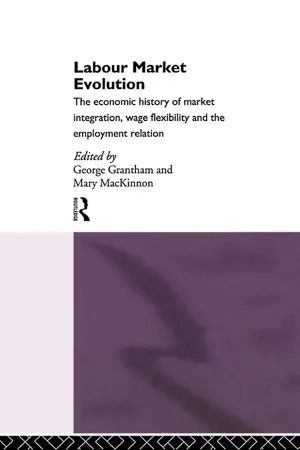
Labour Market Evolution
The Economic History of Market Integration, Wage Flexibility and the Employment Relation
- 336 pages
- English
- ePUB (mobile friendly)
- Available on iOS & Android
eBook - ePub
Labour Market Evolution
The Economic History of Market Integration, Wage Flexibility and the Employment Relation
About this book
1
ECONOMIC HISTORY AND THE HISTORY OF LABOUR MARKETS
George Grantham
What is the connection between the history of labour markets and the history of the economy? The answer to this question usually depends on whether it comes from an economist or an historian. When economists think about the economic history of the labour market, they are primarily concerned about how efficiently and equitably it allocated labour. To them the critical connections are those linking market outcomes to the evolution of technology, resource endowments, and individual preferences. Historians are inclined to consider labour markets sociologically, as one form of human organization among many. They blur, perhaps unconsciously, a line that in the economist’s way of thinking separates a given environment from events generated within it. The divergent visions of what the labour market means historically are rooted in the intellectual traditions of the two disciplines; they echo a fundamental ambiguity in how we understand historical causation. Economics was born under the sign of Natural Law: its vision of historical process is the working out in time of a permanent psychological propensity to optimize the employment of scarce resources. History grew out of the subjectivist revolution of the late eighteenth century, for which history represented the unfolding of latent propensities in the human spirit; each period of history had its own kind of humanity and its own kind of economy. Though rooted in the intellectual life of a time long past, these differences in vision survive to the present day.
Economists’ interest in historical labour markets has crystallized around four issues that are clarified, though hardly resolved, by modern economic analysis. The first is Marx’s allegation that the extension of competitive labour markets during the early phases of industrialization reduced the range of economic opportunity for the working poor, in effect turning them into a proletariat with no alternative to working for wages.1 The second took the form of a debate about whether the extension of competitive labour markets lessened or exacerbated economic discrimination based on personal characteristics unrelated to economic performance. A peculiarly American variant of this issue has focused on the economics of slavery and racially based systems of coercive labour management that characterized tropical and subtropical commercial agriculture in the New World to the late nineteenth century (Engerman 1992). The third is whether the evolution of labour market contracts can be explained by a theory of ‘natural selection’ of efficient or incentive-compatible responses to the environment. The final issue has been stimulated by the persistent inability of contemporary competitive labour markets to achieve real wage levels consistent with full employment. Researchers seek to explain the reasons for and characteristics of unemployment and wage determination over time.2
To professionally trained economists these issues typically pose themselves in the analytical terms of market failure, which is conventionally measured relative to a benchmark of a perfect market, given specified technology, resources, and preferences. Because people can be expected to trade voluntarily with each other when they can gain from the exchange, a market failure implies the existence of impediments—it does not matter whether they are legal, technological, or strategic—to transactions that increase economic welfare. From the perspective of the perfect market, a given outcome that does not conform to the predicted outcome can be explained either as a non-equilibrium state in which the market has not completed its work of reconciling demand and supply, or as an equilibrium in which the optimal allocation has been blocked by institutional or other obstacles. Historical study of labour markets by economists mostly aims at distinguishing between these alternatives.3 In principle the analytical procedure involves defining a market, determining its competitive configuration of prices and quantities, comparing this configuration with the one that historically occurred, and explaining any differences. This approach requires, however, that the market to be analysed be identified in advance.
To historians, on the other hand, the scope, as distinct from the existence, of labour markets is problematic. As in the concept of ‘liquidity’ in financial analysis, the ‘scope’ of a market is not easily defined. After all, everyone is ‘connected’ to the market in the trivial sense that there is a price at which it would pay someone to apply capital and labour to arbitrage away any conceivable difference in opportunity cost. Yet, in a non-trivial sense one can assert that the costs of such arbitrage, given the opportunity cost of capital and labour, are a function of the density and quality of information flows among potential participants to an exchange, and it is this density of information flows that historians have implicitly tried to monitor when they write or think about the ‘scope’ of the labour market (McCloskey 1993). It is precisely the scope of the market that is in question when the span of historical time becomes long enough to sustain a fully equilibrated response of institutions and expectations to the environment. In other words, does the labour market adjust to given conditions, or do some conditions adjust to the labour market?
Economists study how given market structures produce specific outcomes. To historians, however, the question is how that structure came to be what it is. How did labour market ‘space’ vary and in response to what panoply of opportunities and motivations? How and why has the mix of voluntary and compulsory elements in work organization changed over time? Who initiates changes in market scope? Did the integration of new social and geographical spheres come from efforts of employers to find workers or the struggle of workers to find jobs? Did pre-existing regional, occupational, and social structures affect the terms on which wage labour was supplied to industry and did they affect the subsequent evolution of the employment relation? At what dates and by what historical routes did wages and salaries come to constitute the core of family income? These are fundamentally evolutionary questions about the feedbacks from labour market structures to the direction of technological change and the other lines of psychological, social, and intellectual causation that define an economy’s path in time.
The first sustained effort to explain the evolution of labour markets was proposed by early nineteenth century German historical economists who, inspired by romantic philosophy, invented a developmental morphology of organizational forms running from self-sufficient households to large firms and world-wide markets in a taxonomical sequence they believed corresponded to the historical sequence of stages in the division of labour. The inner force driving the sequences they called capitalism, by which protean term they meant not only the legal institutions that facilitated exchange and accumulation of private wealth, but also the markets that forced individuals to adopt economic strategies consistent with survival in competitive equilibrium. In a broad sense, the evolutionary theory proposed by the historical economists was an account of how the market came to be the central institution determining the economic welfare of families and individuals (Parker 1986).
It was inevitable that an economic history based on a ‘stages’ vision of historical evolution should fasten on problems associated with the transition from self- to paid employment, as the major instance of an historical transformation of organizational forms. It was this transition to which the phrase ‘rise of the market’ usually applied. The dominant concern of western economic history to 1960 was, in a broad sense, labour history.4 Its narrative line commenced with the loss of individual economic autonomy during the Industrial Revolution and progressed through an eventful winning of universal suffrage and the right to organize free trade unions to the achievement of the welfare state. The linking of history to the problems of democratically adjusting social policy to the needs of early twentieth century industrial societies endowed it with urgency and contemporary relevance. As an historical justification of social democratic politics, it was adopted by reform-minded intellectuals, many of whom had attended economic and social history seminars in Germany before the First World War, where they learned to apply the research tools and methods of interpretation of the German historical school to contemporary problems. In the long run, however, the primitive economics of German economic historiography and its inability to explore equilibrium states made it an easy target for economist-historians who began in the late 1950s to deploy formal economic theory to demolish its edifice, an effort subtended by the contemporaneous drift of ideology and opinion towards the virtues of unimpeded competition and the belief that early post-war America represented the end of history. It is nevertheless doubtful that a historiography based on a unilinear sequence of well-defined ideal types, which has implicitly been accepted as a stylized fact by the theorists of the ‘new institutional economies’, is a fruitful way of categorizing institutional change (North 1981).
The discovery that western economic history did not logically end around 1960 in Sweden or the United States has encouraged economic historians to take another look at the way labour markets evolved to their present state (Wright 1986, 1987). The papers in this volume are part of the renewed effort by economic historians to recover the markets of our past, employing techniques pioneered by the new economic history to analyse statistical information generated by the great flash of statistical light generated between 1870 and 1930. Much of this information has been buried in the archives of governments and firms since its production. The papers are thus very much a voyage of discovery. We begin with a Mappamundi to this voyage. Like its original, the centre of the map of our historical world is Europe; its proportions are necessarily distended by what is known, and its southern and eastern borders are still empty spaces figured with fabulous beasts. Its cosmography is contemporary social physics; it summarizes ignorance as well as understanding. It guides by exaggeration, as did the charts that led Columbus to believe the ocean was narrow enough to cross.
The study of twentieth century labour markets has been stimulated mainly by contemporary problems of economic and social policy, the urgency of which has tended to produce historically foreshortened accounts of the processes that underlie their development. The studies in this volume provide part of the material for a longer view, which, being informed by a sense of movement, will perhaps be less dogmatic.
THE ROLE OF SPACE
The central interpretative issue in the economic history of labour markets is whether labour market institutions are a natural consequence of adjustments to exogenously determined technology and individual preferences, or whether technology and individual preferences are themselves significantly affected by the structure of labour markets. Focused on factors that determine price, the analytical tradition in economics usually takes tastes and technology as given, ignoring feedbacks other than those directly connected to the formation of market prices. This makes taste and technology the ultimate causes of observed patterns of resource allocation and the distribution of income and opportunity. This neat analytical distinction between exogenous and endogenous factors has long seemed to trained economists to be the only logically defensible way to analyse market processes, including processes that occur over long stretches of time. Its great value is that it permits a clean separation of cause from effect. Any other démarche would be considered by most economists to be muddled and even mystical.
That the scope and form of labour markets may reflect influences besides technology and tastes, however, in no way means that a transcendental spirit animated their history; only that the individual decisions creating the history were not predicated on a full knowledge of all the possible consequences. When this happens, the feedbacks from decisions to environment create unforeseeable evolutionary paths, which had they been foreseeable might have led to a different set of decisions.
The information flows that govern the most important decisions in the labour market—the kind of training to invest in, the kind of firm in which to apply for work, the kind of life cycle to plan for—are still most effectively transmitted by word of mouth and personal impressions and therefore operate across short distances. The externalities that have had the most influence on the scope of labour markets thus tended to present themselves at the level of the state or region rather than the whole intercommunicating world. This regionalization of labour markets is most obvious in the sphere of social regulation of the conditions of employment. Laws and social attitudes governing immigration, permitting or forbidding discrimination (see Chapter 13), regulating the employment of children and women, hours worked and other conditions of employment (see Chapter 8), as well as the macroeconomic policies pursued by government (see Chapter 11) all impose national or cultural definitions on labour markets.
That people prefer to restrict job search to regions defined by linguistic and religious communities is another example of how labour market scope and behaviour reflect attitudes growing out of common values imposed by religious and social institutions and by the history that people have been taught to believe is their common heritage. From the standpoint of technology and innate preferences, however, there is nothing ‘natural’ about these communities. Different political histories give rise to different ‘natural’ groupings of people (e.g. Shiells 1990).
Historically, the discontinuities and feedbacks that sustained the informational structure of labour markets have been rooted in geographical externalities. Among populations that are not continuously mobile, regional economic specialization gave rise to communities whose common history led to common preferences with respect to wages and working conditions. Such learned attitudes and expectations produce region-specific life cycle patterns of labour supply. For example, the kind of skills young people are likely to acquire reflects the quality of local schooling and local possibilities of learning by doing, which in turn reflect local opportunities for employment, which in turn is a function of the regional division of labour. Being intrinsically spatial, such facilities for learning and developing human character are fundamentally public goods (see Chapter 13). Everyone in the region is exposed to them, whether they like it or not.
Although in theory the whole world with which a region communicates constitutes the opportunity set for young people when they are making up their minds on what they want to do in life, under normal circumstances the ties of place and family are too strong for working people to sort themselves geographically on the basis of individual preferences about the kind of public good they prefer. Most people have to take what is available in the region where they were raised.5 Consequently there is no reason to believe that the distribution of regional ‘environments’ reflects an optimal outcome with respect to exogenous preferences; and of course, children do not ‘sort’ themselves, but are sorted socially and educationally by their parents. Moreover, the kind of job people find is often determined by information they obtain from friends and relatives whose judgement they trust and share. Such privileged channels of job information are especially important for communicating non-local employment opportunities.6 Finally, employers form expectations about workers and discriminate among them on the basis of geographical and social markers. In geographically extensive labour markets, they recruit in places that are known to ‘produce’ certain types of worker. A similar dynamic governs the evolution of contractual forms. The labour market thus reflects strongly self-reinforcing learning processes on both sides of the market (Whatley 1990:43–56).
Geographical externalities also determine an historical relationship between the evolution of labour markets and patterns of technological change. In the past and to a considerable degree even today innovations and industries displayed strong tendencies towards spatial clustering (Krugman 1991). The reason innovation clusters are initially strongly region specific seems to be that communicating complex pieces of information requires prolonged personal contact among the innovators. The subtle and idiosyncratic bits of technological information that constitute the raw material of invention are not easily transmitted by more formal means of communication.
In this century the sensitivity of technological change to small variations in the economic environment has been surprisingly high. For example, the labour-using bias of Canadian industrial technology relative to that of the United States developed in response to a moderate gap in wages when the United States closed its frontiers to mass immigration after the First World War (Wylie 1989). This example of technological malleability causing a divergence in the technology of countries whose economies are very similar illustrates why one cannot assume that the technological constraint is exogenous. When the period of adjustment is long enough to allow for all the equilibrating responses to work themselves out, regional differences in technology can be expected to emerge. The Canadian case illustrates the importance of public choices on the evolution of these constraints.7
The history of American manufacturing provides an important example of how the structure of labour markets influenced the development of a specific kind of technology, which in turn reinforced many distinctive features of the American labour market. American manufacturing from its birth was biased towards using unskilled labour. This was largely because the United States had virtually no indigenous tradition of high craftsmanship maintained by an effective system of long apprenticeships, nor a structure of demand capable of sustaining a small class of highly skilled workmen. Such a tradition could hardly be expected to take root in a newly settled agricultural colony that satisfied its limited demand for high-quality manufactures by importing them from Europe (Elbaum 1989; Rorabaugh 1986; Douglas 1921).
In the absence of a domestic supply of highly skilled craftsmen, the young Republic could have continued to import manufactures from Britain, in line with the comparative advantage of the two nations. But politics intervened, as it had in the colonial period. Between 1800 and 1830 the federal government took two decisions that were to give rise to a uniquely American technology. The first was to subsidize a domestic small-arms industry; the second was to protect an infant cotton textile industry that had sprung up during the years when trade with Britain was interrupted by embargo and war. The resulting expanded demand for skilled and semi-skilled labour to make large quantities of standardized items like spindles and gunstocks in a society with few craftsmen led to the extended development of templates and lathes that could be pre-set to reproduce shapes in wood and metal (Rosenberg 1972; Parker 1987; James and Skinner 1985). The first crude machine tools invented as a result of this effort permitted employers to substitute abundant raw materials and unskilled workers for skilled labour across a spectrum of mechanical operations that was narrow at first but progressively widened as the technology was perfected.
The drive to economize scarce supplies of skilled labour is also evident in changes in the organization of the workshops. Where it was impossible to substitute a machine for a man, manufacturers divided the work by hiving off the simpler operations to unskilled workers.8 By imposing a division of labour al...
Table of contents
- Cover Page
- Title Page
- Copyright Page
- Figures
- Tables
- Contributors
- Preface
- 1 Economic History and the History of Labour Markets
- 2 Bridging the Gap Between Labour Economics and Economic History
- 3 How did Pre-Industrial Labour Markets Function?
- 4 The Dis-Integration of Traditional Labour Markets in France
- 5 Regional Labour Market Integration in England and Wales, 1850–1913
- 6 Real Incomes in the English-Speaking World, 1879–1913
- 7 Did Labour Flow Uphill?
- 8 The Decline in Hours of Work in US Labour Markets, 1890–1903
- 9 Job Tenure in the Gilded Age
- 10 The Great War and the Canadian Labour Market
- 11 Wage Woes in Weimar?
- 12 Wage Behaviour in Inter-War Britain
- 13 Race, Human Capital, and Labour Markets in American History
- Bibliography
Trusted by 375,005 students
Access to over 1.5 million titles for a fair monthly price.
Study more efficiently using our study tools.
Frequently asked questions
Yes, you can cancel anytime from the Subscription tab in your account settings on the Perlego website. Your subscription will stay active until the end of your current billing period. Learn how to cancel your subscription
No, books cannot be downloaded as external files, such as PDFs, for use outside of Perlego. However, you can download books within the Perlego app for offline reading on mobile or tablet. Learn how to download books offline
Perlego offers two plans: Essential and Complete
- Essential is ideal for learners and professionals who enjoy exploring a wide range of subjects. Access the Essential Library with 800,000+ trusted titles and best-sellers across business, personal growth, and the humanities. Includes unlimited reading time and Standard Read Aloud voice.
- Complete: Perfect for advanced learners and researchers needing full, unrestricted access. Unlock 1.5M+ books across hundreds of subjects, including academic and specialized titles. The Complete Plan also includes advanced features like Premium Read Aloud and Research Assistant.
We are an online textbook subscription service, where you can get access to an entire online library for less than the price of a single book per month. With over 1.5 million books across 990+ topics, we’ve got you covered! Learn about our mission
Look out for the read-aloud symbol on your next book to see if you can listen to it. The read-aloud tool reads text aloud for you, highlighting the text as it is being read. You can pause it, speed it up and slow it down. Learn more about Read Aloud
Yes! You can use the Perlego app on both iOS and Android devices to read anytime, anywhere — even offline. Perfect for commutes or when you’re on the go.
Please note we cannot support devices running on iOS 13 and Android 7 or earlier. Learn more about using the app
Please note we cannot support devices running on iOS 13 and Android 7 or earlier. Learn more about using the app
Yes, you can access Labour Market Evolution by George Grantham, Mary MacKinnon, George Grantham,Mary MacKinnon in PDF and/or ePUB format, as well as other popular books in Business & Business General. We have over 1.5 million books available in our catalogue for you to explore.