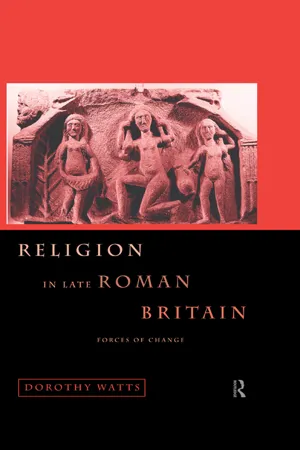
Religion in Late Roman Britain explores the changes in religion over the fourth century; the historical background for these changes and the forces which contributed to them.
Dorothy Watts examines the reasons for the decline of Christianity and the continuation of the pagan, Celtic cults in Britain. The author establishes a chronology for the rise and decline of Christianity, based on the available archaeological evidence, and she charts the fate of the pagan cults and temples in the fourth century. The author discusses the nature of Romano-British pagan religion and she analyses the controversial rite of decapitated burial in the light of some startling new archaeological evidence.
- 224 pages
- English
- ePUB (mobile friendly)
- Available on iOS & Android
eBook - ePub
About this book
1
Historical Background AD 294–360
By the mid-fourth century of the Christian era, Britain had been part of the Roman Empire for over 300 years. Once divided up by tribes which did not always peacefully co-exist, it was progressively conquered by the Roman army and became one, two and ultimately five1 Roman provinces. These were administered from Rome through provincial governors, if necessary with the help of the large army which was stationed there. The Romans brought not only peace and the material trappings of romanitas but also their language, culture and religion. The historian Tacitus (Agric. 21) describes how the native aristocracy, at least, readily adopted Roman ways:
[Agricola] … provided a liberal education for the sons of the chiefs, and showed such a preference for the natural powers of the Britons over the industry of the Gauls that they who lately disdained the tongue of Rome now coveted its eloquence. Hence, too, a liking sprang up for our style of dress, and the toga became fashionable. Step by step they were led to … the lounge, the bath, the elegant banquet.
As a general policy, Rome had always practised tolerance towards the religions of a conquered people, provided there was no threat to the state. The influence of the Druids had been regarded by Caesar with a certain amount of macabre fascination (e.g. B.G. 6.13–16). Augustus also tolerated their activities, banning their cults only to citizens, but Tiberius took steps to abolish the Druids in Gaul, and Claudius their practices (Pliny N.H. 30.13; Suetonius Claud. 25.5). After the conquest of Britain, the Druids on Anglesey were seen to be subversive and were eliminated2 by Suetonius Paulinus (Tacitus Ann. 14.30; Dio Epit. 52.7).3 Some of the activities associated with their religion which were abhorrent to the Romans, such as human sacrifice, headhunting and even cannibalism, were rigorously suppressed (Strabo 4.4.5; Pliny N.H. 30.13).
The cults of Iron Age Britain were many and varied, frequently animistic, and usually associated with war, nature or fertility: the earth itself, the sun, trees or groves, streams, marshes, animals and birds were invested with religious significance. There were few cult buildings or anthropomorphic representations of deity. On the other hand, the religious practices of the conqueror were well developed, and gradually the native people came to build temples (mostly of a distinctively ‘Romano-Celtic’ type, rather than the classical style), to represent their gods as humans, and to bury their dead more in the Roman way. It may be that they also adopted Roman gods, or conflated them with their own.4 There was at least a veneer of Romanisation. Certainly cults which were followed by Romans themselves were found where acculturation was at its greatest: in the towns, the ‘villa belts’ and areas of occupation by the Roman army.
As in other parts of the empire, the Imperial Cult was introduced and formed part of the official religious life of the province after initial opposition and revolt (Tacitus Ann. 14.31). To Britain also came Jupiter, Juno, Minerva and a host of lesser gods, along with more exotic imports such as Cybele, Isis, Mithras and Bacchus.
Some time in the late second or early third century, Christianity reached Britain. The peak of expansion was probably c. 340–60. After this, the impetus seemed to have slowed, and in some parts halted altogether. In line with events at Rome, paganism revived to some extent in the years 360–90, but in Britain it seems to have been mainly in Celtic form. Despite Theodosius’ closure of the temples and banning of pagan cults in 391, Christianity failed to become established by the end of the fourth century, as it had in the Eastern Empire and in Gaul, as the dominant religion.
The reasons for the failure of Christianity and for the resurgence of paganism in Britain are manifold. The present work is intended to determine what changes occurred in religion in Britain in the late fourth century, to examine the forces that contributed to them and to assess the state of religion at the time of the withdrawal of the official Roman presence by AD 410. It is helpful to begin by looking at the empire as a whole.
The Empire: Diocletian, Constantine and his House5
The third century was, for the Roman Empire, one of turmoil and uncertainty. Serious problems included spiralling inflation, an out- of-control army, and barbarian incursions. Frequent political assassinations and usurpations, resulting in the rapid turnover of emperors, also contributed to the degeneration of the empire. This was temporarily arrested by the actions of the emperor Diocletian, who, having seized power nine years earlier, proceeded to introduce administrative and constitutional reforms. In 293 he divided the state into East and West,6 each with its own head or Augustus and a junior Caesar to provide practical (military) support and a peaceful succession.
Diocletian’s reforms, dependent as they were on mutual cooperation and trust between members of the tetrarchy, proved to be unworkable, and during the fourth century various ambitious and capable generals were able to achieve sole power, or to be the senior Augustus dominating a weaker partner.
It was against this background that Christianity came to be, first, the religion of the imperial family, a religion tolerated by the state and, finally, by the end of the century, the official religion of the empire. Yet this progress was not without setbacks, as a brief survey of the years 294–361 (below) and 361–91 (Chapter 2) will show.
By the end of the third century, Christianity had expanded greatly (Eusebius H.E. 8.1.1). Whole towns in the eastern part of the empire had become Christian7 and North Africa was rapidly doing the same. While it was generally the ordinary folk who were attracted to the faith, there were converts even in high positions in the imperial administration. These were to be especial targets for persecution.
It is not known precisely why Diocletian instituted one of the most severe persecutions against Christians in 303. It may have been the result of his inherently conservative nature that he saw the Christians as a threat to the religion of the state, and thus to the state itself. His Caesar in the east, Galerius, was a fierce pagan. At first, martyrdoms, a feature of earlier persecutions,8 were avoided. Instead Diocletian concentrated on the fabric of the Church – buildings and copies of Scripture. Christians lost their positions in public office. But successive imperial edicts increased the intensity of the purge, and Christian lives were lost when, with the fourth edict, all citizens of the empire were required to sacrifice on pain of death.
In the Western Empire, the Augustus, Maximian, and his Caesar, Constantius (father of Constantine), carried out the persecution with far less zeal. Lactantius (De Mort. Pers. 15.7) and Eusebius (H.E. 8.13.13) tell us that Constantius, who was responsible for Britain, Spain, Gaul and the Rhineland, took little action against Christians. Church buildings seem to have been the main casualties. Indeed, there is no certainty that the edict concerning sacrifice was ever proclaimed in the Western Empire (A. H. M. Jones 1964: 72).
Although the abdication of Diocletian and Maximian in 305 did not bring Christians any immediate respite from their sufferings, the next quarter of a century was to prove the most significant period in the growth of Christianity since the apostolic era. Constantine had been passed over in the formation of the Second Tetrarchy of 305 (Galerius and Constantius as Augusti, Maximin and Severus as Caesars) and was named Caesar only in 306, despite his having been acclaimed Augustus by the army on his father’s death at York. Yet in a series of manoeuvres, he came to be in a strong position to achieve sole power. He married the daughter of the old Emperor Maximian, who had come out of retirement to support the campaign of his son, Maxentius, for the throne, and also bestowed on his son-in-law the title of Augustus. In 308, at a conference at Carnuntum, Constantine refused to resign as Augustus and take instead the title films Augusti. In his way were (by now) three other Augusti,9 Galerius, Licinius and Maximin10 and, by 310, the renegade Maxentius.
Up to this point there had been no indication of Constantine’s turning to Christianity, but that was to change. Galerius died in 311, after a deathbed edict putting an end to the persecution of Christians. Maximin moved quickly east to take over Galerius’ eastern dominions and once more institute a harsh persecution.11 He may have formed some kind of an alliance with Maxentius, who had been declared a public enemy in 308 but was still head of an army and gaining ground. Constantine and Licinius were each marshalling armies. It was the former who met Maxentius in battle near the Milvian Bridge outside Rome in 312. His victory, with the help of the God of the Christians (Eusebius V. Const. 1.28; Lactantius De Mort. Pers. 44), sealed his commitment to Christianity, and changed the western world for the next sixteen centuries. Maximin died a fugitive in 313, and in the same year an Edict of Toleration (the so-called Edict of Milan) was issued by Constantine and Licinius. Licinius, however, later reneged on this agreement and was ousted by his fellow Augustus. In 324 Constantine became sole emperor, and the House of Constantine the powerful patrons of Christianity throughout the empire.
Constantine’s conversion, while not necessarily a smooth progression spiritually, had an immediate and far-reaching effect materially. Impressive churches sprang up, those in Italy and at Rome and Jerusalem in particular being heavily endowed from the royal purse. The influence of men such as Lactantius and Eusebius of Caesarea (Frend 1984: 482–7, 502–5) ensured that the clergy had privilege and immunities, and eventually the status of magistrates. Funds flowed into the imperial coffers with the confiscation of temple treasure, and were disbursed to family, friends and the Church.
This positive advancement for Christianity was, however, marred by schisms and reprisal. The first, arising in 311, was a movement led by Donatus against the supposed ‘traitors’ to the faith during the persecutions in North Africa; Constantine’s personal intervention failed to suppress the Donatists or to produce Church unity. In the east, a doctrinal dispute led to the rise of Arianism. Arius, a presbyter at Alexandria, had questioned the nature of the Trinity and for his pains was exiled in 318–19. He reappeared in Nicomedia, Licinius’ eastern capital, whence his teachings took root and spread. The Council of Nicaea of 325, convened and chaired by Constantine, reinforced orthodoxy by producing the Nicaean Creed. Conciliation later brought the two sides together, yet Arius and his doctrine remained to simmer in the east.
Constantine died in 337, but his hopes that political and religious peace would be maintained were in vain. Although he had planned the restoration of the tetrarchy, the army had other ideas, and in September of 337 they acclaimed his three remaining sons,12Constantine II, Constantius II and Constans, as Augusti. Their territories were the western provinces, the eastern provinces, and Italy and North Africa, respectively. Other male family members, with the exception of the young Julian and his half-brother Gallus, were murdered. The triumvirate had a short life, however. Constantine died in an attempt on the domains of Constans in 340, after which Constans came to control the greater part of the empire (including Britain). Constans himself was murdered by the rebellious Magnentius in 350; and Constantius, after finally defeating Magnentius in 353, became sole ruler until his death in 361.
The sons of Constantine had been brought up as Christians, and were all, in their own way, totally committed to the Christian cause, although Constantius leaned towards Arianism and his brothers to orthodoxy. During the years 337–60 Christianity continued to make great advances, despite the recalcitrance of some bishops (especially Athanasius of Alexandria, a passionate opponent of Arianism), the resurgence of Donatism in Africa and the continued existence of Arius’ doctrines in the East. Bans increased against paganism, temples were closed (C.Th. 16.10.3–4) and altars removed. Among these was the Altar of Victory from the Senate House in Rome, when Constantius visited the city in 357 (Ambrose Ep. 18.32; Ammianus 16.10.1). This was to be a bone of contention with pagan senators until almost the end of the century (see below, Chapter 2). The clergy and the Church gained a privileged position,13 financial immunities to clergy were extended and even allowed to their children, and the wealthy admitted to orders without having to surrender their property. Part of state funds was directed to the Church in some provinces. Throughout the empire the religion expanded and flourished. The growth of the Church in distant Britain was also probably the result of these stimuli during the reign of the sons of Constantine.
Britain: Paganism and the Rise of Christianity
As noted earlier, by the fourth century Britain had long been part of the empire, although Romanisation does not seem to have been as thoroughgoing as it had been elsewhere.14 Resistance to the Occupation from AD 43 had generally been firm and prolonged; the attempted conquest of Scotland had had to be abandoned along with the wall built in the time of the Antonines. Clearly the peo...
Table of contents
- Cover
- Half Title
- Title Page
- Copyright
- Dedication
- Contents
- List of figures
- Preface
- 1. Historical background AD 294–360
- 2. The pagan revival of the late fourth century AD 360–90
- 3. Closure of the temples and beyond
- 4. Further evidence for the revival of paganism
- 5. The economy and religion in the late period
- 6. The question of syncretism
- 7. Change and continuity
- Appendix 1: Religion and the Fasti 360–95
- Appendix 2: A lead tank fragment from Brought, Notts (Roman Crococalana)
- Notes
- References: Archaeological and secondary sources
- Names and Places index
- General index
Trusted by 375,005 students
Access to over 1.5 million titles for a fair monthly price.
Study more efficiently using our study tools.
Frequently asked questions
Yes, you can cancel anytime from the Subscription tab in your account settings on the Perlego website. Your subscription will stay active until the end of your current billing period. Learn how to cancel your subscription
No, books cannot be downloaded as external files, such as PDFs, for use outside of Perlego. However, you can download books within the Perlego app for offline reading on mobile or tablet. Learn how to download books offline
Perlego offers two plans: Essential and Complete
- Essential is ideal for learners and professionals who enjoy exploring a wide range of subjects. Access the Essential Library with 800,000+ trusted titles and best-sellers across business, personal growth, and the humanities. Includes unlimited reading time and Standard Read Aloud voice.
- Complete: Perfect for advanced learners and researchers needing full, unrestricted access. Unlock 1.5M+ books across hundreds of subjects, including academic and specialized titles. The Complete Plan also includes advanced features like Premium Read Aloud and Research Assistant.
We are an online textbook subscription service, where you can get access to an entire online library for less than the price of a single book per month. With over 1.5 million books across 990+ topics, we’ve got you covered! Learn about our mission
Look out for the read-aloud symbol on your next book to see if you can listen to it. The read-aloud tool reads text aloud for you, highlighting the text as it is being read. You can pause it, speed it up and slow it down. Learn more about Read Aloud
Yes! You can use the Perlego app on both iOS and Android devices to read anytime, anywhere — even offline. Perfect for commutes or when you’re on the go.
Please note we cannot support devices running on iOS 13 and Android 7 or earlier. Learn more about using the app
Please note we cannot support devices running on iOS 13 and Android 7 or earlier. Learn more about using the app
Yes, you can access Religion in Late Roman Britain by Dorothy Watts in PDF and/or ePUB format, as well as other popular books in History & Ancient History. We have over 1.5 million books available in our catalogue for you to explore.