- 368 pages
- English
- ePUB (mobile friendly)
- Available on iOS & Android
eBook - ePub
About this book
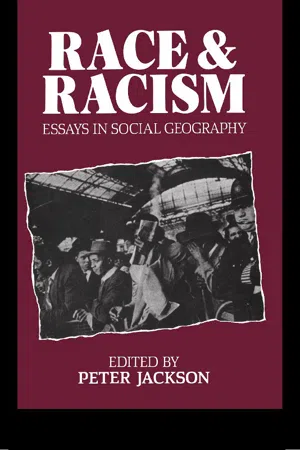
First Published in 1987. In September 1985 the Social Geography Study Group of the Institute of British Geographers held a three-day conference at Coventry (Lanchester) Polytechnic on the subject of 'Race and Racism'. The present volume is a selection of essays derived from some of the papers that were given at the conference, together with one newly commissioned paper (by Susan Smith) and an introductory essay.
PART I
Segregation reconsidered
The relationship between physical and social distance has exercised the imagination of geographers and sociologists for generations. While ample attention has been paid to the empirical question of mapping and measuring the residential patterns of different social groups, the theoretical significance of varying degrees of clustering and dispersal has received far less attention. The first three essays begin to address this issue, recognizing the political significance of segregation in both reflecting and reproducing the structure of social relations.
In the first essay, Susan Smith offers a political theory of residential segregation which she interprets as the geographical expression of a specifically English racism. She argues that, whatever their stated intention, housing and urban policies have had the practical effect of sustaining racial segregation. While issues of ‘race’ have rarely been the subject of direct government policy, she presents a persuasive argument to show how successive policies from slum clearance schemes to improvement grants and council house sales have contributed to the social reproduction of a spatially segregated black population.
Whereas Smith deals with the political context and social consequences of residential segregation, Alisdair Rogers and Rika Uto focus on the significance of the geographical separation of home and work in explaining the social geography of southern California. Emphasizing the centrality of production in the structuring of social relations, they employ post-Weberian location analysis and labour theory to explain the ethnic division of labour that has developed in association with the rise of high-tech industry in Los Angeles and Orange Counties. Drawing on the work of Michael Storper, Richard Walker and Allen Scott, in particular, Rogers and Uto seek to explain the persistence of the ghetto in social and spatial terms and the paradox of continued Latino in-migration at a time of high black unemployment. They explore the relationship between the spheres of production and reproduction, the ‘racialization’ of different kinds of labour, and the relatively neglected rôle of the state as an employer of minority labour.
David Sibley is also concerned with the rôle of the state, which he explores in relation to the development of settlement policies towards Gypsies. He shows how central and local government have opposed the Gypsy’s characteristic mobility with specific residential policies involving sanctions on their location outside certain designated areas. Sibley further shows how the state legitimizes the use of such overt means of social control via the perpetuation of certain biological and cultural myths which serve to define the Gypsies as a ‘deviant’ group. Social marginality translates directly into spatial terms, as the ideological designation of the Gypsies as ‘undesirable’ permits the adoption of a crudely racist strategy of territorial containment.
1
Residential segregation: a geography of English racism?
SUSAN J.SMITH
Racial residential segregation is well documented empirically, but less often the focus of theoretical scrutiny. Arguing against such neglect, this chapter explores, from an historical perspective, some legislative and political aspects of the segregation of ‘racial’ minorities in Britain. Focusing primarily on those whose family histories originate in the New Commonwealth and Pakistan, I use the term ‘black’ to describe people of both South Asian and Afro-Caribbean appearance. Although this label masks important cultural differences—which Peach (1984) and Robinson (1981) show are important axes of residential differentiation within black communities—my starting point is in black people’s common experience of segregation from the majority of white Britons.
It is impossible to specify accurately the size or characteristics of the black population (Peach 1982, Rees & Birkin 1984 itemize the difficulties), and the term ‘race’ is, of course, a social construction—real only in its effects and, except as a focus for combating racism, ‘racist’ in application. Nevertheless, Britain’s economic and political history has defined dark-skinned immigrants and their descendants as a ‘racial’ category (see Miles 1982), whose incumbents experience more discrimination and disadvantage than do white immigrants (Brown 1984). From this starting point my aim is to assess how far racial residential segregation might be interpreted theoretically as an expression of the racism that permeates Britain’s social and political life. To that end, I focus mainly on the effects of housing and urban policy in England (the different social and political context of the Scottish experience is outlined in Ch. 5). Obviously other political arenas, such as those encasing education and employment policies, also contribute to the social reproduction of a segregated black population: this chapter, however, is specifically concerned with the place of residential segregation in that wider process.
Race as a dimension of residential segregation
Ballard (1983) and Brown (1984) estimate the size of Britain’s black population to be about 2.2 million (somewhat less than 4 per cent of the total population) in 1980–2. The OPCS labour-force survey (1983) estimates that of those whose ‘ethnic origin’ (by birth or descent) is in the West Indies/Guyana or South Asia, 46 per cent are Indian, 20 per cent Pakistani, 5 per cent Bangladeshi and 29 per cent West Indian/ Guyanese. Although black people have lived in Britain since the 16th century—and before, according to Fryer’s (1984) meticulous documentation—their present regional distribution was established during a brief period of sustained immigration (rather small-scale by international standards) during the late 1950s and the 1960s. The relationship between labour demand and the location of migrants is discussed by Peach (1966, 1968, 1978–9) and Robinson (1980b). This chapter, however, is less concerned with the economic influences that initiated segregation than with the political factors that help to sustain it.
The persisting spatial dissimilarity of black and white households on a regional scale is well documented elsewhere (Brown 1984, Jones 1978, Peach 1982). The majority of black people live in Greater London and the West Midlands (where 50 per cent of black households but only 20 per cent of white families live) and in the largest textile towns of Lancashire and Yorkshire; black households are less prominent in the coalfield regions and in the spatially peripheral heavy-industrial regions of Scotland, Wales, the North and the North West.
The black population is overwhelmingly urban—only about 3 per cent live in rural enumeration districts. As many as 43 per cent of West Indians and 23 per cent of Asians live in inner-city areas of London, Birmingham and Manchester, where only 6 per cent of the white population is to be found. Overall, three-quarters of the black population live in a set of urban enumeration districts which contain only one-tenth of the whites (Brown 1984). Black people constitute an average of 20 per cent of the population in these enumeration districts, though the figure can be much higher (Haynes 1983).
This broad locational dissimilarity between black and white Britain shows few signs of changing. The Policy Studies Institute survey found no significant dispersal of blacks into white-dominated wards between 1971 and 1982 (Brown 1984). Only in wards relatively densely populated by blacks has there been some residential dispersal from high- to low-concentration enumeration districts. Despite evidence of the limited dispersal of West Indians, associated with their movement into council housing (Lee 1977, Peach & Shah 1980), the PSI survey confirms the dominant theme of increased polarization of black and white residential space which runs through the work of Cater and Jones (1979) Peach (1966, 1982), and Jones (1978). Jones (1983), in fact, identifies a trend in some areas towards racially homogeneous neighbourhoods large enough to form the basis of a separate community life.
Although some of Britain’s most deprived urban areas (including Glasgow, Belfast and Tyneside) have few black residents, overall in Britain black people are disproportionately likely to live in the most deprived enumeration districts (Brown 1984). Similarly, it is an enduring feature of successive surveys that, in each sector of the housing market, black people experience below-average housing conditions (see McKay 1977 for a summary; see also Clark 1977, Karn 1982). Although in absolute terms there has been some improvement to the quality of black people’s housing in the past decade, black households are still under-represented as the occupants of detached and semi-detached homes, and they are more likely than whites to occupy pre-war properties, to share their home with another household, and to live at above-average densities. Given an association between residential differentiation and social disadvantage, there can be few grounds for complacency in the oft-quoted finding that intra-urban racial segregation in Britain is less marked than in the USA.
Obviously, segregation coupled with relative deprivation does not persist independently of economic inequality. The National Dwelling and Housing survey of 1977–8, for instance, revealed that black heads of households face disproportionate risks of unemployment. Black people born in the UK to West Indian parents are four to five times as likely as their white counterparts to be unemployed (Cross 1982). Moreover, white people, whether born in the UK or not, tend to be of higher status than any non-white immigrant group; and ‘second generation’ West Indians have, on average, an even lower status than their ‘first generation’ predecessors (Barber 1981). However, the locational dissimilarity and housing discrepancies between the majority of black and white households cannot be explained wholly in terms of income differentials (Clark 1977, Smith 1978). Indeed, McKay’s study prompts him to conclude that in England, ‘as far as racial minorities are concerned, residential location has been critical in determining their subordinate position in society’ (McKay 1977, p. 16). It should not be assumed, therefore, that locational marginality simply reflects economic marginality. In part, this chapter is an attempt to elicit some of the political and social factors that mediate between the two.
What follows shows first how existing patterns of residential segregation reflecting racial inequality, which emerged from the economic exigencies of a short period of labour or refugee migration, have been sustained as a consequence—sometimes intentional, but more usually unanticipated—of a series of central and local government decisions implemented without specific reference to the distinctiveness of black people’s disadvantage. Having considered the legislative basis of segregation, I then attempt to set these decisions in the wider context of the history of the idea of race and segregation in British politics. For however stimulating empirical debates about the form and intensity of segregation might be (see Jones & McEvoy 1978, 1979a,b; Lee 1978; Morgan 1980, 1983; Morgan & Norbury 1981; Peach 1979a,b, 1981; Robinson 1980a; Sims 1981; Woods 1976), a more fundamental, yet frequently neglected, question concerns its meaning within the British political economy. I suggest, therefore, that it is only within a theoretical framework directing attention to the politics of race—which of course reach beyond the governmental framework in which they are here located—that it is possible to explain how racial residential segregation is sustained and reproduced now that New Commonwealth immigration has all but ceased and as much as 40 per cent of the black population is British-born.
Public policies sustaining segregation
More than a decade ago, a report of the Select Committee on Race Relations and Immigration (1974–5) argued that few departments of the Home Office were equipped to deal effectively with the needs of black people. Concern was expressed regarding the rôles of the Departments of Employment, Education and Science, and Health and Social Security. The most serious reservations, however, related to the Department of the Environment, which is responsible for two areas of legislation carrying particularly important implications for race relations: housing policy and the Urban Programme. For the moment, I concentrate on the former. First, I suggest that although central government has always been reluctant to build the concept of ‘race’ into legislation combating disadvantage in housing and related fields, national housing policies have had a direct and unmistakable (if usually unintended) impact on the life-chances of the black population—most notably by working to sustain relatively high levels of intra-urban segregation. Local governments have had to work within the constraints imposed by the outcomes of centrally dispensed legislation. Nevertheless, the second part of this section provides an account of how local institutional practices have, usually inadvertently, encouraged racial segregation (in all sectors of the housing market) to be associated with the racial inequalities perpetuated in other spheres of social and economic life.
Housing policy: the rôle of central government
Black workers were originally forced to cluster into inner-city private rental accommodation as a consequence of the postwar housing shortage (Doherty 1983). Although Britain has never had a policy linking housing provision with labour migration, dispersal—initially conceived on a regional rather than intra-urban scale—was held to be the solution to immigrants’ housing problems. The government’s enthusiasm for dispersal came with a package of integrationist measures introduced, in the 1965 White Paper on Immigration from the Commonwealth, to offset public objections to tighter immigration controls (see Dummett & Dummett 1969). Subsequently, the dispersal ideal received further legitimation from the report of the Central Housing Advisory Committee (1969).
The government did not, however, commit itself to a comprehensive dispersal scheme. On the national scale, it was expected that dispersal, of both the black and the white populations, would be a natural outcome of successful regional economic development and planning. It was therefore the view of Maurice Foley, appointed in 1965 to co-ordinate the work of government departments in the integration of immigrants, that dispersal policie...
Table of contents
- Cover Page
- Title Page
- Copyright Page
- Preface
- Acknowledgements
- List of Tables
- List of Contributors
- Introduction
- Part I: Segregation Reconsidered
- Part II: Racism In Britain
- Part III: Racism and Anti-Racism In Housing and Social Policy
- Part IV: Ideology and Resistance
Trusted by 375,005 students
Access to over 1.5 million titles for a fair monthly price.
Study more efficiently using our study tools.
Frequently asked questions
Yes, you can cancel anytime from the Subscription tab in your account settings on the Perlego website. Your subscription will stay active until the end of your current billing period. Learn how to cancel your subscription
No, books cannot be downloaded as external files, such as PDFs, for use outside of Perlego. However, you can download books within the Perlego app for offline reading on mobile or tablet. Learn how to download books offline
Perlego offers two plans: Essential and Complete
- Essential is ideal for learners and professionals who enjoy exploring a wide range of subjects. Access the Essential Library with 800,000+ trusted titles and best-sellers across business, personal growth, and the humanities. Includes unlimited reading time and Standard Read Aloud voice.
- Complete: Perfect for advanced learners and researchers needing full, unrestricted access. Unlock 1.5M+ books across hundreds of subjects, including academic and specialized titles. The Complete Plan also includes advanced features like Premium Read Aloud and Research Assistant.
We are an online textbook subscription service, where you can get access to an entire online library for less than the price of a single book per month. With over 1.5 million books across 990+ topics, we’ve got you covered! Learn about our mission
Look out for the read-aloud symbol on your next book to see if you can listen to it. The read-aloud tool reads text aloud for you, highlighting the text as it is being read. You can pause it, speed it up and slow it down. Learn more about Read Aloud
Yes! You can use the Perlego app on both iOS and Android devices to read anytime, anywhere — even offline. Perfect for commutes or when you’re on the go.
Please note we cannot support devices running on iOS 13 and Android 7 or earlier. Learn more about using the app
Please note we cannot support devices running on iOS 13 and Android 7 or earlier. Learn more about using the app
Yes, you can access Race and Racism by Peter Jackson in PDF and/or ePUB format, as well as other popular books in Physical Sciences & Geography. We have over 1.5 million books available in our catalogue for you to explore.