eBook - ePub
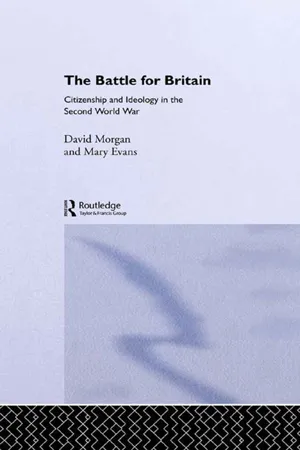
The Battle for Britain
Citizenship and Ideology in the Second World War
- 208 pages
- English
- ePUB (mobile friendly)
- Available on iOS & Android
eBook - ePub
About this book
It is generally accepted that Britain was held together during the second world war by a spirit of national democratic `consensus'. But whose interests did the consensus serve? And how did it unravel in the years immediately after victory?
This well observed and powerfully argued book overturns many of our assumptions about the national spirit of 1939-45. It shows that the current return to right-wing politics in Britain was prefigured by ideologies of change during and immediately after the war.
Information
Chapter 1
Whose war?
From the very beginning, the war against Hitler's Germany was presented to the British people as a fight against tyranny and the destruction of civilised ways of life. In that respect, the confrontation was as much ideological as territorial. Chamberlain's broadcast to the nation at the outbreak of war was unequivocal in its condemnation of National Socialism: ‘It is evil things that we shall be fighting against: brute force, bad faith, injustice, oppression and persecution’.1 Against this, Britain stood in defence of liberty, democracy and the rule of law. Unlike the politically complicated alliances that drew Britain into the First World War, the reasons for engagement were readily understood: it was a ‘just’ war that would allow no compromise short of Hitler's unconditional surrender and the restoration throughout occupied Europe of democracy and civil rights.
The war against the loose alliance of Germany, Italy and Japan was thus much more than a conflict of economic interests and military might. It is true that during the 1930s the imperialist aspirations of the Axis powers extended across Eastern Europe, North Africa, China and the Far East, but territorial incursions were not in themselves a justification for war: Britain and the United States were largely content with the world as it was. German fascism, however, was a threat of quite a different kind: it challenged the moral order of western democracy, repudiating international conventions and the contractual basis of consent. Nazi occupation brought exploitation, servitude, the loss of liberty and human rights. For Jews, gypsies, communists and liberals brave enough to dissent, life itself was at risk. Within Germany, opposition parties had been destroyed, trade union leaders imprisoned and free speech had ceased. Jews and other minorities had been expelled from public life and their property attacked. These acts of political violence were rendered all the more abhorrent by bizarre beliefs in the supremacy of the German race.
The atrocities committed in the name of National Socialism were well known to foreign governments and widely reported in the world's press. But apart from diplomatic protests, the British government was no more willing to intervene against Hitler than it had been against Franco and the fascists in Spain. Its response was based upon the optimistic if guarded belief that by acquiescing to Hitler's territorial claims, the German threat could be ‘contained’. In 1938, Neville Chamberlain returned from Munich having conceded the partition of Czechoslovakia to announce an agreement with Hitler that would give ‘Peace with honour…. Peace in our time’. It was not the first nor the last occasion that the British government tried to appease the Third Reich, but it was the only time an understanding had apparently been reached. Hitler personally regarded the Munich Agreement as a diplomatic nuisance,2 but at home it was greeted with enthusiasm and relief by all except minority opinion on the British Left. Enough was known of Hitler's Germany and Franco's regime in Spain for the Left to recognise that the defeat of fascism was a priority, and a priority that called for a united front. As G.D.H. Cole wrote in 1937,
In the present state of the world I, as a socialist, am fully prepared to collaborate in preventing war with non-socialists who believe that it is possible to preserve the institutions of liberal democracy and to use them to a peaceful advance. I want socialism to come, if it can come, peacefully and not by violence; and most urgently of all I want to stand shoulder to shoulder with everyone who hates Fascism, with its exhaltation of militarism and its determination to supress every liberal movement.3
Public opinion swung in favour of a more decisive stand when Hitler annexed the rump of Czechoslovakia in the spring of 1939. Those who had expected ‘appeasement’ to work now had to accept the reality of the Nazi threat. In response to Hitler's manifest bad faith, the British and French governments guaranteed the independence of Romania and Poland, and Britain hastily stepped up preparations for war.
The German invasion of Poland on 1 September 1939 confronted the British Government with a diplomatic and political crisis. Chamberlain tried unsuccessfully to persuade the Poles to accede to Hitler's demands, and still appeared to be seeking a negotiated settlement rather than go to war. On 2 September, Chamberlain addressed the House of Commons in such a way as to suggest that another Munich agreement might be under consideration. His reluctance to take a stand against Hitler angered Labour and Liberal MPs. Arthur Greenwood, Labour's Deputy Leader, asked the House of Commons, ‘I wonder how long we are prepared to vacillate, at a time when Britain and all Britain stands for, and human civilisation are in peril?’ Greenwood's speech rallied both sides of the House of Commons. Harold Nicolson wrote in his diary,
The House gasped for one moment in astonishment. Was there to be another Munich after all? Then Greenwood got up. The disappointment at the P. M.'s statement, the sense that appeasement had come back, vented itself in the reception of Greenwood. His own people cheered, as was natural; but what was so amazing was that their cheer was taken up in a second and greater wave from our benches. Bob Boothby (sic)4 cried out, ‘You speak for Britain’. It was an astonishing demonstration. Greenwood almost staggered with suprise.
It was a crucial moment for the Labour movement. The bitter antagonisms of the preceeding years – the General Strike, the Household Means Test, the violation of trade union rights – were set aside. In a quite unprecedented moment, the Labour Party became associated with everything that was valued and worth fighting for in the British way of life. The appeasers and the ‘guilty men of Munich’ were left vulnerable and exposed. Even Chamberlain and his close associates recognised that some kind of watershed had been reached. On the following day, Sunday, 3 September, he announced on the radio that the nation was at war.
Nicolson's anecdote illustrates just how fluid ideological alliances had become by the beginning of the war. Opposition to Nazi Germany united left-wing and moderate opinion on a common front. Others much further to the right had equally patriotic reasons for supporting the war. Calder summarises these diverse interests that converged with the onset of war:
At this stage only the most literal-minded Englishman could have believed he had gone to war for Poland. There was, by now, some purpose in this for everyone. Jews, of course, had a special stake in the struggle; but anti-semitic right wing patriots hated Hitler as a reincarnation of Kaiser Wilhelm, if nothing worse, and fought to defend the British Empire from the Huns. Catholics, after the Nazi Soviet pact, could deceive themselves for a while that they were fighting Russia, and most Christians identified Nazism with paganism. Conservatives fought to conserve Britain's power; Liberals on behalf of liberty; Socialists to preserve the modest gains of trade unionism.5
It is not suprising that the Second World War remains such a potent symbol of validation for all shades of opinion in British political life. Here was a grossly inegalitarian and socially divided capitalist society prepared to suspend domestic conflicts to defend common beliefs in freedom, equality and democracy against a foreign and no less divided capitalist power.
There is little doubt that ordinary people detested Hitler and his fascist Reich, but such feelings did not obscure the fact that the freedoms people were asked to defend in the name of democracy and liberty were often more rhetorical than real. The same freedoms had been invoked in justification for the First World War, yet poverty, unemployment, illness and social deprivations had stalked the working population since the end of that war. The ‘land fit for heroes’ promised to volunteers had proved to be at least as inhospitable and insecure as British society immediately before the Great War.6 When the TUC conference voted in 1939 in favour of war, it was a vote against fascism, not an expression of solidarity with the ruling class. Trade union leaders had repeatedly urged the Government to make a determined stand against Hitler and were suspicious of its motives for delaying so long. Indeed, without a firm commitment against fascism, the TUC was reluctant to support increased production of arms, fearing these might be sold to fascists in Italy and Spain. Furthermore, Labour leaders remembered with bitterness the fortunes made from armament contracts during the First World War. So deep was their distrust of the Government and its financial backers that to win their co-operation, Chamberlain had to promise to tax ‘excess profits’ in the event of another war.7
Labour's hostility to the National Government was not unexpected in view of the experiences of working people between the wars. Chamberlain personified the interests of capital, while his complicity in the invasion of Czechoslovakia and his last-minute equivocation over Poland, damaged his government's credibility on both sides of the House. However, while a war to stop Hitler was hailed as a just and necessary cause, wider comparisons between British and German society were morally less clear-cut. For many on the Left, it was a case of defending what C. Day Lewis described as ‘the bad’ against ‘the worse’. But for others, including many Conservatives on the Right, the rise of National Socialism and a war with Germany was seen in a rather different light. Throughout the 1930s, Hitler had been admired as a dynamic leader, a champion of capitalism and a committed enemy of Bolshevism and trade union power. He had revitalised the German economy, overcome problems of inflation and unemployment and restored a sense of direction and national pride. As Bullock says, it was an impressive record: by the beginning of the war, Germany had recovered from the depths of depression to become one of the best-equipped industrial nations in the world.8 Furthermore, there was some sympathy for Hitler's efforts to unite German-speaking peoples and redress the grievances that had festered since the Treaty of Versailles. Even though his racist policies were formally deplored, they presented no evident threat to Britain and the Empire that justified full-scale war. From this point of view, a confrontation with Germany made rather less sense than a defensive alliance against the Soviet Union. Here was an undisputed opponent of capitalism, dedicated to world revolution, and an ideologically disturbing influence in home affairs. As it appeared from the Right, ‘appeasement’ avoided alienating Germany as a potential ally against the greater menace of communist influence in the West.
It is uncertain whether Chamberlain and his advisors were ahead of their time in their efforts to reach a diplomatic solution to the tensions in Europe, or simply irresolute and naïve. Clearly, Chamberlain was mindful of the Bolshevik threat and thus the risks of open confrontation amongst western European states. After his popular reception in Munich, he might well have been persuaded that Hitler could be appeased. On more than one later occasion, Hitler expressed regret that Germany should be at war with Britain, particularly as he had long thought of Britain as a natural ally and friend.9 Until the summer of 1939, a war with Britain must have seemed unlikely; after all, Britain was linked to Germany by dynastic ties, and as the policy of ‘appeasement’ suggests, influential sections of British opinion were drawn towards a settlement that would leave Hitler free to consolidate German hegemony in the East. Even after war was declared, Hitler retained lingering hopes of an Anglo-German alliance.10 There was at least an element of truth in Nazi propaganda that, up to the moment war was declared, Britain' position appeared weak and ideologically confused. Allied objections to Germany' treatment of minorities and subject peoples provoked jibes of hypocrisy which could not be lightly dismissed. Britain had shown little concern for the fate of German Jewry while trying to reach an understanding before 1939. Moreover, Britain ruled a colonial empire with an unshakeable belief in the racial and cultural superiority of the British Raj. As for the United States, the black minority was discriminated against and largely unrepresented in the political process and public life; whilst in France, women were virtually without any legal and political rights until 1945. But above all, there were affinities between Britain and Germany in their opposition to communism and their suspicions of the USSR: in Hitler's view, it was only Britain's obduracy in failing to recognise these common interests that frustrated an alliance.
With the onset of hostilities, both sides drew upon a potent sense of their nation' history to give coherence and meaning to the war. In particular, each constructed an idealised image of their common people – ordinary, decent, productive citizens for whom and by whom the war was being fought. In both cases, the meaning given to these populist ideals was closely linked to the idea of freedom and the sovereignty of the State; however, what was made of these ideas was ideologically distinct. For Hitler, freedom for the German people was tied to the concept of Lebensraum – a policy of preserving and enlarging the ‘racial community’ by extending its political domination and living space. In accord with this policy, Austria and Czechoslovakia were annexed and Poland attacked, and the integrity of the Aryan race protected from the converging menace of Judaism, Liberalism and Bolshevism by methods that the civilised world cannot forget. As is commonly the case with totalitarian regimes, freedom...
Table of contents
- Cover
- Half Title
- Full Title
- Copyright
- Dedication
- Contents
- Introduction
- 1 Whose war?
- 2 Production for victory
- 3 Keeping the home fires burning
- 4 The spirit of the times
- 5 When the war is over
- 6 Reconstructions from the past
- 7 Postscript: On the political economy of citizenship
- Bibliography
- Name index
- Subject index
Trusted by 375,005 students
Access to over 1.5 million titles for a fair monthly price.
Study more efficiently using our study tools.
Frequently asked questions
Yes, you can cancel anytime from the Subscription tab in your account settings on the Perlego website. Your subscription will stay active until the end of your current billing period. Learn how to cancel your subscription
No, books cannot be downloaded as external files, such as PDFs, for use outside of Perlego. However, you can download books within the Perlego app for offline reading on mobile or tablet. Learn how to download books offline
We are an online textbook subscription service, where you can get access to an entire online library for less than the price of a single book per month. With over 1.5 million books across 990+ topics, we’ve got you covered! Learn about our mission
Look out for the read-aloud symbol on your next book to see if you can listen to it. The read-aloud tool reads text aloud for you, highlighting the text as it is being read. You can pause it, speed it up and slow it down. Learn more about Read Aloud
Yes! You can use the Perlego app on both iOS and Android devices to read anytime, anywhere — even offline. Perfect for commutes or when you’re on the go.
Please note we cannot support devices running on iOS 13 and Android 7 or earlier. Learn more about using the app
Please note we cannot support devices running on iOS 13 and Android 7 or earlier. Learn more about using the app
Yes, you can access The Battle for Britain by Mary Evans,David Morgan in PDF and/or ePUB format, as well as other popular books in Scienze sociali & Sociologia. We have over 1.5 million books available in our catalogue for you to explore.