- 472 pages
- English
- ePUB (mobile friendly)
- Available on iOS & Android
eBook - ePub
About this book
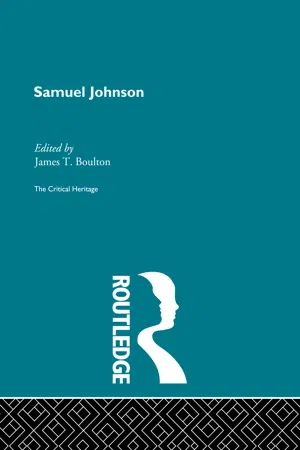
The Critical Heritage gathers together a large body of critical sources on major figures in literature. Each volume presents contemporary responses to a writer's work, enabling students and researchers to read for themselves, for example, comments on early performances of Shakespeare's plays, or reactions to the first publication of Jane Austen's novels. The carefully selected sources range from landmark essays in the history of criticism to journalism and contemporary opinion, and little published documentary material such as letters and diaries. Significant pieces of criticism from later periods are also included, in order to demonstrate the fluctuations in an author's reputation. Each volume contains an introduction to the writer's published works, a selected bibliography, and an index of works, authors and subjects. The Collected Critical Heritage set will be available as a set of 68 volumes and the series will also be available in mini sets selected by period (in slipcase boxes) and as individual volumes.
Information
Footnotes
1. Johnson seeking a publisher for London
| 1 | Probably Johnson’s ode ‘Ad Urbanum’. |
| 2 | Although Cave liked the poem he suggested that Robert Dodsley should publish it. |
| 3 | A poem (1737) by Thomas Beach. |
2. William Mudford on London and The Vanity of Human Wishes
| * | ‘His poetry, though not any where loaded with epithets, is destitute of animation. We are now and then struck with a fine thought, a fine line, or a fine passage, but little interested by the whole. After reading his best pieces once, few are desirous of reading them again.’ [William Shaw,] Life of Johnson, 1785, [71–2]. |
| 1 | Boswell, Life, i. 128–9. |
| * | He did not often conform himself to his own precepts. In his Essay on Pope’s Epitaphs, (which is indeed an invidious piece of criticism), he says, ‘I think it may be observed that the particle O! used at the beginning of a sentence, always offends.’4 Yet, in his translation of the dialogue between Hector and Andromache, he himself uses it. How would the Trojans brand great Hector’s name, And one base action sully all my fame, Acquired by wounds and battles bravely fought! Oh! how my soul abhors so mean a thought.5 And in many other of his pieces, as his ‘Lines to a Friend’, ‘To a Young Lady on her birthday’, &c. &c. |
| 2 | Both this and the previous example of tautology were cited by William Shaw (Memoirs of the Life of Johnson, 51) to whom, it would appear, Mudford was often indebted. |
| 3 | Ambrose Philips (1675?–1749) and Nahum Tate (1652–1715). |
| 4 | Lives, i... |
Table of contents
- THE CRITICAL HERITAGE SERIES
- General Editor’s Preface
- Contents
- Preface
- Acknowledgments
- Note on the Text
- Introduction
- JOHNSON’S POEMS
- IRENE
- THE RAMBLER
- THE DICTIONARY
- RASSELAS
- EDITION OF THE PLAYS OF WILLIAM SHAKESPEARE
- POLITICAL PAMPHLETS
- JOURNEY TO THE WESTERN ISLANDS OF SCOTLAND
- LIVES OF THE ENGLISH POETS
- JOHNSON’S PROSE STYLE
- BIOGRAPHICAL AND GENERAL
- Bibliography
- Select Index
- Footnotes
Trusted by 375,005 students
Access to over 1.5 million titles for a fair monthly price.
Study more efficiently using our study tools.
Frequently asked questions
Yes, you can cancel anytime from the Subscription tab in your account settings on the Perlego website. Your subscription will stay active until the end of your current billing period. Learn how to cancel your subscription
No, books cannot be downloaded as external files, such as PDFs, for use outside of Perlego. However, you can download books within the Perlego app for offline reading on mobile or tablet. Learn how to download books offline
We are an online textbook subscription service, where you can get access to an entire online library for less than the price of a single book per month. With over 1.5 million books across 990+ topics, we’ve got you covered! Learn about our mission
Look out for the read-aloud symbol on your next book to see if you can listen to it. The read-aloud tool reads text aloud for you, highlighting the text as it is being read. You can pause it, speed it up and slow it down. Learn more about Read Aloud
Yes! You can use the Perlego app on both iOS and Android devices to read anytime, anywhere — even offline. Perfect for commutes or when you’re on the go.
Please note we cannot support devices running on iOS 13 and Android 7 or earlier. Learn more about using the app
Please note we cannot support devices running on iOS 13 and Android 7 or earlier. Learn more about using the app
Yes, you can access Samuel Johnson by James T. Boulton in PDF and/or ePUB format, as well as other popular books in Literature & Literary Criticism. We have over 1.5 million books available in our catalogue for you to explore.