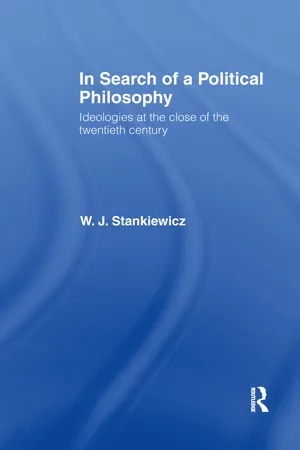
In Search of a Political Philosophy is an analysis of the three democratic `isms' - conservatism, liberalism and socialism - and of the distinct nature of the all-devouring ideology - Marxist communism. The author is concerned with the conscious and unconscious assumptions of the proponents and followers of each ideology, and those of their theoreticians and critics.
eBook - ePub
In Search of a Political Philosophy
Ideologies at the Close of the Twentieth Century
- 480 pages
- English
- ePUB (mobile friendly)
- Available on iOS & Android
eBook - ePub
In Search of a Political Philosophy
Ideologies at the Close of the Twentieth Century
About this book
Information
Part I
Prudential conservatism
Chapter 2
Norms and relativism
CONSERVATISM, NORMS AND REASON
It is difficult to decide on the basis of ideological statements what a conservative is. Yet most of us on hearing certain views about crime, welfare, immigration and ‘undemocratic’ régimes in other countries would not hesitate to label them conservative. Thus the conservative interprets crime in terms of a normative breakdown; welfare is to him at best an expedient rather than a social obligation; immigration is something which must be subject to careful control if it is not to be a ‘threat to our way of life’; and some undemocratic régimes are considered the best possible under the circumstances and therefore deserving the support of a democratic government. What do these views have in common that allows us to call them conservative? If they do not have anything in common, conservatism becomes a waste-basket concept to which all non-liberal and non-socialist views are relegated – an obviously unacceptable interpretation unless we can argue that only liberal or socialist views are democratic.
Some people do in effect adopt this stance declaring that all the above views are ‘Fascist’ or tainted with Fascism: the view on crime is an argument for the ‘police State’; that on immigration is ‘racist’; that on welfare shows a lack of social conscience; and the view on undemocratic régimes is the clearest proof of ‘Fascism’. It is argued that no democrat could possibly look with favour on the military dictatorships currently supported by democracies; hence the conservative cannot be very strongly committed to democratic principles if he is not eager to universalize the democratic way of life, but rather is prepared to tolerate dictatorships elsewhere provided they are not Communist. The conservative view is presented as undemocratic and expedient.
But it is precisely the conservative who emphasizes the traditional norms; he declares that it is adherence to concepts of right and wrong, good and bad that determines his position. Non-conservatives either set up a system of norms as the only valid set (the norms of democracy, socialism, science or Marxist-Communism) or they assert that all normative sets are a form of prejudice and that relativism is the only valid attitude. Hence democracy is ‘valid’ because it is a relativistic system, premised on making decisions by a show of hands, believing in acceptance of all points of view and based on the assumption that as we are all ‘equal’ no valid distinctions can be made between human beings.
To the conservative, democracy is false inasmuch as it is relativistic, and it is valid only inasmuch as its premises can be given a conceptual content. For him, the ‘individualism’ of democracy is a statement about the worth of the ‘self’ as a fundamental concept without which no other statement can be made. For him, for instance, ‘equality’ is the self’s recognition of other ‘selfs’. There is no possible way we can avoid solipsism, accept science, believe in democracy or any other system, unless we begin with a threefold conceptualization in which the ‘self’ recognizes other ‘selfs’ and distinguishes this set of entities from a world of non-selfs or ‘its’. If we ignore this conceptualization we have to discard science as a methodology, for it is not based on a distinction between the perception by the self of an objective reality and the self’s experiencing the objective reality, but on the assumption that perceptions of the ‘self’ can be checked against the perceptions of other selfs to arrive at a body of ‘commonsense’ information.1
It is not common for conservatives to analyse their position in this way. But if we look at the position of some of those we acknowledge as ‘conservative’, beginning with Edmund Burke – who raised the very issue of who is conservative by setting himself, within a democratic framework, in opposition to those who insisted that ‘democracy’ required a viewpoint strictly consistent with the norms of democracy – we find that the conservative view is fundamentally different from the scientific. Human behaviour is distinct from the behaviour of things (the ‘its’ of objective reality); and the viewpoint parallelling conservatism is the religious (rather than scientific) view of reality.
From the religious point of view, the ‘self’ is opposed to the ‘body’ which somehow incorporates the ‘self’. In many religions this ‘self’ – defined as ‘soul’ – is conceived of as transcending the death of the biological organism. It may continue cyclically, being incorporated into other organisms – as in Buddhism – or it may move into a different sphere which in Christianity is called heaven, hell or purgatory. The fate of the soul, however, while of major consequence for believers in the particular religion, is outside the scope of our analysis.
What matters to both religious people and conservatives is that there is a ‘self’ distinct from the biological organism. To both conservatives and religious people it is not true that the determinants of behaviour are the biological drives of the organism (unless it happens to be a ‘lower’ organism that has not evolved a sense of self). Although the conservative can make a stronger case for his position than the determinist, validity is not the issue. Whether ‘special creation’ or ‘evolution’ is assumed, the concept of a ‘self’ transcending immediate circumstances is biologically advantageous; if it can be shown that such a sense of self has evolved, it can certainly be argued that it has a biological advantage. Man has become the dominant species because he has a sense of self transcending the immediate circumstances; ‘prudence’ rather than ‘impulse’ motivates human beings.
Because of the primacy of the ‘soul’ or ‘immortal self’ in religion, competition for goods and conflicts of interest are seen as departures from the commitment to the primacy of the soul, which by nature cannot be in conflict with other souls. Hence the emphasis placed by all major religions on peace and charity. Accordingly, human relations should not be competitive or hostile, and the good society should so organize itself as to avoid conflict. Such is also the view of the conservative, who is prepared to support (as a means to this end) social arrangements not always acceptable to non-conservatives; if a class system reduces rivalries and conflicts, it is acceptable; if a measure of coercion is necessary against those disturbing public order – this, too, is acceptable.
It is on the issue of law and order that the conservative viewpoint is most strikingly at odds with the liberal and socialist attitudes. Both of the latter are likely to see conflict in society as a symptom of something wrong within the body politic rather than as something wrong in itself. They see the conservative insistence on law and order as an undemocratic adherence to coercion and a foolish attempt to suppress symptoms while disregarding the ‘meaning’ of disorder. The conservative’s reply is that his adherence to democracy represents adherence to a system which is capable of solving social problems without public disorder; further, that anyone who argues that a breakdown in law and order is sometimes justifiable, cannot be genuinely committed to democracy as a system of government.
At this point the nature of the conservative’s position becomes clearer. Although for him, as for the socialist and the liberal, man can be driven by inarticulated wants and passions, the conservative believes man ‘should not’ be so driven and certainly should not be encouraged by society to act in this way. Problems cannot be solved unless they are articulated. The ‘good’ society should not treat its members as if they were babies who can express needs only by squalling, leaving others to guess what is wrong. If some adult members of a democratic community are in fact incapable of expressing their wants, then the universal franchise of democracy must be modified; the ‘equality’ that the conservative recognizes is the seeming capacity of normal adults to know what they want and to express it verbally. If you argue that our motivations are subconscious and seldom expressible, democratic government becomes a mere form having no advantage over other systems. To a conservative, violence under a democracy is irrational.
The conservative position is most clearly manifest in the view that it is the total body of norms that must be brought to bear in decision-making; it can be seen in the readiness to ‘muddle through’ rather than follow strictly the logic of fundamental democratic principles (as the only ones relevant to democratic practice). Thus he is not moved by the argument that freedom of the press requires the total elimination of censorship; he believes that other norms apply as well: that there are such things as pornography, slander and misrepresentation; and that no valid decision can be made about censorship unless we consider other norms in addition to the democratic norm of ‘freedom of the press.’
To the conservative, customary norms constitute a vast body of experience with human behaviour that we ignore only at our peril. This view has often been used to argue that the conservative is anti-rational, even anti-intellectual, preferring the security of what he knows to the logic of genuine moral principles, and further that he is not ‘consistent’. In fact, while the liberal and the socialist characteristically attempt to reduce the norms of social life to those derivable from the set defining the system of government (thus making equality, freedom and rights the determining norms and leaving the rest to individual conscience), the views of the conservative are premised on broader principles. Can one at this stage draw any conclusion as to whether conservatism is an ideology? If an ideology is a body of norms and beliefs derived from a small set of assumed principles then conservatism is not an ideology, for it is precisely this attitude to norms that the conservative rejects. But if the adherent of an ideology must be inclined to ‘intellectuality’ and oppose the view that human behaviour is the product of unanalysable experiences and inarticulated feelings, then conservatism has a far greater claim to be called an ideology than either liberalism or socialism.
CONSERVATISM, NORMS AND RELATIVISM
Because norms are functional, enabling us to avoid trial-and-error learning with regard to human behaviour and to make decisions in terms of our ‘self-other’ conceptions rather than simply on the basis of biological impulses, relativism has not ‘destroyed’ norms, but has operated rather to disrupt both our systematization of norms and our efforts to arrive at some kind of natural law. To define norms as tastes or attitudes is to imply that it is a waste of time thinking about them. To assert that human behaviour is determined solely by biological drives is to put forward a ‘natural law’ of behaviour that excludes the need for reflection (reflection about motives becomes a rationalization). The same is true of social deterministic theory: establishing the ‘causes’ of norms is something a social scientist might undertake, yet the result will not be a validation of the norms but evidence of their irrelevance (and relativism).
Under relativism, the norms remain in the form of ‘facts’, whilst ethical systems (‘hierarchies of values’) become false and redundant.
The consequence can be seen in the shift of meaning of the Jesuit statement that ‘the end justifies the means’. To Loyola, this meant that norms have a hierarchical order. The view that some norms are more important than others represented a tremendous advance over the traditional view that norms are ‘separate absolutes’ which are somehow equals and hence cause ethical dilemmas in situations where more than one norm applies. But if one denies the validity of any attempt to systematize norms, the assertion ‘the end justifies the means’ becomes the assertion that acceptance of a goal permits one to ignore any compunction one might have about the methods of attaining it. Thus if you believe that the union of Northern and Southern Ireland is a good and that violence will achieve this objective, you need not worry about traditional components of ‘justice’ such as innocence: let babies be killed by the bombs – if this is likely to induce a capitulation to demands. Violence and terrorism become goods when normative systems are represented as irrational nonsense. What was once considered irrational is now thought of as rational in the sense that the end justifies the means.
Acceptance of particular norms is not enough. Norms need to be systematized and if the given systematization – the ideology – violates the principles of justice, it is false, no matter how logical it may otherwise seem. It is important how one systematizes norms. The conservative, ever since Burke had doubts about the French Revolution, has denied that ‘efficiency’ and the ‘logic’ of excluding norms from the system in order to attain an end is valid – or essential – in making normative decisions. To him, equally, a method of systematizing norms which is based on excluding norms from the system is invalid – it is this very attitude to norms which defines him ideologically. Yet he is rather reluctant to label his outlook an ideology. In general opinion, political ‘ideology’ has become restricted to the type of normative system which achieves logical consistency by disregarding normative factors in the means. (All that matters is the goal; achieving the goal or striving in this direction ‘justifies’ the means.)
While denying that his views are ‘ideological’, a conservative will be more inclined to accept the label ‘religious.’ The distinction to him is not that an ‘ideology’ deals with matters of man and the State and a religion with man and God, but that followers of ‘ideologies’ systematize norms in terms of the efficiency of norms, whereas all religions deny that their normative systems have such a basis.
Many conservatives are worried that they can agree with others (non-conservatives) about goals and yet be opposed to most practical proposals for achieving them. For this reason, many opponents see them as hypocrites who are ready, for instance, to speak about the evils of poverty but unwilling to adopt any practical measures. To be sure, they raise many (too many, say their opponents) objections based on ‘justice’, while the issues seem so much more clear cut to everyone else. Indeed, the concept of justice appears central to conservative thinking. It is tantamount to the systematization of norms that arranges them in a hierarchy in which anything that is a norm has validity. To non-conservatives ‘justice’ is the attainment by society of normative goals – the object of the good State. To the conservative, it is rather an operating system in which the attainment of the good never means disregarding norms. The kind of relativism the conservative is least likely to accept is one that defines the breaking of norms in terms of the end.
REASON, RELIGION AND MECHANISM
Clinton Rossiter, the American student of conservatism, writing in the 1950s, suggested twenty-one ‘conservative principles’. Of these, number thirteen gives one pause: ‘The fallibility and limited reach of human reason’.2 If we are going to use attitudes to ‘reason’ as a criterion of conservatism, it would seem closer to the truth to think of the conservative as someone who objects to those who, while recognizing the limits of ‘reason’, deduce that it is fallible.
The issue is what Rossiter and other modern conservatives mean when they doubt ‘reason’ (as well as those who reject reason). We have a clue in Rossiter’s strong emphasis on what most would call a ‘religious’ view. Thus in point (2) of his principles he speaks of a ‘precious soul’; in (9) of ‘duties’; in (11) of the ‘sanctity of inherited institutions, values, symbols and rituals’; in (12) of the ‘essential role of religious feeling’; in (17) of the ‘wondrous, divinely ordained union of land, laws, customs’; and in (18) of ‘reverence, contentment.’ A great many conservatives would object to the way Rossiter formulates his view of conservatism: it certainly would not appeal to intellectuals, philosophers or the common man. Yet despite dissatisfaction with the formulation, most conservatives are likely to agree that its author was in the conservative tradition. The points he makes, though formulated in an anti-rational and non-philosophic way, have something in common.
Rossiter’s image of the ‘conservative tradition’ is coloured by ‘religious’ concepts and his statement of principles is not satisfactory: the implications of these concepts are vague; no clear definition of ‘religion’ emerges.
Suppose we try terms like mechanism and non-mechanism. Can we define conservatism with reference to the rejection of a mechanistic view of State and society – hence as a position that does not regard reason as ‘fallible and limited’ but rather as a technique for penetrating behind appearances and coping with theories for which some empirical evidence can be advanced (but which does not make us willing to surrender the body of human experience)?
The philosophic conservative would like the issue of mechanism put back where it belongs – a matter of academic debate – but the rise of the ideological State has both secularized and politicized ethics. Many conservatives – as well as others – are quite pleased by this development so long as the State permits non-secular ethical systems to operate freely (allows freedom of religion). For various reasons (such as the experience of the Wars of Religion, the fact that the premises of religious ethical systems are non-materialist) religious ethics are not an appropriate basis for State policy. But the politicizing of ethics is a different matter. Only relativists committed to the view that ‘natural law’ concepts of ethics are absurd can be pleased when the State defines itself as the source of social good (defined by its ideology), or as the agency by which the good is realized in action (as, for instance, as the enforcer of ‘rights’).
Behind disputes about relativism are assumptions about mechanism; behind the latter are assumptions about cause and effect. It is agreed that despite the philosophic difficulties Hume raised about the concept of ‘cause’, it is an indispensabl...
Table of contents
- Cover
- Halftitle
- Title
- Copyright
- Dedication
- Contents
- Preface
- Introduction
- Part I Prudential conservatism
- Part II Empty liberalism
- Part III Hedonistic socialism
- Part IV The tyranny of ideology
- Part V Conclusion
- Notes
- Bibliographical references
- Index
Trusted by 375,005 students
Access to over 1.5 million titles for a fair monthly price.
Study more efficiently using our study tools.
Frequently asked questions
Yes, you can cancel anytime from the Subscription tab in your account settings on the Perlego website. Your subscription will stay active until the end of your current billing period. Learn how to cancel your subscription
No, books cannot be downloaded as external files, such as PDFs, for use outside of Perlego. However, you can download books within the Perlego app for offline reading on mobile or tablet. Learn how to download books offline
Perlego offers two plans: Essential and Complete
- Essential is ideal for learners and professionals who enjoy exploring a wide range of subjects. Access the Essential Library with 800,000+ trusted titles and best-sellers across business, personal growth, and the humanities. Includes unlimited reading time and Standard Read Aloud voice.
- Complete: Perfect for advanced learners and researchers needing full, unrestricted access. Unlock 1.5M+ books across hundreds of subjects, including academic and specialized titles. The Complete Plan also includes advanced features like Premium Read Aloud and Research Assistant.
We are an online textbook subscription service, where you can get access to an entire online library for less than the price of a single book per month. With over 1.5 million books across 990+ topics, we’ve got you covered! Learn about our mission
Look out for the read-aloud symbol on your next book to see if you can listen to it. The read-aloud tool reads text aloud for you, highlighting the text as it is being read. You can pause it, speed it up and slow it down. Learn more about Read Aloud
Yes! You can use the Perlego app on both iOS and Android devices to read anytime, anywhere — even offline. Perfect for commutes or when you’re on the go.
Please note we cannot support devices running on iOS 13 and Android 7 or earlier. Learn more about using the app
Please note we cannot support devices running on iOS 13 and Android 7 or earlier. Learn more about using the app
Yes, you can access In Search of a Political Philosophy by W. J. Stankiewicz in PDF and/or ePUB format, as well as other popular books in Politics & International Relations & Communism, Post-Communism & Socialism. We have over 1.5 million books available in our catalogue for you to explore.