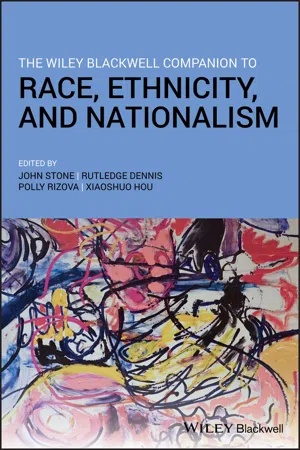
The Wiley Blackwell Companion to Race, Ethnicity, and Nationalism
eBook - ePub

The Wiley Blackwell Companion to Race, Ethnicity, and Nationalism

  1. English
  2. ePUB (mobile friendly)
  3. Available on iOS & Android
eBook - ePub

The Wiley Blackwell Companion to Race, Ethnicity, and Nationalism

About this book

A broad examination of the rise of nationalism, populism, xenophobia, and racism throughout the world

The Wiley Blackwell Companion to Race, Ethnicity, and NationalismĀ provides expert insight intoĀ theĀ complex, interconnected factors that are influencing patterns of human relations worldwide in a time of rising populist nationalism,Ā intensifiedĀ racial and religious tensions, andĀ mountingĀ hostilities towards immigrants and minorities. Analyzing the underlying forces which continue to drive global trends, this volume examines contemporary patterns based on the most recent evidence spanning five continents—offering a diversity of interpretations, models and perspectives that address the challenges facing the study of race,Ā ethnicity,Ā and nationalism.Ā  Ā  Ā 

TheĀ CompanionĀ features original contributions by both established experts and emerging scholarsĀ thatĀ exploreĀ anĀ expansiveĀ rangeĀ of theoretical, historical,Ā and empirical case studies. Organized into five sections, the text first discusses growing trends in the United States, the significance of populism in major societies around the globe, and how global changes are influencing regional variations in race, ethnicity,Ā and nationalism.Ā An investigation of globalĀ migration patternsĀ is followed by examination ofĀ conflict and violence, from urban riots and boundary disputes toĀ warfare and genocide. The final section focuses onĀ theĀ policy debatesĀ resulting from changing patterns and their impactĀ onĀ politics, the economy, and society. Timely and highly relevant, this book:Ā 

  • Discusses contemporary issues such asĀ the failureĀ ofĀ school systemsĀ to provide equal opportunitiesĀ toĀ minorities,Ā theĀ evolutionĀ of theĀ School-to-Prison pipeline, and the Black Lives Matter movementĀ 
  • Explores shifts in American race relations, the influence of social media and the internet, and theĀ links between increased globalization and contemporary forms of nationalism, racism, and populismĀ 
  • Features essays on national and ethnic identity in China, Japan, and South Korea, India,Ā Central Asia, Africa, Latin America, and EuropeĀ 
  • Analyzes policies regarding borders,Ā immigration, refugees, and human rights in different countries and regionsĀ 
  • Ā Offers perspectives on the radicalization of social movements, the creation of ethnic, linguistic and other boundaries between groups, and the models used to understand intractable conflictsĀ in many global settingsĀ 

The Wiley Blackwell Companion to Race, Ethnicity, and NationalismĀ is an indispensable resource for scholars, researchers, instructors, and studentsĀ across the social sciences, including sociology, political science, global affairs, economics, comparative race and ethnic relations, international migration, social change, and sociological theory.Ā 

Trusted byĀ 375,005 students

Access to over 1.5 million titles for a fair monthly price.

Study more efficiently using our study tools.

Information

Year
2020
Print ISBN
9781119430391
9781119430193
Edition
1
eBook ISBN
9781119430407

Part I
Revising the Agenda: Race, Ethnicity and Nationalism in the Twenty-First Century

1
Confrontational Politics: The Black Lives Matter Movement

Rutledge Dennis and Kimya Dennis

Introduction

The history of black social movements in the United States is a history replete with organizations created by blacks, including in some cases white supporters, crafting programs, tactics, and strategies to address the pressing problems confronting a black dispossessed and oppressed population. Although blacks in local communities often created organizations and institutions which catered to their local immediate problems and needs, in the nineteenth century blacks began to view themselves as a national socio‐political racial unit, thus the issue of slavery and social, political, educational, and economic restrictions and exclusions prompted the creation of national black organizations. The Knights of Liberty (1846), The National Council of Colored People (1853), and The National Negro Convention (1864) represented this emerging national black socio‐political consciousness in the nineteenth century.
The Civil War, the Reconstruction and its aftermath, the emergence of white terrorist groups, and the institutionalization of Jim Crow laws and the official and unofficial policy of racial segregation and discrimination, both north and south, accelerated the need to create organizations which would serve, as Du Bois suggested, as weapons in the struggle for justice. During the first two decades of the twentieth century, The Niagara Movement (1905), the National Association for the Advancement of Colored People (NAACP) 1909, the National Urban League (1911), and the Universal Negro Improvement Association (1916) were formed. The 1954 Brown v. Board of Education of Topeka, while focusing on education, broadened and called attention to the fact that blacks were excluded from a host of social, political, cultural, economic, as well as educational opportunities then available to whites. One cannot help but tie the Brown Decision, the flight of whites from urban areas to avoid integration, the aftermath of World War II and the victory of the allied forces and the black soldiers who fought in the war, and the ongoing Pan‐African and anti‐colonial movements which intensified throughout the 1950s and 1960s, spearheaded by Du Bois and others, led to the quickened pace by blacks for freedom, justice, and equality. The Montgomery Bus Boycott Movement and the emergence of Dr. Martin Luther King, Jr. as the leader and symbol for the movement and later the leader and symbol of a national civil rights movement took the issue of segregation and exclusion to yet another level, this time to international and global dimensions as the US national civil rights problems became entangled with national liberation struggles in Africa and Asia, especially in Vietnam. The civil rights to human rights issues in the 1950s and 1960s intensified with the criticisms of Dr. King and the civil rights movement by Malcolm X and the Nation of Islam from outside the movement. Changes were also taking place inside the movement: the formation of The Southern Christian Leadership Conference (SCLC) in 1957 became yet another organizational link, the ministerial link, in the movement along with the NAACP. Black college and university students were dissatisfied with the pace of racial and social change, and dissatisfied with the older ministerial leadership, pulled out and formed The Student Non‐Violent Coordinating Committee (SNCC) in 1960, while in Oakland, California Huey P. Newton and Bobby Seale formed The Black Panther Party. Another phenomenon which emerged in the middle and late 1960s was the Black Student Union Movement, initially formed to argue for the institutionalization of Black Studies and African American Studies programs and departments at predominately white colleges and universities. Later, the movement was forced to address the increasing number of racist issues and problems which emerged on predominately white campuses as the number of black student enrollment increased even infinitesimally.
Dr. Martin Luther King, Jr. leading the Montgomery Bus Boycott Movement, Malcolm X taking over the everyday leadership of the Nation of Islam, the college and university students who broke away from the NAACP and SCLC to form SNCC, the black students who formed Black Student Unions chapters on dozens of predominately white campuses, and Huey Newton and Bobby Seale who created the Black Panther Party, were all black men and women in their twenties who believed they were ushering in a new era of black life and progress. A part of the new way of thinking required a rejection of the ways and the world of an older generation of blacks. For each of these groups, the new ways demanded the transformation into, not the New Negro of an Alain Locke’s generation but a New Black who wanted freedom now and were unwilling to wait as previous generations of blacks had done. It is this impatience with ongoing injustice and the lack of racial and social justice progress that prompted a rejection of previous institutions and organizations and a, it seems, lurch into unknown social avenues and the quest for new and contentious allies and philosophies that prompted many to question the direction as well as wisdom of these highly energized new warriors and freedom fighters. A description and assessment of the contemporary Black Lives Matter Movement forces an assessment of it and how and why it may be linked to previous organizations which sought comparable changes in the black community and in the larger dominant white society.

Blacks Lives Matter – The Beginning

The Black Lives Matter movement is similar to previous predominately black movements in American socio‐political history. Yet it is different in many fundamental ways. It was born in controversy as charges and counter charges surrounded its very name, ā€œBlack Lives Matter.ā€ For months, if not years, critics attacked the name, suggesting that a better public relations strategy and more acceptable name would be ā€œAll Lives Matter.ā€ It was the debate over the name which offended many and provided the impetus for their opposition to the concept, while many among those opposing the name stated their support for the cause and the ideas and ideals they represented. Those opposing the term insisted that the focus on ā€œBlackā€ in the title suggested an exclusionary ideal not consistent with uniting and bringing together a multicultural and multiethnic society. This is reminiscent of the highly charged debate over the concept of Black Power in the mid‐1960 and 1970s. Similar to the Black Power concept, endless debates have, and are still occurring, over the meanings, dimensions, and philosophy and politics of this new, fast rising, and for many, ill‐defined movement.
Black Lives Matter’s emergence parallels that of previous black movements created by, and led by younger blacks, such as SNCC and the Black Panthers. These organizations emerged out of the turmoil of the 1950s and 1960s when the promises and hopes of the recent past went unfulfilled, i.e., the promises and failures of school desegregation, open housing ordinances, and the Civil Rights and Voting Rights Bills. Older blacks were used to waiting it out, biding time, and hoping for a better day in the future. The generation of young blacks in the 1960s were much more adamant about unfulfilled promises and the urgent need for change and wanted ā€œfreedom now.ā€ A similar kind of urgent energy appeals to young blacks today, especially those who have joined the Black Lives Matter (BLM) movement. And it is to their credit and wisdom that the titular head and organizers of the movement, Alicia Garza, Patrisse Cullors, and Opal Tometi, have wisely chosen, unlike the leaders of SNCC and the Black Panther Party of the 1960s, not to launch frontal attacks against older established civil rights leaders and their organizations. Perhaps a part of the trenchant assault on older organizations and leaders by SNCC and Black Panther leaders in the 1960s was the involvement of many SNCC organizers who worked with the NAACP and SCLC. They were convinced that no new policies and strategies would emerge from these groups which would permit a more direct confrontation with racism and inequality in the US. Plus, Carmichael (Ture) and the other young Turks began to see and define racism and economic inequality in more global, and increasingly Marxist, terms. The poverty and racism in Oakland, California prompted Huey Newton and Bobby Seale to first focus their attention on local issues such as feeding hungry schoolchildren and addressing police transgressions against local citizens. Later, they too, like SNCC, moved to a more Marxist internationalist class‐based approach to poverty, racism, and economic inequality, while incorporating a host of Marxist–Leninist individuals such as Mao, Ho Chi Minh, Castro, Guevara, and Lumumba (Forman, 1985; Ture, 2003)
The BLM movement began in 2012 with the murder of Trayvon Martin in Sanford, Florida (Cobb, 2016), but when the not guilty verdict was given to George Zimmerman in July 2013, Alicia Garza posted a message on Facebook saying, ā€œBlack People, I love you, I love you. I love you. Our loves matter,ā€ the movement was launched. Added momentum was given to the BLM movement when a later series of black male deaths occurred due to actual commission, Michael Brown in Ferguson, Missouri, or gross neglect, Freddie Gray in Baltimore. But crucial to the movement’s organization, and perhaps its early success is the founders and their relations. Garza is a labor union organizer, Cullors is a community organizer, and Tometi is an immigrant‐rights activist. They identified themselves as outside the traditional gender terrain as issues of gender and transgender concerns are intricately linked to their overall movement objectives. That a much talked about, and an up and coming organization which would not define itself as a traditional civil rights organization was unique in itself, and that the three leaders would be females, was one thing. But that its organizers would have gender and sexual issues as central themes i...

Table of contents

  1. Cover
  2. Table of Contents
  3. Title Page
  4. Copyright Page
  5. Contributor Information
  6. The Wiley Blackwell Companion to Race, Ethnicity and Nationalism
  7. Part I: Revising the Agenda: Race, Ethnicity and Nationalism in the Twenty-First Century
  8. Part II: Regional Responses to Global Changes
  9. Part III: Migration in a Transnational World
  10. Part IV: Violence, Genocide, Terrorism, and War
  11. Part V: The Policy Debates: Politics, Economy, and Society
  12. Index
  13. End User License Agreement

Frequently asked questions

Yes, you can cancel anytime from the Subscription tab in your account settings on the Perlego website. Your subscription will stay active until the end of your current billing period. Learn how to cancel your subscription
No, books cannot be downloaded as external files, such as PDFs, for use outside of Perlego. However, you can download books within the Perlego app for offline reading on mobile or tablet. Learn how to download books offline
Perlego offers two plans: Essential and Complete
  • Essential is ideal for learners and professionals who enjoy exploring a wide range of subjects. Access the Essential Library with 800,000+ trusted titles and best-sellers across business, personal growth, and the humanities. Includes unlimited reading time and Standard Read Aloud voice.
  • Complete: Perfect for advanced learners and researchers needing full, unrestricted access. Unlock 1.5M+ books across hundreds of subjects, including academic and specialized titles. The Complete Plan also includes advanced features like Premium Read Aloud and Research Assistant.
Both plans are available with monthly, semester, or annual billing cycles.
We are an online textbook subscription service, where you can get access to an entire online library for less than the price of a single book per month. With over 1.5 million books across 990+ topics, we’ve got you covered! Learn about our mission
Look out for the read-aloud symbol on your next book to see if you can listen to it. The read-aloud tool reads text aloud for you, highlighting the text as it is being read. You can pause it, speed it up and slow it down. Learn more about Read Aloud
Yes! You can use the Perlego app on both iOS and Android devices to read anytime, anywhere — even offline. Perfect for commutes or when you’re on the go.
Please note we cannot support devices running on iOS 13 and Android 7 or earlier. Learn more about using the app
Yes, you can access The Wiley Blackwell Companion to Race, Ethnicity, and Nationalism by John Stone, Rutledge M. Dennis, Polly Rizova, Xiaoshuo Hou, John Stone,Rutledge M. Dennis,Polly Rizova,Xiaoshuo Hou in PDF and/or ePUB format, as well as other popular books in Social Sciences & Ethnic Studies. We have over 1.5 million books available in our catalogue for you to explore.