A concise and convenient pocket guide to interventional cardiology's latest procedures and technologies
Interventional cardiology is growing more and more integral to the modern-day management of cardiovascular problems. Indeed, trainees are taught interventional methods as a matter of course. With a widening range of options open to them, however, the practicing cardiologist must be diligent and discerning when selecting the appropriate course of action for each patient, adapting their strategy as circumstance demands. Developing the skills and experience necessary to make these key judgments can be a challenging and lengthy process.
Bringing together the knowledge of an international group of over 50 experts, this fifth edition of the Practical Handbook of Advanced Interventional Cardiology helps cardiologists of all levels to find interventional solutions to a wide range of problems. Its revised contents cover topics including new devices, valve procedures, and venous and atrial occlusion, and also feature new chapters on bioresorbable vascular scaffolds, protected percutaneous coronary intervention, coronary atherectomy, pulmonary embolism, and more. This essential companion:
Offers clear, easy-to-follow guidance for cardiology practitioners of all levels of skill and experience
Grades each strategic or tactical action by level of complexity
Includes full-color clinical images and illustrations
Covers all key interventional procedures and techniques
Provides practical tips and tricks for handling difficult clinical scenarios and complications
The Practical Handbook of Advanced Interventional Cardiology is an invaluable resource for both practitioners and trainees in interventional cardiology and all related areas of cardiovascular medicine.
Frequently asked questions
Yes, you can cancel anytime from the Subscription tab in your account settings on the Perlego website. Your subscription will stay active until the end of your current billing period. Learn how to cancel your subscription.
No, books cannot be downloaded as external files, such as PDFs, for use outside of Perlego. However, you can download books within the Perlego app for offline reading on mobile or tablet. Learn more here.
Perlego offers two plans: Essential and Complete
Essential is ideal for learners and professionals who enjoy exploring a wide range of subjects. Access the Essential Library with 800,000+ trusted titles and best-sellers across business, personal growth, and the humanities. Includes unlimited reading time and Standard Read Aloud voice.
Complete: Perfect for advanced learners and researchers needing full, unrestricted access. Unlock 1.4M+ books across hundreds of subjects, including academic and specialized titles. The Complete Plan also includes advanced features like Premium Read Aloud and Research Assistant.
Both plans are available with monthly, semester, or annual billing cycles.
We are an online textbook subscription service, where you can get access to an entire online library for less than the price of a single book per month. With over 1 million books across 1000+ topics, weâve got you covered! Learn more here.
Look out for the read-aloud symbol on your next book to see if you can listen to it. The read-aloud tool reads text aloud for you, highlighting the text as it is being read. You can pause it, speed it up and slow it down. Learn more here.
Yes! You can use the Perlego app on both iOS or Android devices to read anytime, anywhere â even offline. Perfect for commutes or when youâre on the go. Please note we cannot support devices running on iOS 13 and Android 7 or earlier. Learn more about using the app.
Yes, you can access Practical Handbook of Advanced Interventional Cardiology by Thach N. Nguyen, Shao Liang Chen, Moo-Hyun Kim, Duane S. Pinto, Cindy L. Grines, C. Michael Gibson, Ernest F. Talarico, Thach N. Nguyen,Shao Liang Chen,Moo-Hyun Kim,Duane S. Pinto,Cindy L. Grines,C. Michael Gibson,Ernest F. Talarico, Jr. in PDF and/or ePUB format, as well as other popular books in Medicina & Cardiologia. We have over one million books available in our catalogue for you to explore.
Thach N. Nguyen, Nguyen Hong Phat, Phuoc T. Nguyen, and Tri Pham
Challenges
Femoral Approach
Gameplay: Ideal Location of Femoral Access
Best Players: aka Standard of Technical Excellence in Femoral Approach
Realâtime Actions
Ultrasoundâguided puncture
Tricks and Tips
***Selection of the area for puncture under ultrasound
**Difficulty in cannulating the arterial sheath
Realâtime Actions
Fluoroscopically guided micropuncture access
Large sheath
Dedicated Equipment
Tricks and Tips
**Angiography to check the location of femoral entry through a dilator
*Preparations in obese patients
*Directing the needle
*If the wire cannot be inserted
*Sequential order for arterial and venous puncture
**Kinked wire
**Puncture of pulseless femoral artery
Confronting the Challenges
**Two catheters inserted with single puncture technique
**Insertion of intraâaortic balloon pump (IABP) through a diseased iliac artery
Puncture of femoral bypass graft
Realâtime Actions
Bypass graft puncture
Confronting the Challenges
***Parallel technique
Antegrade Puncture
Realâtime Actions
Common femoral artery antegrade puncture
Tricks and Tips
**Manipulation of the wire
**Puncture of CFA with high bifurcation 11
**Puncture with abduction and external rotation of the thigh
Brachial Approach
Axillary Puncture
Right Heart Catheterization in Patients Undergoing Procedure with Radial Approach
Closure Devices
Collagen Plug Device: MYNXÂŽ
Clip Device: StarCloseÂŽ
Realâtime Actions
The Perclose
Preclosure of large arterial access
Preclosure of large venous access
Tricks and Tips
***Differences in technical details for preclosure of venous access
***Double AngioâSeal⢠closure for 10âFr vascular access
***Double MYNX closure for a 14âFr arterial access
Discriminating Differences
Which vascular closure devices for which patients?
Confronting the Challenges
Suspecting intraâarterial deployment of collagen plug
***Management of intraâarterial deployment of collagen plug
Complications
Hematoma
Arteriovenous Fistula (AVF)
Acute Arterial Thrombosis
Confronting the Challenges
Mechanical thrombectomy for acute thrombosis
Limb Ischemia
Confronting the Challenges
***Temporary relief of iatrogenic ischemic limb: percutaneous technique for in vivo femoral artery bypass
Preventing limb ischemia
Retroperitoneal Hematoma
Mechanism of clinical symptoms
Discriminating Differences
Medical and surgical management of retroperitoneal hemorrhage
Tricks and Tips
**How to detect retroperitoneal hematoma in a 1âsecond maneuver
Realâtime Actions
How to seal a perforation with a balloon
How to close a perforation with a microcoil or injection of thrombin
Perforation
Realâtime Actions
How to seal a perforation with a covered stent
Pseudoâaneurysm
Tactical Move: Best options for exclusion of femoral pseudoâaneurysm
Femoral Dissection
Case Report: Retrograde Abdominal and Thoracic Dissection from the Iliac Artery
CHALLENGES
Gaining vascular access without early or late bleeding at the access site is a major challenge for every operator carrying out diagnostic or interventional cardiovascular procedures.
FEMORAL APPROACH
GAMEPLAY
Ideal Location of Femoral Access
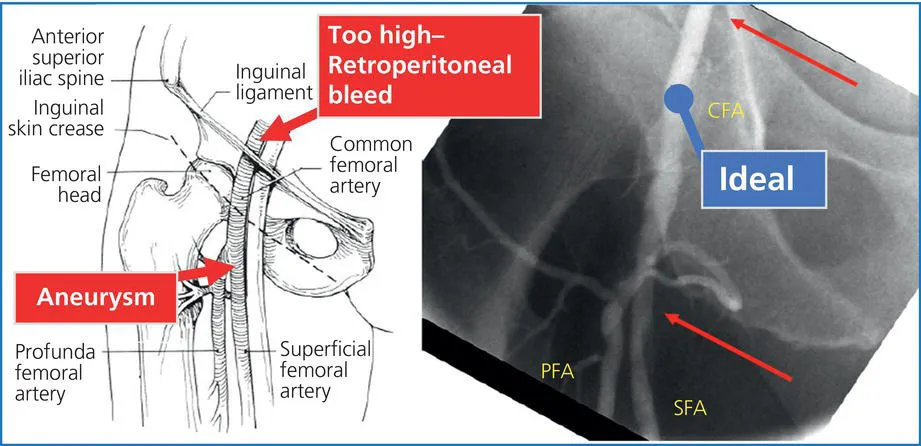
Usually the femoral artery is palpated below the inguinal ligament that runs from the anterior superior iliac spine to the pubic tubercle. The true position of the inguinal ligament is 1â2 cm below that line. An ideal âlanding zoneâ is defined by vascular entry above the femoral bifurcation and below an upper margin conservatively defined as several centimeters below the inferior excursion of the inferior epigastric artery (IEA). The IEA descends to, but does not cross, distal to the inguinal ligament; thus, entry above the lowest point of the course of this vessel, which typically then turns cranial to supply circulation to the epigastrium, can be used to define an unequivocally high puncture [1] (Figure 1.1).
Figure 1.1 Ideal location for puncture of the femoral artery.
Reproduced with permission of Wiley.
BEST PLAYERS
aka Standard of Technical Excellence in Femoral Approach
The technique employs visualization of the femoral head under fluoroscopy in a posteriorâanterior projection. The skin puncture starts at the level of the lower border of the head of femur with the eventual goal of arterial cannulation at the midâthird of the head of femur. However, even with this technique, punctures below the bifurcation of the common femoral artery (CFA) cannot be completely avoided. This is due to variability in the site of the femoral artery bifurcation in reference to the femoral head. Although in a majority of cases (approximately 77%) the bifurcation is below the level of the femoral head, in approximately 2...
Table of contents
Cover
Table of Contents
Preface
Contributors
Foreword
Acknowledgments
CHAPTER 1: Vascular Access
CHAPTER 2: Dynamic Coronary Angiography and Flow
CHAPTER 3: Guides
CHAPTER 4: Wires
CHAPTER 5: Balloon Angioplasty
CHAPTER 6: Stenting
CHAPTER 7: Bioresorbable Vascular Scaffolds
CHAPTER 8: Transradial Approach
CHAPTER 9: Slender Transradial Intervention
CHAPTER 10: Left Main Percutaneous Coronary Intervention