Semiconductor Basics
eBook - ePub

Semiconductor Basics

A Qualitative, Non-mathematical Explanation of How Semiconductors Work and How They are Used

  1. English
  2. ePUB (mobile friendly)
  3. Available on iOS & Android
eBook - ePub

Semiconductor Basics

A Qualitative, Non-mathematical Explanation of How Semiconductors Work and How They are Used

About this book

An accessible guide to how semiconductor electronics work and how they are manufactured, for professionals and interested readers with no electronics engineering background

Semiconductor Basics is an accessible guide to how semiconductors work. It is written for readers without an electronic engineering background. Semiconductors are the basis for almost all modern electronic devices. The author—an expert on the topic—explores the fundamental concepts of what a semiconductor is, the different types in use, and how they are different from conductors and insulators. The book has a large number of helpful and illustrative drawings, photos, and figures.

The author uses only simple arithmetic to help understand the device operation and applications. The book reviews the key devices that can be constructed using semiconductor materials such as diodes and transistors and all the large electronic systems based on these two component such as computers, memories, LCDs and related technology like Lasers LEDs and infrared detectors. The text also explores integrated circuits and explains how they are fabricated. The author concludes with some projections about what can be expected in the future. This important book:

  • Offers an accessible guide to semiconductors using qualitative explanations and analogies, with minimal mathematics and equations
  • Presents the material in a well-structured and logical format
  • Explores topics from device physics fundamentals to transistor formation and fabrication and the operation of the circuits to build electronic devices and systems
  • Includes information on practical applications of p-n junctions, transistors, and integrated circuits to link theory and practice

Written for anyone interested in the technology, working in semiconductor labs or in the semiconductor industry, Semiconductor Basics offers clear explanations about how semiconductors work and its manufacturing process.
Frequently asked questions

Yes, you can cancel anytime from the Subscription tab in your account settings on the Perlego website. Your subscription will stay active until the end of your current billing period. Learn how to cancel your subscription.
No, books cannot be downloaded as external files, such as PDFs, for use outside of Perlego. However, you can download books within the Perlego app for offline reading on mobile or tablet. Learn more here.
Perlego offers two plans: Essential and Complete
  • Essential is ideal for learners and professionals who enjoy exploring a wide range of subjects. Access the Essential Library with 800,000+ trusted titles and best-sellers across business, personal growth, and the humanities. Includes unlimited reading time and Standard Read Aloud voice.
  • Complete: Perfect for advanced learners and researchers needing full, unrestricted access. Unlock 1.4M+ books across hundreds of subjects, including academic and specialized titles. The Complete Plan also includes advanced features like Premium Read Aloud and Research Assistant.
Both plans are available with monthly, semester, or annual billing cycles.
We are an online textbook subscription service, where you can get access to an entire online library for less than the price of a single book per month. With over 1 million books across 1000+ topics, we’ve got you covered! Learn more here.
Look out for the read-aloud symbol on your next book to see if you can listen to it. The read-aloud tool reads text aloud for you, highlighting the text as it is being read. You can pause it, speed it up and slow it down. Learn more here.
Yes! You can use the Perlego app on both iOS or Android devices to read anytime, anywhere — even offline. Perfect for commutes or when you’re on the go.
Please note we cannot support devices running on iOS 13 and Android 7 or earlier. Learn more about using the app.
Yes, you can access Semiconductor Basics by George Domingo in PDF and/or ePUB format, as well as other popular books in Technologie et ingénierie & Ingénierie de l'électricité et des télécommunications. We have over one million books available in our catalogue for you to explore.

1
The Bohr Atom

OBJECTIVES OF THIS CHAPTER

To understand how semiconductors work and how they are used, we need to be familiar with the concept of allowed energy levels first proposed by Niels Bohr. How Bohr came up with the idea of a planetary model of the atom is very interesting. Science is a continuum: one observation leads to a hypothesis that leads to a theory that leads to more observations, and so on. Bohr did not come up with his model of the atom out of the blue – no apple fell on his head. A lot of observations and theories going back to the 1700s were proposed before he put them together in a now well‐known theory.
In this chapter, I discuss the experimental evidence and the scientific observations that led to Bohr's planetary model of the atom and the discrete energy levels it postulated. This brief journey will help us understand the significance of the Bohr atom that explains the strange behavior of light spectra.

1.1 Sinusoidal Waves

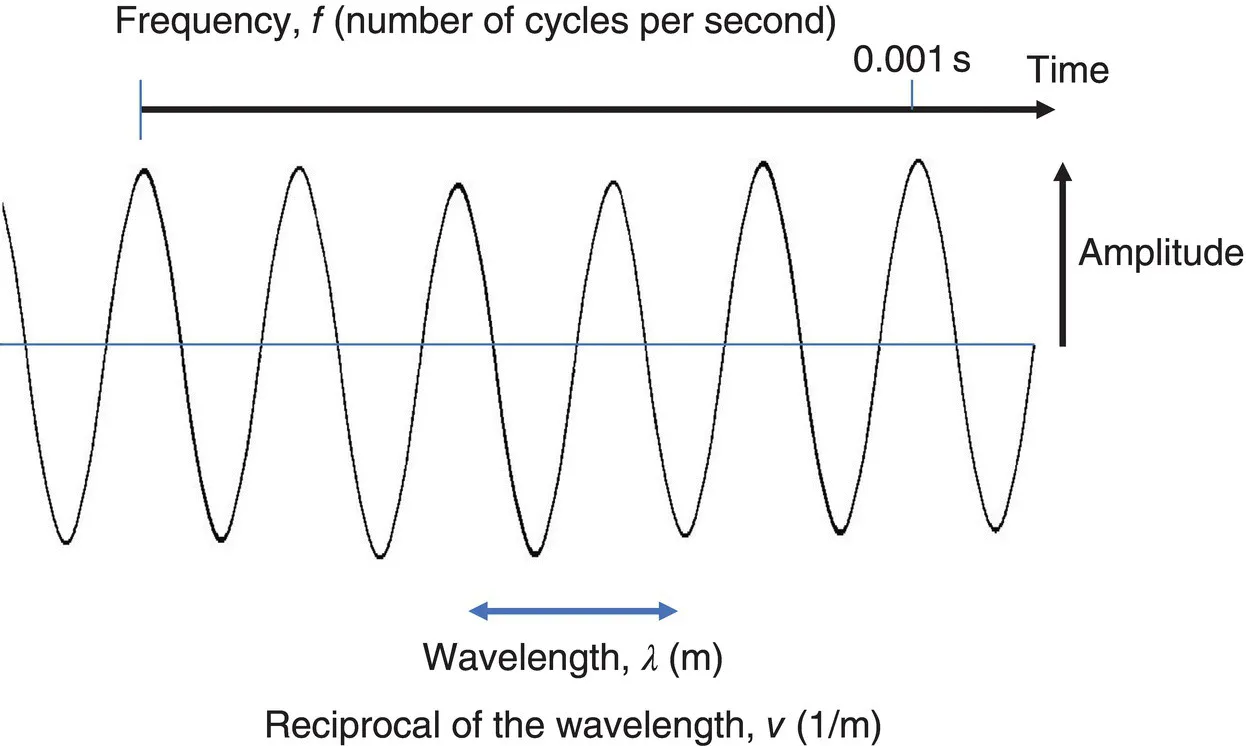
Before I start, I want to clarify the terms used to define a wave, which I use in the next few sections, and the relations between these terms (see Figure 1.1). There are four variables that we use to define any sinusoidal wave:
  • The amplitude, A: How high each peak of the wave is in relation to the middle, its zero value.
  • The frequency, f: The number of ups and downs in the wave in a given time. The units are Hertz or number of ups and downs per second: a number/s.
  • The wavelength, λ: The distance between two peaks, in meters (m), centimeters (cm), or micrometers (μm).
  • The wave number, ν (the Greek letter nu, not the letter v): The reciprocal of the wavelength. Some properties of waves are better expressed by the reciprocal of the wavelength. The units are therefore 1/m or m−1, or cm−1, or μm−1.
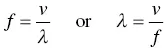
The last three variables are related by the velocity of the wave. Velocity is the distance that a moving object covers during a fixed amount of time, so the velocity v (this is now the letter v) has units of meters per second (m/s). The key relationships are
(1.1)
equation
and the wave number – the reciprocal of the wavelength – is
(1.2)
equation
For example, suppose that Figure 1.1 represents a sound wave. The velocity of sound in air is 343 m s−1. Take a look at Figure 1.1:
  • The figure shows 5 cycles in 0.001 seconds, which means the frequency is 5000 cycles per second or f = 5000 Hz, (where Hz, Hertz is the unit for frequency) which happens to be the middle of our hearing range.
  • The wavelength is the velocity divided by the frequency, or λ = 343 (m s−1)/5000 (1 s−1) = 0.069 m or 6.9 cm. Notice that the seconds cancel out, and therefore the units are in meters or centimeters.
  • The wave number is v = 1/0.069 m = 14.5 m−1.
As much as possible, I use the metric system of units (MKS, meter, kilogram, second). I have always found it very annoying when books keep changing the unit system. When necessary, I will give you the equivalents.
Schematic illustration of a sinusoidal wave is described in several ways including frequency, wavelength, and reciprocal of the wavelength plus its amplitude.
Figure 1.1 A sinusoidal wave is described in several ways: frequency, wavelength, and reciprocal of the wavelength plus its amplitude.
Now we are ready to dive into the pre‐history of the Bohr atom and understand how Dr. Bohr came up with his famous model.

1.2 The Case of the Missing Lines

To explain how semiconductors work, we start with the Bohr atom. Most readers are familiar with Bohr's planetary model of the atom. How Bohr came up with this model is a very interesting scientific historical path involving many famous scientists of the nineteenth and early twentieth centuries. Science goes one step at a time.
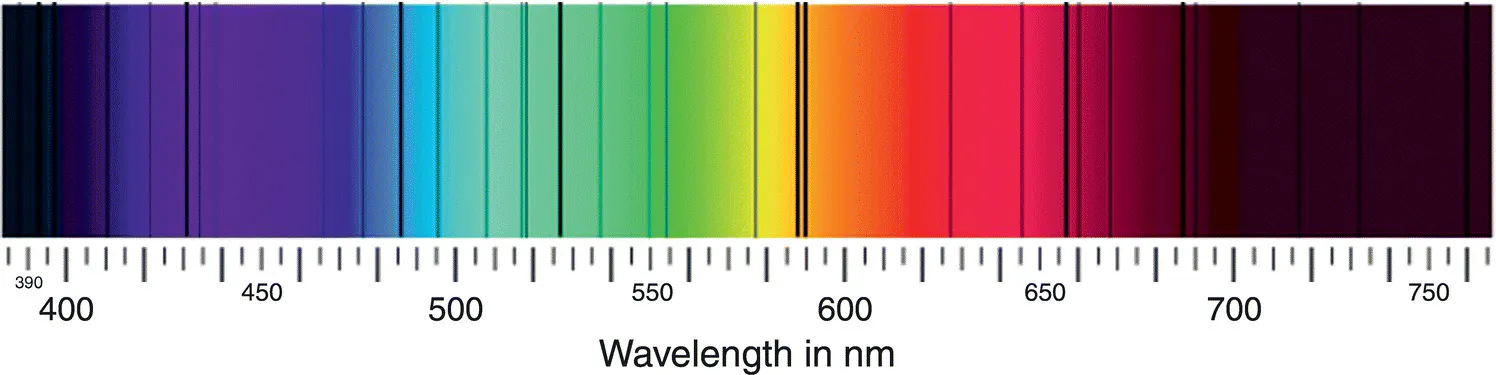
William Wollaston (1766–1826), shown on the left in Figure 1.2, was an English chemist who discovered a couple of atomic elements, including palladium and rhodium. Very early in the 1800s, he built the first spectrometer. Wollaston focused the light from the sun through a prism and, to his surprise, found black lines partitioning the spectra (Figure 1.3). What the heck was going on?
Illustrations of William Wollaston (left) looking at the sun's light through a prism and was the first to observe the missing lines and Joseph von Fraunhofer (right) studied the missing lines with his spectrometer and named them A–K.
Figure 1.2 William Wollaston (left) looked at the sun's light through a prism and was the first to observe the missing lines.
Source: https://library.si.edu/image‐gallery/73731. Joseph von Fraunhofer (right) studied the missing lines with his spectrometer and named them A–K. where Hz, Hertz is the unit for frequency. https://www.kruess.com/en/campus/spectroscopy/history‐of‐spectroscopy/
Schematic illustration of the sun's spectrum through a prism shows dark lines in which the wavelengths of light that seem to have disappeared.
Figure 1.3 The sun’s spectrum through a prism shows dark lines: wavelengths of light that seem to have disappeared.
Source: https://www.kruess.com/en/campus/spectroscopy/history‐of‐spectroscopy/.
Suppose ...

Table of contents

  1. Cover
  2. Table of Contents
  3. Acknowledgements
  4. Introduction
  5. 1 The Bohr Atom
  6. 2 Energy Bands
  7. 3 Types of Semiconductors
  8. 4 Infrared Detectors
  9. 5 The pn‐Junction
  10. 6 Other Electrical Components
  11. 7 Diode Applications
  12. 8 Transistors
  13. 9 Transistor Biasing Circuits
  14. 10 Integrated Circuit Fabrication
  15. 11 Logic Circuits
  16. 12 VLSI Components
  17. 13 Optoelectronics
  18. 14 Microprocessors and Modern Electronics
  19. 15 The Future
  20. Epilogue
  21. Appendix A: Useful Constants
  22. Appendix B: Properties of Silicon
  23. Appendix C: List of Acronyms
  24. Additional Reading and Sources
  25. Index
  26. End User License Agreement