- English
- ePUB (mobile friendly)
- Available on iOS & Android
eBook - ePub
IMechE Engineers' Careers Guide 2013
About this book
An indispensable career roadmap for newly graduated mechanical engineers From the Institution of Mechanical Engineers comes a practical and hands-on exploration of the career opportunities available to engineers. The IMechE Engineers??? Careers Guide 2013 discusses the engineering industry from a birds-eye view before conducting deep dives into a variety of industries, including energy and utilities, aerospace and defense, transport and automotive, healthcare, and more. You???ll get practical guidance on obtaining necessary work experience, submitting attractive applications, and preparing for industry interviews. You???ll also learn about the benefits of professional registration and the steps you???ll need to take if you wish to further your engineering education.
Information
1
Engineering Industry Overview
1.1 Engineering in the UK
The engineering sector is huge. In the UK alone it employs over 5.4 million people and contributes more than a fifth of the turnover of the UK. Engineering turnover was £1.1 trillion in the year ending March 2012, a rise of 3.5% over 2011. Engineering now accounts for a quarter of the turnover of all enterprises in the UK. However, there continues to be a shortage of engineers – the UK will need approximately 87,000 new engineers per year over the next ten years to meet demand. This means that engineering is almost certain to remain an attractive and well paid career choice – second only to medicine and dentistry for entry level salaries (source: Engineering UK 2014 report). Today, many engineering sectors are thriving. The UK manufacturing sector is the ninth largest in global output and accounts for almost three-quarters of all industrial research and development in the UK.
The UK is host to some of the world's top engineering enterprises. All sectors of industry are represented, from aerospace and automotive through chemicals and energy to manufacturing, transport and utilities.
The energy sector in the UK has always had its share of big players. It includes the oil and gas companies plus the electricity power utilities that are developing new low-carbon technologies such as biogas, landfill gas, hydrogen, solar, wind, wave, etc. Higher prices have enabled the UK off-shore oil and gas industry to exploit previously uneconomic deposits. An ambitious nuclear build programme has recently been announced, which could create 30,000 jobs, to replace the 15 nuclear reactors set to close by 2023. These developments have resulted in more jobs and opportunities in the industry, especially for graduates in engineering.
The UK's aerospace industry is the largest in the world outside the USA. In March 2013, the UK government announced £2 billion funding for the sector over a seven year period, to help to secure around 115,000 jobs. A new UK Aerospace Technology Institute (ATI) has been established as a joint venture between Government and industry to achieve a step change in aircraft technology and to improve the UK's future in aerospace. Aerospace engineering is a significant driver of regional and national economic growth and productivity. In the UK, defence equipment products include military aircraft, satellites, rockets and missiles, navigation and electronic guidance systems. Hundreds of small firms act as suppliers to the industry and there is work for a broad range of engineers from disciplines including aeronautical, structural, electronic and mechanical engineering.
The UK has a strong manufacturing base, employing 2.5 million people, and accounts for 72% of UK business research and development. However the trend from high volume, low value manufacturing to more specialist products has meant that, although turnover has increased in recent years, the number of employees in manufacturing has declined.
The UK has an extensive transport network of around 400,000 km of roads, carrying an estimated 34 million vehicles; a rail network that carries 1.2 billion passenger journeys per year and a fleet of naval, merchant and passenger ships. Add into this the light rail, tram and underground networks, aviation and freight operators, and the scale of the transport sector soon becomes clear.
Opportunities in the automotive industry are more prone to peaks and troughs than many other industries, and positions for engineering graduates can be hard to find. However, the UK boasts several major car manufacturers as well as a number of smaller producers serving specialist markets, such as sports and luxury cars. There are, in addition, over 1,000 automotive component suppliers manufacturing in the UK, 90% of which are SMEs (small to medium sized enterprises). The UK is recognized as a world leader in innovation in component manufacture and attracts considerable investment from international manufacturers. Recognising the importance of automotive research to the UK economy, the Government recently announced a £1 billion initiative to establish an Advanced Propulsion Centre, which it will jointly fund with industry. The UK is also the centre of the motorsport world, which is one of the UK's major export earners with a turnover of over £1.3 billion.
1.2 Is There a Shortage of Engineers?
A 2013 report by the Royal Academy of Engineers forecasts that the engineering profession needs 104,000 STEM (science, technology, engineering and mathematics) new graduates each year between now and 2020. However only around 82,000 students graduate in these subjects at present, of whom just 64,000 end up in engineering sectors – a shortfall of around 40,000 suitably qualified graduates.
The report suggests that one indicator that the economy needs more graduate level engineers is “a persistent, sizeable wage premium for people holding engineering degrees”. It is recognised that in many cases the engineering industry is struggling to recruit suitably qualified engineers and consequently some are having to recruit from outside the UK.
The UK's need for engineers, commonly mirrored in other countries, is driven by expansion in key sectors (such as nuclear and information technology) as well as the need to replace an ageing workforce.
1.3 What Do Engineering Graduates Do?
The engineering sector can offer you the opportunity to travel, work on exciting and innovative projects, and get your hands dirty with practical work and responsibility early on in your career. It encompasses a huge range of occupations, including:
- product and process development
- manufacturing
- consultancy
- research and development
- design, construction, commissioning and operation
- data management
- IT support
- logistics
- management and administration
- sales.
Opportunities exist in major towns and cities throughout the UK and some regions have traditionally hosted particular industries. For example, companies working in high-tech areas of engineering are most prevalent in the ‘golden triangle’ of Oxford, Cambridge and London, and there is a concentration of automotive companies in the West Midlands. Many companies are multinationals offering opportunities to spend periods of time working overseas on short-term projects, or for extended periods of time. For example, although the UK oil industry extends throughout the UK (albeit with a particular focus on Aberdeen), oil exploration has always been international in nature, with seismic investigations and the drilling of wells often taking place in the most remote regions. The industry is used to working in multinational teams, and English is the business language.
The international nature of many areas of engineering is further highlighted by the transferability of professional engineering status across the European Union (EU). All EU countries have an agreement on what they call the ‘formation’ of a professional engineer, which takes around seven years and includes education, initial training and experience. The order in which these occur differs around Europe. French and German employers generally prefer their students to gain industrial experience at home and abroad during the course of their studies. In contrast, in the UK, although there are some sandwich courses, work experience before graduation is more restricted and it is quite possible to graduate without any. This inevitably places more emphasis on industrial training after graduation.
It is relatively difficult for a new graduate to secure a permanent job overseas (EU nationals wishing to work in EU countries are an exception). If you are keen to work abroad it may be worth looking for employment in a multinational company where there could be opportunities for overseas postings. Once you have gained a few years of experience then the international job market is likely to open up considerably.
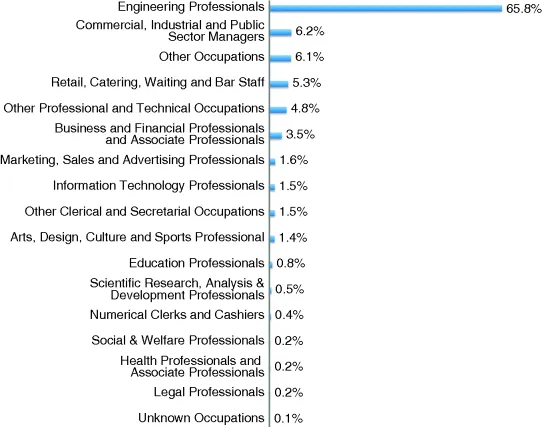
According to the analysis of graduate destinations statistics by Engineering UK, there is a positive employment picture for engineering and technology graduates (Figure 1.1). Over 60% of UK domiciled engineering and technology graduates are in full-time paid work six months after graduating. Over 60% of those who enter employment work for employers in sectors in or associated with engineering and technology (Figure 1.2).
Figure 1.1 Destinations six months after graduation of those completing first degrees at UK universities in 2011 (data source: HESA)
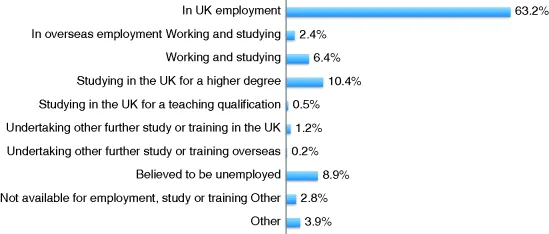
Figure 1.2 Industry sector for those in employment six months after graduation with first degrees from UK universities in 2011 (data source: HESA)
1.4 What Is It Like Working in the Engineering Sector?
Working conditions vary according to your role. You could work in an office, in a laboratory, on the factory floor, on site, outdoors - in any number of combinations. Some roles - for example, site engineer or field engineer - may require extended periods of time working away from home. Others require regular office hours, or perhaps shift work.
Salaries for newly graduated trainee engineers compare favourably with pay for other graduate jobs. There is a wide variation in starting salaries for graduate engineers. High profile employers typically offer between £22,000 and £32,000, though some will fall outside of this range. For example, a graduate engineer could earn an annual starting salary of £18,000 with a modest regional employer, or more than £33,000 with a global energy company. According to figures provided by Engineering UK, the average starting salary for engineering and technology graduates is £25,762 or nearly 16% higher than the average for all graduates.
Women are under-represented in the engineering industry. Analysis of new registered engineers and technicians, undertaken by Engineering UK, shows that in 2010 just 9% of registrants were female. This gender imbalance does not begin in the workplace however. The proportion of women studying engineering and technology in higher education institutions is just above 15%. This compares poorly even with other technical subjects - in biological sciences 64% of students are female and in physical and mathematical sciences it is 41% and 38% respectively.
The careers followed by graduates on leaving education are also highly gender-orientated. Issues arising from this under-representation are widely acknowledged. Engineering companies and professional institutions are taking steps to understand the underlying causes and try to shift the balance. The Institution of Mechanical Engineers, for example, issued a policy statement Women in Engineering (IMechE, Education Policy Statement 01/14) in which recommendations were made not only to government but also to schools and to engineering employers. Several large companies and professional organizations have mentoring programmes for women, and sponsorship schemes. There are also a number of projects and campaigns set up to encourage women into engineering, for example, Women Into Science & Engineering (WISE). There are many inspiring and reassuring case studies of women who have pursued highly successful careers in engineering. For examples consult the WISE website and NOISE blogs.
Consultancy versus in-house: One feature of the engineering industry is that many companies use external consultants to provide knowledge or skills rather than developing that expertise themselves in-house. This includes consultants who are employed by firms which specialize in consultancy services, as well as individuals who run their own small businesses capitalizing on their own expertise. Recent graduates will find it difficult to work as an individual, or freelance, consultant before gaining significant experience in their chosen industry. There are, however, many engineering consultancy firms who take on graduate engineers each year. These may be global multidisciplinary companies who provide expert services and technology to a range of engineering industries on a contractual basis. Examples of these types of organizations include Atkins, Scott Wilson and AMEC. Other consultancies such as Newton Europe work on short-term projects to troubleshoot manufacturing processes or improve industrial productivity. Advantages of consultancy work include the variety of projects and exposure to a range of businesses and industries, often involving travel, and providing valuable experience for future employment. However, for some the need to market the services of your firm, and liaise extensively with clients, whilst useful business experience, can feel like a distraction from their vocation.
1.5 How Can my Career Develop?
Your career as an engineer could develop in many different ways. You might start in a technical function and develop as a professional, before moving into a managerial position. This may involve managing a facility such as manufacturing or a project for a client. In addition to your technical abilities, you will also develop the skills necessary to manage people, budgets and clients' expectations.
Gaining the professional qualification of Chartered (CEng) or Incorporated Engineer (IEng) is the next step for many graduate engineers. The Engineering Council, the UK regulatory body for the engineering profession, holds the national register of 235,000 Chartered, Incorporated Engineers and Engineering Technicians in the UK. Such professional titles are gained by demonstrating that you have built up the necessary competencies and experience in your job as an engineer. IMechE offers an Initial Professional Development (IPD) programme that will build on your academic skills and lead you to registration as a Chartered (CEng) or Incorporated Engineer (IEng). You are likely to be supported in this process by your...
Table of contents
- Cover
- Title Page
- Copyright
- Foreword
- About the Author
- Acknowledgements
- Chapter 1: Engineering Industry Overview
- Chapter 2: Energy and Utilities
- Chapter 3: Aerospace and Defence
- Chapter 4: Transport and Automotive
- Chapter 5: Healthcare
- Chapter 6: Manufacturing
- Chapter 7: Getting In: Work Experience, Applications and Interviews
- Chapter 8: Getting On: Training and Qualifications
- Chapter 9: Further Study and Academia
Trusted by 375,005 students
Access to over 1.5 million titles for a fair monthly price.
Study more efficiently using our study tools.
Frequently asked questions
Yes, you can cancel anytime from the Subscription tab in your account settings on the Perlego website. Your subscription will stay active until the end of your current billing period. Learn how to cancel your subscription
No, books cannot be downloaded as external files, such as PDFs, for use outside of Perlego. However, you can download books within the Perlego app for offline reading on mobile or tablet. Learn how to download books offline
Perlego offers two plans: Essential and Complete
- Essential is ideal for learners and professionals who enjoy exploring a wide range of subjects. Access the Essential Library with 800,000+ trusted titles and best-sellers across business, personal growth, and the humanities. Includes unlimited reading time and Standard Read Aloud voice.
- Complete: Perfect for advanced learners and researchers needing full, unrestricted access. Unlock 1.5M+ books across hundreds of subjects, including academic and specialized titles. The Complete Plan also includes advanced features like Premium Read Aloud and Research Assistant.
We are an online textbook subscription service, where you can get access to an entire online library for less than the price of a single book per month. With over 1.5 million books across 990+ topics, we’ve got you covered! Learn about our mission
Look out for the read-aloud symbol on your next book to see if you can listen to it. The read-aloud tool reads text aloud for you, highlighting the text as it is being read. You can pause it, speed it up and slow it down. Learn more about Read Aloud
Yes! You can use the Perlego app on both iOS and Android devices to read anytime, anywhere — even offline. Perfect for commutes or when you’re on the go.
Please note we cannot support devices running on iOS 13 and Android 7 or earlier. Learn more about using the app
Please note we cannot support devices running on iOS 13 and Android 7 or earlier. Learn more about using the app
Yes, you can access IMechE Engineers' Careers Guide 2013 by Abby Evans in PDF and/or ePUB format, as well as other popular books in Technology & Engineering & Mechanical Engineering. We have over 1.5 million books available in our catalogue for you to explore.