eBook - ePub
Archaeology Meets Science
Biomolecular Investigations in Bronze Age Greece
- 320 pages
- English
- ePUB (mobile friendly)
- Available on iOS & Android
eBook - ePub
Archaeology Meets Science
Biomolecular Investigations in Bronze Age Greece
About this book
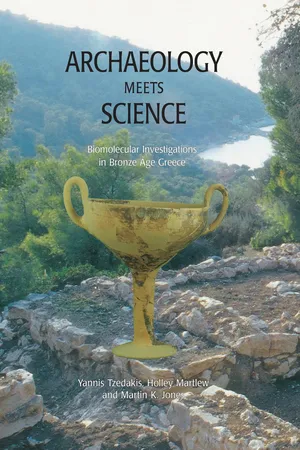
The 'Archaeology meets Science' project is currently transforming our understanding of the Minoan and Mycenaean civilisations, through the in-depth application of state of the art scientific analyses to ceramic artefacts and skeletal material. This book is the fruit of this acclaimed research, which was carried out between 1997 and 2003, and presented in an exhibition in a number of museums across Europe and the United States, starting with the National Archaeological Museum in Athens. Moving beyond the standard archaeological format of illustrations with descriptions of contexts, the book analyses each object from the inside , and consequently each has a different story to tell. Organic residue and stable isotope analysis has extended our knowledge beyond anything previously gleaned through conventional archaeological research, and we now have a much better understanding of the food and drink consumed by ordinary people in Bronze Age Greece. There are some fascinating insights, such as the origin of modern Greek retsina, which was traced first to the time of Agamemnon, then to Crete in the 17th century BC and finally to the Early Minoan Period, c. 2000 BC. The book provides the primary scientific evidence on which the world renowned scientists who have carried out this work have based their conclusions.
Information
Subtopic
Greek Ancient HistoryIndex
Social SciencesSection 1
Organic Residue Analysis Ceramic Artefacts
Introduction The History and Present State of Organic Residue Analysis
Poets have long understood the dramatic difference between the taphonomy of inorganic and organic materials. Buried stone, metal, glass, and pottery last almost indefinitely (“Thou still unravish’d bride of quietness, thou foster-child of silence and slow time”, John Keats, Ode on a Grecian Urn). But the fabric of plants and animals, including humans, rapidly succumbs to decomposition, both because of its inherent instability and because it may be consumed by succeeding life forms. (“Thy beauty shall no more be found; ... then worms shall try that long-preserved virginity”, Andrew Marvel, To His Coy Mistress). Accordingly, the study of inorganic objects by chemical analysis has a venerable history reaching into the 18th century (Klaproth, 1798), but corresponding work on organic remains has only lately reached the level where it is useful to archaeology.
The reasons for that delay lie in the history of analytical chemistry, and particularly in the development of separation techniques. Inorganics are either ionic or could be converted to soluble ionic species, from which insoluble compounds were precipitated, filtered off, and weighed. Ions that do not form insoluble compounds yielded to emission spectroscopy, developed by Kirchhoff and Bunsen in 1859. Until the early 20th century, the only means of separating mixtures of the largely covalent or weakly ionic organic compounds were the tedious and incomplete process of distillation, solvent extraction and fractional crystallisation. By these techniques the great French chemist Berthelot analysed wine in sealed Gallo-Roman glass vessels beginning in 1877. He reported percentages of alcohol, acetic acid, ethyl acetate, and,–collectively,–fatty acids. In later work, (Berthelot, 1897) he qualitatively identified individual fatty acids (palmitic, stearic and oleic) in a similar vessel that had contained oil. Other early results of organic residue analysis are less convincing. In 1906, Gill reported, without any evidence, the contents of a Mycenaean stirrup jar found in Egypt to be “some preparation of cocoanut [sic] oil”. The first attempt to introduce the coconut palm, Cocos nucifera, into Egypt was made in 1830 (Täckholm and Drar, 1950).
The great leap forward in organic separation techniques was the evolution of chromatographic techniques, in all of which repeated process of absorption and desorption separates a mixture into its components by size and polarity. The earliest variant was column chromatography (CC), first practiced by Tswett in 1903, but systematically applied to organic analysis only by Kuhn beginning in 1930. It resolves a mixture into its components by passing it through a vertical column of the absorbent. Thin-layer chromatography (TLC), in which the mixture is spotted into a plate coated with the absorbent and developed by a solvent rising by capillary action, was first practiced in 1938 and was soon followed by paper chromatography (PC) in 1944. This technique, in which the coated plate is replaced by a sheet of filter paper, was so instrumental in advancing protein chemistry that its inventors, Martin and Synge, were awarded the Nobel Prize in Chemistry in 1952. That was also the year when gas chromatography (GC) was introduced, in which a mixture of sufficiently volatile components is separated by having a carrier gas push them through a column packed or coated with the absorbent, here called the stationary phase. The requirement of volatility is met inadequately by fatty acids and not at all by carbohydrates (sugars) and proteins (amino acids), but it can be sufficiently enhanced by converting these compounds into more volatile derivatives.
In CC, TLC, and PC, the separated components are distinguished only by a distance they have travelled, made apparent by their colour in ordinary or ultraviolet light, or with visualisation reagents. In GC, they are distinguished by their rate of travel and are detected as they emerge from the column by their thermal conductivity or by flame ionisation. In all cases, their identification must be made by matching those distances and rates to a known reference compound that has the same migratory predilection. That is a severe limitation, not only because the choice of reference compound must anticipate the nature of the constituents of the original mixture, but especially because when millions of potential candidates are crammed into a finite distance, many quite different compounds will appear at the same, or very nearly, the same, location.
Column chromatography is rarely used in organic residue analysis, because it is designed for quantities much larger than what is usually available in archaeological finds; but it appears to have been the “kapillaranalytische Methode” used by Grüss (1934) to analyze much degraded wine in a Roman glass bottle with quite limited success.
Thin-layer rather than paper chromatography has been used for the categorical identification of compound classes (hydrocarbons, free fatty acids, triglycerides) as well as individual compounds (cholesterol) absorbed in ceramics (Bowyer, 1972). It has served for the identification of birch bark tar by establishing the presence of betulin (Rottländer, 1974; Sauter, 1980). Even now, when more definitive methods are available, it continues to be useful for the preliminary separation of compound classes which are then further analysed by other means (e.g. Charters et al., 1993).
Gas chromatography has been widely applied to organic residue analysis and has also given great impetus to phytochemistry. This latter role has been extremely valuable, for without knowledge of the constituents of plants, the identification of organic compounds in archaeological ceramics tells only half the story: clearly the important question in vessel use is about the floral and faunal species that fed our ancestors. Because fatty acids are most easily identified by their retention time alone, much of this work has concentrated on lipids. Most noteworthy is the compilation of Rottländer (1990) who determined and plotted the fatty acids in about a hundred plant oils, nearly as many animal fats, and more than 500 archaeological organic residues. Rottländer used these fatty acid profiles, together with a semi-quantitative test for cholesterol, to make specific identifications of animal and plant species that are open to some doubt.
A watershed in organic residue analysis was the coupling of gas chromatography (GC) with mass spectrometry (MS) by Lindeman and Annis (1960). GC-MS combines an effective separation technique with a detection system that can identify the components of a mixture with considerable certainty. The most widely used MS technique uses high-energy electrons to ionize and fragment a molecule, and then collects and registers the positively charged ions. From these, the structure of the molecule can be reconstructed by interpretation or, more securely, by comparison of the recorded mass spectra with those of known reference compounds. Compilations of mass spectra are an essential adjunct to this method; the largest now comprises 275,000 mass spectra (McLafferty, 1997). The earliest uses of GC-MS were in the analysis of petroleum and in other areas of organic geochemistry, followed by those in phytochemistry; the technique has been used in archaeometry for not much more than twenty years. An illustration of its power is given by a comparison of two papers from the same laboratory. In 1965, Seher subjected the contents of Roman glass bottles found in Germany to analysis by TLC and GC. He was able to identify 19 organic compounds, all of them straight-chain mono- and dibasic fatty acids. Fifteen years later the same author investigated fatty residues from an Egyptian tomb of the XXVI Dynasty by GC-MS and reported nearly 80 constituents, incuding normal, iso-, and anteiso-fatty acids, benzoic acids, methyl ketones, phenols, sesquiterpenes, diterpenes, wax esters, and alkanes, most of which could not have been identified by GC alone (S...
Table of contents
- Title Page
- Copyright Page
- Dedication
- Table of Contents
- Preface and Acknowledgements
- Contributors
- Introduction by Martin K. Jones
- Archaeology Meets Science
- Archaeology Meets Science
- Conventions and Abbreviations
- Section 1 - Organic Residue Analysis Ceramic Artefacts
- Section 2 - Methods and Primary Evidence for Stable Isotope Analyses Neolithic and Bronze Age Sites Skeletal Material
- Section 3 - Lessons for the Future
- Appendix - Site Descriptions and Catalogue Entries
- Index
- EUM Numbers
Trusted by 375,005 students
Access to over 1.5 million titles for a fair monthly price.
Study more efficiently using our study tools.
Frequently asked questions
Yes, you can cancel anytime from the Subscription tab in your account settings on the Perlego website. Your subscription will stay active until the end of your current billing period. Learn how to cancel your subscription
No, books cannot be downloaded as external files, such as PDFs, for use outside of Perlego. However, you can download books within the Perlego app for offline reading on mobile or tablet. Learn how to download books offline
Perlego offers two plans: Essential and Complete
- Essential is ideal for learners and professionals who enjoy exploring a wide range of subjects. Access the Essential Library with 800,000+ trusted titles and best-sellers across business, personal growth, and the humanities. Includes unlimited reading time and Standard Read Aloud voice.
- Complete: Perfect for advanced learners and researchers needing full, unrestricted access. Unlock 1.5M+ books across hundreds of subjects, including academic and specialized titles. The Complete Plan also includes advanced features like Premium Read Aloud and Research Assistant.
We are an online textbook subscription service, where you can get access to an entire online library for less than the price of a single book per month. With over 1.5 million books across 990+ topics, we’ve got you covered! Learn about our mission
Look out for the read-aloud symbol on your next book to see if you can listen to it. The read-aloud tool reads text aloud for you, highlighting the text as it is being read. You can pause it, speed it up and slow it down. Learn more about Read Aloud
Yes! You can use the Perlego app on both iOS and Android devices to read anytime, anywhere — even offline. Perfect for commutes or when you’re on the go.
Please note we cannot support devices running on iOS 13 and Android 7 or earlier. Learn more about using the app
Please note we cannot support devices running on iOS 13 and Android 7 or earlier. Learn more about using the app
Yes, you can access Archaeology Meets Science by Holley Martlew,Martin Jones, Yannis Tzedakis, Martin Jones in PDF and/or ePUB format, as well as other popular books in Social Sciences & Greek Ancient History. We have over 1.5 million books available in our catalogue for you to explore.