Personal status laws remain a highly politicized area of debate in the Middle East, as the arena in which the contentious issues of women's rights, religion and minority groups meet. This is especially so when it comes to divorce. In Tunisia, with the moderate Islamist party Ennahda winning the first elections following the 2011 revolution, questions of religion in public life have gained greater primacy. The country is often hailed for its progressive personal status code, seen as an exception to the practice in many other Muslim countries. Polygamy is banned, for example, and in divorce cases there is gender equality. However, Tunisia's legal system contains many gaps and leaves much room for interpretation. Bearing in mind this importance of the role of Islam in judicial courts, Maaike Voorhoeve investigates whether the more progressive, and ostensibly secular, principles enshrined in Tunisia's Personal Status Code of 1956 are in fact adhered to in divorce cases. And if not, whether judges frequently turn to the Sharia, custom or societal norms as their primary sources of guidance.
Through extensive research in the Tunisian courts, Voorhoeve investigates the different types of divorce, the arguments presented to the court and the consequent legal decisions made. She focuses on the role of female judges, testing the assumption that they adjudicate in a more gender-neutral way and examining the impact they have had on Tunisian legal culture and through this, Tunisian society. Gender and Divorce Law in North Africa therefore sheds light on the wide-reaching debate throughout North Africa and the Middle East concerning the role of Islam and Sharia in the public, political, legal and private spheres. This debate, which often pits secularists against Islamists, but is in reality much more nuanced, is key in a variety of fields, including Middle East studies and Islamic law.
eBook - ePub
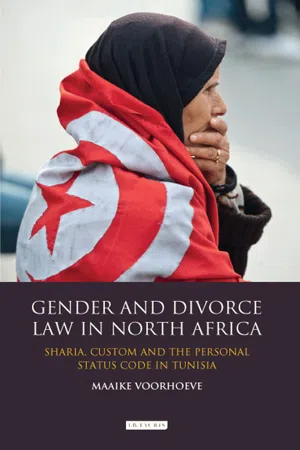
Gender and Divorce Law in North Africa
Sharia, Custom and the Personal Status Code in Tunisia
- 352 pages
- English
- ePUB (mobile friendly)
- Available on iOS & Android
eBook - ePub
Gender and Divorce Law in North Africa
Sharia, Custom and the Personal Status Code in Tunisia
About this book
Information
Table of contents
- Cover Page
- Title Page
- Contents
- Notes on transliteration
- Preface
- Introduction
- 1. The Background to the Debate in Tunisian Legal Literature
- 2. A Description of Divorce Procedure
- 3. Divorce by Mutual Consent
- 4. Divorce without Grounds
- 5. Divorce for Harm on the Grounds of Domestic Violence
- 6. Divorce for Harm on the Grounds of Non-Payment of Maintenance
- 7. Divorce for Harm on the Grounds of Abandonment of the Marital Home
- 8. Divorce for Harm on the Grounds of Adultery
- 9. Divorce for Harm on Other Grounds
- 10. The Consequences of Divorce When Children are Involved: Custody and Visiting Rights
- 11. The Consequences of Divorce When Children are Involved: Child Maintenance and Housing
- Conclusion
- Appendix - Legislation
- Notes
- References
- Index
- eCopyright
Trusted by 375,005 students
Access to over 1.5 million titles for a fair monthly price.
Study more efficiently using our study tools.
Frequently asked questions
Yes, you can cancel anytime from the Subscription tab in your account settings on the Perlego website. Your subscription will stay active until the end of your current billing period. Learn how to cancel your subscription
No, books cannot be downloaded as external files, such as PDFs, for use outside of Perlego. However, you can download books within the Perlego app for offline reading on mobile or tablet. Learn how to download books offline
Perlego offers two plans: Essential and Complete
- Essential is ideal for learners and professionals who enjoy exploring a wide range of subjects. Access the Essential Library with 800,000+ trusted titles and best-sellers across business, personal growth, and the humanities. Includes unlimited reading time and Standard Read Aloud voice.
- Complete: Perfect for advanced learners and researchers needing full, unrestricted access. Unlock 1.5M+ books across hundreds of subjects, including academic and specialized titles. The Complete Plan also includes advanced features like Premium Read Aloud and Research Assistant.
We are an online textbook subscription service, where you can get access to an entire online library for less than the price of a single book per month. With over 1.5 million books across 990+ topics, we’ve got you covered! Learn about our mission
Look out for the read-aloud symbol on your next book to see if you can listen to it. The read-aloud tool reads text aloud for you, highlighting the text as it is being read. You can pause it, speed it up and slow it down. Learn more about Read Aloud
Yes! You can use the Perlego app on both iOS and Android devices to read anytime, anywhere — even offline. Perfect for commutes or when you’re on the go.
Please note we cannot support devices running on iOS 13 and Android 7 or earlier. Learn more about using the app
Please note we cannot support devices running on iOS 13 and Android 7 or earlier. Learn more about using the app
Yes, you can access Gender and Divorce Law in North Africa by Maaike Voorhoeve in PDF and/or ePUB format, as well as other popular books in History & Middle Eastern History. We have over 1.5 million books available in our catalogue for you to explore.