Saudi Arabia is generally and justifiably viewed as a country with the fewest democratic institutions and the weakest traditions of pluralism in the world. It is therefore surprising to learn that at least in one corner of the Saudi world, there is a plurality voices. Jörg Matthias Determann brings this element to light by analysing an important field of cultural activity in Saudi Arabia: historical writing. By exploring the emergence of a plurality of historical narratives in the absence of formal political pluralism, Determann seeks to paint a more nuanced picture of Saudi Arabia than has previously been drawn.
Since the 1920s local, tribal, Shi'i and dynastic histories have contributed to a growing plurality of narratives, diverging from and contesting the histories which focus on the royal family. Instead, they have emphasized the communities' historical independence from the House of Saud or asserting the communities' importance in Saudi national history. In addition to this, during the 1970s, distinct social and economic histories began to be developed, new narratives which have described important historical events evolving from wider social and economic factors rather than resulting from the actions of individual rulers or communities. Paradoxically, this happened because of the expansion of the Saudi state, including state-provision of mass education. A variety of previously illiterate and relatively poor sections of Saudi society, including former Bedouin, were thus empowered to produce histories which, while conformist for the most part, also provided a vehicle for dissenting voices. Furthermore, Determann argues that this proliferation of alternative histories is also due to globalizing processes, such as the spread of the internet. It is through this phenomenon that narrative plurality has been facilitated, by putting Saudi historians in contact with different ideologies, methodologies and source material from abroad.
In challenging the widely-held perception of Saudi Arabia as an irredeemably closed and monolithic society, Historiography in Saudi Arabia provides a deeper understanding of modern Arab historiography, the Saudi state, and education and scholarship in the Middle East.
eBook - ePub
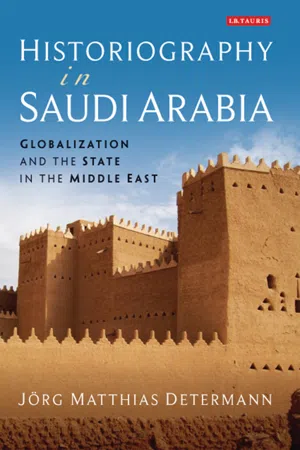
Historiography in Saudi Arabia
Globalization and the State in the Middle East
- 352 pages
- English
- ePUB (mobile friendly)
- Available on iOS & Android
eBook - ePub
Historiography in Saudi Arabia
Globalization and the State in the Middle East
About this book
Information
CHAPTER 1
HISTORIES OF A MUSLIM ARAB DYNASTY, EARLY BEGINNINGS TO 1960S
In 1961, Suʿūd ibn Hadhlūl (1906/7–83), a Saudi provincial governor and member of the extended royal family, published a book entitled The History of the Kings of the Al Saud. It was one of the first elaborate histories of the Saudi dynasty written by one of its members. It gave the biographies of fourteen Saudi rulers, beginning with Saud ibn Muhammad ibn Muqrin, the eighteenth-century ancestor who lent his name to the Al Saud, ending with King Abdulaziz (r. 1902–53). However, Ibn Hadhlūl’s work was not the first dynastic history written in Saudi Arabia. A number of historians from the Arabian peninsula and outside of it preceded him. Indeed, one of Ibn Hadhlūl’s motivations was to ‘correct’ previous writings. In his introduction, he wrote, ‘I read most of the writings by contemporary historians on Najd and on the history of the royal Saudi family and think that many events were told either in a falsified or distorted way’.1
Although Ibn Hadhlūl was critical of some aspects of previous dynastic historiography, he also relied on this historiography for his own account of the Al Saud. In this account, Arabian history effectively started with the appearance of the Saudi family in the eighteenth century. Ibn Hadhlūl wrote that ‘this Saudi house is the great pillar of the renaissance of the Arabian peninsula. No more testimony or evidence is needed than a reading of most historians’ writings. By reading this, it becomes very clear that Najd was not worth mentioning before the rule of the Al Saud.’ At the time, Najd ‘was a region whose people were torn apart by division. Hunger, bareness and illnesses killed them. It was completely stricken by ignorance, and its inhabitants only conspired against and killed each other.’ As for Islam, ‘it had absolutely no influence. Superstition spread, sins prevailed, and rocks and trees were worshipped instead of God.’ ‘If we now compare the present of this nation with its past’, Ibn Hadhlūl went on, ‘we find that the difference is like the difference between day and night, heaven and earth. This is due to God and the glorious Al Saud, who supported the pure Islamic mission started by the Imam, the reformer and renewer, Sheikh Muhammad ibn Abd al-Wahhab.’2
Ibn Hadhlūl’s work thus constructed a glorious political and religious history centred on the Al Saud. The fall of the first and second Saudi states in 1818 and 1891 respectively interrupted this history only temporarily. The governor argued that ‘during the times, in which the rule of the Al Saud is overwhelmed by its enemies, is weak or suffers a setback, this country returns to its first condition. It becomes divided and is being brought down. Chaos rules, calamities spread, and relatives fight each other, until God sends someone from the Al Saud who renews the mission and unites the word. Then calm prevails, the country prospers, and matters become straight.’3
In producing his narrative, Ibn Hadhlūl relied on, and formed part of, a tradition of dynastic histories that had its roots in the first Saudi state (c. 1744–1818).4 While many of these histories were entitled histories of Najd, Saudi Arabia or the Arabian peninsula, they tended to focus on the history of the Al Saud from the eighteenth century onwards. In this chapter, I describe how Saudi state building and globalization contributed to the development of three features of Saudi dynastic historiography from its early beginnings under the first Saudi state until the 1960s. These features are to some extent also present in Ibn Hadhlūl’s book. The first was a narrative describing the Al Saud as the only true Muslim dynasty, which spread Islam where it had been absent. The second feature was an exclusivism that disregarded historical events other than those related to the Saudi dynasty. The third feature of dynastic histories emphasized the Arab character of the Saudi family, presenting it as leading the Arabs’ modern renaissance and their struggle for independence.
The Ibn Ghannām School and the Saudi State
Histories of the Al Saud first emerged at the turn of the nineteenth century within a new school of Najdi chronicles. The founder of this school was Ḥusayn ibn Ghannām (1739–1810), a scholar from the oasis of al-Aḥsāʾ in eastern Arabia who entered the service of the first Saudi state. Saud ibn Abdulaziz (r. 1803–13), one of the princes of the Al Saud, invited him to teach Arabic in the first Saudi capital al-Dirʾīyah near Riyadh. There, Ibn Ghannām authored two major historical works at the order of either Saud ibn Abdulaziz or Muhammad ibn Abd al-Wahhab, the founder of the Wahhabi mission himself.5 Both were written in an elaborate rhymed prose (sajʿ). The first was entitled The Garden of Ideas and Concepts for Someone Exploring the State of the Imam (the imam referred to Ibn Abd al-Wahhab). It included a portrait of the situation in Najd and al-Aḥsāʾ before the Wahhabi mission, .a biography of Ibn Abd al-Wahhab and a comment on some of his letters to various dignitaries. The title of Ibn Ghannām’s second historical work was The Koranic Raids, the Divine Conquests, and the Reason for Them. It chronicled the Saudi expansion across Arabia from 1746 until 1797.6
Although Ibn Ghannām was the pioneer of Saudi dynastic historiography, he was not the first chronicler in Najd. At least six scholars, who mainly worked as judges, preceded him. They included Aḥmad ibn Bassām (d. 1631), al-Manqūr (1656–1713), Ibn Rabī ah (1654–1745), Ibn Uḍayb (d. c. 1747), Ibn Yūsuf (whose work reaches 1759/60) and Ibn Abbād (d. 1761). This historiography was a local evolution that bore no explicit reference to historical literature elsewhere in the Middle East. It recorded skirmishes, migrations, rainfalls, droughts, deaths of religious scholars and other events from the sixteenth century onwards. The chronicles probably emerged out of some sort of private diaries recording private and public events. Al-Manqūr, for instance, inserted a reference to the birth of a son, or his planting of an orchard, alongside killings and droughts.7
In contrast to Ibn Ghannām’s works on Ibn Abd al-Wahhab and the expansion of the Al Saud, the pre-Wahhabi Najdi chronicles focused on the small hometowns and regions of their authors. Moreover, they neither explicitly took side in conflicts nor explained the reasons for, and consequences of, certain events. Their statements were brief, usually ambiguous and put in the passive form. As Michael Cook notes, ‘in such-and-such a year, the chronicler will tell us, so-and-so was killed, the people of this settlement attacked the people of that, such-and-such a lineage migrated from here to there’.8 The chroniclers thus offered hardly any explicit support to states and empires outside of Najd. Ibn ʿAbbād, for example, even mentioned the Ottoman conquest of Baghdad in the seventeenth century only briefly. He stated, ‘In 1638, the battle of Baghdad happened, and Sultan Murād conquered it. Murād died after the conquest that year.’9
Ibn Ghannām’s texts marked a departure from these previous Najdi annals. Written under the patronage of the first Saudi state, they formed an elaborate history of an expanding political and religious entity. The chronicler transcended his home region of al-Aḥsāʾ and .followed the growth of the first Saudi state and the Wahhabi mission. In contrast to pre-Wahhabi authors, Ibn Ghannām also established the ‘takfīrist’ paradigm (from takfīr ‘to declare someone an unbeliever’) that featured so prominently in later Saudi historiography, such as Ibn Hadhlū l’s text. This paradigm assumed that only the followers of the Wahhabi mission, led by the Al Saud, were true Muslims. Non-Wahhabi Muslims were described as infidels or idolaters.
Putting the takfīrist paradigm into practice, Ibn Ghannām applied a whole set of ideas and idioms from the historiography of early Islam to the first Saudi state. Ibn Abd al-Wahhab, the ‘imam’, propagated ‘monotheism’ (tawḥīd). He performed a ‘hijra’ from the land of polytheism in search of supporters. The Al Saud, who agreed to support his mission in 1744, subsequently undertook ‘jihad’, ‘raids’ (ghazawāt) and ‘conquests’ (futūḥāt). Earlier generations of Muslim historians used ghazawāt and fatḥ particularly to describe the Prophet Muhammad’s expeditions against infidels.10 In line with this terminology, Ibn Ghannām usually referred to the Al Saud and their subjects as the ‘Muslims’ and to their Arabian enemies as the ‘idolaters’ (mushrikūn).11
Rebellions against the Al Saud were termed ‘apostasy’ (riddah), implicitly referring to the battles between Arabian tribes and the early Muslims under the Prophet Muhammad and the first caliph Abu Bakr (r. 632–34).12
Ibn Ghannām’s takfīrist paradigm was the expression of the violent exclusivism that characterized the Wahhabi mission, as the first Saudi state expanded from its base in al-Dirʿīyah and came into conflict with its neighbours. In this conflict, the Saudi leadership called all neighbouring rulers and their people to repentance for having lapsed from the pure monotheism of the early Muslims. The Saudis also accused other rulers of having espoused ‘corrupt and decadent beliefs and practices’, such as the veneration of tombs and saints.13 In 1802, the Saudis sacked Karbala and destroyed the Shiite shrine of Muhammad’s grandson H. Ḥusayn (626–80). By 1805, they had conquered Mecca and Medina and had the audacity to call the Ottomans infidels. The ‘imam’ Saud ibn Abdulaziz, who had invited Ibn Ghannām to al-Dirʿīyah, proudly reminded an Ottoman leader in Iraq that he refused a truce even if the Ottomans were willing to pay t...
Table of contents
- Cover Page
- About the author
- Title Page
- Dedication
- Contents
- List of Figures
- List of Abbreviations and Glossary
- Acknowledgements
- Note on Transliteration, Translation and References
- Dramatis Personae
- Introduction
- 1. Histories of a Muslim Arab Dynasty, Early Beginnings to 1960s
- 2. Particularistic Local Histories, 1920s to 1970s
- 3. The Saudization of Dynastic Historiography, 1960s to Present
- 4. Asserting Towns, Tribes and the Shiites in National History, 1970s to Present
- 5. Social and Economic Histories, 1970s to Present
- Conclusion
- Notes
- Bibliography
- Index
- eCopyright
Trusted by 375,005 students
Access to over 1.5 million titles for a fair monthly price.
Study more efficiently using our study tools.
Frequently asked questions
Yes, you can cancel anytime from the Subscription tab in your account settings on the Perlego website. Your subscription will stay active until the end of your current billing period. Learn how to cancel your subscription
No, books cannot be downloaded as external files, such as PDFs, for use outside of Perlego. However, you can download books within the Perlego app for offline reading on mobile or tablet. Learn how to download books offline
Perlego offers two plans: Essential and Complete
- Essential is ideal for learners and professionals who enjoy exploring a wide range of subjects. Access the Essential Library with 800,000+ trusted titles and best-sellers across business, personal growth, and the humanities. Includes unlimited reading time and Standard Read Aloud voice.
- Complete: Perfect for advanced learners and researchers needing full, unrestricted access. Unlock 1.5M+ books across hundreds of subjects, including academic and specialized titles. The Complete Plan also includes advanced features like Premium Read Aloud and Research Assistant.
We are an online textbook subscription service, where you can get access to an entire online library for less than the price of a single book per month. With over 1.5 million books across 990+ topics, we’ve got you covered! Learn about our mission
Look out for the read-aloud symbol on your next book to see if you can listen to it. The read-aloud tool reads text aloud for you, highlighting the text as it is being read. You can pause it, speed it up and slow it down. Learn more about Read Aloud
Yes! You can use the Perlego app on both iOS and Android devices to read anytime, anywhere — even offline. Perfect for commutes or when you’re on the go.
Please note we cannot support devices running on iOS 13 and Android 7 or earlier. Learn more about using the app
Please note we cannot support devices running on iOS 13 and Android 7 or earlier. Learn more about using the app
Yes, you can access Historiography in Saudi Arabia by Jörg Matthias Determann in PDF and/or ePUB format, as well as other popular books in Politics & International Relations & Middle Eastern History. We have over 1.5 million books available in our catalogue for you to explore.