- 288 pages
- English
- ePUB (mobile friendly)
- Available on iOS & Android
eBook - ePub
About this book
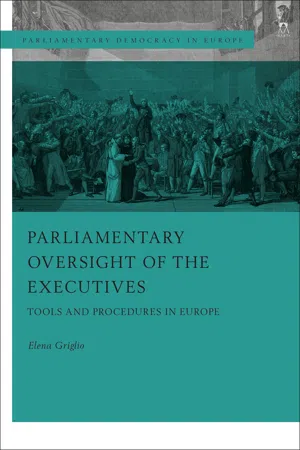
Oversight of executives has always been a key function of parliaments and one that is central to developing the relationship between the executive and legislative branches of government. However, in reality governments are taking a more pronounced role in controlling legislation, diluting the influence of parliament. This book plots this trend in parliaments across Europe, to illustrate points of convergence and divergence. In so doing, it suggest tools and methods that parliaments can develop to bolster their crucial oversight role.
Information
PART I
Constitutional Features of Parliamentary Oversight in Europe
1
Introduction: Oversight of the Executives. A European Approach
I.What Parliamentary Oversight Serves: In Search of a Definition
Oversight of the executives has always been a major function of parliaments.1 One of the fundamental tasks of representative assemblies according to liberal thought,2 parliamentary oversight has turned out to be one essential mechanism for limiting3 and, at the same time, sharing executive power. It is part of the wider sphere of constitutional controls whose aim is to keep government within its limits, prevent abuse of power and protect fundamental liberties.4 The settlement of parliamentary oversight offers an answer to the fundamental question, ‘Is power concentrated in the hands of a single power holder or state organ, or is it mutually shared and reciprocally controlled by several power holders or state organs?’.5 Oversight is closely intertwined with the principle of responsibility of governing bodies, but at the same time it is something more than a formal mechanism for implementing this doctrine.6 It is both the possibility to determine political decisions with the intimation or application of a serious penalty,7 and the positive act of participating in government action by influencing – persuading or dissuading – decision-making.8 It is therefore co-essential to the very notion of constitution.9
Placed at the heart of the relationship between the executive and the legislative powers, parliamentary oversight may come in many forms. There is no universal principle to identify the nature, scope, functioning and constitutional implications of the oversight function. This is an ever-changing prerogative, whose transformation is continuously being fostered by constitutional and political factors at both national and supranational level. At the beginning of the twenty-first century, the oversight function is considered to be a marker of parliaments’ relevance.10 Its potentialities are not always fully appreciated by MPs and yet oversight is deemed to have the potential of being an extremely powerful function. This trend is fostered by two parallel processes.
On the one hand, whereas law-making has long been perceived as the pivotal function of representative assemblies, legislation is increasingly being controlled by governments and the legislative room for manoeuvre left to parliaments is being reduced more and more.11 This situation fosters the idea that parliaments have become law-influencing legislatures12 rather than law-makers: at times, they seem to succeed better in influencing the decisions made by other authorities than in acting as fully-fledged legislators. On the other hand, in recent decades, the social claim for effective political oversight has grown stronger. Civil society is increasingly sceptical of the effectiveness of political oversight. However, both the parliament and the government often find little incentive to take the oversight demand seriously. As citizens are pushing for increased control on the conduct of politics and on its outcomes, this pressure leads parliaments to take counter-actions.13
In fact, ahead of these rather general trends, ‘personne ne sait très bien ce qu’est le contrôle’ (‘Nobody really knows what oversight is’).14 We not only lack a universal vision of the scope, purpose, nature and organisation of the oversight function. More radically, we also lack linguistic consistency in defining this prerogative. A large number of linguistic formulae, ranging from oversight to scrutiny, from control to supervision, from evaluation to monitoring, from surveillance to assessment, are currently used in the institutional and academic debate to define the privileged right of critique15 exercised by representative assemblies with regard to government bodies. Different stylistic options are similarly used in legal acts, including constitutions.16 These terms are often used as synonyms, although from a constitutional perspective they are not perfectly equivalent.
The two most recurring terms in the English language are the notions of oversight and scrutiny, which have been used to cover two rather distinct constitutional approaches, often referred to as presidential and parliamentary regimes respectively (see below chapter two, section II).17 The other terms can be considered either as generic variations (this is the case, inter alia, for the notions of supervision,18 surveillance, monitoring)19 or as sectorial implementations (this is the case for audit, applied to the budgetary sector, evaluation,20 referred to the evaluation of public policies and legislation, and assessment, developed in terms of ‘impact assessment’).
The reference to the notion of control21 is instead more equivocal; it is recurring in literature, but can be considered as an ‘imported’ notion. Its spreading is apparently explained by two parallel factors. On the one hand, this notion is semantically corresponding to the terms most diffused in other European languages: contrôle in France, kontrolle in Germany, controllo in Italy and control in Spain. On the other hand, it enables the oversight dimension to gain back a certain legalistic conception of the relationship between the controller and the controlled that is typical in the French contrôle.22 The etymological origins of the word contrôle derive from the contraction of two words, ‘contre’ and ‘rôle’, which, in its original meaning, referred to a double-entry bookkeeping where one entry is used to check the reliability of the other. It gives the idea of a check aimed at assessing the compliance to a model,23 thus including two opposite dimensions: verification and censure.24 This meaning has exercised a major influence on the Napoleonic tradition of administrative law, where the notion has been interpreted as a manifestation of power and authority (on this point, see below chapter two, sections I and V.A)25 and associated with Parliament’s capacity to enforce government responsibility.26 The multilinguistic approach enriches the multifaceted dimensions of parliamentary oversight, showing manifold ways of expressing this function. This is the case, inter alia, of the sindacato ispettivo (parliamentary inspection)27 or the control-fiscalización (supervision),28 respectively used in the Italian and Spanish parliamentary traditions to highlight the investigative/supervisory capacity of the legislative branch corresponding to the duty of the executive to reply, provide information, produce a document, and appear before Parliament.29
On the whole, this linguistic pluralism witnesses the proliferation of rather antithetic theoretical approaches to parliamentary oversight. This is often considered as a comprehensive power, the ‘quintessential’ parliamentary function,30 inclusive of the legislative interaction between the parliament and the government.31 Alternatively, it is seen as a residual domain, comprising all the non-legislative activities of Parliament – the so-called ‘other powers’ – like the censure of the executive or the budget-related powers.32 Oversight may be framed in the general legislative–executive relationship as to also include the processes of government formation and dismissal; or it can be specifically referred to the outcome of government activity, hence the formula of ‘legislative oversight’33 or ‘administrative oversight’,34 whose meaning and definition are often overlapping. The formula ‘legislative oversight’ is used by some scholars mostly referring to presidential systems and having regard to the review of law execution by the administration.35
The variety of linguistic and theoretical approaches confirms that there are many different ways of implementing this function, depending on a number of contextual factors. As a core function of the legislative–executive interaction, parliamentary oversight is a normative conception shared by all theories of democratic constitutionalism. However, there is not one universal constitutional standard for accomplishing this task.36
Presidential and parliamentary systems are specifically acknowledging two rather antithetic ways of fulfilling the same requirement of how to involve representative assemblies in the democratic control of executive business (see below chapter two, section II). The scope and extension of parliamentary oversight is one of the main criteria for distinguishing between the two regimes.37 Parliamentarism finds its constitutive feature in the executive authority’s ‘permanent’ dependence38 on the confidence scheme, so that the government emerges from and is responsible before the legislative authority.39 Under a parliamentary government, oversight of the executive discloses some apparent paradoxes. Whereas the confidence relationship calls the government to be as close as possible to Parliament, the oversight prerogative assumes that some distance is established between the controller and the controlled.40 The paradox is maximal in the case of constitutional arrangements of a Westminster type leading to the fusion of the executive and legislative branches in Parliament and to a one-party majority government supported by strong party discipline.41 Moreover, oversight can be both about monitoring and about overthrowing the executive.42 In this vein, the underlying question is what type of ‘oversight’ could possibly be exercised by the Parliament in regard to a body that, due to the confidence relationship, is by definition an expression of its own majority.43 It is this question, strictly referred to parliamentary democracies, that the monograph addresses.
To answer this question, it is necessary to investigate the distinctive nature of the oversight dynamics as a relational mechanism of a political nature. This task clearly exceeds the pure constitutional legal analysis. The constitutional law of parliamen...
Table of contents
- Cover
- Title Page
- Table of Contents
- PART I: CONSTITUTIONAL FEATURES OF PARLIAMENTARY OVERSIGHT IN EUROPE
- PART II: INSTANCES OF PARLIAMENTARY OVERSIGHT IN SECTORIAL POLICY FIELDS
- Bibliography
- Index
- Copyright Page
Trusted by 375,005 students
Access to over 1.5 million titles for a fair monthly price.
Study more efficiently using our study tools.
Frequently asked questions
Yes, you can cancel anytime from the Subscription tab in your account settings on the Perlego website. Your subscription will stay active until the end of your current billing period. Learn how to cancel your subscription
No, books cannot be downloaded as external files, such as PDFs, for use outside of Perlego. However, you can download books within the Perlego app for offline reading on mobile or tablet. Learn how to download books offline
Perlego offers two plans: Essential and Complete
- Essential is ideal for learners and professionals who enjoy exploring a wide range of subjects. Access the Essential Library with 800,000+ trusted titles and best-sellers across business, personal growth, and the humanities. Includes unlimited reading time and Standard Read Aloud voice.
- Complete: Perfect for advanced learners and researchers needing full, unrestricted access. Unlock 1.5M+ books across hundreds of subjects, including academic and specialized titles. The Complete Plan also includes advanced features like Premium Read Aloud and Research Assistant.
We are an online textbook subscription service, where you can get access to an entire online library for less than the price of a single book per month. With over 1.5 million books across 990+ topics, we’ve got you covered! Learn about our mission
Look out for the read-aloud symbol on your next book to see if you can listen to it. The read-aloud tool reads text aloud for you, highlighting the text as it is being read. You can pause it, speed it up and slow it down. Learn more about Read Aloud
Yes! You can use the Perlego app on both iOS and Android devices to read anytime, anywhere — even offline. Perfect for commutes or when you’re on the go.
Please note we cannot support devices running on iOS 13 and Android 7 or earlier. Learn more about using the app
Please note we cannot support devices running on iOS 13 and Android 7 or earlier. Learn more about using the app
Yes, you can access Parliamentary Oversight of the Executives by Elena Griglio in PDF and/or ePUB format, as well as other popular books in Law & International Law. We have over 1.5 million books available in our catalogue for you to explore.