Fully revised and updated, this new second edition of Knitwear provides an invaluable introduction to the use of knitwear in fashion design. The book delves into the characteristics and behavior of many varieties of yarn and fiber, from traditional to contemporary, providing easy-to-follow diagrams, practical examples, and rich illustrations throughout. Knitwear provides an insider's perspective into the knitwear industry and offers vital need-to-know information to readers on various career pathways, while highlighting contemporary machinery and tools available to knitwear designers today, demonstrating how to create knitting patterns, and laying out the basic techniques used on domestic machines. Interviews with international designers, operating at different levels within the industry, provide further insight into the business of knitwear, and how to get a good head-start into the industry. A must-have handbook for the knitwear designer, Knitwear is a beautiful and indispensable guide to this growing area of the fashion industry.
- 208 pages
- English
- ePUB (mobile friendly)
- Available on iOS & Android
eBook - ePub
About this book
Information
1
Approach to knit
In order to take a fresh look at knitting, and at ideas that are normally taken for granted, we should first understand historically how these techniques came about and consider the classic, timeless designs as significant and creative starting points for further design development. Hand-knitting skills and patterns have long been passed from generation to generation, allowing a greater understanding and acknowledgement of knitting as an intellectual, artistic tradition. A growing number of new and exciting designers are graduating each year from fashion and textile courses, and by comparing their designs with the work from the early knitters, a story starts to emerge.
This chapter offers an introduction to knit and knitwear design, comparing traditional knitting techniques with their modern reinventions. It looks at the characteristics and behaviour of different yarns and fibres, from the traditional to the contemporary, such as metallic, steel and plastic. It offers an overview of knitting machines and tools and the different aspects of work that can be produced. Finally, it looks at how developments in design and technology are radically reinventing this traditional craft.
‘It is a freedom to be able to make your own fabric while working. For me it is the absolute challenge.’
Sandra Backlund
Reinventing traditional knitting
Developments in technology enable new ways of creating knitwear and knitted textiles, but many students and designers are looking to traditional techniques for inspiration to merge with contemporary ideas. Designers are capitalizing on the unique qualities that knit has to offer, pushing boundaries with unusual yarns and materials and playing with scale. There is a natural interplay between craft, design and new technology. We will look at some of these traditional knits – fishermen’s ganseys or guernseys, Aran cables, Fair Isle and lace – and explore their modern reinventions.
A brief history
Wool fabric has protected us since the very early days, and people may well have knitted, using only the fingers, as long ago as 1000 BCE. Techniques using circular peg frames, similar to French bobbin knitting, were also probably practised alongside hand pin knitting.
1.2
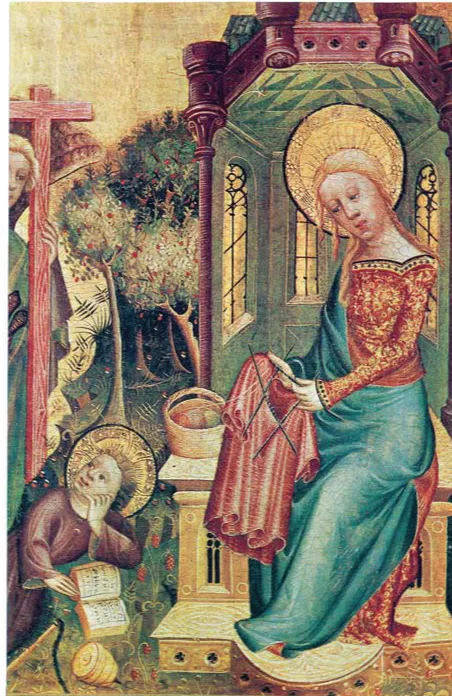
Visit of the Angel, known more commonly as the Knitting Madonna, by Master Bertram of Minden, 1400–10.
There are various European paintings that portray the Virgin Mary knitting, providing evidence that knitting was practised as early as the fourteenth century. Shown here is Master Bertram’s painting of the Madonna, who is seen knitting Christ’s seamless garment on four needles. Hand-knitting was commonplace in medieval Europe, and the production of caps, gloves and socks was an important industry.
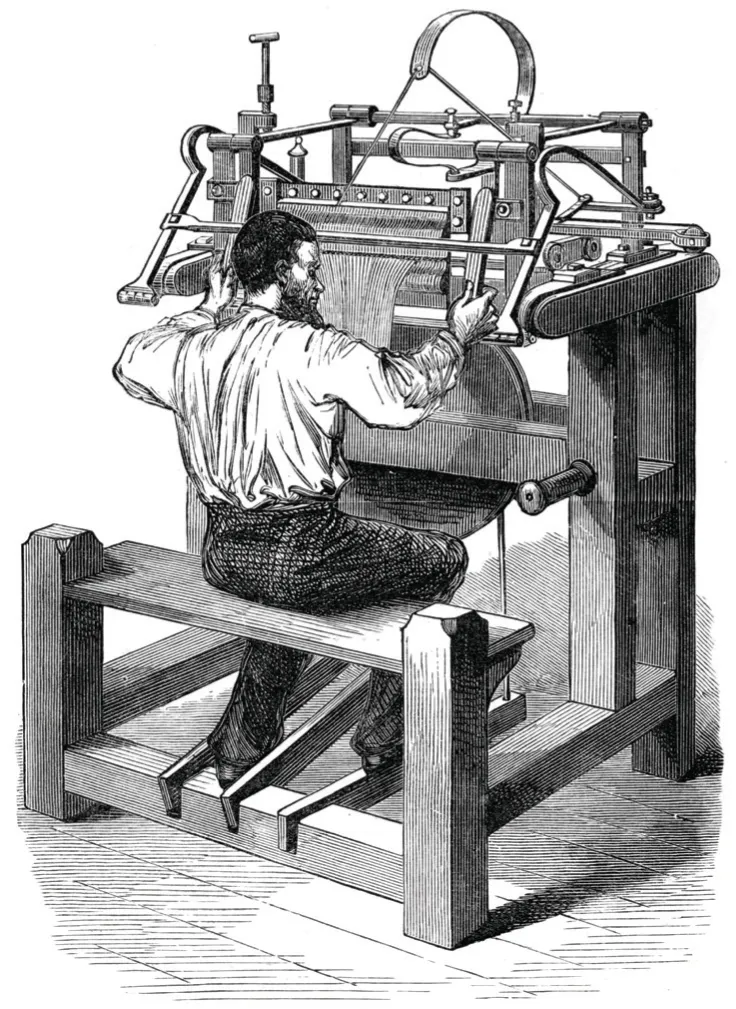
In 1589, the Reverend William Lee invented the stocking knitting frame, which was to revolutionize the knitwear trade. Initially created for use with the short, fine sheep’s wool from Sherwood Forest, this first machine produced coarse knitting for peasant hose. Lee was unsuccessful in promoting the frame; Queen Elizabeth refused the patent because she feared that it would jeopardize the hand-knitting industry. Lee then developed the frame to be used with silk: the original machines had eight needles per inch; this new machine was thought to have twenty needles per inch, and it was perfect for making expensive, fancy stockings. The English were still not interested, and Lee took the frame to France, where the machine eventually proved to be successful. By the end of the seventeenth century, it was in increasingly extensive use across Europe. Knitting had become faster, because now, instead of knitting one stitch at a time, whole rows could be knitted at once. The machine was gradually refined further, and by the eighteenth century, the idea of knitting holes opened up new scope for design. By the late nineteenth century, the knitwear industry was huge; new innovations in technology paved the way for the straight bar, flat frame.
1.3
The framework knitting machine was invented by William Lee in 1589.
Jerseys and guernseys
Jerseys and guernseys originate from the Channel Islands, just off the north coast of France. These fishermen’s garments were hard-wearing, comfortable and warm; they were knitted in oiled wool with a tight stitch and could resist rain and sea spray. Original jerseys and guernseys were dark blue, almost black in colour, and were knitted in the round, using four or more needles, in order to secure a seamless garment.
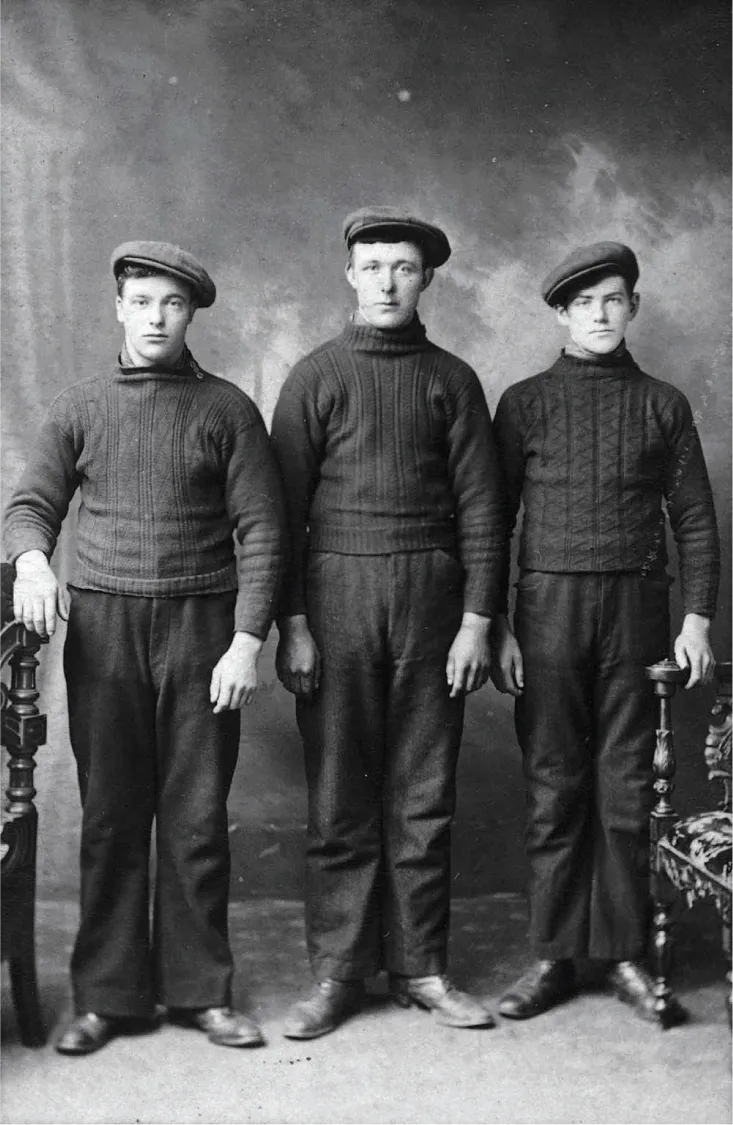
Designs were often knitted in banded patterns, sometimes displaying different textures between the bands. Thanks to the opening up of trade routes in the seventeenth century, these garments soon became the fisherman’s staple around the UK, where they were adapted with new patterns and textures (and are often referred to elsewhere as ‘ganseys’). Stitches were passed down from generation to generation. The wealth of pattern in the stitches gave great scope for individual design. These garments were cherished, looked after, mended and often handed down. It is thought that a fisherman who died at sea could be identified by the handiwork of his guernsey.
1.4
Shetland fishermen wearing individually patterned hand-knitted ganseys in worsted yarn, circa 1900.
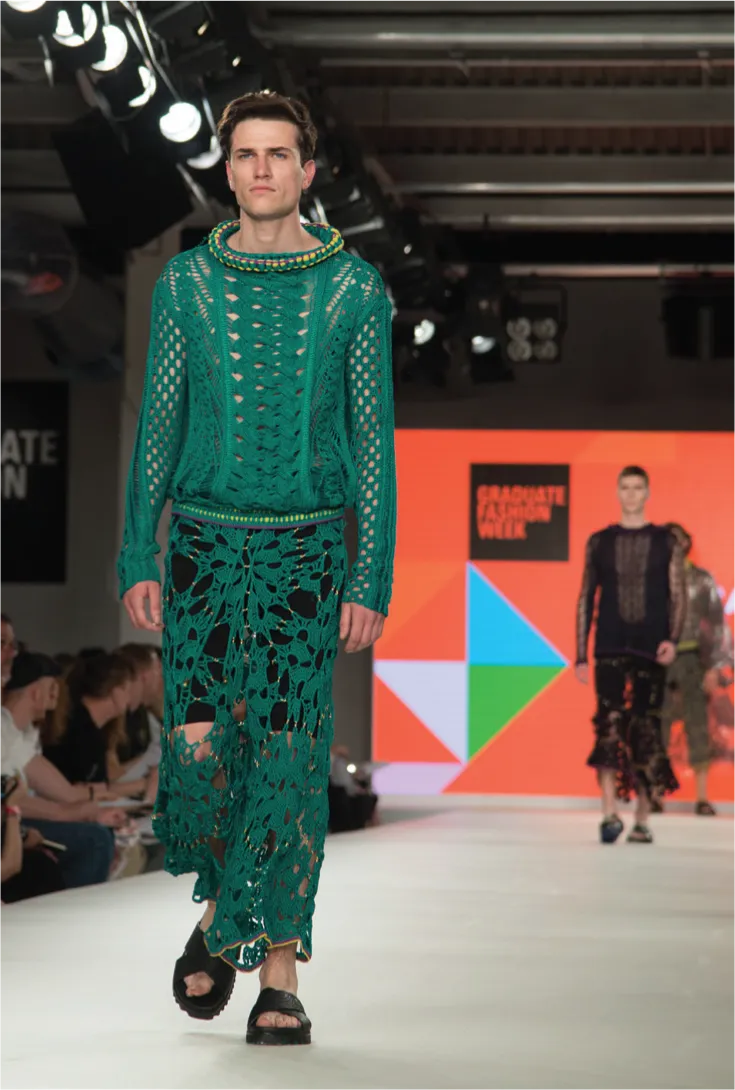
1.5
Knitwear design by Graduate Fashion Week Winner 2016, Kendall Baker. Knitwear collection explored a variety of cable designs for menswear.
Aran
The Aran Islands are located off the west coast of Ireland. Most historians agree that the Aran jumper is a relatively recent invention. The Irish government set up an initiative in the 1890s to encourage poorer families to weave and knit garments to sell.
The garments were originally knitted in thick, untreated wool, which retained its natural oils; they were mostly cream, but sometimes black, in colour. An Aran knit is heavily patterned with closely knitted cables, honeycombs, diamonds and lattice effects; it quite often displays different patterning on the front and back. The basis of many Aran patterns is the simple cable, a twisted rope design, which consists of a certain number of stitches that are divided so they can be twisted around each other. A typical Aran design consists of a centre panel with two side panels and cable stitches. The knitter uses tools to move one stitch or a group of stitches over or behind another.
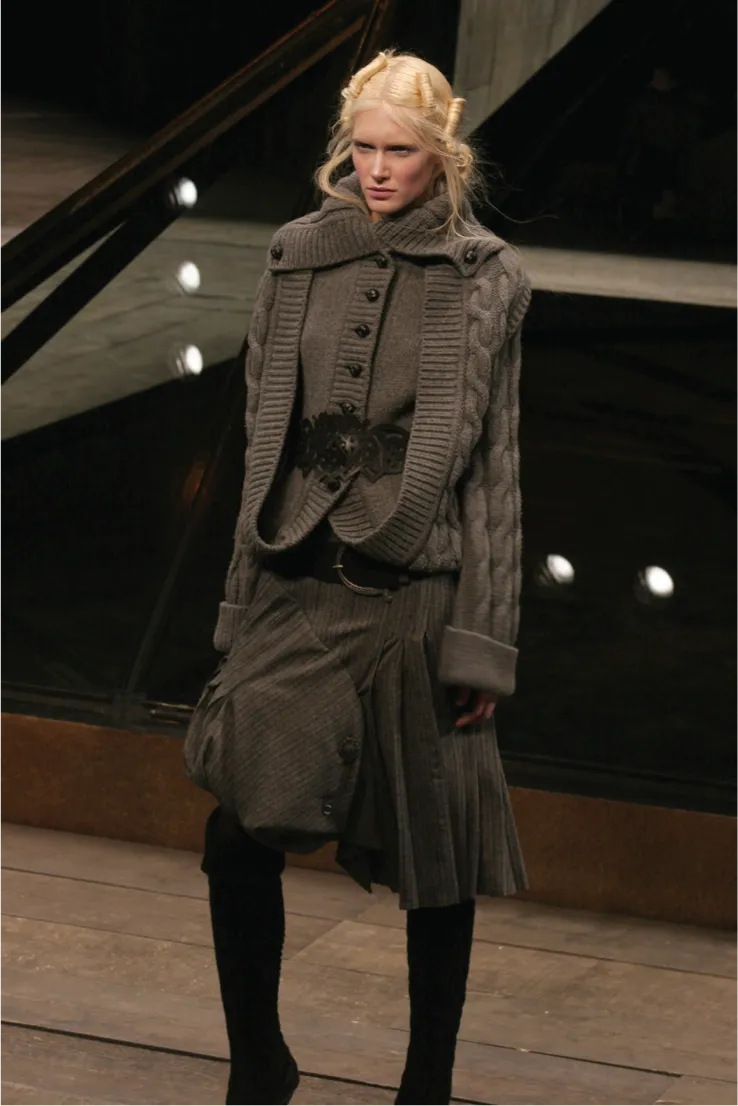
1.6
Modern interpretation of the traditional Aran kni...
Table of contents
- Cover
- Title Page
- Contents
- Foreword
- Introduction
- 1 Approach to knit
- 2 Creative development
- 3 Construction through pattern and texture
- 4 Construction through shape
- 5 Details and trims
- 6 Practitioners in context: menswear
- Conclusion
- Glossary
- Index
- Acknowledgements and picture credits
- eCopyright
Trusted by 375,005 students
Access to over 1.5 million titles for a fair monthly price.
Study more efficiently using our study tools.
Frequently asked questions
Yes, you can cancel anytime from the Subscription tab in your account settings on the Perlego website. Your subscription will stay active until the end of your current billing period. Learn how to cancel your subscription
No, books cannot be downloaded as external files, such as PDFs, for use outside of Perlego. However, you can download books within the Perlego app for offline reading on mobile or tablet. Learn how to download books offline
We are an online textbook subscription service, where you can get access to an entire online library for less than the price of a single book per month. With over 1.5 million books across 990+ topics, we’ve got you covered! Learn about our mission
Look out for the read-aloud symbol on your next book to see if you can listen to it. The read-aloud tool reads text aloud for you, highlighting the text as it is being read. You can pause it, speed it up and slow it down. Learn more about Read Aloud
Yes! You can use the Perlego app on both iOS and Android devices to read anytime, anywhere — even offline. Perfect for commutes or when you’re on the go.
Please note we cannot support devices running on iOS 13 and Android 7 or earlier. Learn more about using the app
Please note we cannot support devices running on iOS 13 and Android 7 or earlier. Learn more about using the app
Yes, you can access Knitwear by Juliana Sissons in PDF and/or ePUB format, as well as other popular books in Design & Fashion Design. We have over 1.5 million books available in our catalogue for you to explore.