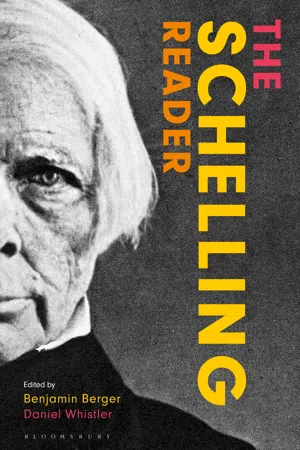
F.W.J. Schelling (1775-1854) stands alongside J.G. Fichte and G.W.F. Hegel as one of the great philosophers of the German idealist tradition. The Schelling Reader introduces students to Schelling's philosophy by guiding them through the first ever English-language anthology of his key texts-an anthology which showcases the vast array of his interests and concerns (metaphysics, epistemology, philosophy of nature, ethics, aesthetics, philosophy of religion and mythology, and political philosophy). The reader includes the most important passages from all of Schelling's major works as well as lesser-known yet illuminating lectures and essays, revealing a philosopher rigorously and boldly grappling with some of the most difficult philosophical problems for over six decades, and constantly modifying and correcting his earlier thought in light of new insights.
Schelling's evolving philosophies have often presented formidable challenges to the teaching of his thought. For the first time, The Schelling Reader arranges readings from his work thematically, so as to bring to the fore the basic continuity in his trajectory, as well as the varied ways he tackles perennial problems. Each of the twelve chapters includes sustained readings that span the whole of Schelling's career, along with explanatory notes and an editorial introduction that introduces the main themes, arguments, and questions at stake in the text. The Editors' Introduction to the volume as a whole also provides important details on the context of Schelling's life and work to help students effectively engage with the material.
- 440 pages
- English
- ePUB (mobile friendly)
- Available on iOS & Android
eBook - ePub
The Schelling Reader
About this book
Information
Part I
Metaphysics
1
The unconditioned
Introduction
One reason Schelling – like Spinoza before him – is a difficult philosopher to begin reading is that, from the outset, many of his writings throw the reader straight into discussions of the fundamental structures of reality, immersing us in the subtlest of metaphysical questions without prologue or apology. Schelling, that is, reverses the modern priority given to epistemological and methodological concerns: he holds that metaphysics is first philosophy, which means studying him demands that we bracket any presupposition that metaphysical enquiry must be preceded by epistemological justification, such as the Cartesian method of doubt or the Hegelian phenomenology of consciousness. Therefore, although the first four chapters of this Reader - and the first chapter in particular - do include attention to some epistemological topics, they largely focus on Schelling’s understanding of reality itself.
In many of his texts, Schelling is primarily concerned with identifying an ‘absolute’ or ‘unconditioned’ principle at the heart of his metaphysics – even if the meaning of this principle seems to change from one text to another. At different stages in Schelling’s thought, the ‘unconditioned’ is understood as an ‘I’, a natural process, a divinity immanent to the world, and something ‘beyond being’. But in each case, Schelling sees great importance in that which is unconditionally, i.e. that which conditions all things (Dinge) but is not itself conditioned (bedingt).
In fact, the metaphysical dualism between an unbedingt generative principle and that which it grounds – bedingt things in the empirical world – can be discerned in many of Schelling’s philosophical writings from the earliest text excerpted below (Of the I) well into his middle period (represented below by The Ages of the World). In all of these texts, however, metaphysical dualism is tempered by an emphasis on strict metaphysical unity (whether it is a unity already realized or still incomplete). It is for this reason that Schelling is often read as a philosopher of ‘the absolute’, a philosopher who posits one single, unifying principle as the ground – and, in some cases, totality – of all that exists. This is part of his ongoing negotiation with the scandal of pantheism: he continually traverses a path between a Parmenidean metaphysics of all-encompassing unity that dissolves all real distinctions and a pluralistic metaphysics attentive to the differences between various domains of being.
The final two extracts in this chapter look beyond the so-called ‘middle period’ to the metaphysics of Schelling’s late philosophy and, in particular, the ways in which the discourse of ‘unconditioned’, ‘absolute’ principles informs his interrelated projects of negative and positive philosophy. For instance, in his description of positive philosophy, the late Schelling radicalizes the search for a principle that is beyond the conditioned – beyond things, beyond products and beyond what is created – by setting up the task of philosophy as the quest for something so fully unconditioned that it is beyond thought itself. Metaphysics thereby becomes, in part, the attempt to think the unthinkable. (This means that, while Schelling is clearly involved in metaphysical speculation, he also finds himself working through methodological issues regarding the appropriate mode of access to the unconditioned, issues that will reappear in Chapter 6 of this volume.)
The following aims to guide the reader through five of the main ways that Schelling conceives the ‘unconditioned’: (i) as the absolute ‘I’ or self that grounds all knowledge (in the opening sections to the 1795 Of the I, Schelling’s first substantial published work); (ii) as natural productivity (in the opening passage to the 1799 First Outline of a System of the Philosophy of Nature, which Schelling envisaged as a textbook overview for students taking his lectures in Jena); (iii) as the immanent development of the natural-divine cosmos (in the opening section on ‘The Past’, i.e. the archaic grounds of creation, of the third fragmentary version of Schelling’s The Ages of the World, written in 1815); (iv) as that which conditions all conceivable determinations of being (from a lecture on the Presentation of the Purely Rational Philosophy, a course given in Berlin in approximately 1847); and (v) as the purely actual, transcendent creator of all that exists (in a late lecture entitled Alternative Deduction of the Principles of Positive Philosophy and delivered a couple of years earlier). A further way that Schelling conceives the unconditioned – namely, as the identity of self and nature, evident in texts from 1801 to 1806 – will be considered in Chapter 2.
Of the I as Principle of Philosophy (1795)*
§ 1
He who wants to know something, wants to know at the same time that what he knows is real. Knowledge without reality is not knowledge. What follows from that?
Either our knowledge has no reality at all and must be an eternal round of propositions, each dissolving in its opposite, a chaos in which no element can crystallize – or else there must be an ultimate point of reality on which everything depends, from which all firmness and all form of our knowledge springs, a point which sunders the elements, and which circumscribes for each of them the circle of its continuous effect in the universe of knowledge.
There must be something in which and through which everything that is reaches existence, everything that is being thought reaches reality, and thought itself reaches the form of unity and immutability. This something (as we can problematically call it for the time being) should be what completes all insights within the whole system of human knowledge, and it should reign –in the entire cosmos of our knowledge – as original ground of all reality.
If there is any genuine knowledge at all, there must be knowledge which I do not reach by way of some other knowledge, but through which alone all other knowledge is knowledge. In order to reach this last statement I do not have to presuppose some special kind of knowledge. If we know anything at all, we must be sure of at least one item of knowledge which we cannot reach through some other knowledge and which contains the real ground of all our knowledge.
This ultimate in human knowledge must therefore not search for its own real ground in something other. Not only is it itself independent of anything superior but, since our knowledge rises from any consequence to the reason thereof and in reverse descends from that reason to the consequence, that which is the ultimate and for us the principle of all knowledge cannot be known in turn through another principle. That is, the principle of its being and the principle of its being known must coincide, must be one, since it can be thought only because it itself is, not because there is something else. Therefore it must be thought simply because it is, and it must be because it itself is being thought, not because something else is thought. Its assertion must be contained in its thought; it must create itself through its being thought. If we had to think something else in order to reach its thought, then that other entity would be superior to the ultimate, which is a contradiction. In order to reach the ultimate I need nothing but the ultimate itself. The absolute can be given only by the absolute.
Now the investigation is becoming more definite. Originally I posited nothing but an ultimate ground of any real knowledge. Now this criterion that it must be the last absolute ground of knowledge permits us at the same time to establish its existence. The last ground for all reality is something that is thinkable only through itself, that is, it is thinkable only through its being; it is thought only inasmuch as it is. In short, the principle of being and thinking is one and the same. The question can now be expressed quite clearly and the investigation has a clue which can never fail.
§ 2
Knowledge which I can reach only through other knowledge is conditional. The chain of our knowledge goes from one conditional [piece of] knowledge to another. Either the whole has no stability, or one must be able to believe that this can go on ad infinitum, or else that there must be some ultimate point on which the whole depends. The latter, however, in regard to the principle of its being, must be the direct opposite of all that falls in the sphere of the conditioned, that is, it must be not only unconditional but altogether unconditionable.
All possible theories of the unconditional must be determinable a priori, once the only correct one has been found. As long as it has not been established, one must follow the empirical progress of philosophy. Whether that progress contains all possible theories will be seen only at the end.
As soon as philosophy begins to be a science, it must at least assume an ultimate principle and, with it, something unconditional.
To look for the unconditional in an object, in a thing, cannot mean to look for it in the generic character of things, since it is evident that a genus cannot be something that is unconditional. Therefore it must mean to look for the unconditional in an absolute object which is neither genus nor species nor individual. (Principle of consummate dogmatism.)
Yet, whatever is a thing is at the same time an object of knowing, therefore a link in the chain of our knowledge. It falls into the sphere of the knowable. Consequently it cannot contain the basis for the reality of all knowledge and knowing. In order to reach an object as object I must already have another object with which it can be contrasted, and if the principle of all knowledge were lying in an object I would in turn have to have a new principle in order to find that ostensibly ultimate principle.
Moreover, the unconditional (by § 1) should realize itself, create itself through its own thought; the principle of its being and its thinking should coincide. But no object ever realizes itself. In order to reach the existence of an object I must go beyond the mere concept of the object. Its existence is not a part of its reality. I can think its reality without positing it as existing. Suppose, for instance, that God, insofar as some define Him as an object, were the ground of the reality of our knowledge; then, insofar as He is an object, He would fall into the sphere of our knowledge; therefore He could not be for us the ultimate point on which the whole sphere depends. Also the question is not what God is for Himself, but what He is for us in regard to our knowledge. Even if we let God be the ground of the reality of His own knowledge, He is still not the ground of ours, because for us He is an object, which presupposes some reason in the chain of our knowledge that could determine His necessity for our knowledge.
The object as such never determines its own necessity, simply because and insofar as it is an object. For it is object only inasmuch as it is determined by something else. Indeed, inasmuch as it is an object it presupposes something in regard to which it is an object, that is, a subject.
For the time being, I call subject that which is determinable only by contrast with but also in relation to a previously posited object. Object is that which is determinable only in contrast with but also in relation to a subject. Thus, in the first place, the object as such cannot be the unconditional at all, because it necessarily presupposes a subject which determines the object’s existence by going beyond the sphere of merely thinking the object. The next thought is to look for the unconditional in the object insofar as it is determined by the subject and is conceivable only in regard to the latter. Or, in the third place, since object necessarily presupposes subject, and subject object, the unconditional could be looked for in the subject, which is conditioned by the object and can be conceived only in relation to the object.
Still, this kind of endeavour to realize the unconditional carries a contradiction within itself, which is obvious at first glance. Since the subject is thinkable only in regard to an object, and the object only in regard to a subject, neither of them can contain the unconditional because both are conditioned reciprocally, both are equally unserviceable. Furthermore, in order to determine the relationship of the two, an ulterior reason for the determination must be presupposed, owing to which both are determined. For one cannot say that the subject alone determines the object because the subject is conceivable only in relationship to the object, and vice versa, and it would amount to the same if I were to treat as unconditional a subject determined by an object and an object determined by a subject. What is more, this kind of a subject as such is also determinable as an object, and for this reason the endeavour to turn the subject into an unconditional fails, as does the endeavour with an absolute object.
The question as to where the unconditional must be looked for becomes slowly clearer, owing to its inherent logic. At the outset I asked only in which specific object we could look for the unconditional, within the whole sphere of objects. Now it becomes clear that we must not look for it in the sphere of objects at all, nor even within the sphere of that subject which is also determinable as an object.
§ 3
The philosophically revealing formation of the languages, especially manifest in languages still well aware of their roots, is a veritable miracle worked by the mechanism of the human mind. Thus the word I have used casually thus far, the word bedingen, is an eminently striking term of which one can say that it contains almost the entire treasure of philosophical truth. Bedingen means the action by which anything becomes a thing (Ding). Bedingt (determined) is what has been turned into a thing. Thus it is clear at once that nothing can posit itself as a thing, and that an unconditional thing is a contradiction in terms. Unbedingt (unconditional) is what has not been turned into a thing, and what cannot at all become a thing.
The problem, therefore, which we must solve now changes into something more precise: to find something that cannot be thought of as a thing at all.
Consequently, the unconditional can lie neither in a thing as...
Table of contents
- Cover
- Halftitle Page
- Title Page
- Contents
- Preface and acknowledgements
- Introduction to the Reader: The life and thought of F.W.J. Schelling
- Part I Metaphysics
- Part II Philosophical methods
- Part III The ideal world
- Index
- Imprint
Trusted by 375,005 students
Access to over 1.5 million titles for a fair monthly price.
Study more efficiently using our study tools.
Frequently asked questions
Yes, you can cancel anytime from the Subscription tab in your account settings on the Perlego website. Your subscription will stay active until the end of your current billing period. Learn how to cancel your subscription
No, books cannot be downloaded as external files, such as PDFs, for use outside of Perlego. However, you can download books within the Perlego app for offline reading on mobile or tablet. Learn how to download books offline
Perlego offers two plans: Essential and Complete
- Essential is ideal for learners and professionals who enjoy exploring a wide range of subjects. Access the Essential Library with 800,000+ trusted titles and best-sellers across business, personal growth, and the humanities. Includes unlimited reading time and Standard Read Aloud voice.
- Complete: Perfect for advanced learners and researchers needing full, unrestricted access. Unlock 1.5M+ books across hundreds of subjects, including academic and specialized titles. The Complete Plan also includes advanced features like Premium Read Aloud and Research Assistant.
We are an online textbook subscription service, where you can get access to an entire online library for less than the price of a single book per month. With over 1.5 million books across 990+ topics, we’ve got you covered! Learn about our mission
Look out for the read-aloud symbol on your next book to see if you can listen to it. The read-aloud tool reads text aloud for you, highlighting the text as it is being read. You can pause it, speed it up and slow it down. Learn more about Read Aloud
Yes! You can use the Perlego app on both iOS and Android devices to read anytime, anywhere — even offline. Perfect for commutes or when you’re on the go.
Please note we cannot support devices running on iOS 13 and Android 7 or earlier. Learn more about using the app
Please note we cannot support devices running on iOS 13 and Android 7 or earlier. Learn more about using the app
Yes, you can access The Schelling Reader by Daniel Whistler, Benjamin Berger, Daniel Whistler,Benjamin Berger in PDF and/or ePUB format, as well as other popular books in Philosophy & Aesthetics in Philosophy. We have over 1.5 million books available in our catalogue for you to explore.