This book provides a bold examination of the political use of history in contemporary Russia. Anton Weiss-Wendt argues that history is yet another discipline misappropriated by the Kremlin for the purpose of rallying the population. He explains how, since the pro-democracy protests in 2011–12, the Russian government has hamstrung independent research and aligned state institutions in the promotion of militant patriotism. The entire state machinery has been mobilized to construe a single, glorious historical narrative with the focus on Soviet victory over Nazi Germany.
Putin's Russia and the Falsification of History examines the intricate networks in Russia that engage in "historymaking." Whether it is the Holocaust or Soviet mass terror, Tsars or Stalin, the regime promotes a syncretic interpretation of Russian history that supports the notion of a strong state and authoritarian rule. That interpretation finds its way into new monuments, exhibitions, and quasi-professional associations. In addition to administrative measures of control, the Russian state has been using the penal code to censor critical perspectives on history, typically advanced by individuals who also happen to call for a political change in Russia.
This powerful book shows how history is increasingly becoming an element of political technology in Russia, with the systematic destruction of independent institutions setting the very future of History as an academic discipline in Russia in doubt.
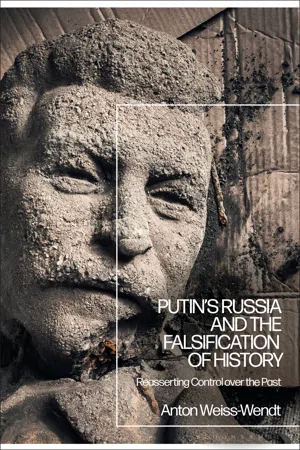
eBook - ePub
Putin’s Russia and the Falsification of History
Reasserting Control over the Past
- 336 pages
- English
- ePUB (mobile friendly)
- Available on iOS & Android
eBook - ePub
About this book
Information
1
A Geopolitical Meaning of History
In February of 2019, Nezavisimaia Gazeta carried an opinion piece by Vladislav Surkov, one of the architects of Putinism. Surkov is the right person to turn to in the discussion on whether Putin’s Russia possesses an ideology. He is the mastermind behind Putin’s 2000 election campaign, the creator of a pro-Kremlin youth group Nashi, and the author of the key concept sovereign democracy. A professed opponent of a civil society, Surkov claims the honor of shaping the “new Russian system.”1
Surkov is brutally honest in justifying the authoritarian form of rule superimposed on Russia, and he does it in the language of history. Indirectly comparing Putin to de Gaulle in France, Atatürk in Turkey, and the founding fathers in the United States, Surkov predicts a long life for the rejuvenated Russia. In his interpretation, the present period is the logical succession and extension of Moscovite Rus, the Russian Empire, and the Soviet Union. He sees “historical rationale” in reversing the “unnatural and ahistorical” collapse of the Soviet Union by means of rebuilding a strong Russia under Putin. Assuming the existence of the so-called deep state—a neologism that denotes a conspiratorial belief in the existence of dark forces that effectively run the country—Surkov proclaims it an uncomfortable reality. In rejecting the failed promise of democracy, Russia has no need for strong institutions, which is just a façade anyway, Surkov admits. To come on top in geopolitical battles of today, Russia unashamedly displays attributes of a police state. Here Surkov turns to his main thesis. The present form of governance, he insists, is inevitable as it is unique to Russia. That uniqueness manifests itself in boundless trust between President Putin and the Russians, whom Surkov has come to call “deep people.” If not the “good” tsar, the people of Russia have acquired the right ruler (pravilnyi pravitel) in the face of Putin. The idea of Putinism will outlive Putin—not unlike Marxism did Marx—and reign supreme for decades if not a century. Furthermore, Putinism has proven an attractive model also outside Russia, pinpoints Surkov.2 Political observers agree that without the go-ahead from Putin, the Surkov manifesto would not have been made public.3
Many an analyst has tried to explain the fundamentals of Putin’s rule in Russia. One of the concepts often aired is “mafia state.” US senator John Kennedy, who visited Moscow in July 2018 as part of the six-member delegation of the Republican lawmakers, evoked it too. Talking to reporters, Kennedy stated: “There is no political philosophy in Russia. It’s sort of like saying what’s the political philosophy of the mafia. Their philosophy is money and power. That’s the philosophy of Putin. He rules with an iron hand. He’s a dictator. You cannot trust Putin.” Political scientist Alexander Morozov, who provided a commentary on the senator’s visit, described Kremlin’s policy vis-à-vis the West as “total trolling.” That policy includes hacker attacks, a propaganda outlet Russia Today, courting far-left and far-right European politicians, and so on. However, policymaking elite as such is never homogenous, which translates into a power struggle between different agencies and individuals who vie for Putin’s attention. That explains numerous contradictions, though not momentous perhaps, that had underlined certain Russian policies.4 To the conduits of the key concepts inferred earlier—paternalism and kleptocracy, quasi-decentralization and post-ideology—I am adding one more, historymaking.
As far as history politics in Russia are concerned, one may identify two major upturns: as a reaction to the so-called color revolutions in the mid-2000s and a response to the pro-democracy protests of 2011–12. The latter period is characterized by institutionalization and a dramatic increase in state financing. The past six years have also seen a tendency toward standardization of historical interpretations by means of restrictive legislation. Since the history of Russia is typically taught as political history, anything that falls outside of the established dogma automatically becomes a “falsification.” Such a Manichean approach interprets history (i.e., alleged attempts at falsification) from the perspective of national security, as manifested in the 2015 redaction of the Russian national security program. Ultimately, the reading of history in Russia has assumed a utilitarian function of framing the current political setup.5
The politicization of history in contemporary Russia is one of the core themes in a comprehensive report, “What Kind of History Does the Future of Russia Need,” prepared in 2016 by Free Historical Society (VIO).6 VIO proceeds from the assumption that history in Russia has become a substitute arena for airing one’s ideolog ical and political beliefs. References to “glorious past,” in the absence of any current, tangible achievements, aim to rally the population behind the present regime. Building upon the nineteenth-century historiographical tradition, the history of Russia appears as a sequence of empires—with Gorbachev’s Perestroika and Yeltsin’s “raunchy 1990s” (likhie devianostye) as an unfortunate interruption. Many an element in the present Russian historymaking takes from the Soviet model, including veneration of particular events and individuals, a top-down perspective, and militarization of history. Other conceptual borrowings include a linear interpretation of history and the centrality of (Soviet) Russia in world affairs. VIO traces the emergence of the cult of the past in Russia to 2011, and compares it with the inculcation of historical themes into Stalinist ideology in the 1930s. In both cases, one may draw a connection between the revival of state interest in history and the foreboding of cataclysm. There are also marked differences between how history was taught in the Soviet Union and in present-day Russia. Such notions as rebellious people and freedom fighters, present in the Soviet historiography, have been replaced with that of obedience to authority. Anything related to a revolutionary liberation movement, including Vladimir Lenin and the Bolshevik takeover, gets automatically associated with “color revolutions” of the past decades. Extolling each and every ruler in Russian history, on the other hand, serves the singular goal of legitimizing the Putin regime. The social contract between the state and its subjects may be framed as political loyalty versus pride in the thousand-year history of Russia. The image of a paternalistic state by default cannot incorporate mass violence that was perpetrated in the name of that state. Even though the glorification of Soviet victory in the Second World War per se does not cancel out Stalin’s terror, it superimposes a dichotomy. Insofar as the regime poses as the guardian of Great Victory, criticizing the former amounts to questioning the latter. Showing the dark side of Russian history invites the accusation of “deforming historical memory.” It may even fall into the category of “falsification of history,” allegedly pursued as part of the hybrid warfare against Russia.7
One of the report’s coauthors, Nikita Sokolov, volunteered an allegory of Russian history as promoted by the state:
One gets the idea that Russia from time immemorial has been a besieged fortress, and that all of its limited resources should be entrusted to the chief commander, who will make decisions singlehandedly. Democracy is impossible, indeed harmful, due to a war situation. . . . All those who disagree become the “fifth column” and “national traitors.”8
A Declaration of War
This type of philosophy of history began crystallizing during Putin’s second presidential term. The first documented attempt to conceptualize the “falsification of history” occurred in 2005. Following the 2004 spat between the Russian and Latvian Foreign Ministries over the Latvian Waffen SS Division, and a subsequent Russian-sponsored resolution in the UN Commission on Human Rights on a related subject, the Duma, on May 27, 2005, issued a statement, “On Attempts at Falsification of History” (for details see Chapter 6). Aiming at domestic audiences, the Russian parliamentarians used street language to nail their counterparts in the Baltic States and Poland. They insisted that holding the Soviet Union co-responsible for the outbreak of the Second World War was immoral and asking present-day Russia to repent for military occupation cynical. By raising compensation claims, the East Europeans sought to paint themselves as an afflicted and humiliated side in the eyes of the Big (West European) Brother. Duma deputies semi-acknowledged that the “smaller nations” had suffered at the hands of both Stalin’s Russia and Hitler’s Germany, but at that very instant inserted a disclaimer: the fact of incorporation into the Soviet Union safeguarded the Baltic States against obliteration by the Nazis. Hence, the path to Baltic independence in 1991 began on May 9, 1945. The statement ended with a warning against the resurgence of fascism and racial discrimination, and a strong advice to European politicians to avoid “burdening with history a difficult path to the future of the entire European continent.” In the opposite case, the Russian lawmakers issued a dark prophecy: the emerging barriers would breed mistrust, fear, and eventually an urge to rearm.9
After a few years’ hiatus, the issue of history falsification was picked up by Sergei Shoigu, then head of the Ministry of Emergency Situations. In February 2009 Shoigu weighed in by proposing to criminalize the denial of the Soviet victory in the Second World War. In his view, that would bar leaders of certain (read: East European) countries from entering Russia and make mayors of certain (read: Baltic) cities pause before dismantling monuments to the Soviet soldier. Taking cues from the laws against Holocaust denial passed in a number of European countries, Shoigu thought of his proposal as a means of “defending history and the heroism of our fathers and forefathers.”10 Endorsed by Prosecutor General Yuri Chaika, Shoigu’s idea was expanded upon by his fellow parliamentarians for the United Russia Party. In the spring of 2009 the ruling party proposed an amendment to the Russian penal code that would make punishable deliberate misinterpretation of the 1946 Nuremberg judgment undertaken for the purpose of whitewashing Nazism. All those who identified members of the anti-German coalition as offenders (i.e., territorial acquisitions by the Soviet Union in accordance with the Secret Protocol to the 1939 Molotov–Ribbentrop Pact) would face a hefty fine and imprisonment for up to three years. This legislative initiative did enjoy popular support, as reported by a state pollster, VTsIOM. Back then, some 60 percent of the respondents—especially people over sixty—backed the proposal to criminalize the said offenses in one form or another. Legal experts, however, remained cold: no one was denying the Soviet contribution to victory over Nazi Germany and/or the Nuremberg verdict per se.11 In May 2009 Duma’s Legal Committee approved of the draft law, but then the process stalled.12
The first comprehensive effort by the Russian state to corral history came in the shape of a Commission to Counteract Attempts to Harm Russia’s Interests by Falsifying History, established by President Dmitry Medvedev on May 15, 2009. Although state officials had explicitly denied a link to the proposed draft law, the establishment of the commission does appear as a stopgap measure. Presidential decree no. 549—which was not immediately made public—spoke of the deliberate falsification of historical facts and events for the purpose of belittling Russia’s international prestige. The commission was expected to analyze alleged attempts at falsification and come up with counterproposals. Coordination would proceed mainly on the federal and regional levels, which reflected in the commission’s makeup. Chaired by Sergei Naryshkin, head of the Presidential Administration and a former KGB operative, the commission was comprised primarily of high-level state bureaucrats. The few professional historians among its twenty-eight members—Natalia Narochnitskaia, president of the Historical Perspective Foundation; Vladimir Kozlov, head of the Federal Archival Agency; Andrei Sakharov, head of the Institute of Russian History of the Academy of Sciences; and Alexander Chubarian, head of the Institute of World History within the same institution—took part in the proceedings mainly pro forma.13
Shortly after the commission came into existence, academic Valery Tishkov sent a circular letter to the heads of history sections within the Academy of Sciences. The letter requested an annotated list of historical falsifications, and the names of the scholars in each respective institute dealing with this issue. When asked point-blank what a falsification of history entails and if certain falsifications may actually work in Russia’s favor, Tishkov became fidgety.14 Naryshkin meanwhile explained that the commission would only have supervisory functions, nothing like forcing historians to draw politically correct conclusions in their research. Rather, it was supposed to bring together historians capable of systematizing the evidence of the falsification of Russian/Soviet history. In his view, Russia was merely replicating a trend he had observed in the case of the political elites of neighboring states. Instead of building a dialog with Russia, he argued, the latter were advancing all sorts of claims against it.15 Particularly unnerving proved the financial compensation claims (e.g., by Lithuania to the tune of up to USD 834 billion).16 Naryshkin primarily had in mind the three Baltic States, each of which in the fall of 1998 set up a historical commission tasked with establishing the facts and determining the legal status of both Nazi and Soviet occupation. This was interpreted as belittling the role of the Soviet Union, and by extension Russia, in the Second World War.
As Medvedev was clearing his office in anticipation of Putin’s resuming his duties as president, the work of the commission also came under review. Besides expediting retrieval of archival records, as deemed necessary by the participating agencies, the commission had achieved precious little in the three years it had existed. Organization and financing were found wanting; the commission met irregularly and did not efficiently publicize its work. Most important, no viable strategy on how to counter the purported falsification of history had emerged.17 The hope that a mere list of historical falsifications and their adepts would prove valuable reference material for scholars and state agencies alike did not come to fruition. A largely bureaucratic mode of operation, insufficient PR campaigning, and a rather symbolic contribution by professional historians and academic institutions—these factors contributed to the February 2012 decision to disband the commission.
Meanwhile, the 2009 legislative initiative to criminalize the “falsification of history” had fallen through, too. In January 2010, the government killed it by citing legal difficulties. Signed by Vice Prime Minister Sergei Sobianin, the document identified three major problems with the proposal. First, it was unclear what specific acts and which particular periods were meant by “allegations of crimes committed by member countries of the anti-Hitler coalition.” Second, it wondered how anyone could possibly twist the meaning of the Nuremberg judgment, since it had already acquired legal force. Third, it failed to identify the authorities that would deal with prospective criminal offenses, especially those that might have “undesirable foreign political consequences.” The “Shoigu Draft Law” received criticism even from pro-government historians such as Alexander Diukov, who regarded it as raw and difficult to implement.18
In short, during Medvedev’s interregnum, the “falsification of history” still remained on the level of a discourse. Coincidentally, the then Russian president, prime minister, and vice prime minister—all had law degrees and hence comprehended the difficulties involved in interpreting history through the prism of criminal law. A carefully choreographed castling in late 2011—as Putin and Medvedev exchanging positions had been dubbed in Russia—and the wave of public indignation that this news had caused made authorities go into extremes in hamstringing history, also by legal means. Putin and his new-old regime wanted history on their side.
Government Agencies Join Forces in the Fight against the Alleged Conspiracy
One of the central documents that expose the workings of Rus...
Table of contents
- Cover
- Half-Title
- Dedication
- Title
- Contents
- List of Figures
- Acknowledgments
- List of Acronyms
- Introduction
- 1 A Geopolitical Meaning of History
- 2 State Affiliates Manufacturing the “Historical Truth”
- 3 For Victory, For Stalin, For Putin!
- 4 Militant Patriotism
- 5 Monumental Mediocrity
- 6 Hijacking the Holocaust
- 7 Injustice of Historic Proportion
- Conclusion
- Notes
- Bibliography
- Index
- Copyright
Trusted by 375,005 students
Access to over 1.5 million titles for a fair monthly price.
Study more efficiently using our study tools.
Frequently asked questions
Yes, you can cancel anytime from the Subscription tab in your account settings on the Perlego website. Your subscription will stay active until the end of your current billing period. Learn how to cancel your subscription
No, books cannot be downloaded as external files, such as PDFs, for use outside of Perlego. However, you can download books within the Perlego app for offline reading on mobile or tablet. Learn how to download books offline
Perlego offers two plans: Essential and Complete
- Essential is ideal for learners and professionals who enjoy exploring a wide range of subjects. Access the Essential Library with 800,000+ trusted titles and best-sellers across business, personal growth, and the humanities. Includes unlimited reading time and Standard Read Aloud voice.
- Complete: Perfect for advanced learners and researchers needing full, unrestricted access. Unlock 1.5M+ books across hundreds of subjects, including academic and specialized titles. The Complete Plan also includes advanced features like Premium Read Aloud and Research Assistant.
We are an online textbook subscription service, where you can get access to an entire online library for less than the price of a single book per month. With over 1.5 million books across 990+ topics, we’ve got you covered! Learn about our mission
Look out for the read-aloud symbol on your next book to see if you can listen to it. The read-aloud tool reads text aloud for you, highlighting the text as it is being read. You can pause it, speed it up and slow it down. Learn more about Read Aloud
Yes! You can use the Perlego app on both iOS and Android devices to read anytime, anywhere — even offline. Perfect for commutes or when you’re on the go.
Please note we cannot support devices running on iOS 13 and Android 7 or earlier. Learn more about using the app
Please note we cannot support devices running on iOS 13 and Android 7 or earlier. Learn more about using the app
Yes, you can access Putin’s Russia and the Falsification of History by Anton Weiss-Wendt in PDF and/or ePUB format, as well as other popular books in History & Modern History. We have over 1.5 million books available in our catalogue for you to explore.