In Morality and Ethics of War, which includes a foreword by Major General Susan Coyle, ethicist Deane-Peter Baker goes beyond existing treatments of military ethics to address a fundamental problem: the yawning gap between the diverse moral frameworks defining personal identity on the one hand, and the professional military ethic on the other.
Baker argues that overcoming this chasm is essential to minimising the ethical risks that can lead to operational and strategic failure for military forces engaged in today's complex conflict environment. He contends that spanning the gap is vital in preventing moral injury from befalling the nation's uniformed servants. Drawing on a revised account of what he calls 'the Just War Continuum', Baker develops a bridging framework that combines conceptual clarity and rigour with insights from cutting edge psychological research and creates a practical means for military leaders to negotiate the moral chasm in military affairs.
eBook - ePub
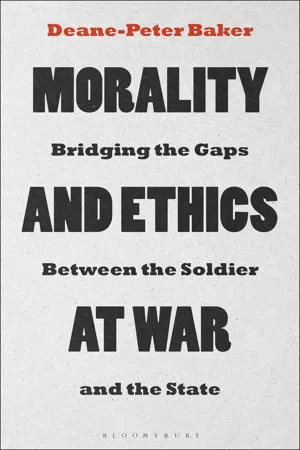
Morality and Ethics at War
Bridging the Gaps Between the Soldier and the State
- 224 pages
- English
- ePUB (mobile friendly)
- Available on iOS & Android
eBook - ePub
About this book
Information
1
Moral frameworks and identity
Soldiers, sailors, airmen and marines are, first and foremost, human beings. Even the prospect of ‘robot combatants’ (artificially intelligent autonomous weapons) coming soon to a battlefield near you is unlikely to ever render the humanity of military personnel irrelevant. And, while it is not common to talk about it, the sense of self of individual combatants is fundamental to the conduct of war. As ethicist Shannon French and neuroscientist Tony Jack write, ‘When we consider why troops have often been unwilling or unable to shoot at the enemy, it is worth considering that they are indeed engaged in a form of self-defense: their unconscious motivation is not so much to protect the integrity of their bodies but rather the integrity of their sense of self’ (French and Jack 2015, 178). My central claim in this book is that there is a critical gap between the moral identity of the individual who dons uniform in service of the state, on the one hand, and the ethics of war at the level of the state, on the other. To show that requires, as a first step, an exploration of the nature of personal moral identity – we must roll up our pant legs and wade into the daunting depths of philosophy.
Arguably the richest account of personal moral identity is that which has been put forward by the Canadian philosopher Charles Taylor, among the most influential philosophical thinkers of contemporary times. In what follows, I attempt to pull together the central features of Taylor’s account – as we shall see, they are the foundation on which the argument of this book rests.1 That said, however, it must be admitted that it is sometimes difficult to fix an exact definition of Taylor’s concepts. In this regard we must keep in mind C. Stephen Evans’s level-headed comment regarding his interpretation of the even more difficult to pin down work of Søren Kierkegaard, that ‘regardless of who is right on the question of interpretation, the more interesting question is whether or not a sound position can be salvaged (or reconstructed) from [the articulated] position’ (Evans 1988, 30).
While I have done my best to keep the discussion in this chapter as accessible as possible, some readers with less of a philosophical bent might find it a testing read. In that case, I encourage you to skip to the chapter’s conclusion, which summarizes the main points, and go on from there. I hope then, once you’ve gone through to the end of the book, you will come back to this chapter with an understanding of why its content is important, and with the determination to unpick the more challenging details.
First principles
In his book Charles Taylor: Meaning, Morals and Modernity, Nicholas H. Smith is perceptive in pointing out that the wide range of Taylor’s philosophy, for all its diversity, is nonetheless a unified philosophical project. At the heart of that project, Smith points out, is an insight Taylor gleaned from the work of Continental philosopher Maurice Merleau-Ponty (a critical early influence on Taylor), namely that ‘because we are in the world, we are condemned to meaning’ (Smith 2002, p. I; emphasis in original). ‘At the core of Taylor’s project is the conviction that human reality is structured, and in some sense constituted, by layers of meaning. This is the first principle of his philosophical anthropology’ (p. 18).
As noted, Taylor’s conviction regarding this central belief is derived at least in part from Merleau-Ponty, who applied what he called ‘the phenomenological method’, a method aimed at producing ‘an undistorted description of experience’ (Smith 2002, 26). The first principle of the method is the ‘phenomenological reduction’,2 the principle that ‘if we are to be genuinely open to the content of original experience, if we are to arrive at an undistorted or “pure” description of it, we have to be prepared to “bracket” or “suspend” the natural assumptions of ordinary reflection’ (p. 26). The phenomenological reduction enables us to discover a crucial principle of the nature of consciousness, the intentionality thesis. This, in broad terms, is the idea that consciousness is always consciousness ‘of’ something; it is inescapably directed. More than that, according to Taylor, phenomenologists claim that whatever has consciousness has ‘significance’: phenomenal objects take their place in a phenomenal field, to which they refer. ‘So, for instance, we perceive objects or events as “hiding” others or “bringing them into view”, as being “in front of” or “behind” other things, as “the beginning of” or “end of” some object or event. Such percepts refer to or “announce” other things that are not actual or present’ (p. 27). Another crucial factor of ‘the significance feature’ is that experience always relates to the purpose of the perceiver. ‘A phenomenal object will appear, for example, as “a means to” or “in the way of” an end desired by the perceiving subject. In this sense, perception is closely tied to the way in which perceivers are “at grips” with their environment. Perception is thus intimately connected to behaviour’ (p. 27).
The activity of knowing, for Taylor, cannot be separated from our coping with the world, a coping which depends on
an overall sense of ourselves and our world; which sense includes and is carried by a spectrum of rather different abilities: at one end, beliefs which we hold, which may or may not be ‘in our minds’ at the moment; at the other, abilities to get around and deal intelligently with things. Intellectualism has made us see these as very different sites; but philosophy in our day has shown how closely akin they are, and how interlinked. (Taylor 2000, 117)
One of the central aspects of our sense of ourselves, in Taylor’s account, is our sense of ourselves as intrinsically moral beings. It is this aspect that is central for our purposes here, and to which I therefore now turn.
Strong evaluations
Terry Pinkard points out that for Taylor agency is a normative matter, and to view it that way ‘is to grasp it in terms of its self-relation, a way of assuming a stance towards ourselves, a kind of self-conscious distance from ourselves, which realizes that even in our most straightforward and mindless dealings with things, we are never simply dealing with them in a way that bypasses our interpreting our encounter with them’ (Pinkard 2004, 192). For Taylor the sense of ourselves in relation with our world is at its base defined by what he calls ‘strong evaluations’. These are assessments of ourselves and others that are phenomenologically basic in the sense that they are ‘almost like instincts, comparable to our love of sweets, or our aversion to nauseous substances, or our fear of falling’ (Taylor 1989, 5). It is this almost visceral aspect of strong evaluations that gives them their phenomenological primacy, but it is a second part of their description that accounts for their importance. In this second respect, strong evaluations ‘seem to involve claims, implicit or explicit, about the nature and status of human beings. From this second side, a moral reaction is an assent to, an affirmation of, a given ontology of the human’ (p. 5). From this angle, strong evaluations are
discriminations of right or wrong, better or worse, higher or lower, which are not rendered valid by our own desires, inclinations, or choices, but rather stand independent of these and offer standards by which they can be judged. So while it may not be judged a moral lapse that I am living a life that is not really worthwhile or fulfilling, to describe me in these terms is nevertheless to condemn me in the name of a standard, independent of my own tastes and desires, which I ought to acknowledge. (Taylor 1989, 4)
We can, according to Taylor, recognize judgements of strong evaluation if, generally speaking, they invoke in us feelings of admiration or contempt. These moral intuitions are ‘uncommonly deep, powerful, and universal’ (Taylor 1989, 4).
It is important here to be clear on just what Taylor understands by the term ‘moral’. When Taylor speaks of morality, he paints with a broader brush than is today’s convention. He is not concerned merely with what Pincoffs calls ‘quandary ethics’, which is the idea that
the business of ethics is with ‘problems’, that is, situations in which it is difficult to know what one should do; that the ultimate beneficiary of ethical analysis is the person who, in one of these situations, seeks rational ground for the decision he must make, often conceived of as moral rules and the principles from which they can be derived. (Pincoffs 1983, 92–3; italics added)
Taylor is convinced that this approach is a dangerous narrowing of the area of morality.
For Taylor morality involves not merely what it is good to do, but also what it is good to be. It is here that Taylor’s debt to virtue-based accounts of morality is paramount. Morality is concerned with ‘what underlies our own dignity, or questions about what makes our lives meaningful or fulfilling’ (Taylor 1989, 4) in addition to the normal range of questions on justice, mutual respect and so on. Thus, to be moral by Taylor’s definition is not merely to do what is right, but rather to live the good or meaningful life.
Taylor contends that because we live in a world that places endless demands upon us, unless we are able to order our response to those demands in some non-arbitrary way, our lives simply cannot ‘make sense’. Certain issues must weigh more heavily than others for us, or else we are, in Taylor’s opinion, doomed to lives of incoherence. While strong evaluations enable us to identify what matters to us, they often conflict and on their own give no direction as to how to order our responses to the world. It is here that Taylor’s notion of moral frameworks comes into play.
Moral frameworks
Taylor believes that our identity – that which makes us who we are in a unique way – is dependent on our conception of ‘the good’, and it is this that defines the horizons in which we exist. Put another way, Taylor’s understanding of our sense of the self is as an orientation in moral space – indeed, the space metaphor is one of which Taylor is particularly fond and which he sees as having quite deep significance. Thus, when we feel moral outrage at a particular act of cruelty (for example) we are acting out of an orientation to a moral source, which, with other such sources, makes up a moral framework. For Taylor it is an inescapable part of our experience of being persons that we exist within a ‘space’ of moral questions, our answers to which are defined for each of us by a moral framework. As Taylor puts it, ‘a framework incorporates a crucial set of qualitative distinctions. To think, feel, judge within such a framework is to function with the sense that some action, or mode of life, or mode of feeling, is incomparably higher than the others which are more readily available to us’ (1989, 140).
In coming to an understanding of Taylor’s idea of moral frameworks, it is instructive to compare what he says about moral frameworks to what Merleau-Ponty (at least in Taylor’s reading) says about embodied agency. For Merleau-Ponty it is essential to personhood that we are embodied agents whose experience is defined by an ‘orientational structure’, while for Taylor it is essential to personhood that we are moral beings within a ‘moral framework’. In Merleau-Ponty’s vision,
Our perceptual field has an orientational structure, a foreground and a background, an up and down. And it must have; that is, it can’t lose this structure without ceasing to be a perceptual field in the full sense, our opening onto a world. In those rare moments where we lose orientation, we don’t know where we are; and we don’t know where or what things are either; we lose the thread of the world and our perceptual field is no longer our access to the world, but rather the confused debris into which our normal grasp on things crumbles. (Taylor 1978, 23)
The similarity of Taylor’s understanding of moral frameworks to Merleau-Ponty’s concept of an ‘orientational structure’ is clear when we compare the above to the following description of moral frameworks:
We naturally tend to talk of our fundamental orientation in terms of who we are. To lose this orientation, or not to have found it, is not to know who one is. And this orientation, once attained, defines where you answer from, hence our identity. But then what emerges from all this is that we think of this fundamental moral orientation as essential to being a human interlocutor, capable of answering for oneself. But to speak of orientation is to presuppose a space-analogue within which one finds one’s way. To understand our predicament in terms of finding or losing orientation in moral space is to take the space which our frameworks seek to define as ontologically basic. The issue is, through what framework-definition can I find my bearings in it? In other words, we take as basic that the human agent exists in a space of questions. And these are the questions to which our framework-definitions are answers, providing the horizon within which we know where we stand, and what meanings things have for us. (Taylor 1989, 29)
For Taylor, then, one’s framework is deeply entrenched and is indeed the very source and foundation of one’s self. So much so that to live without a framework and remain a person in any meaningful sense is inconceivable to Taylor. A person in this state would, in his view, experience a crisis of the utmost magnitude, the ultimate identity crisis:
Such a person wouldn’t know where he stood on issues of fundamental importance, would have no orientation in these issues whatever, wouldn’t be able to answer for himself on them. If one wants to add to the portrait by saying the person doesn’t suffer this absence of frameworks as a lack, isn’t in other words a crisis at all, then one rather has a picture of frightening dissociation. In practice, we should see such a person as deeply disturbed. He has gone way beyond the fringes of what we think of as shallowness: people we judge as shallow do have a sense of what is incomparably important, only we think their commitments trivial, or merely conventional, or not deeply thought out or chosen. But a person without a framework altogether would be outside our space of interlocution; he wouldn’t have a stand in the space where the rest of us are. We would see this as pathological. (Taylor 1989, 31)
Frameworks, then, are the underlying structure of our inescapable moral phenomenology. Following the analogy between Merleau-Ponty’s argument and Taylor’...
Table of contents
- Cover
- Half-title Page
- Dedication Page
- Also available from Bloomsbury
- Title Page
- Contents
- Foreword
- Acknowledgements
- Introduction
- 1 Moral frameworks and identity
- 2 The ethics of war and the thin and narrow morality of the liberal democratic state
- 3 Moral pain and moral injury
- 4 Bridging the gaps
- 5 The Guardian ethos
- 6 Risk factors
- 7 Rising to the challenge: Preparing and leading the Guardian
- Conclusion: Morality and ethics in the four block war
- Notes
- Bibliography
- Index
- Copyright Page
Trusted by 375,005 students
Access to over 1.5 million titles for a fair monthly price.
Study more efficiently using our study tools.
Frequently asked questions
Yes, you can cancel anytime from the Subscription tab in your account settings on the Perlego website. Your subscription will stay active until the end of your current billing period. Learn how to cancel your subscription
No, books cannot be downloaded as external files, such as PDFs, for use outside of Perlego. However, you can download books within the Perlego app for offline reading on mobile or tablet. Learn how to download books offline
Perlego offers two plans: Essential and Complete
- Essential is ideal for learners and professionals who enjoy exploring a wide range of subjects. Access the Essential Library with 800,000+ trusted titles and best-sellers across business, personal growth, and the humanities. Includes unlimited reading time and Standard Read Aloud voice.
- Complete: Perfect for advanced learners and researchers needing full, unrestricted access. Unlock 1.5M+ books across hundreds of subjects, including academic and specialized titles. The Complete Plan also includes advanced features like Premium Read Aloud and Research Assistant.
We are an online textbook subscription service, where you can get access to an entire online library for less than the price of a single book per month. With over 1.5 million books across 990+ topics, we’ve got you covered! Learn about our mission
Look out for the read-aloud symbol on your next book to see if you can listen to it. The read-aloud tool reads text aloud for you, highlighting the text as it is being read. You can pause it, speed it up and slow it down. Learn more about Read Aloud
Yes! You can use the Perlego app on both iOS and Android devices to read anytime, anywhere — even offline. Perfect for commutes or when you’re on the go.
Please note we cannot support devices running on iOS 13 and Android 7 or earlier. Learn more about using the app
Please note we cannot support devices running on iOS 13 and Android 7 or earlier. Learn more about using the app
Yes, you can access Morality and Ethics at War by Deane-Peter Baker in PDF and/or ePUB format, as well as other popular books in Philosophy & Ethics & Moral Philosophy. We have over 1.5 million books available in our catalogue for you to explore.