- 344 pages
- English
- ePUB (mobile friendly)
- Available on iOS & Android
eBook - ePub
About this book
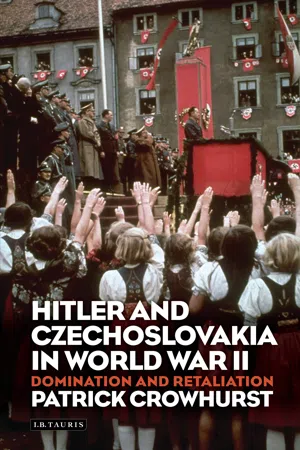
The invasion of Czechoslovakia by Nazi Germany in March 1939 helped to precipitate Europe's descent into World War II sis months later. The move, supposedly to protect the Sudeten Germans, shocked many in Europe, who saw it as a clear statement of intent by Hitler. Here, Patrick Crowhurst argues that occupation of the Sudetenland and the Czech lands was also crucial to the Nazi war machine. The armaments, factories and raw materials that Hitler seized accelerated Germany's capabilities; Czech tanks would prove crucial in the Ardennes and, as the Wehrmacht fought at Stalingrad, Armaments Minister Albert Speer was corralling Czech industrial machinery to produce engines, aircraft and equipment in support. In addition, new Slovakian and Czech primary material are used to give a new in-depth account of the German reaction to the assassination of Reinhardt Heydrich on the streets of Prague in June 1942. The recriminations were brutal, and dovetailed with Hitler's plans for the genocide of Czech Jewry. This is a new side of the History of Nazi Europe, and argues for the centrality of the Czech occupation in the overall narrative of World War II.
Information
CHAPTER 1
DEEPENING CRISIS, THE MUNICH CONFERENCE AND REFUGEES
Reduced to the bare essentials, Hitler’s policy in the final Czechoslovak crisis of September 1939 and the subsequent dismemberment of what remained of Czechoslovakia was based on no more than bluff. Conditions in the Sudeten German area were never as bad as he claimed, though there was serious hardship and widespread discontent. Events which he claimed were ‘proof’ of Czech hostility were exaggerated or deliberately provoked. Nor was there any real risk of civil war in Czechoslovakia. Equally, there had been discontent in the predominantly Polish area around ‘Teschen’ (Czech Český Tĕšín, Polish Cieszyn) and ‘Freistadt’ (Czech Karviná-Fryštát) for a long time, but nothing to suggest that the area was in such ferment that a transfer to Poland would solve the matter. The same could be said about the southern border of Slovakia inhabited by a majority of Hungarian speakers or the Ruthene area in the extreme east occupied by people who were ethnically Ukrainian. Yet within six months of the Munich Conference, Czechoslovakia had lost territory to Germany, Poland and Hungary and the remaining Czech lands in Bohemia and Moravia had been seized and renamed the Protectorate. Czechoslovakia had ceased to exist, but without creating the peace and stability that Hitler and German diplomats had claimed would be the result.
Every move by Hitler was accompanied by violent threats of imminent destruction. He claimed in every case to be acting in the name of peace, trying to find a solution to events that were rapidly falling into chaos. He succeeded partly because he appeared plausible and because he was a unique head of state. Diplomats and politicians had never encountered such a man before in that position. He was the first twentieth-century politician to base his aggressive policy on the simple, Machiavellian thesis that anything was permissible if it was successful. His later policy from March 1939 to the outbreak of the Second World War was no more than a continuation of this. He wanted more living space for Germans. At the same time he was thinking of ways of disposing of (killing) as many of the inhabitants of these lands in Central and Eastern Europe and the USSR that could not be ‘Germanised’. In the case of the Czechs, at the centre of this study, this would have resulted in a ‘solution’ that would have destroyed them as a people, either by starving them or turning them into some form of second-class ‘German’ people.1 Fortunately for the Czechs, Hitler never had the time or opportunity to complete these plans and put them into effect, though German control of the former Czechoslovakia from 1938 to 1945 caused immense hardship. It also resulted later in the expulsion of virtually all of the Sudeten Germans in an act of revenge. Only those married to Czechs or who were regarded as pro-Czech were allowed to stay and they changed the spelling of their German family name to make them appear ‘Czech’. The German presence in Czechoslovakia disappeared.
Prelude to the Munich Conference
By August 1938 Hitler’s plans for invading Czechoslovakia were complete and the army had been persuaded that it could be successful. The Sudeten German political demands had been backed by German writers in Czechoslovakia and Germany, who claimed that the Sudeten Germans had never been treated fairly and that Czechs and Germans had hated each other for centuries. In Berlin, Rudolf Jung’s book, Die Tschechen; Tausend Jahre deutsch-tschechischer Kampf had appeared in 1937 in a second, enlarged, edition. In 1938, as the crisis deepened, there were attempts to influence British foreign policy and public opinion by articles in The Times, Observer, Daily Mail and Daily Express. To this were added books such as the apparently reasonable pro-Sudeten German book by ‘Diplomaticus’, The Czechs and their Minorities, published in London. The earlier, measured, Czech response to German claims in Josef Chmelař, The German Problem in Czechoslovakia, published in Prague in 1936, had failed to carry equal weight. There were British newspapers that took a pro-Czechoslovak view: Daily Telegraph, Sunday Times, News Chronicle and Daily Herald, besides the important provincial newspapers Manchester Guardian and Yorkshire Post.2 When the Slovak separatists were encouraged to seek independence in 1938, there appeared the strident Should Britain go to war – for Czechoslovakia? published by the Slovak Council in Geneva. This opened with a section headed ‘Why is Czechoslovakia not worthy of being helped?’ which set the tone of the whole book.
The earlier, liberal and pro-Czech views of Wickham Steed, former foreign editor of The Times, and Professor Seton-Watson carried no weight because they were out of favour.3 Nor did the report by a group of British students in We saw Czechoslovakia, published in 1938. They declared: ‘Is Czechoslovakia worth defending? To those of us who saw something of its achievements in the past 18 years and felt something of the passion of its people for democracy and social justice, only one answer is possible. We say “Yes.”’ Toynbee, writing in The Economist in July 1937, had also warned that if Britain ignored events in Central Europe the British would eventually either have to accept German domination of Europe or would have to fight to keep a balance of power. But there were more powerful influences on Chamberlain. Most Conservatives considered that fascism was somehow ‘all right’. The influential Cliveden Set and the 30 peers and 30 MPs in Anglo-German fellowships also influenced him.
It was not merely Chamberlain’s ignorance of Czechoslovak affairs and his urgent desire to avoid war that made the crisis from August 1938 so severe. What is clear from the British diplomatic correspondence is that the Foreign Office knew that Hungary and Poland were also pressing demands against Czechoslovakia. This widened the problem by threatening a more general European war. In the case of Hungary, the Versailles settlement had awarded Czechoslovakia land on its Hungarian frontier that was occupied by a majority of Hungarian speakers. Hungarian hopes of regaining this territory had never disappeared, but had been held in check by the Little Entente. Hungarian relations with Romania and Yugoslavia were also in a state of ‘virtually constant tension’.4 During the August 1938 crisis the Hungarians attended a conference of the Little Entente at Bled and in return for a promise of non-violence were given assurances that the condition of the Hungarian minority would be improved, though this promise was never ratified.5 There were also German–Hungarian discussions at Kiel, where Hitler promised Upper Slovakia to Hungary if the two countries jointly attacked Czechoslovakia. But Hungary was worried about possible action by the Little Entente in the event of a German–Czechoslovak war.6 The German view was that Yugoslavia would remain neutral but the Hungarian army was still relatively weak and the government preferred a peaceful solution.
This crisis in August, accompanied by Czechoslovak mobilisation, made the British government anxious to try and find a solution to the problem that was not only about the Sudeten Germans but also the other minorities as well. Liddell Hart, writing to Anthony Eden on 10 September, offered an analysis of a possible German–Czech war to help the government form its policy. He stressed British military weakness (inadequate anti-aircraft defence) and the likelihood that Germany would attack Czechoslovakia from Austria, between Brno and Bratislava.7 He thought that Germany might initially make rapid progress there. But he felt it would be unable to conquer the whole country quickly. The Czech army was capable of putting up a prolonged resistance, provided the Germans did not have total control of the air. The only help that the French could offer was to tie down German forces on the Maginot Line. Nor could Russia offer any more assistance. Its army was unbelievably slow, though it might invade East Prussia, if given permission by Latvia and Lithuania to enter their territory. The central problem would be how to remove the German forces if the initial stage of the war came to a halt. This might be done by economic pressure, and by demoralising the German troops.
This was a serious attempt to provide the government, via Eden, with a realistic military assessment of the situation. However, it had one serious weakness. It assumed that the German army had a battle plan to invade Czechoslovakia from Austria. This was unlikely. The Anschluss had taken place little more than a year earlier. No battle plan would have been made before then unless Hitler was working to a timetable that made the seizure of Austria a first step. There was no evidence for that. Nor was it likely that the German military planners would have had time to make a detailed invasion plan between the Anschluss and the August 1938 crisis. A further weakness was that any invasion from that part of Austria would require large numbers of troops and all their equipment, including tanks, to be moved by rail from Germany. The build up and initial manoeuvres to test the battle plan would alert foreign diplomats and the Czech army, which could take defensive measures. There was also a line of bunkers and defence posts to protect the southern frontier. It was much easier for Germany to plan an invasion based on the existing military base at Dresden. Even in that case, however, rumours about the initial troop manoeuvres reached foreign diplomats and the Czechs, who had time to prepare their defence.
A plebiscite seemed to offer a way out of this dangerous situation. It had become Henlein’s chief demand, and therefore might solve the problem. But, as the Foreign Office memorandum of 11 September showed, opinions were mixed about whether it might prove a longterm solution.8 The Foreign Office opinion was that, in any case, Britain had a moral and legal obligation to prevent aggression, especially since Britain would quickly be drawn into any general war. Alternatively, the races could be separated: ‘No one wants to compel a person to stay in a state to which they are not loyal’. But if a plebiscite were held to establish popular choice, it needed law and order to guarantee that the results were fair. Also, if Germany were to take the territory after the plebiscite, a four-power conference would be needed to provide stability and give people time to leave. There was also the problem of German treatment of the Jews and the risk that the Czechs would resist and ‘go down fighting’. This would be the first stage of dismembering Czechoslovakia. It was a perceptive assessment of the situation and was borne out by results.
Hungarian and Polish demands
Discontent among the Hungarian population of Slovakia also formed part of this crisis. On 14 September, the Hungarian Chargé d’Affaires in Prague asked what the British attitude was towards the treatment of these people.9 The message was passed to the Foreign Office in London. In reply, Vansittart told the Hungarian ambassador that any concessions offered to the Sudeten Germans should also automatically be given to other minorities.10 The Hungarian government moved quickly to exploit this. The Times had carried an article on 7 September on the possibility of the Sudeten Germans being given a plebiscite. On 15 September the British ambassador in Budapest, Sir G. Knox, was told by the Hungarian foreign minister that if the Sudeten Germans were given a plebiscite, Hungary would demand the same for its minority in Slovakia.11 The same day, Chamberlain had his first meeting with Hitler at Berchtesgaden. Hitler appeared reasonable. He knew that he would not be able to invade Czechoslovakia before 1 October and in the meantime was concerned to keep up the pressure on the Sudeten German issue. Chamberlain, for his part, made his position as an arbitrator clear: ‘In principle I had nothing to say against the separation of the Sudeten Germans from the rest of Czechoslovakia, provided that the practical difficulties could be overcome.’12 However, far from easing the tension as Chamberlain had hoped, Hitler continued to raise his demands. In Czechoslovakia many expected war to break out. Sudeten Germans had no definite information about what was happening. Czech newspapers were heavily censored, no German newspapers could be imported and German information was regarded, correctly, as propaganda. Radios and telephones had been confiscated and all contact with the outside world was broken. To give one example of conditions in the Sudetenland, the German population of the textile town of Fle...
Table of contents
- Cover
- Title Page
- Contents
- Acknowledgements
- Tables
- Map
- Introduction
- 1. Deepening Crisis, the Munich Conference and Refugees
- 2. The Destruction of Czechoslovakia
- 3. The Protectorate Government
- 4. Forced Labour
- 5. Resources
- 6. Beneš’ Government in Exile, the End of the War and the Expulsion of Sudeten Germans
- Notes
- Bibliography
- Index
- eCopyright
Trusted by 375,005 students
Access to over 1.5 million titles for a fair monthly price.
Study more efficiently using our study tools.
Frequently asked questions
Yes, you can cancel anytime from the Subscription tab in your account settings on the Perlego website. Your subscription will stay active until the end of your current billing period. Learn how to cancel your subscription
No, books cannot be downloaded as external files, such as PDFs, for use outside of Perlego. However, you can download books within the Perlego app for offline reading on mobile or tablet. Learn how to download books offline
Perlego offers two plans: Essential and Complete
- Essential is ideal for learners and professionals who enjoy exploring a wide range of subjects. Access the Essential Library with 800,000+ trusted titles and best-sellers across business, personal growth, and the humanities. Includes unlimited reading time and Standard Read Aloud voice.
- Complete: Perfect for advanced learners and researchers needing full, unrestricted access. Unlock 1.5M+ books across hundreds of subjects, including academic and specialized titles. The Complete Plan also includes advanced features like Premium Read Aloud and Research Assistant.
We are an online textbook subscription service, where you can get access to an entire online library for less than the price of a single book per month. With over 1.5 million books across 990+ topics, we’ve got you covered! Learn about our mission
Look out for the read-aloud symbol on your next book to see if you can listen to it. The read-aloud tool reads text aloud for you, highlighting the text as it is being read. You can pause it, speed it up and slow it down. Learn more about Read Aloud
Yes! You can use the Perlego app on both iOS and Android devices to read anytime, anywhere — even offline. Perfect for commutes or when you’re on the go.
Please note we cannot support devices running on iOS 13 and Android 7 or earlier. Learn more about using the app
Please note we cannot support devices running on iOS 13 and Android 7 or earlier. Learn more about using the app
Yes, you can access Hitler and Czechoslovakia in World War II by Patrick Crowhurst in PDF and/or ePUB format, as well as other popular books in Historia & Historia europea. We have over 1.5 million books available in our catalogue for you to explore.