Victorian Britain, at the head of the vast British Empire, was the wealthiest and most powerful country in the world. Yet, not all Britons were seen as possessing the characteristics that defined what it actually meant to be 'British.' At the Margins of Victorian Britain focuses on the political means of policing unwanted 'others' in Victorian society: the Irish, Catholics and Jews, atheists, prostitutes and homosexuals. In this groundbreaking study, Dennis Grube details the laws and conventions that were legally and culturally enforced in order to bar these 'others' from gaining power and influence in Victorian Britain. Utilizing a wide-ranging analysis, the book focuses on key case-studies: the anti-Semitism implicit in Lord Rothschild's barring from the House of Commons; the fine line between accepted male love and companionship and homosexuality, culminating in the Oscar Wilde trials of the 1890s; and how laws against disease were used to police prostitutes and correct moral vices. Political and legal rhetoric, backed by the force of legislation, set the boundaries of 'Britishness', and enforced those boundaries through the 'majesty' of British law.
As Jews, Roman Catholics and atheists were brought into a genuine sense of partnership in the British constitution by being allowed to seek election to Parliament - homosexuals, prostitutes and the allegedly innately criminal Irish found themselves further and more vehemently displaced as the nineteenth century progressed. 'Otherness' stopped being a religious question and became instead a moral one. That fundamental shift marks the moment that 'Britishness' became a values-based question. And we've been arguing about what those values are ever since. This will be essential reading for those working in the fields of Victorian studies, social and cultural history and constitutional identity.
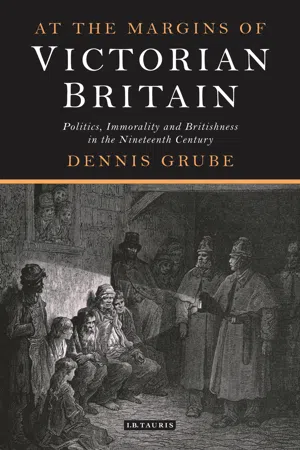
eBook - ePub
At the Margins of Victorian Britain
Politics, Immorality and Britishness in the Nineteenth Century
- 232 pages
- English
- ePUB (mobile friendly)
- Available on iOS & Android
eBook - ePub
At the Margins of Victorian Britain
Politics, Immorality and Britishness in the Nineteenth Century
About this book
Information
CHAPTER 1
INTRODUCTION: BRITISHNESS AND THE OTHER
‘Britishness’ is a political question. But it is also a legal, social, and emotional one. For centuries British governments have played a leading role in shaping, defining and guarding ‘Britishness’. They have framed the characteristics that define who is and who is not ‘British’. The question of what it means to be British continues to be a topic of intense contemporary debate as twenty-first-century Britain comes to terms with challenges such as devolution, European integration and mass immigration.1 In his introductory essay to a 2009 collection on Being British, Prime Minister Gordon Brown suggested that British national identity is centred not on race, religion or difference, but on shared values.2 In this, Brown’s view is consistent with much of the recent literature, which supports the assertion that British national identity is essentially a collection of values and ideas – the invisible ties that bind.3
The idea that a uniquely ‘British’ character is based on shared values of some kind is not new. In fact the contemporary debate is framed by decisions made over a century ago, in the Victorian era. The parameters for the modern debate were set in the age of Gladstone and Disraeli, when the shift occurred from a British identity based on religious difference to one based on shared moral values. Between 1829 and 1895 – from Roman Catholic emancipation to the Oscar Wilde trials – successive British governments slowly moved from viewing religious groups as ‘others’ to viewing moral ‘deviants’ as the chief outsiders against whom Britons should unify in shared disdain. As Jews, Roman Catholics and atheists were brought into a genuine sense of partnership in the British constitution by being allowed to seek election to Parliament, homosexuals, prostitutes and the allegedly innately criminal Irish found themselves further and more vehemently displaced. ‘Otherness’ stopped being a religious question and became instead a moral one.4 That fundamental shift marks the moment that ‘Britishness’ became a values-based question. And we’ve been arguing about what those values are ever since.
What has changed is the absence in the modern debate of that most vital ingredient of any national identity – an ‘other’. National identity is defined by its boundaries – by who is included and who is excluded. Current conceptions of ‘Britishness’ based on notions of ‘tolerance’, ‘liberty’ or ‘fair play’ provide values, but no ‘other’ to measure them against. They are universal values and by definition universalism embraces everyone. So if ‘everyone’ is a part of modern Britishness, it becomes a national identity without boundaries – meaning it becomes no identity at all.
Politics is a battle of definition. Political leaders create rhetorical frames through which to define how the public sees policy issues, how they decide on who is a friend and who is an enemy, and how they assess who are outsiders and who are insiders. This book scrutinizes how the frame of ‘Britishness’ was positioned in Victorian Britain; it examines who sought to define British national identity and how they did so. Political and legal rhetoric, backed by the force of legislation, set the boundaries of ‘Britishness’ and enforced those boundaries through the ‘majesty’ of an ‘unproblematised’ British law.
In Victorian Britain – through legislation, political rhetoric and the courts – successive governments identified a series of religious or moral ‘others’ who displayed a set of characteristics or behaviours incompatible with ‘Britishness’. In doing so they reinforced the identity of the majority of British people as morally upright and religiously acceptable citizens.
In Victorian Britain the law was used and promoted as an instrument of unity while paradoxically being used simultaneously by lawmakers to ostracise religious or moral deviants from British society. The ‘law’ of course is not an objective entity. It is a definitional tool which provided the dividing line in Victorian Britain between those who obeyed the law and those who, by thumbing their nose at the law, were seen as thumbing their nose at one of the core components of ‘Britishness’ itself. The law could limit the rights of people professing an ‘un-British’ faith to sit in Parliament – the ultimate lawmaking body. It could also render as moral outcasts those whose nationality or sexuality threatened to undermine British social norms.
The ‘Other’
British government, so changed in its character over the course of the nineteenth century, remained consistent in its defence of British law from the interference of groups deemed to be ‘un-British’. For much of the first half of the nineteenth century Jews, atheists and Roman Catholics were all prevented on religious grounds from entering Parliament to make British law. These were people whose religion rendered them unfit to participate in lawmaking in a nation which defined itself as defiantly Protestant. As the century progressed these religious bans were slowly lifted, leaving lawmakers to define a replacement class of scapegoats: ‘moral criminals’. Prostitutes, homosexuals and a certain class of Irishman came to dominate the imagination of the late Victorians as threats to the moral integrity of Britain. These people were not truly ‘British’ and could thus safely be excluded by laws that they had little hand in making.
Linda Colley’s seminal work on British nationalism in the eighteenth century has stressed that the idea of ‘Britain’ has always needed to have an ‘other’ against which to define itself.5 Colley’s work has unleashed a now two-decade-long conversation on what it means to be British. Colley of course is not without her critics;6 Keith Robbins has suggested that the United Kingdom in the eighteenth and nineteenth centuries moved towards a greater degree of cultural homogeneity than is allowed by Colley’s theory of a British identity superimposed on distinct and continuing national identities.7
Hugh Kearney too has been critical of Linda Colley’s approach as producing too holistic a picture of a Britain that was more fragmented by its composite nationalities than Colley’s overarching analysis would suggest.8 The composite work Uniting the Kingdom: The Making of British History, edited by Alexander Grant and Keith Stringer, similarly emphasises that the many forces which pushed the disparate nations of Great Britain together were matched by an equal number of forces pulling it apart.9
Paul Ward’s work suggests perhaps a more harmonious relationship. He argues that the separate nationalities within the United Kingdom were not mutually exclusive with the broader nationality of ‘British’, and that in some ways the two forces were actually mutually reinforcing.10 That of course does not mean that the distinctions between nationalities were always a source of pride for the whole. For instance, Peter Jupp has examined government in Ireland between 1801 and 1841 within the context of national identity. He argues that the union in 1801 simultaneously worked to incorporate the Irish as part of the United Kingdom while emphasising that they were different from their fellow British subjects.11
This debate about how to define Britishness has in many ways been a debate about competing nationalisms. It has been about what it means to be English, or Scottish or Welsh, or Irish, and extrapolating from that what it means to have a ‘British’ identity superimposed on these existing identities. This book is less about competing nationalisms and more about the buttressing of a values-based ‘Britishness’ in the late Victorian period. It’s about the ‘outsiders’ within British society against which all British nationalities could define themselves as religiously, racially or morally legitimate.12
By stereotyping and ostracising certain minority groups, British politicians were building internal cultural boundaries – delineating moral and sexual outsiders who could be frowned upon equally by the Scots, the Welsh and the English. In the absence of a natural cultural hegemony based on language or a unifying church, the Scottish, the English, and the Welsh could be unified in their disdain for those whose religious beliefs, moral standards or sexual practices rendered them ‘outsiders’. British law was the instrument that could define who these outsiders were. British governments were the keepers of law. They made law in parliament, appointed the judges who upheld the law in the courts, and chose the top policemen who would administer and execute the law at a practical level. These were all people very much at the core of that peculiarly British institution – the ‘Establishment’.13
Governments could make and influence pathways to justice. By choosing to act against Oscar Wilde but not against the Duke of Clarence after the Cleveland Street Scandal, the Salisbury Government could decide who should be held up to the judicial mirror for judgement.14 By passing a series of Contagious Diseases Acts isolating prostitutes from their own communities, successive governments in the 1860s and ’70s were able to confirm with the force of law that these people, and not their clients, were sexual deviants who should be ostracised. Their detention for medical examination could be tested in court but the government had already, through legislation, made the outcome a formality. It was this subtle ability to decide the legal rules by which society’s games were played that gave British governments the power to create and maintain outsider groups.
Of course, what also emerges when examining any group defined as ‘other’ is that each has its champions in the wider society that can affect when and if a group is welcomed into the fold. Jews, atheists and Roman Catholics all had vocal and articulate champions within Parliament and outside it that were willing to advocate for their cause. In the case of Jewish emancipation, by 1858 Whig governments had been willing to support change for a decade, only to be consistently stymied by an intransigent House of Lords determined to defend Britain’s Protestant national character until the end. In the late Victorian period, even such widely feared moral outsiders as prostitutes and homosexuals had people at both a local and a national level that would seek to protect them from the harsh judgements of the law.
There have been many theories put forward on the relationship between society, government and the law. From Marx to Foucault and beyond, theorists have grappled with how best to characterise the power of the State with regard to its citizens. In Britain, legal historians have added to our understanding of the ways in which criminality impacted on the popular consciousness in eighteenth- and nineteenth-century Britain.15 Douglas Hay, for example, referring to the criminal law in the eighteenth century, has argued that ‘[the law] allowed the rulers of England to make the courts a selective instrument of class justice, yet simultaneously to proclaim the law’s incorruptible impartiality and absolute determinacy.’16 Hay sees this as ‘the peculiar genius of the law’.17 It is this conception of reverence for the law being misused, as Hay suggests, which is important in understanding the power of the law as a tool of exclusion used to support particular conceptions of national identity.
The law was used not only to target criminals, but to isolate certain religious and moral minorities as outsiders within British society by labelling them as insufficiently ‘British’. Laws passed or upheld that excluded Jews or atheists from becoming lawmakers served a function in keeping a certain set of people in power. They helped to define who was ‘British’ enough to be trusted to make British law.18 Popular reverence for the idea of British law as an objective force for justice acted to buttress these definitions of who was and who was not British.
Every nation state and every system of law contains within it flexibilities and nuances, and I do not suggest that British political leaders had unfettered power to rule simplistically and overtly who was ‘in’ and who was ‘out’. British lawmakers were defeated at times by the discretion of judges, as in the trial of the Irish leader Daniel O’Connell, or worn down by the persistence of Jews and atheists in seeking their rights to sit as elected members of the House of Commons. Such outcomes should not, however, hide the actions of British governments in attempting to use the law to ostracise outsiders, even when their attempts were unsuccessful.
The time period covered by this book stretches from Roman Catholic Emancipation in 1829 to the Oscar Wilde trials in 1895. The period marks the crucial years in the shaping of an outwardly more inclusive British society. In these years, following the Great Reform Act in 1832, more and more Britons became active players in their emerging democracy. Also over the course of this period, the pervading power of liberal thought saw governments of all political persuasions slowly move from seeing religious groups as ‘others’ to seeing moral ‘deviants’ as the truly ‘un-British’ outsiders.19 In 1829 ‘true Britons’ were Protestants who bore al...
Table of contents
- Cover
- Title Page
- Contents
- Acknowledgements
- Abbreviations
- 1. Introduction: ‘Britishness’ and the ‘Other’
- 2. British Law and the Irish Other
- 3. Ireland on Trial: The Parnell Experience
- 4. British Jews: The Search for Equality
- 5. The Politics of Atheism
- 6. Roman Catholics: The Enduring ‘Other’
- 7. The New Jewish Threat
- 8. ‘Un-British’ Women: The ‘Problem’ of Prostitution
- 9. Containing Deviance: The Legal Limits of Male Sexuality
- 10. Conclusion
- Notes
- Bibliography
- Index
- eCopyright
Trusted by 375,005 students
Access to over 1.5 million titles for a fair monthly price.
Study more efficiently using our study tools.
Frequently asked questions
Yes, you can cancel anytime from the Subscription tab in your account settings on the Perlego website. Your subscription will stay active until the end of your current billing period. Learn how to cancel your subscription
No, books cannot be downloaded as external files, such as PDFs, for use outside of Perlego. However, you can download books within the Perlego app for offline reading on mobile or tablet. Learn how to download books offline
Perlego offers two plans: Essential and Complete
- Essential is ideal for learners and professionals who enjoy exploring a wide range of subjects. Access the Essential Library with 800,000+ trusted titles and best-sellers across business, personal growth, and the humanities. Includes unlimited reading time and Standard Read Aloud voice.
- Complete: Perfect for advanced learners and researchers needing full, unrestricted access. Unlock 1.5M+ books across hundreds of subjects, including academic and specialized titles. The Complete Plan also includes advanced features like Premium Read Aloud and Research Assistant.
We are an online textbook subscription service, where you can get access to an entire online library for less than the price of a single book per month. With over 1.5 million books across 990+ topics, we’ve got you covered! Learn about our mission
Look out for the read-aloud symbol on your next book to see if you can listen to it. The read-aloud tool reads text aloud for you, highlighting the text as it is being read. You can pause it, speed it up and slow it down. Learn more about Read Aloud
Yes! You can use the Perlego app on both iOS and Android devices to read anytime, anywhere — even offline. Perfect for commutes or when you’re on the go.
Please note we cannot support devices running on iOS 13 and Android 7 or earlier. Learn more about using the app
Please note we cannot support devices running on iOS 13 and Android 7 or earlier. Learn more about using the app
Yes, you can access At the Margins of Victorian Britain by Dennis Grube in PDF and/or ePUB format, as well as other popular books in Politics & International Relations & British History. We have over 1.5 million books available in our catalogue for you to explore.