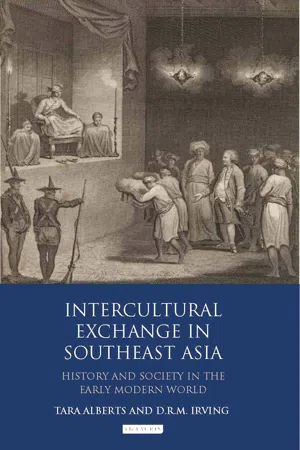
At the dawn of European colonialism, the Southeast Asian region encompassed some of the most diverse and influential cultures in early modern history. The circulation of people, commodities, ideas and beliefs along the key trading routes, from the eastern edge of the Mughal empire to the southern Chinese border, stimulated some of the great cultural and political achievements of the age. This volume highlights the multifarious dimensions of exchange in eight fascinating case studies written by leading experts from the fields of History, Anthropology, Musicology and Art History. Intercultural Exchange in Southeast Asia explores religious change at both ends of the social spectrum, examining the factors which led to or impeded the conversion of kings to new faiths, as well as those which affected the conversion of the marginal communities of mercenaries and renegades.
The artistic and cultural refashioning of new religions such as Christianity to suit local needs and sensibilities is highlighted in the Philippines, Siam, Vietnam and the Malay world while detailed analyses of scientific exchanges in maritime southeast Asia highlight the role of local agents, especially women, in the transmission of knowledge and beliefs. The articulation and cultural expression of power relations is addressed in chapters on colonial urban design and the use of music in diplomatic exchanges. This book utilises rare and unpublished sources to shed new light on the processes, strategies, and consequences of exchanges between cultures, societies and individuals and will be essential reading for those interested in the cultural and political origins of modern Asia.
eBook - ePub
Intercultural Exchange in Southeast Asia
History and Society in the Early Modern World
- 304 pages
- English
- ePUB (mobile friendly)
- Available on iOS & Android
eBook - ePub
Intercultural Exchange in Southeast Asia
History and Society in the Early Modern World
About this book
Information
CHAPTER ONE
IMMANENCE AND TOLERANCE: RULER CONVERSIONS TO ISLAM AND CHRISTIANITY IN ARCHIPELAGIC SOUTHEAST ASIA
Alan Strathern
The mechanism of ‘top-down’ conversion, whereby a ruler is induced to accept a new religion and his subjects eventually follow suit, may not have been quite the most important vehicle for religious change in world history: sheer conquest probably takes that honour, and the impact of the slow seepage of ideas introduced by traders or opportunistically adopted by commoners can hardly be gainsaid.1 But in certain times and places the vexed decision of a king to adopt a foreign cult has been critical in transforming large stretches of the earth – one thinks immediately of the adoption of Christianity by the Roman Emperor Constantine I (r.306–37). Nowhere was this more the case, apparently, than in the progressive Islamisation of island Southeast Asia from the fifteenth to the seventeenth centuries.
The present chapter is intended as a test case for an attempt to pursue a more general or theoretical understanding of the conditions which have determined the success or failure of ruler conversions throughout world history. A preliminary argument has already been presented in a rather abstract form elsewhere, but this is currently being substantially reworked as it is applied to examples from Africa, Japan, the Pacific, and elsewhere.2 Unfortunately there is not the space here to explore the theoretical issues in any detail, and we must be confined to a brief sketch of a few salient points. The dilemma as to whether or not to convert usually arises for a ruler when there are clear political advantages on the table: inducements of commerce and diplomacy and so on. What is more intriguing and mysterious is how a ruler is able to sell the deal to his or her subjects. A priori, one would imagine that this is unlikely to be a straightforward affair: nearly all societies legitimise rulership by reference to deeply rooted conceptions of the sacred, through divine associations and responsibilities. Might not conversion entail casting all that into epistemological jeopardy, as subjects are asked to construe their ruler’s legitimacy in terms of a cultural system to which they do not yet belong?
It seems that such considerations of internal legitimacy have formed almost insuperable barriers to a royal conversion in those areas of the globe where the world religions (Islam, Christianity, Buddhism, and probably Brahmanic Hinduism) have become firmly established. These religions are described as ‘transcendentalist’, in preference to the phrase ‘world religions’, because the former term refers us more precisely to what is relevant and specific about them: the way in which they have used religious impulses as a vehicle for an insistence on universal ethics, truth-realisation, and salvation-seeking.3 These qualities – which give them a specific dimension beyond the day-to-day negotiations with supernatural entities that have characterised all other ritual systems – reflect their origins in the transcendentalist philosophical breakthroughs of the first millennium bc: the period which Karl Jaspers called the ‘Axial Age’ of human history.4
Of course, all societies have called upon religious authority to provide some sense of enduring social order and cohesion, and this always makes successful ruler conversions problematic, to say the least. Yet once transcendentalist traditions have entwined themselves around the construction of political power, they seem to form an institutional unity that is particularly difficult to disentangle. This may be a consequence of the way in which, on an ideological level, the mundane affairs of politics are held to be ultimately subservient to a new vision of the transcendent aims of man. Rulers now typically establish their legitimacy through becoming in some way responsible for upholding the conditions in which salvation may be achieved. In societies that have not been influenced by transcendentalist systems, on the other hand, another kind of logic is more likely to rise to the fore when it comes to evaluating competing ritual techniques: how will they allow supernatural forces to be harnessed for the benefit of people in the here-and-now? This means that they may be subject to a certain ‘empiricism’: what is legitimate is what works. If it can be demonstrated that the religious activities of a foreign group will precipitate showers of boons from the supernatural sphere, then there is just a chance that the relevance of old cults may be called into question. Where salvation is the primary objective, however, then such practices may be deemed good or wicked regardless of their observable effects in this lifetime.
Furthermore, rulers must now negotiate their legitimacy in relation to a literati (or clerisy), whose members can claim moral superiority because of their role as interpreters and representatives of the transcendent. They may therefore have the capacity to arbitrate the ruler’s behaviour, holding him or her to account by standards that trump mundane concerns. Whether or not they are gathered together in an expansive but centralised institution such as the Church or the Sangha, the roles that monks, ulema, and Brahmans perform through society make them seriously dangerous enemies to annoy. And nothing would be more annoying than being discarded altogether. In some contexts – most obviously in the histories of the monotheistic religions – clerisies have been able to promote religious boundaries successfully enough to allow us to speak of ‘religious identity’. Regardless of how salient such identities are, transcendentalist traditions are able to shape society into a moral community with a particularly strong sense of itself as such. The effect of such developments is to enhance the ways in which a ruler’s religious behaviour is constrained by his subjects.5
One clarification, at least, must be introduced here, which is that all religions have responded to humankind’s ineradicable desire for supernatural assistance in this life, for contact with immanent divinity. For all that people may recognise the authority of transcendentalist texts, clerisies, and institutions, the popular forms of religious life will always speak to desires for healing, fertility, and other kinds of tangible assistance from accessible beings.6 Sometimes, so much ground may be yielded to immanentist needs and understandings (particularly but not only when the transcendentalist religions are in the process of expanding) that the distinctive qualities of the religion in question are diminished: clerisies may be thin on the ground, for example, or lose their discipline and organisation. In other words, we need to look beyond whether any given society has been labelled ‘Christian’, ‘Muslim’, ‘Hindu’, or ‘Buddhist’, and consider how much these systems have developed or maintained the characteristic features and institutional incarnations of a transcendentalist perspective. This will be of great importance in the following analysis. Equally, many forms of kingship, particularly in the Indic world, have sought to combine proclamations of righteousness with claims to harness supernatural potency.7
Archipelagic Southeast Asia provides something more than just another case study, because the region might seem to offer a bald challenge to the model sketched above. On the one hand, we appear to have an extremely rich hunting ground for cases of ruler conversion. Perhaps only the march of Christianity in the nineteenth-century Pacific can compare to the expansion of Islam – and, to a much lesser extent, Christianity – in sixteenth- and seventeenth-century Southeast Asia for the central role played by the ruler.8 Yet, on the other hand, had not the whole region of Southeast Asia already been touched by the wand of transcendentalism through its importation of Indic culture? In this context, Hinduism and Buddhism seem more crumbly than intransigent . . .
There is a further puzzle in that Theravada Buddhism seems to have offered almost complete resistance in mainland Southeast Asia. Indeed, the original conception of the present chapter had been to draw this contrast more systematically, and to consider why the rulers of Siam, for example, resisted foreign conversion attempts in the late seventeenth century – but limitations of space militated against this.9 A major suggestion of this essay will be that the wand of transcendentalism had in fact been waved rather casually over much of the island part of Southeast Asia, and that Hinduism and Buddhism had been received in a relatively superficial manner, so that they presented few features of intransigence to conversion. Furthermore, even within the island world one can posit the following rule of thumb: along the spectrum of most to least Indianised regions, we have the same spectrum of most to least resistant to ruler conversion. Previous scholarship has sometimes approached something like this suggestion. In Anthony Reid’s work there is an underlying assumption that Indianisation offered some kind of inoculation against the appeal of Islam.10 This is so in a general sense, which is never argued explicitly, but refers to the exalted imagery of kingship that Brahmanic Hinduism offered. However, Hinduism has a somewhat ambiguous place in his schema, certainly when compared to the more decisively scriptural religions of Theravada Buddhism and Islam.11 The advantages of the latter to centralising rulers in the early modern world are certainly explicitly and compellingly laid out, from their ability to supersede the power of local spirits to the opportunities for new kinds of patronage. However, exactly why different societies should apparently vary so widely in the kind of obstacle that they present at the critical moments of ruler conversion – and in the possibility of overcoming the putative crisis of legit...
Table of contents
- Cover
- Title Page
- Contents
- Acknowledgements
- Contributors
- Introduction Faith, Knowledge, and Power
- Chapter One Immanence and Tolerance: Ruler Conversions to Islam and Christianity in Archipelagic Southeast Asia
- Chapter Two Priests, Portuguese, and Religious Change on the Periphery of Western Mainland Southeast Asia in the Sixteenth and Seventeenth Centuries
- Chapter Three Priests of a Foreign God: Catholic Religious Leadership and Sacral Authority in Seventeenth-century Tonkin and Cochinchina
- Chapter Four The Virgin of the Breadfruit Tree: The Impact of Early Modern Marian Art on Filipino Women
- Chapter Five Global Trade and Local Knowledge: Gathering Natural Knowledge in Seventeenth-century Indonesia
- Chapter Six ‘Ask About Everything!’ Clas Fredrik Hornstedt in Java, 1783–4
- Chapter Seven Trading Tunes: Thomas Forrest, Malay Songs, and Musical Exchange in the Malay Archipelago, 1774–84
- Chapter Eight Intercultural Exchange in the City of Malacca
- Bibliography
- Index
- eCopyright
Trusted by 375,005 students
Access to over 1.5 million titles for a fair monthly price.
Study more efficiently using our study tools.
Frequently asked questions
Yes, you can cancel anytime from the Subscription tab in your account settings on the Perlego website. Your subscription will stay active until the end of your current billing period. Learn how to cancel your subscription
No, books cannot be downloaded as external files, such as PDFs, for use outside of Perlego. However, you can download books within the Perlego app for offline reading on mobile or tablet. Learn how to download books offline
Perlego offers two plans: Essential and Complete
- Essential is ideal for learners and professionals who enjoy exploring a wide range of subjects. Access the Essential Library with 800,000+ trusted titles and best-sellers across business, personal growth, and the humanities. Includes unlimited reading time and Standard Read Aloud voice.
- Complete: Perfect for advanced learners and researchers needing full, unrestricted access. Unlock 1.5M+ books across hundreds of subjects, including academic and specialized titles. The Complete Plan also includes advanced features like Premium Read Aloud and Research Assistant.
We are an online textbook subscription service, where you can get access to an entire online library for less than the price of a single book per month. With over 1.5 million books across 990+ topics, we’ve got you covered! Learn about our mission
Look out for the read-aloud symbol on your next book to see if you can listen to it. The read-aloud tool reads text aloud for you, highlighting the text as it is being read. You can pause it, speed it up and slow it down. Learn more about Read Aloud
Yes! You can use the Perlego app on both iOS and Android devices to read anytime, anywhere — even offline. Perfect for commutes or when you’re on the go.
Please note we cannot support devices running on iOS 13 and Android 7 or earlier. Learn more about using the app
Please note we cannot support devices running on iOS 13 and Android 7 or earlier. Learn more about using the app
Yes, you can access Intercultural Exchange in Southeast Asia by Tara Alberts, D. R. M. Irving, Tara Alberts,D. R. M. Irving in PDF and/or ePUB format, as well as other popular books in History & Asian History. We have over 1.5 million books available in our catalogue for you to explore.