eBook - ePub
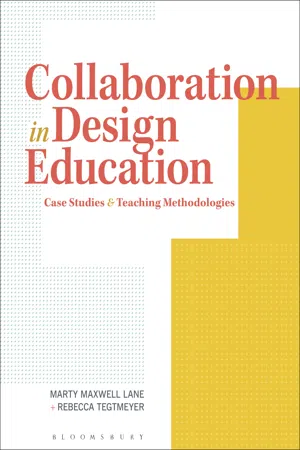
Collaboration in Design Education
Case Studies & Teaching Methodologies
- 176 pages
- English
- ePUB (mobile friendly)
- Available on iOS & Android
eBook - ePub
Collaboration in Design Education
Case Studies & Teaching Methodologies
About this book
The book is a comprehensive guide for students and practitioners who want to take a collaborative approach in their design practice. Authors Marty Maxwell Lane and Rebecca Tegtmeyer introduce a range of case study collaborations, both face-to-face and remote, and between individuals and groups. The book addresses the basics of getting started, planning ahead and reflecting on outcomes, alongside the issues that come up in collaborative work, e.g. cross-cultural exchange, or managing roles within a diverse team. Editorial commentary runs throughout the chapter introductions and case studies, with informatics illustrating key concepts and expanded 'call out' points in the martin. More complex case studies offer a 'deep dive' section to explain and share further details of the featured projects.
Information
 | Community Collaborations with Students |

Design-based collaborations with community partners have become high-profile examples within academic institutions to showcase outreach and a commitment to civic engagement. These types of collaborations are beneficial for students, faculty, design departments, university systems, and community partners. These projects ask students to look beyond commercial content and projects that prioritize profit-based outcomes and focus on designing with their community. The process can empower students to commit to community engagement and further develop their values as citizen designers. Furthermore, the results of these collaborations can demonstrate the power of design to universities and the greater community.
CITIZEN DESIGNERS
Cultivating students who respond to community needs in this way requires a shift in how we approach typical practices in design education. As Elizabeth Resnick states in the preface to her book Developing Citizen Designers, “design educators urgently need to revisit our ingrained methods and philosophies in order to review and reconsider how we will actually steward our future generations of young design practitioners.” Faculty are poised to expose students to a broader way of thinking about the purpose of design.
HIERARCHY OF DESIGN PROBLEMS
The first steps in shifting our approach can start with giving students the opportunity to solve unexpected and complex problems and explaining the context through which these problems exist. In Design Methods, J. Christopher Jones introduced a hierarchy of design problems that ranges from component to product to system to community. Jones states that most design solutions exist at the component or product level, but most problems exist at the system or community level. These types of problems extend past the formal attributes of visual communication and are often not addressed in traditional coursework.
CHAPTER 1CASE STUDIES
CASE STUDY ONE
ThinkTank 2020
Tyler Galloway, Kansas City Art Institute (Professor Galloway previously taught at the University of Kansas)
CASE STUDY TWO
Growing NearWest
Pamela Napier, Indiana University and Starla Hart, 16 Tech Community Corporation
CASE STUDY THREE
Wicked Problems in Your Community
Liese Zahabi, University of New Hampshire
CASE STUDY FOUR
Farm-to-Market
Meta Newhouse and Caroline Graham Austin, Montana State University
In order to bridge the gap for students working within this complexity, various methods and processes must be integral to their education. Human-centered research practices will aid in developing a better understanding of the audiences and communities they work with. Students with this foundational inspiration and knowledge will continue on to be leaders rather than followers and properly exploit the power of design to create positive change.
Providing students the experience of working with communities comes with some challenges. The most common is finding and maintaining committed community partners and scheduling times of working that respect the community members and the students. A good starting point can be for faculty to look into university systems that can connect them to community partners that have already been cultivated. Bringing the university outreach services into the conversation can also help clarify each institution’s policies of working with human subjects. Consulting resources on campus and beyond, such as IDEO’s The Field Guide to Human-Centered Design, can provide guidance for faculty and awareness for students.
ARTIFACTS FEATURED:
»Website
»Concept Maps
»Environmental Graphics
»Branding
»Way-Finding
»Stop-Motion
»Experience Design
»Publications
»Product Development
The case studies in this chapter provide examples of how community partnerships were established, a wide range of research methods, and several different processes that facilitate a collaborative approach to designing with communities. The first case study is situated within a course and the community project is initiated with one group of students and passed on to the group that follows. A semester-long project is the context for the second case study and outlines a robust process, beginning with the initiation of community collaboration all the way to completion. The third case study offers a course structure that scaffolds exercises that lead up to multiple collaborative projects. And finally, the fourth case study is a multidisciplinary established course that works with a rotation of local farmers.
RESOURCES:
Developing Citizen Designers by Elizabeth Resnick
Design Methods by J. Christopher Jones
The Field Guide to Human-Centered Design: by IDEO
CHAPTER 1TAKEAWAYS
Finding Community Partners
Collaborative Research
Research Through Making
Technical Tools
Human-Centered Research Methods
»Culture Probes
»Generative Tools
»Concept Maps
Physical Disruption
Audience Interviews
Teaching Complexity
Human Research Subjects
Learning Objectives
Grant Funding
Field Work
Outside Experts
Icebreakers
Making Teams
CASE STUDY 1.1
ThinkTank 2020
Tyler Galloway, Kansas City Art Institute
»10 sophomores, juniors, seniors in graphic design, industrial design, illustration, and interior design at the University of Kansas (Professor Galloway previously taught at the Universtiy of Kansas)
COMMUNITY PARTNERS
Erika Dvorske, United Way of Douglas County
Jennifer Bessolo, South Middle School
HOW THE TEAM MET:
Tyler Galloway was introduced to Erika Dvorske through the Center for Civic and Social Responsibility at The University of Kansas. Through Erika, Tyler was then introduced to Jennifer Bessolo.
COURSE DESCRIPTION
Tyler Galloway challenged his students to reduce the dropout rate in Lawrence, Kansas, public schools to zero by 2020. This goal was to be completed through a three-phase process spanning three semesters, with the work from the previous class informing the next class. Phases 1 and 2 were completed; however, phase 3 (implementation) was halted due to Tyler moving to another institution.
Students in both phases were tasked with performing primary and secondary research to understand the nature and complexity of the problem, summarize the issues, and visually communicate their findings for future classes to build upon. They collaborated with Erika Dvorske, the Pre...
Table of contents
- Cover
- Title Page
- Contents
- Foreword
- Preface
- Introduction
- CHAPTER 1 COMMUNITY COLLABORATIONS WITH STUDENTS
- CHAPTER 2 FACULTY SHARING KNOWLEDGE TO BROADEN STUDENT EXPERIENCE
- CHAPTER 3 PEER-TO-PEER LEARNING ACROSS DISCIPLINES
- CHAPTER 4 CONFRONTING BIAS IN CULTURAL EXCHANGES
- CHAPTER 5 INTRA-DISCIPLINARY FACULTY COLLABORATION
- CHAPTER 6 INDUSTRY INTERVIEWS
- Conclusion
- Resources
- Bibliography
- About the Authors
- Index
- Acknowledgments
- eCopyright
Trusted by 375,005 students
Access to over 1.5 million titles for a fair monthly price.
Study more efficiently using our study tools.
Frequently asked questions
Yes, you can cancel anytime from the Subscription tab in your account settings on the Perlego website. Your subscription will stay active until the end of your current billing period. Learn how to cancel your subscription
No, books cannot be downloaded as external files, such as PDFs, for use outside of Perlego. However, you can download books within the Perlego app for offline reading on mobile or tablet. Learn how to download books offline
Perlego offers two plans: Essential and Complete
- Essential is ideal for learners and professionals who enjoy exploring a wide range of subjects. Access the Essential Library with 800,000+ trusted titles and best-sellers across business, personal growth, and the humanities. Includes unlimited reading time and Standard Read Aloud voice.
- Complete: Perfect for advanced learners and researchers needing full, unrestricted access. Unlock 1.5M+ books across hundreds of subjects, including academic and specialized titles. The Complete Plan also includes advanced features like Premium Read Aloud and Research Assistant.
We are an online textbook subscription service, where you can get access to an entire online library for less than the price of a single book per month. With over 1.5 million books across 990+ topics, we’ve got you covered! Learn about our mission
Look out for the read-aloud symbol on your next book to see if you can listen to it. The read-aloud tool reads text aloud for you, highlighting the text as it is being read. You can pause it, speed it up and slow it down. Learn more about Read Aloud
Yes! You can use the Perlego app on both iOS and Android devices to read anytime, anywhere — even offline. Perfect for commutes or when you’re on the go.
Please note we cannot support devices running on iOS 13 and Android 7 or earlier. Learn more about using the app
Please note we cannot support devices running on iOS 13 and Android 7 or earlier. Learn more about using the app
Yes, you can access Collaboration in Design Education by Marty Maxwell Lane,Rebecca Tegtmeyer, Marty Maxwell Lane, Rebecca Tegtmeyer in PDF and/or ePUB format, as well as other popular books in Design & Design General. We have over 1.5 million books available in our catalogue for you to explore.