"A reference book in this area of EU competition law and a must-have companion for academics, enforcers and practitioners alike, as well as EU and national judges."
Judge Nils Wahl, Court of Justice of the European Union
This seminal text offers an authoritative and integrated treatment of the legal and economic principles that underpin the application of Article 102 TFEU to the behaviour of dominant firms.
Traditional concerns of monopoly behaviour, such as predatory pricing, refusals to deal, excessive pricing, tying and bundling, discount practices and unlawful discrimination are treated in detail through a review of the applicable economic principles, the case law and decisional practice and more recent economic and legal writings. In addition, the major constituent elements of Article 102 TFEU, such as market definition, dominance, effect on trade and applicable remedies are considered at length.
The third edition involves a net addition of over 250 pages, with a substantial new chapter on Abuses In Digital Platforms, an extensively revised chapter on standards, and virtually all chapters incorporating substantial revisions reflecting key cases such as Intel, MEO, Google Android, Google Shopping, AdSense, and Qualcomm.
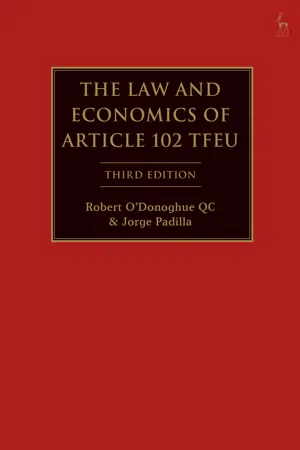
eBook - ePub
The Law and Economics of Article 102 TFEU
- 1,368 pages
- English
- ePUB (mobile friendly)
- Available on iOS & Android
eBook - ePub
The Law and Economics of Article 102 TFEU
Chapter 1
INTRODUCTION, SCOPE OF APPLICATION, AND BASIC FRAMEWORK
1.1 INTRODUCTION
Article 102 TFEU in the context of the Treaty on the Functioning of the European Union. Ensuring a system of free competition is a central objective of the Treaty on the Functioning of the European Union (TFEU) (and its progenitor, the original Treaty of Rome (1957)).1 Article 119 TFEU states that the economic activities of the EU and its Member States should be “conducted in accordance with the principle of an open market economy with free competition.” Similar principles are repeated in Article 120 TFEU—a provision concerning economic policy—which requires Member States and the EU to “act in accordance with the principle of an open market economy with free competition, favouring an efficient allocation of resources.” These broad policy objectives are reflected in detail in Title VII, Chapter I of Part III the TFEU, which contains the competition provisions.
Superficially, the TFEU appeared to downgrade the EU’s competition objectives. Previously, Article 3(g) EC stated that “a system ensuring that competition in the internal market is not distorted” was one of the core objectives of the (then) European Community. But this has been replaced by Protocol 27 of the TFEU which states as follows:2
“The High Contracting Parties, considering that the internal market as set out in Article 3 of the Treaty on European Union includes a system ensuring that competition is not distorted, have agreed that: to this end, the Union shall, if necessary, take action under the provisions of the Treaties, including under Article 352 of the Treaty on the Functioning of the European Union. This protocol shall be annexed to the Treaty on European Union and to the Treaty on the Functioning of the European Union.”
This apparent relegation of competition law objectives in the TFEU generated significant discussion among commentators, since it involved a change to the rank of a provision that had stood for over 50 years.3 Article 3(g) EC had also been referred to in a number of seminal judgments on competition law as the cornerstone of competition policy.4 Thus far, it appears that the direct practical impact has been little or nothing. Indeed, in its judgment in TeliaSonera the Court of Justice referred to Protocol 27 in terms that clearly conveyed that it saw no effective difference between the pre- and post-TFEU situations in this regard.5 Perhaps even more directly, the General Court held in Timab that “Article 3 TEU, read in conjunction with Protocol No 27 on the internal market and competition, has changed neither the purpose of Article 101 TFEU nor the rules for the imposition of fines.”6 This obviously applies mutatis mutandis to Article 102 TFEU.
Agreements and unilateral conduct. A basic distinction can be made under EU competition law between contractual relations involving two or more firms and the unilateral conduct of a single firm. Article 101 TFEU and Council Regulation 139/2004 on the control of concentrations between undertakings7 are the basic EU legal instruments governing agreements. The latter concerns agreements that bring about a lasting change in the control of an undertaking—mergers, acquisitions, and fully-functional joint ventures—whereas the former deals with other types of horizontal and/or vertical agreements that have a non-trivial impact on competition.
Article 102 TFEU complements the provisions of EU competition law dealing with agreements by placing certain restrictions on the unilateral conduct of firms. It provides that “any abuse by one or more undertakings of a dominant position within the common market or in a substantial part of it shall be prohibited as incompatible with the common market insofar as it may affect trade between Member States.” The text goes on to offer the following examples of an “abuse”:
“(a) directly or indirectly imposing unfair purchase or selling prices or other unfair trading conditions; (b) limiting production, markets or technical development to the prejudice of consumers; (c) applying dissimilar conditions to equivalent transactions with other trading parties, thereby placing them at a competitive disadvantage; (d) making the conclusion of contracts subject to acceptance by the other parties of supplementary obligations which, by their nature or according to commercial usage, have no connection with the subject of such contracts.”
The EU Courts have insisted on the broad unity of the purpose that exists between the competition provisions of the EU Treaties,8 even if they seek to achieve them in different ways. One reason is that the laws on agreements and unilateral conduct share a common concern: to curb the adverse welfare effects of monopoly power. It is well-documented in industrial organisation literature that a firm, or group of firms, with a dominant position (or its synonym market power) have the possibility to reduce output (or innovation) and raise prices, thereby harming consumer welfare.9 In the case of mergers and acquisitions and other agreements, market power can be acquired, maintained, or increased through contractual arrangements. Such agreements may be subject to review under Article 101 TFEU and merger control laws. In the case of anticompetitive unilateral conduct, a firm typically relies on its market power to engage in strategic actions that unlawfully exclude rival firms, to the detriment of consumers (or it may also directly exploit consumers by charging excessive prices). Article 102 TFEU, and analogous provisions of national laws, therefore seek to place restrictions on unilateral conduct that harms consumer welfare.
The general scheme of Article 102 TFEU. The basic aim of Article 102 TFEU is to set standards for the conduct of firms with a position of such economic strength that they have a degree of immunity from the normal disciplining effects of a competitive market. In markets characterised by the presence of one or more firms with economic power of this kind, Article 102 TFEU seeks to avoid the use and misuse of market power and, more controversially, to bring about some of the results that would occur if competition did exist. Thus, Article 102 TFEU has been used to force prices down towards a level that would exist in a competitive market,10 to increase prices where low prices are part of a deliberate plan to exclude rivals and raise prices following exit,11 or to require a dominant firm to share key non-replicable assets with rivals.12 But Article 102 TFEU also goes further and requires dominant firms to refrain from certain acts that would be perfectly lawful if carried out by a non-dominant firm—the so-called “special responsibility” of a dominant firm.13
The wording of Article 102 TFEU requires a number of cumulative conditions to be satisfied before a violation can be established: (1) there must be an undertaking; (2) that undertaking must hold a dominant position on a properly defined relevant market; (3) the dominant position must be held in a substantial part of the common market; (4) there must be an abuse; and (5) that abuse must affect trade between Member States. A basic overview of these minimum requirements for the application of Article 102 TFEU is provided below:
1.Undertaking. In common with Article 101 TFEU, Article 102 TFEU only applies to “undertakings.” The TFEU does not define this term, but it has been extensively developed in the decisional practice and case law. In basic terms, an undertaking is any person engaged in an “economic activity.” Most of the controversy surrounding this issue concerns State undertakings and private firms that are not for profit and whether such entities can be regarded as “undertakings” for purposes of EU competition law. Section 1.3 below discusses the main areas of difficulty in detail.
2.Dominant position. The concept of dominance contained in Article 102 TFEU relates to a position of economic strength on a properly-defined relevant market. The relevant market therefore provides a framework for analysing whether an undertaking holds a dominant position. The techniques used in this regard are similar to those used under Article 101 TFEU and EU merger control: a detailed analysis of the category of products that consumers regard as effective substitutes based on characteristics, use, or price. However, once such a market is defined, the assessment of dominance further requires the calculation of market shares, an analysis of barriers to entry, and other factors that might affect the nature and scope of dominance. Consistent with economic theory and the EU Merger Regulation, dominance can be that of a single firm or a number of collectively dominant firms. Market definition and dominance are treated in detail in Chapters Three and Four, respectively.
3.Substantial part of the common market. The requirement that dominance should arise in a substantial part of the common market reflects the consideration that EU competition law should not be concerned with trivial or localised matters. In practic...
Table of contents
- Cover
- Title Page
- Dedication
- Foreword to the Third Edition by Nils Wahl
- Foreword to the First Edition by John Temple Lang
- Authors’ Preface to the Third Edition
- Table of Contents
- Table of Cases
- Table of Legislation
- 1. Introduction, Scope Of Application, And Basic Framework
- 2. History, Development, and Reform
- 3. Market Definition
- 4. Dominance
- 5. The General Concept Of An Abuse
- 6. Predatory Pricing
- 7. Margin Squeeze
- 8. Exclusive Dealing and Related Practices
- 9. Loyalty Rebates and Related Practices
- 10. Refusal to Deal
- 11. Tying and Bundling
- 12. Exclusionary Non-Price Abuses
- 13. Abusive Conduct And Standards
- 14. Excessive Pricing
- 15. Abusive Discrimination
- 16. Other Exploitative Abuses
- 17. Abuses In Digital Platform Markets
- 18. Effect On Trade
- 19. Remedies
- Index
- eCopyright Page
Trusted by 375,005 students
Access to over 1.5 million titles for a fair monthly price.
Study more efficiently using our study tools.
Frequently asked questions
Yes, you can cancel anytime from the Subscription tab in your account settings on the Perlego website. Your subscription will stay active until the end of your current billing period. Learn how to cancel your subscription
No, books cannot be downloaded as external files, such as PDFs, for use outside of Perlego. However, you can download books within the Perlego app for offline reading on mobile or tablet. Learn how to download books offline
Perlego offers two plans: Essential and Complete
- Essential is ideal for learners and professionals who enjoy exploring a wide range of subjects. Access the Essential Library with 800,000+ trusted titles and best-sellers across business, personal growth, and the humanities. Includes unlimited reading time and Standard Read Aloud voice.
- Complete: Perfect for advanced learners and researchers needing full, unrestricted access. Unlock 1.5M+ books across hundreds of subjects, including academic and specialized titles. The Complete Plan also includes advanced features like Premium Read Aloud and Research Assistant.
We are an online textbook subscription service, where you can get access to an entire online library for less than the price of a single book per month. With over 1.5 million books across 990+ topics, we’ve got you covered! Learn about our mission
Look out for the read-aloud symbol on your next book to see if you can listen to it. The read-aloud tool reads text aloud for you, highlighting the text as it is being read. You can pause it, speed it up and slow it down. Learn more about Read Aloud
Yes! You can use the Perlego app on both iOS and Android devices to read anytime, anywhere — even offline. Perfect for commutes or when you’re on the go.
Please note we cannot support devices running on iOS 13 and Android 7 or earlier. Learn more about using the app
Please note we cannot support devices running on iOS 13 and Android 7 or earlier. Learn more about using the app
Yes, you can access The Law and Economics of Article 102 TFEU by Robert O'Donoghue QC,Jorge Padilla,Robert O'Donoghue KC in PDF and/or ePUB format, as well as other popular books in Law & Antitrust. We have over 1.5 million books available in our catalogue for you to explore.