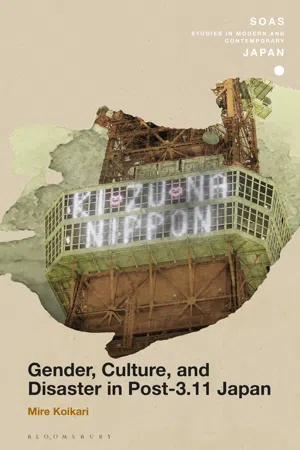
The Great East Japan Disaster – a compound catastrophe of earthquake, tsunami, and nuclear meltdown that began on March 11, 2011 – has ushered in a new era of cultural production dominated by discussions on safety and security, risk and vulnerability, and recovery and refortification. Gender, Culture, and Disaster in Post-3.11 Japan re-frames post-disaster national reconstruction as a social project imbued with dynamics of gender, race, and empire and in doing so Mire Koikari offers an innovative approach to resilience building in contemporary Japan.
From juvenile literature to civic manuals to policy statements, Koikari examines a vast array of primary sources to demonstrate how femininity and masculinity, readiness and preparedness, militarism and humanitarianism, and nationalism and transnationalism inform cultural formation and transformation triggered by the unprecedented crisis. Interdisciplinary in its orientation, the book reveals how militarism, neoliberalism, and neoconservatism drive Japan's resilience building while calling attention to historical precedents and transnational connections that animate the ongoing mobilization toward safety and security.
An important contribution to studies of gender and Japan, the book is essential reading for all those wishing to understand local and global politics of precarity and its proposed solutions amid the rising tide of pandemics, ecological hazards, industrial disasters, and humanitarian crises.
- 240 pages
- English
- ePUB (mobile friendly)
- Available on iOS & Android
eBook - ePub
Gender, Culture, and Disaster in Post-3.11 Japan
About this book
Information
Table of contents
- Cover
- Halftitle Page
- Title Page
- Contents
- List of Illustrations
- Acknowledgments
- 1 Introduction: Rethinking Japanese Culture since 3.11
- 2 Re-masculinizing the Nation: Resilient Manhood and Revitalized Nationhood
- 3 Training Women for Disasters: Domesticity and Preparedness in the Age of Uncertainty
- 4 Securitizing Childhood: Children and Disaster Readiness Education
- 5 Mobilizing Paradise: Hawai‘i in Post-Disaster National Imagination
- 6 Conclusion
- Notes
- Bibliography
- Index
- Imprint
Trusted by 375,005 students
Access to over 1.5 million titles for a fair monthly price.
Study more efficiently using our study tools.
Frequently asked questions
Yes, you can cancel anytime from the Subscription tab in your account settings on the Perlego website. Your subscription will stay active until the end of your current billing period. Learn how to cancel your subscription
No, books cannot be downloaded as external files, such as PDFs, for use outside of Perlego. However, you can download books within the Perlego app for offline reading on mobile or tablet. Learn how to download books offline
Perlego offers two plans: Essential and Complete
- Essential is ideal for learners and professionals who enjoy exploring a wide range of subjects. Access the Essential Library with 800,000+ trusted titles and best-sellers across business, personal growth, and the humanities. Includes unlimited reading time and Standard Read Aloud voice.
- Complete: Perfect for advanced learners and researchers needing full, unrestricted access. Unlock 1.5M+ books across hundreds of subjects, including academic and specialized titles. The Complete Plan also includes advanced features like Premium Read Aloud and Research Assistant.
We are an online textbook subscription service, where you can get access to an entire online library for less than the price of a single book per month. With over 1.5 million books across 990+ topics, we’ve got you covered! Learn about our mission
Look out for the read-aloud symbol on your next book to see if you can listen to it. The read-aloud tool reads text aloud for you, highlighting the text as it is being read. You can pause it, speed it up and slow it down. Learn more about Read Aloud
Yes! You can use the Perlego app on both iOS and Android devices to read anytime, anywhere — even offline. Perfect for commutes or when you’re on the go.
Please note we cannot support devices running on iOS 13 and Android 7 or earlier. Learn more about using the app
Please note we cannot support devices running on iOS 13 and Android 7 or earlier. Learn more about using the app
Yes, you can access Gender, Culture, and Disaster in Post-3.11 Japan by Mire Koikari in PDF and/or ePUB format, as well as other popular books in Histoire & Histoire du 21ème siècle. We have over 1.5 million books available in our catalogue for you to explore.