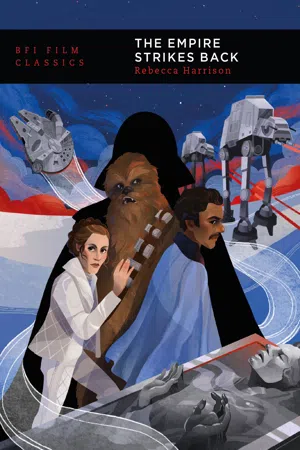
The Empire Strikes Back (1980), the second film in the original Star Wars trilogy, is often cited as the 'best' and most popular Star Wars movie. In her compelling study, Rebecca Harrison draws on previously unpublished archival research to reveal a variety of original and often surprising perspectives on the film, from the cast and crew who worked on its production through to the audiences who watched it in cinemas.
Harrison guides readers on a journey that begins with the film's production in 1979 and ends with a discussion about its contemporary status as an object of reverence and nostalgia. She demonstrates how Empire's meaning and significance has continually shifted over the past 40 years not only within the franchise, but also in broader conversations about film authorship, genre, and identity.
Offering new insights and original analysis of Empire via its cultural context, production history, textual analysis, exhibition, reception, and post-1980 re-evaluations of the film, the book provides a timely and relevant reassessment of this enduringly popular film.
- 112 pages
- English
- ePUB (mobile friendly)
- Available on iOS & Android
eBook - ePub
The Empire Strikes Back
About this book
Information
1 Creating an Empire
Star Wars is a global cultural phenomenon that has colonized cultural landscapes around the world. Referenced and remediated in literature, television shows, and other films, there are numerous paratexts (that is, other print and screen media that expand on the cinematic narratives), as well as vast merchandising lines and fan-created media. The saturation of everyday life with Star Wars dialogue, characters, and philosophies is so great that following a wave of census returns listing ‘Jedi’ as a religion in 2001 and 2011, the UK Charity Commission was forced to determine whether it was an official faith.11 Since 2012, the Walt Disney Company’s acquisition of the Star Wars canon, along with the Lucasfilm studio and its visual effects division Industrial Light and Magic (ILM), has helped create new generations of fans and ensure the continuing relevance of a vast media empire.12
But how did Star Wars come to acquire cultural capital? What was Empire’s role in the saga? And how did the tumultuous conditions of Hollywood and beyond inform Empire’s production and aesthetic? Paying attention to the generic conventions of Star Wars as well as its tentative connections to New Hollywood cinema, in this chapter I outline how Empire is situated in broader histories of film-making and both domestic and international politics. Arguing that the foundations of Empire were rooted in the cultural anxieties of the late 1970s, this chapter provides a framework for reading the themes and historical narratives that shape the rest of the book.
New Hollywood; new hope?
A long time ago, in a galaxy far, far away, Star Wars burst onto cinema screens and gathered a cult-like following among viewers, who repeatedly returned to theatres to watch Princess Leia Organa (Carrie Fisher), Luke Skywalker (Mark Hamill), and Han Solo (Harrison Ford) battle against the villainous Darth Vader (voiced by James Earl Jones and performed by David Prowse). The film follows the Rebel Alliance and the Jedi – who defer to the Light Side of the mystical Force – as they fight the Empire and its Dark, Sith overlords. Based on the desert planet Tatooine, moisture farmer Luke intercepts a call for help from Leia via two droids (Kenny Baker’s Artoo Detoo and Anthony Daniels’ See Threepio). When Luke tracks down the message’s intended recipient, a reclusive Jedi knight called Obi-Wan Kenobi (Alec Guinness), he and his new mentor begin a quest to rescue Leia and fight Vader’s tyranny. Teaming up with bounty hunter Han and his shaggy-haired companion Chewbacca (or Chewie; Peter Mayhew), the accidental rebels face Vader and his menace of stormtroopers on the Death Star, a moon-like, weaponized space station. Luke eventually destroys the Death Star, and the film ends with Leia rewarding the Rebels at a ceremonial celebration. Vader, meanwhile, has a more ambiguous ending; he vanishes into space, overcome but not yet defeated.
A science-fiction space opera that recalls the 1936 serial adventures of Flash Gordon, as well as Greek myth and Arthurian legend, Star Wars and its prequels and sequels defy straightforward generic convention.13 Indeed, scholars have long commented on the ‘hybridity and fluidity’ of science-fiction cinema, and have described Star Wars as both fantasy and a western.14 There are romantic elements, too, with a love triangle between Han, Leia, and Luke. As critic Carol A. Crotta noted somewhat cynically in 1980, Star Wars was guilty of ‘picking through genres like a shopping-bag lady through trash bins’.15 Yet as scholar Christine Cornea argues, generic hybridity is crucial to the mass appeal of blockbuster cinema, and so the film navigates a range of registers that offer viewers a variety of modes through which to interpret the story.16
Alongside its playful engagement with genre, the movie also attracted viewers thanks to its explosive visual effects, which include a planet disintegrating into dust under laser fire and ships careening across star-flecked space. The technical artistry was down to visual effects teams at ILM under the direction of George Lucas, who with producer Gary Kurtz made the movie outside the confines of studio control. As Tara Lomax notes, ‘since graduating from film school, Lucas has openly expressed distrust and cynicism towards the unchecked authority of the Hollywood studio system’.17 His suspicions about studio practices were in keeping with his negative experiences on previous film edits and with his status as what Clyde Taylor calls ‘one of the “movie brats” who ushered in “New Hollywood”’.18 Since the mid-1960s, New Hollywood directors such as Francis Ford Coppola and Martin Scorsese had gained authorial power by eschewing studio finance in favour of independent production, and Lucas was an established figure in their set thanks to his work on THX1138 (1971).19 Certainly, in interviews, Lucas tended to cast himself as a plucky outsider with New Hollywood spirit, while on-screen, critics read the Rebel Alliance as freedom fighters, Vietnamese forces – or even New Hollywood film-makers – fighting the colonialist US government or the dogma of the studio system.
The blockbuster aesthetics of Star Wars nevertheless represent a departure from the usual tropes of New Hollywood’s art-house style and its backlash against traditional film-making practices. And, as Peter Krämer suggests, in creating the behemoth Star Wars brand, Lucas merely established an alternative to the studio order of capitalist white patriarchy via merchandise.20 For alongside a tie-in line of Star Wars toys manufactured by Kenner that quickly sold out in 1977, the Los Angeles Times listed a range of other consumables, including ‘masks and costumes, t-shirts, lunch boxes, toothbrushes, posters, books, comics, bubble-gum cards, record albums, tapes and almost anything that might sell if it is tied to the box-office smash’.21 The effect of the sales strategy was twofold. On the one hand, the commercial triumph of Star Wars via merchandise sales boosted revenue for Lucasfilm and its corporate partners. On the other, it provided significant resources to help the firm maintain authorial control over what would soon become a multi-film franchise that was for the most part un-reliant on the studio system.
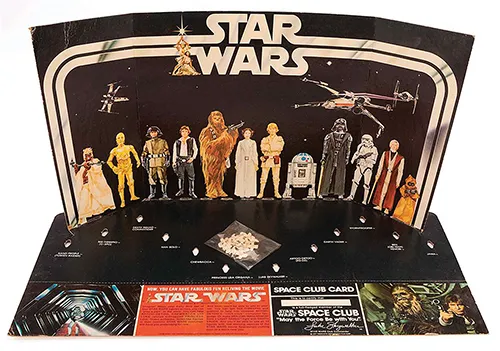
The Kenner Toys Star Wars line sold out so quickly that the company issued empty boxes with gift certificates, c. 1977 (Courtesy of Kenner Toys and Lucasfilm)
Consequently, in February 1978 Lucas announced that a sequel would enter production, and he confidently reported that the saga would incorporate nine films of which Star Wars was the fourth part.22 However, the franchise’s future was far from certain, and production on The Empire Strikes Back went over schedule and over budget.23 Its box-office success was not guaranteed, either, with Lucasfilm marketing consultant Ashley Boone arguing that audiences had to be ‘reconvinced’ by a sequel.24 Thus, in the run-up to Empire’s release, distributor Twentieth Century-Fox ran a campaign that saturated the media with TV spots, cast interviews, the early release of the soundtrack, radio advertising, and, of course, more merchandise.25 Nothing about Empire’s success was left to chance.
The Empire attacks
In June 1980, a little over a month after opening in theatres, The Empire Strikes Back had secured ‘the second largest weekend total of any new picture in film history’, collecting $10,840,307 in box-office revenue from 823 US theatres.26 Furthermore, the distributor expected it to exceed $50,000,000 ‘after only one week of wide release across the country’. Revenue, announced Twentieth Century-Fox, ‘is running consistently higher than Star Wars’. While it never eclipsed the sales figures of Star Wars and remains behind Episode IV in adjusted box-office terms, Empire was a financial success and received positive audience responses.27
In the film, the Rebels have established a base on the ice planet Hoth, where they are tracked, attacked, and forced to flee by invading Imperial forces with giant mechanical ‘Walkers’, or AT-ATs. The protagonists take diverging paths: Luke travels to Dagobah to complete his Jedi training with Yoda (Frank Oz), a small, 900-year-old alien creature. Meanwhile, Leia, Han, Chewie, and Threepio hide out in an asteroid field before travelling to Bespin’s Cloud City to seek protection from Lando Calrissian (Billy Dee Williams). They are attempting to evade Darth Vader and the Emperor (voiced by Clive Revill and played by Marjorie Eaton), who both fear Luke’s increasing power. However, on reaching Bespin the Rebels walk into a trap, for Vader has blackmailed Lando into giving up their whereabouts in exchange for Cloud City’s safety. Luke, sensing his friends are in trouble, defies Yoda and Obi-Wan’s advice (his mentor reappears as a Force ghost) and journeys to Bespin. He is too late to save Han, who is frozen in carbonite and handed to bounty hunter Boba Fett (Jeremy Bulloch) for delivery to crime lord Jabba the Hutt. Luke and Vader then battle in a lightsaber duel: Vader cuts off Luke’s hand, and in the film’s plot twist, reveals that he is Luke’s father. Barely alive after his rejection of Vader’s entreaties to join the Dark Side, Luke is rescued by Leia, Lando, Chewie, and the droids. Disheartened but not yet defeated, they set off to rescue Han.
With the Rebels’ victory uncertain, Empire’s narrative ambiguity resists a definite conclusion. Directed by Irvin Kershner, who was known for the character-driven and spectacularly camp The Eyes of Laura Mars (1978), Empire further destabilizes the uniformity of classical cinema with its restless cinematography and canted framing.28 Whereas Star Wars works on geometric planes along x, y, and z (width, height, and depth) axes – all right angles and static cinematography – Empire introduces anxiety-inducing diagonal planes, or ‘space diagonals’ that use asymmetry to create visual tension. Indeed, when Carrie Fisher said of the film, ‘sure, it’s a fairy tale, just like the first, but it has an additional dimension’, she could have been referring to characterization or the film’s aesthetics.29 Moreover, the film’s bolder, darker colour palette (which recalls the melodramas of Powell and Pressburger or Douglas Sirk), and eerie invocation of a ghostly Vader in the Dagobah gloom, introduce elements of camp, Gothic horror to the saga.30 Writing in The Washington Post, Gary Arnold proposed that the ‘deliberately unresolved sequel […] [is] aligning the story in a powerful, sinister new direction, full of dreadful implications for the original movie and the sequels ahead’.31 And with myriad social and political upheavals affecting both the US and the UK in 1980, Empire’s darker themes spoke to potential horrors occurring off-screen as well as on it.
Dark times
The moral and narrative uncertainty of Empire emerged from and into a cultural maelstrom of paranoia and change: alongside escalations in the Cold War and crises in living standards, Clyde Taylor points to economic anxieties which caused a ‘tremor in confidence’ in the ‘contradictions of advanced capitalism’.32 Certainly, the film is full of visual tremors. The cast bounce around the screen and rock back and forth as the Rebels weave between incoming asteroids in the Millennium Falcon, and the earth moves beneath them inside the mouth of a monstrous exogorth. Indeed, David S. Meyer refers to Empire as a film of ‘disarray’ and suggests that it speaks to the ‘political upheaval’ that led to President Carter losing to Ronald Reagan in the presidential election of November 1980.33 In the UK, where the film’s studio shoot took place, there was similar political turbulence. Stuart Hall, writing in 1979, acknowledged the ‘swing to the Right’ that had been gaining ‘dynamic and momentum’ since the late 1960s and preceded Margaret Thatcher’s Conservative Party winning an election held during Empire’s production.34 The film thus emerged amid upheaval and disturbance.
In his work on the original trilogy films in 1986, Robin Wood argued that increasingly right-wing politics at the turn of the 1980s brought about a desire for films such as Star Wars and Empire that offered ‘the comforting nostalgia for the childish [and the] repetitive pleasure of comic strip and serial’.35 In the aftermath of Vietnam and Watergate, he proposed that ‘reassurance is the keynote’.36 Later, writing in 1993, Ed Guerrero described Star Wars as ‘a white versus Black allegory that celebrated the recovery of patriarchy and a technological militarism’, that, as a product of the corporatized blockbuste...
Table of contents
- Cover
- Halftitle Page
- Title Page
- Contents
- Acknowledgments
- Notes on the Text
- Introduction
- 1 Creating an Empire
- 2 In Production
- 3 The Film
- 4 Seeing Star Wars
- 5 Critics Strike Back
- 6 Number Five at Number One
- Notes
- Credits
- Glossary
- Bibliography
- Imprint
Trusted by 375,005 students
Access to over 1.5 million titles for a fair monthly price.
Study more efficiently using our study tools.
Frequently asked questions
Yes, you can cancel anytime from the Subscription tab in your account settings on the Perlego website. Your subscription will stay active until the end of your current billing period. Learn how to cancel your subscription
No, books cannot be downloaded as external files, such as PDFs, for use outside of Perlego. However, you can download books within the Perlego app for offline reading on mobile or tablet. Learn how to download books offline
Perlego offers two plans: Essential and Complete
- Essential is ideal for learners and professionals who enjoy exploring a wide range of subjects. Access the Essential Library with 800,000+ trusted titles and best-sellers across business, personal growth, and the humanities. Includes unlimited reading time and Standard Read Aloud voice.
- Complete: Perfect for advanced learners and researchers needing full, unrestricted access. Unlock 1.5M+ books across hundreds of subjects, including academic and specialized titles. The Complete Plan also includes advanced features like Premium Read Aloud and Research Assistant.
We are an online textbook subscription service, where you can get access to an entire online library for less than the price of a single book per month. With over 1.5 million books across 990+ topics, we’ve got you covered! Learn about our mission
Look out for the read-aloud symbol on your next book to see if you can listen to it. The read-aloud tool reads text aloud for you, highlighting the text as it is being read. You can pause it, speed it up and slow it down. Learn more about Read Aloud
Yes! You can use the Perlego app on both iOS and Android devices to read anytime, anywhere — even offline. Perfect for commutes or when you’re on the go.
Please note we cannot support devices running on iOS 13 and Android 7 or earlier. Learn more about using the app
Please note we cannot support devices running on iOS 13 and Android 7 or earlier. Learn more about using the app
Yes, you can access The Empire Strikes Back by Rebecca Harrison in PDF and/or ePUB format, as well as other popular books in Media & Performing Arts & Film & Video. We have over 1.5 million books available in our catalogue for you to explore.