Analysing three cases of British colonial violence that occurred in the latter half of the 19th century, this book argues that all three share commonalities, including the role of racial prejudices in justifying the perpetration of extreme colonial violence. Exploring the connections and comparisons between the Perak War (1875–76), the 'Hut Tax' Revolt in Sierra Leone (1898–99) and the Anglo-Egyptian War of Reconquest in the Sudan (1896–99), Gordon highlights the significance of decision-making processes, communication between London and the periphery and the influence of individual colonial administrators in outbreaks of violence.
This study reveals the ways in which racial prejudices, the advocacy of a British 'civilising mission' and British racial 'superiority' informed colonial administrators' decisions on the ground, as well as the rationalisation of extreme violence. Responding to a neglect of British colonial atrocities within the historiography of colonial violence, this work demonstrates the ways in which Britain was just as willing and able as other European Empires to resort to extreme measures in the face of indigenous resistance or threats to the British imperial project.
eBook - ePub
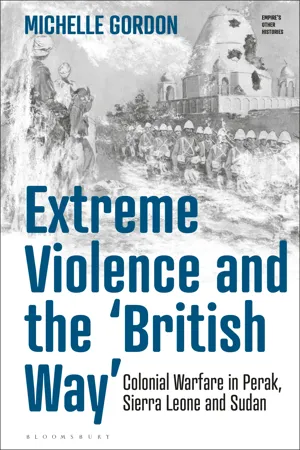
Extreme Violence and the ‘British Way’
Colonial Warfare in Perak, Sierra Leone and Sudan
- 256 pages
- English
- ePUB (mobile friendly)
- Available on iOS & Android
eBook - ePub
Extreme Violence and the ‘British Way’
Colonial Warfare in Perak, Sierra Leone and Sudan
About this book
Information
1
Introduction
The place of colonial violence within the history of the British Empire
In many ways, the British Empire remains ubiquitous in British society and culture. It is present in Britain’s street names, its monarchy and its rewards system, museums and statues to name a few. ‘Positive’ aspects of Britain’s imperial legacy are regularly espoused and this narrative typically includes abolition, benevolence and all-round British ‘exceptionalism’, which claims Britain was ‘not as bad’ as other contemporaneous European empires and that decolonization was achieved peacefully. But the realities and consequences of the British imperial project on the ground are often overlooked and underplayed. Infamous violent episodes are expressed as ‘regretful’, but not part of the wider system of colonialism. The true extent of the violence used to uphold the empire and British interests as a whole has failed to seep into British consciousness more generally. Britain’s direct relationship with extreme – and at times genocidal – violence needs to be acknowledged.1 The empire is an inescapable part of British history, but also of numerous countries across the world that were given no choice but to be a part of it. Rather than a component of a ‘positive’ British identity, we need to engage honestly with this history, moving beyond arguments of benevolence, balance sheet approaches and a dichotomy of ‘good’ versus ‘bad’.
We cannot understand the empire, what it means within British history, nor its consequences for the ‘colonized’ without an examination of the violence that was used to establish and maintain colonial relations. This study aims to write violence back into the history of the British Empire and argues the importance of acknowledgements of and engagements with the imperial project’s reliance on violence or the threat thereof, within standard histories of empire.2 This study examines three instances of colonial violence and explores the nature of colonial warfare in the British Empire, focusing specifically on the second half of the nineteenth century, therefore within the period of ‘new imperialism’. The cases of colonial violence that will be in focus are the Perak War in Malaya (1875–6), the ‘Hut Tax’ War in Sierra Leone (1898–9) and the Anglo-Egyptian War of Reconquest in Sudan (1896–9). In each case, the British used a variety of methods to enforce and maintain their power in these regions. These methods included the use of ‘divide and rule’ tactics, looting, a disregard for international standards of warfare, the use of collective reprisals on civilians and scorched earth policies, starvation tactics on the enemy, as well as the wider population. Throughout, I will investigate issues that contributed to outbreaks of extreme violence, including Britain’s superiority complex, which led to an intricate web of contradictory policies and justifications for imperial oppression. There will be an exploration of the increasing influence of ‘scientific’ racism and the racial prejudices which accompanied the British imperial project and how these developments influenced the manner in which the ‘men on the spot’ dealt with indigenous populations.3 I will consider the role of these men in shaping events on the ground and the nature of the violence once hostilities broke out. I argue the importance of the role of communications between London and the periphery, particularly in terms of understanding the decision-making processes that led to the use of more extreme tactics of violence, as well as tensions between these two localities. I will address the influence of politicians in the imperial metropole related to the use of extreme violence across the empire to suppress indigenous opposition. The part played by Britain’s military men in advocating and participating in extreme methods of violence is also central to this work and I examine the role played by racial prejudices, conditions on the ground and the doctrine of ‘colonial warfare’ in the perpetration of this violence.
My approach also explores the case studies in the context of what they can tell us about the wider history of the British Empire and its relationship with violence. This book endeavours to place violence at the centre of the history of Britain’s imperial project; this is an important aim, not least in order to bring indigenous silent suffering to the fore – ‘silent’ from the perspective of ‘colonial archives’ – and acknowledge the devastation that was wrought across the empire. I will illuminate the direct consequences of colonialism that were of little interest to the colonists, but which are often implicitly discernible in histories and accounts of the empire. While a central aim of this work is to demonstrate how the British Empire contributed to a wider framework of violence, it is also important to emphasize that these events need to be considered in their own right. It is essential that individual examples of British colonial violence be addressed and acknowledged by historians; given the ubiquity of violence across the empire, smaller instances of violence or British campaigns in ‘small wars’ are often forgotten or ignored.4
Violence, genocide and the British Empire
While this work is groun ded in British imperial history and understandings of the dynamics of colonialism, studies of mass violence are key to my analysis of cases of extreme British colonial violence. As such, this work has the merit of bringing together the fields of imperial history and studies of mass violence. There are of course imperial historians that engage with the complex histories of violence and empire; however, there is often a particular lack of engagement between imperial and genocide scholars, and for some imperial historians, discussions related to colonial genocide are addressing an ‘anachronistic question’.5 However, the aim of such discussions is not to ‘fit’ colonial violence into contemporary definitions of genocide, as Jordanna Bailkin claims. Rather, historians are viewing genocidal violence as part of a wider historical process.6 Also, as Dirk Moses argues, ‘colonialism needs to be viewed as a dynamic process’ within an international context.7 Both he and Mark Levene discuss the importance of genocidal ‘moments’ of potentiality8 within colonialism that need to be investigated, thus helping us to identify key instances in which genocide can become a policy option, even if this is not realized.9 Rather than holding genocide up as the ‘ultimate yardstick of depravity’, it is important to acknowledge that extreme violence is part of a wider framework of destruction that includes a range of dynamics of violence, which in certain circumstances may become genocidal.10
Studies of violence and genocide have contributed significantly to understandings of the dynamics of violence against indigenous peoples in the colonies.11 Standard histories of the British Empire often neglect violence as a category for analysis and certainly do not discuss the genocidal processes that were apparent in settler colonialism.12 Histories of British colonial campaigns are generally limited to traditional and, at times, ‘parochial’ military history.13 Furthermore, examples of British colonial violence are often studied in isolation, rather than within a consideration of the wider implications of the role of violence across the British Empire. Studies tend to neglect the wider context and how these brutalities may be part of a broader pattern of both British and European colonial violence. Examples include the suppression of the Indian Uprising of 1857,14 the Morant Bay Rebellion (1865),15 the Second Anglo-Boer War (1899–1902)16 and the Amritsar Massacre (1919).17 Other areas of research include Rhodesia, Ireland and Zululand.18 Scholars of counterinsurgency are examining the violence of the British Empire focusing on the Arab Revolt in Palestine in 1936–9,19 and the prolonged and brutal ending of empire in Malaya (1948–60) and Kenya (1952–60). Indeed, recent research on these processes has proved particularly fruitful – based on archival research20 – and demonstrates that British decolonization did not reflect a ‘graceful exit’, as the prevailing view suggests but that extreme violence was continually resorted to as Britain clung to power.21 Furthermore, decolonization was not simply a gift handed to the ‘colonized’ as Priyamvada Gopal has shown, but was hard fought for by the ‘colonized’.22 Studies of decolonization are relevant to the present study because the wars of ‘pacification’ across the empire in the second half of the nineteenth century anticipated the violence that came with the demise of the British imperial project; hence, the violence of the latter was the logical conclusion to British colonial rule, rather than a ‘radicalization’ of this violence.23
Also within imperial history, there has been a recent focus on inherent everyday violence within the colonies. Aspects of British rule that are being emphasized include the failings and contradictions within colonial legal systems, demonstrating the huge gulf between the principle and practice of British law in colonial rule and therefore emphasizing an inherent hypocrisy within the running of the British Empire.24 As Jill Bender emphasizes, we need to understand both the ‘micromoments’ of everyday violence as well as the ‘macromoments’ such as the Indian Uprising, which, as Bender and others have argued, ‘dramatically shaped the accepted use of force in the colonies’.25 Regarding such violence, the role of law and order in the colonies is significant, and this issue has implications for our understanding of both everyday violence and the processes of more extreme violence. Taylor Sherman’s work on quotidian violence undertaken by the colonial state in India shows that once colonial rule was established, everyday violence remained in a variety of forms: ‘from firing on crowds and bombing from the air, to dismissal from one’s place of work or study, to collective fines, imprisonment and corporal punishment’.26 Hence, the relationship between war and peace in the colonies was blurred as a result of the continual threat of vio...
Table of contents
- Cover
- Half-Title
- Title
- Contents
- Acknowledgements
- List of illustrations
- 1 Introduction: The place of colonial violence within the history of the British Empire
- 2 A ‘little war’ in Perak: British intervention, 1875–6
- 3 British suppression of the ‘Hut Tax’ War in Sierra Leone, 1898–9
- 4 The Anglo-Egyptian reconquest of Sudan, 1896–9
- 5 Conclusion: Was there a British way in colonial warfare?
- Bibliography
- Index
- Copyright
Trusted by 375,005 students
Access to over 1.5 million titles for a fair monthly price.
Study more efficiently using our study tools.
Frequently asked questions
Yes, you can cancel anytime from the Subscription tab in your account settings on the Perlego website. Your subscription will stay active until the end of your current billing period. Learn how to cancel your subscription
No, books cannot be downloaded as external files, such as PDFs, for use outside of Perlego. However, you can download books within the Perlego app for offline reading on mobile or tablet. Learn how to download books offline
Perlego offers two plans: Essential and Complete
- Essential is ideal for learners and professionals who enjoy exploring a wide range of subjects. Access the Essential Library with 800,000+ trusted titles and best-sellers across business, personal growth, and the humanities. Includes unlimited reading time and Standard Read Aloud voice.
- Complete: Perfect for advanced learners and researchers needing full, unrestricted access. Unlock 1.5M+ books across hundreds of subjects, including academic and specialized titles. The Complete Plan also includes advanced features like Premium Read Aloud and Research Assistant.
We are an online textbook subscription service, where you can get access to an entire online library for less than the price of a single book per month. With over 1.5 million books across 990+ topics, we’ve got you covered! Learn about our mission
Look out for the read-aloud symbol on your next book to see if you can listen to it. The read-aloud tool reads text aloud for you, highlighting the text as it is being read. You can pause it, speed it up and slow it down. Learn more about Read Aloud
Yes! You can use the Perlego app on both iOS and Android devices to read anytime, anywhere — even offline. Perfect for commutes or when you’re on the go.
Please note we cannot support devices running on iOS 13 and Android 7 or earlier. Learn more about using the app
Please note we cannot support devices running on iOS 13 and Android 7 or earlier. Learn more about using the app
Yes, you can access Extreme Violence and the ‘British Way’ by Michelle Gordon in PDF and/or ePUB format, as well as other popular books in History & 19th Century History. We have over 1.5 million books available in our catalogue for you to explore.