eBook - ePub
Creating Time
Using Creativity to Reinvent the Clock and Reclaim Your Life
- 268 pages
- English
- ePUB (mobile friendly)
- Available on iOS & Android
eBook - ePub
About this book
Most of us have said, "If only I had more time," as a way of explaining why we aren't leading our most fulfilling lives. This book turns the concept of time management upside down by presenting exciting new tools for viewing and experiencing your time. Creating Time combines creativity with science in a gorgeous colorful format that presents a fascinating adventure in which you will imagine, create, and completely reshape the way you experience time. Each chapter presents a shift-making concept illustrated by real-life examples, step-by-step introspective processes, and powerful creative projects that inspire a new sense of time, a liberating view of self, and a fresh perspective on the meaning of being human, empowered, and fully alive.
Includes a download link to your FREE Time Expansion Kit!
Information
Topic
Personal DevelopmentSubtopic
Time ManagementSECTION 1
EXPLORING YOUR
RELATIONSHIP WITH TIME
 | 1. WHAT IS TIME? |
Poetic Pause
Time as sunflowers
Facing the light in worship
Petaling forward
The subject of time covers everything from how long something takes to how old we are, how long we will live, and decisions about the “right time” to make choices or take action. Time is familiar to everyone, and yet it’s quite challenging to define and identify.
Modern science defines time within the term space-time in an effort to explain that coordinates in time do not exist without the corresponding coordinates in space. Space-time may therefore reference a scientific interpretation of time. To fully explain the personal experience of time, however, there are an endless number of “coordinates” that locate us in a certain moment, such as emotions, expectations, relationships, and values.
We do not live in purely sequential time, where any moment consists of the moment and that moment only. In fact, the true “present” is so brief that it can’t even be perceived. So, naturally, even when we are completely focused in the present, our awareness extends both to the past and to the future. To illustrate the brief temporality of the present, Leonardo da Vinci said, “The water you touch in a river is the last of that which has passed, and the first of that which is coming. Thus it is with time present.”
The term specious present, coined by E. Robert Kelly (aka E. R. Clay) in 1882, refers to the period that we tend to think of as the present, though it also includes the near past and upcoming future. Specious present indicates the overlap between the circles of past, present, and future. In actuality, though, our perception extends beyond the overlap of three defined circles. We can feel the fabric of time folding itself over us, or perhaps folding itself within us, at every given moment.
“I have a vision of the three bears with bowls of ‘time’ instead of porridge. Ultimately, time is precious, whether it’s going too fast, too slow, or just right.”
— SANDE ROBERTS,
ARTbundance Coach
ARTbundance Coach
By way of example, I identified a few of the time continua that we use to measure and define time, and asked artist Michelle Berlin to illustrate them as linear timelines. As you can see, each one is represented here by an arrow facing in one direction.
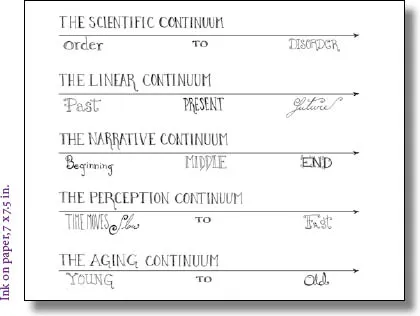
Linear Time Continua
by Michelle Berlin
by Michelle Berlin
The Linear Time Continua graphs indicate a variety of quantitative continua. However, qualitative continua are more multidimensional, allowing us to measure time in an infinite number of ways. Here are some examples that come to my mind, again illustrated by Michelle:
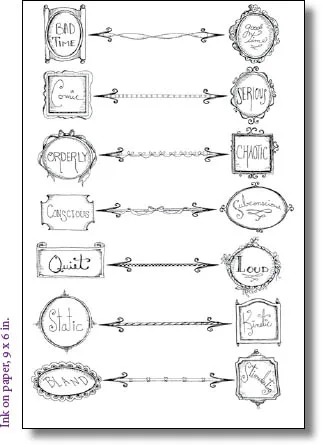
Nonlinear Time Continua
by Michelle Berlin
by Michelle Berlin
Any given moment can be plotted on any combination of the above timelines, as a way to “measure” it. However, when we do so, the measurement consists not only of the “dot” itself but also of the very continuum it lies upon. No matter how we choose to measure time, any moment includes the entire time continuum. Time is not something outside of us; it is an element of everything.
THE PROBLEM WITH TIME
I asked some ACT trainees why we have time, and here are a few of their responses:
“Time allows us to see, to witness the unfolding of free will.” — Tanya Laurin
“We use time to categorize our moments, by year, era, or timeline. Time is a backdrop to place our memories in order, to make sense of the happenings that take us from here to there.” — Amy Heil
“Time makes life’s ‘little gifts’ bigger. Time is here for us to learn and heal and discover.” — Peggy Lynn
As all the statements above indicate, the structure of time allows us to see and experience life. And yet time also can blind us to greater truths, as our time-based consciousness can greatly limit our worldview.
The concept of time management is very new, just as “stress” is a modern phenomenon. Time management can improve what we accomplish but often at the peril of what we experience. As a result, the more we try to manage our time, the more fragmented we feel. If you pay attention to the conversations all around you, it’s startling how often the subject of time comes up.
“How are you?”
“Oh fine, just crazy busy…”
“You should come check it out…”
“Yeah, I know; I just don’t know when I can find the time…”
“How are you?”
“I can’t really talk now, I’m running late…”

People used to be tied to things like families, communities, rituals, worship, curiosity, and beauty. Now we are tied to schedules, watches, datebooks, computers, gadgets that start with i, the media, and exercising on treadmills that don’t go anywhere.
ARTbundance Coach Amy Heil expressed it nicely: “When we become a slave to the system of measuring time, when we are focused on too much or not enough, we are not serving our best interests. This instant is truly endangered, so the only time to focus on is now!”
Somehow the tendencies of our society make it acceptable and even expected that we fall into patterns of being worried and stressed about time. And while worrying about time seems to be part of our humanity, I wonder…does it really need to be?
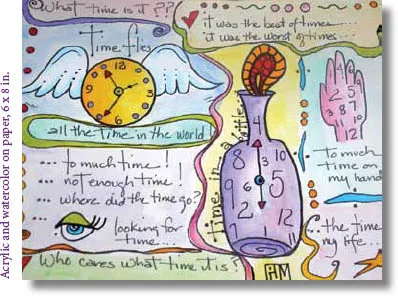
Time Collage by Patricia J. Mosca
MEASUREMENT AND PERCEPTION
One second is officially defined in atomic time as 9,192,631,770 oscillations of the “undisturbed” cesium atom. However, even with this precise number of oscillations, time is surprisingly nonuniform. There is not perfect unity between the rotation of the earth (which measures a day) and atomic time. In fact, official time often has to be put back or forward a bit to compensate.
We measure time in a variety of units, from seconds, hours, and minutes to beginning, middle, end. We also measure time according to our needs (“Is it time to eat yet?”), external demands (“When is it due?”), and anticipations (“Are we there yet?”). Regardless of how we measure time, however, that measurement is always trumped by perception. While so many of us are controlled by time, the interesting thing is that we’re rarely aware of time itself. We usually don’t know how long something takes in the moment, and yet its length is how we end up measuring it.
I was stunned at my own inability to correctly perceive time when recently I was having an MRI and was situated so that I could see a countdown timer of the scan, which I presume is there so that the patient knows how much longer she needs to stay still. I played a game of closing my eyes and opening them when I thought a minute had passed. The first time, I opened my eyes after only forty seconds. I tried again, and it had been forty-one seconds. I continued to try for each minute, and each time I was “accurate” within my own perception: I always opened my eyes at around forty seconds. It was only when I pushed myself to wait a little longer that I came closer to a minute, and I was still under sixty seconds.
Naturally, lying still in an MRI machine would qualify as one of those instances when time perception is slowed, the antithesis of “Time flies when you’re having fun.” Still, I was surprised at my experience. I suppose I shouldn’t have been; many scientific experiments have proved that individuals have a varying sense of perception of time passing. Psychochronometry is the study of the psychology of time estimation. Many studies have explored the various factors that affect time perception, including environment, emotions, and age. Studies of the Logtime Hypothesis, for example, have found that perception of the passage of time increases by the square root of one’s age, and at age sixty, time is perceived about two and a half times faster than it was at age ten.
I decided to conduct my own experiment, a casual wa...
Table of contents
- Cover
- Title
- Copyright
- Dedication
- Contents
- Foreword by Marci Shimoff
- Introduction
- Section 1: Exploring Your Relationship with Time
- Section 2: Creating Time through Creativity
- Section 3: Integration and Inspiration
- Preface: (or, The End Is Really the Beginning)
- Acknowledgments
- Notes
- Illuminating Time Wraps
- Contributors
- Index
- About the Author
- Visit the Enchanting Isles of Artella Land
Trusted by 375,005 students
Access to over 1.5 million titles for a fair monthly price.
Study more efficiently using our study tools.
Frequently asked questions
Yes, you can cancel anytime from the Subscription tab in your account settings on the Perlego website. Your subscription will stay active until the end of your current billing period. Learn how to cancel your subscription
No, books cannot be downloaded as external files, such as PDFs, for use outside of Perlego. However, you can download books within the Perlego app for offline reading on mobile or tablet. Learn how to download books offline
Perlego offers two plans: Essential and Complete
- Essential is ideal for learners and professionals who enjoy exploring a wide range of subjects. Access the Essential Library with 800,000+ trusted titles and best-sellers across business, personal growth, and the humanities. Includes unlimited reading time and Standard Read Aloud voice.
- Complete: Perfect for advanced learners and researchers needing full, unrestricted access. Unlock 1.5M+ books across hundreds of subjects, including academic and specialized titles. The Complete Plan also includes advanced features like Premium Read Aloud and Research Assistant.
We are an online textbook subscription service, where you can get access to an entire online library for less than the price of a single book per month. With over 1.5 million books across 990+ topics, we’ve got you covered! Learn about our mission
Look out for the read-aloud symbol on your next book to see if you can listen to it. The read-aloud tool reads text aloud for you, highlighting the text as it is being read. You can pause it, speed it up and slow it down. Learn more about Read Aloud
Yes! You can use the Perlego app on both iOS and Android devices to read anytime, anywhere — even offline. Perfect for commutes or when you’re on the go.
Please note we cannot support devices running on iOS 13 and Android 7 or earlier. Learn more about using the app
Please note we cannot support devices running on iOS 13 and Android 7 or earlier. Learn more about using the app
Yes, you can access Creating Time by Marney K. Makridakis in PDF and/or ePUB format, as well as other popular books in Personal Development & Time Management. We have over 1.5 million books available in our catalogue for you to explore.