Both science and spirituality see the enemy as a teacher — one who holds information critical to resolving common struggles. But learning from one's enemies, especially in these polarized times, can be a profoundly difficult task. Worst Enemy, Best Teacher integrates spiritual, cultural, and scientific methods to transform adversarial relationships into powerful learning experiences. Here mediator and corporate trainer Deidre Combs expands on the revolutionary philosophy introduced in her first book The Way of Conflict. She suggests a cross-cultural elemental typing system — earth, air, fire, water — to identify and learn how best to approach the person or problem that plagues us most — whether it's a neighbor, a brother-in-law, a new boss, or the factory's fiercest competitor. The book shows how to apply the wisdom gained from studying the opponent to any challenge, whether within one's self, with friends or family, or between companies or nations, and offers ingenious tips and techniques for learning from the enemy and converting conflict into resolution.
eBook - ePub
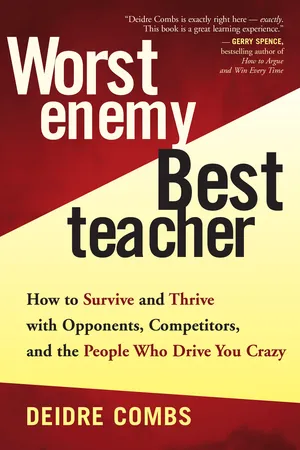
Worst Enemy, Best Teacher
How to Survive and Thrive with Opponents, Competitors, and the People Who Drive You Crazy
- 227 pages
- English
- ePUB (mobile friendly)
- Available on iOS & Android
eBook - ePub
Worst Enemy, Best Teacher
How to Survive and Thrive with Opponents, Competitors, and the People Who Drive You Crazy
About this book
Trusted by 375,005 students
Access to over 1.5 million titles for a fair monthly price.
Study more efficiently using our study tools.
Information
Topic
Personal DevelopmentSubtopic
Personal SuccessPART ONE
Learning to Live Fully
No pressure, no diamonds.
— MARY CASE
CHAPTER ONE
See Your Enemy
as a Teacher
Listen to your enemy, for God is talking.
— JEWISH PROVERB
In India, everything has a purpose. The tea and the tea grower, the yogi and the thief, the mother and the child: all have a purpose.
One clear and temperate day, a Brahman, or priest, was walking happily down a dusty road when he heard the most terrible weeping coming from under a large tree. The Brahman knew that it was his job to help even the most pitiful, so he ran over to the tree to find a tiger in a cage. “Help me, help me,” cried the tiger. “They are going to make a rug out of me. Please release me from this cage.”
“Well,” thought the Brahman, “it is my purpose to help even the most pitiful, but this is a tiger. He might eat me.”
“Please, oh please, help me,” sobbed the tiger.
“If I let you go,” said the Brahman, “do you promise not to eat me?”
“I won’t eat you. Please hurry and let me out,” replied the tiger.
So the Brahman opened the cage and the tiger leapt out, right on top of the Brahman!
“Thank you,” said the tiger. “Now prepare to be eaten.”
“Is there no gratitude, did you not promise to spare me?” asked the Brahman.
The tiger thought for a moment or two and replied, “Let us do this. Go ask the first three things that you see on the road ahead if I should eat you. If one says no, then go on your way; otherwise, return to your destiny.”
So grimly down the road went the Brahman until he came to a pipal tree. When he told the tree his situation, the tree replied, “All my life people have come and used my branches to make whips and fires. I give shade and shelter, and I am given nothing in return. There is no gratitude; the tiger is your destiny, return to be eaten.”
Next, he found an elephant with an iron chain and ring attached to his foot. The Brahman wept as he told the elephant about the tiger and asked if the tiger should eat him. The elephant replied, “I work from morning to night for my master. I am whipped and chained. There is no gratitude. Go prepare to be eaten.”
The Brahman looked down in despair and spoke to the road beneath him. “You have heard my story. Doeth thou think the tiger should eat me?” The road quickly replied, “Holy man, I have listened to your story and ask you to remember that I am useful to all. Nevertheless, people trample on me and drop their garbage upon my back. Return to the tiger.”
As the Brahman began to walk back to the tiger, he heard a voice from behind him say, “I just don’t understand, you want to eat a tiger?”
The Brahman spun around to see a small jackal sitting in the middle of the road. “No,” said the Brahman. “The tiger wants to eat me,” and he told the jackal his tale.
“Very strange, you are very scrawny, and you don’t eat meat. I just don’t understand. Take me to this tiger,” the jackal commanded. So, frustrated with the jackal, the Brahman accompanied him back to the tiger.
The tiger lay under the large tree, purring with contentment. “You have returned, as I knew you would. Now, prepare for your fate,” he said.
The jackal replied, “Very confusing, very confusing, I just don’t understand. You are going to let this man eat you?”
“No, you silly creature,” the tiger gruffly answered. “I am going to eat the man,” and he explained the situation and how it was his destiny to eat the Brahman.
“I just don’t understand why you would let a man eat you. How did the man get into the cage? Very strange, very strange,” said the jackal.
“I AM GOING TO EAT HIM,” roared the tiger. “I was in the cage, you idiot, like this!”
As the tiger leapt back into the cage, the jackal shut the door saying, “Don’t let the tiger out again.” And he ran away.
In the future, the Brahman was a wiser man. He continued to serve the poor and help even the most pitiful. But he had learned. If nothing else, he had learned that even tiger cages serve a purpose.
If you want to make enemies, try to change something.
— WOODROW WILSON
Like the Brahman, we too may walk down happy roads, basically content with our lot, when we are called to react to an adversary. “Tigers” appear in our homes, in our businesses, and at our national borders. They shake up our worlds and can threaten our very existence. We may hate them and see their presence as an injustice, but as we will discuss in this chapter, even enemies have a purpose.
Enemy, what a strong word. When I speak and consult on conflict strategies and recommend that we should “learn from the enemy” or “appreciate the enemy,” many believe that this advice applies to very few in their lives. Initially, they think of enemies as dangerous criminals or those whom they know hate and wish to destroy them. They relegate the word to international conflicts, fierce personal battles, and serious illnesses like cancer.
However, the etymology of the word enemy describes it as simply “not friend.” It is one that “opposes the purposes or interests of another.” An “enemy” can thus be anyone, or anything, that brings difference or discord into our lives. With this broadened definition, a terrorist is of course an enemy, but so are a dear next-door neighbor and his barking puppy. Both business clients and trusted employees who disagree with a new policy would fit this description. Family members who strike out in directions for which we are not prepared become surprise adversaries. Viruses and death are global enemies. And the list continues. …
Be grateful even for hardship, setbacks, and bad people. Dealing with such obstacles is an essential part of training in the Art of Peace.
— MORIHEI UESHIBA
The bad news is, using this definition, we are surrounded by enemies. Initially that can be quite a fear-inducing thought. However, our opponents can bring us information that we most need at this time, which they are drawn to share with us. We can therefore view all opponents as potential teachers. This expanded description makes the world our classroom, where we are encircled by those who assist in our evolution and transformation. In this view, an enemy becomes anything that causes us problems, be it a bothersome person, a strange culture, or a chronic illness, and, like any other difficulty with which we are faced, it can be perceived as one who brings opportunity.
“The Tiger and the Brahman” is a Jataka, or a Buddhist teaching tale, that describes a past life of the Buddha. I tell stories monthly at a local elementary school and like to recount this tale and its origins. So when I ask which character the kids think is the Buddha, they will initially yell out, “The Brahman!” When I smile and don’t respond, soon after I’ll hear, “The jackal!” No one ever guesses the tiger.
We may not like them, and we might justly fear them, but we absolutely need our opponents. Without up there is no down. Without black, we have no white. Without the tiger, there is no wise Brahman. Our adversaries show us who we are by holding up a contrasting side. As one client told me, “My mother-in-law has always been extremely critical because we don’t attend church. I hated her attacks, yet she was just what I needed to explore my spiritual beliefs and to share my discoveries with my children.”
Through our adversaries’ pushing, we can more clearly perceive our own capabilities and innate values. A newly married Iraqi woman in her twenties, Intisar, was directing a women’s relief organization in her country soon after the war in 2003. “We must stay small for now because of those who oppose our work,” Intisar explained. Yet through these trials, she has resolved to persevere: “I tell my family that they should not mourn for me if I die. In the past, others were killed for no reason. What I am doing has meaning, and this makes the dangers worth confronting.”
If we forget that our opponent is a potential teacher, we can become distracted by the question “Why me?” The Brahman gets stuck in the injustice of it all and almost perishes as a result. We might ask, “Why is he picking on me?” or, “Why did this happen to us?” Although we can gather information with these queries so that the situation won’t happen again, we won’t learn anything until we accept our reality. As the elephant, tree, and road describe, life isn’t always fair. Tigers eat people, terrorists bomb buildings, and illnesses attack our immune systems. These events are indeed horrible, but we need to accept what is and figure out what to do next.
An unencumbered stream has no song.
— ZEN SAYING
Jerry White, cofounder and president of Landmine Survivors Network, explains, “You probably remember a date that cleaved your personal history into ‘before’ and ‘after.’ [Landmine] survivors aren’t the only ones who have devastating experiences. All of us have ‘explosive’ events — illnesses, deaths, accidents — that create an urgent need for resiliency and resolve. And each of us, if we’re fortunate, may also have a day when we start to conquer those events.”
We might also mistakenly believe that we already hold all the answers. The Brahman might have said, “It is my job to help even the most pitiful, and I know exactly what that means.” Fixed perceptions leave us vulnerable, and we do not see other perspectives when we are sure we have the complete picture. With rigid views, we instead unconsciously invite opponents to drop by and show us what we have missed.
To learn from our opponent and to resolve conflict, we must change the paradigm. Conflict calls us to see the world in completely new ways. “So you want to eat a tiger?” Stand on your head and turn your beliefs inside out to see more broadly; from that perspective lies the true solution. Our dumb jackal was the wisest in the bunch. We must remember that nothing is fully as it seems.
In some conflicts, enemies become so victimized or attached to their views that they believe that the other is evil and must be destroyed. The Holocaust and the recent civil wars in Rwanda and Bosnia make this painfully clear. We are all at great risk in these circumstances both as potential victims and as perpetrators. Whenever we demonize, we commit atrocities that in times of peace we would define as deeply wrong. The humiliation and torture of prisoners by U.S. and British soldiers in Iraq’s Abu Ghraib prison in 2003 provided a sobering example of this propensity. Yet by studying history and the warrior traditions, including conflict texts like the three-thousand-year-old The Art of War, we find that seeking mutual destruction is rarely our best or only available response.
We get stuck in a conflict when we believe it is irresolvable. When we fight with demonized enemies we might then see our only solution as “seek and destroy.” Since our world is intimately interconnected, the destruction of our enemies weakens our own position. By removing my opponent, I also lose access to his perspectives, resources, and solutions. We destroy cultures, ecosystems, and species in this way, and ultimately we compromise our own health and safety.
Running away also buys us nothing in the long term. At the beginning of the Bhagavad Gita, an ancient Hindu epic story about life’s battles, the kind warrior Arjuna is leading an army into a war against his relatives. He is to fight for what he knows is right. Arjuna starts by begging the god Krishna, who is at his side, not to fight, for he does not want to harm his family and compatriots. Krishna says Arjuna must fight:
Arjuna said: … Thou holdest that the attitude of detachment is superior to action, then why O Keshava, does thou urge me to dreadful action? …
The Lord [Krishna] said: … Never does man enjoy freedom from action by not undertaking action, nor does he attain that freedom by mere renunciation of action.
When we are faced with an enemy, a person, or group of people that wishes us harm, we can view this as an opportunity to develop patience and tolerance. … And the only occasion we have to develop them is when we are challenged by an enemy. So, from this point of view, our enemy is our guru, our teacher … a blessing.
— HIS HOLINESS THE DALAI LAMA
But as Krishna and Mohandas Gandhi, who drew heavily from ...
Table of contents
- Cover
- Title
- Copyright
- Dedication
- Contents
- Introduction
- Part 1: Learning to Live Fully
- Part 2: An Everyday Warrior’s Handbook
- Conclusion
- Appendix: Quick Reference to the Four Opponent Types
- Notes
- Selected Bibliography and Resources
- Acknowledgments
- Index
- About the Author
Frequently asked questions
Yes, you can cancel anytime from the Subscription tab in your account settings on the Perlego website. Your subscription will stay active until the end of your current billing period. Learn how to cancel your subscription
No, books cannot be downloaded as external files, such as PDFs, for use outside of Perlego. However, you can download books within the Perlego app for offline reading on mobile or tablet. Learn how to download books offline
Perlego offers two plans: Essential and Complete
- Essential is ideal for learners and professionals who enjoy exploring a wide range of subjects. Access the Essential Library with 800,000+ trusted titles and best-sellers across business, personal growth, and the humanities. Includes unlimited reading time and Standard Read Aloud voice.
- Complete: Perfect for advanced learners and researchers needing full, unrestricted access. Unlock 1.5M+ books across hundreds of subjects, including academic and specialized titles. The Complete Plan also includes advanced features like Premium Read Aloud and Research Assistant.
We are an online textbook subscription service, where you can get access to an entire online library for less than the price of a single book per month. With over 1.5 million books across 990+ topics, we’ve got you covered! Learn about our mission
Look out for the read-aloud symbol on your next book to see if you can listen to it. The read-aloud tool reads text aloud for you, highlighting the text as it is being read. You can pause it, speed it up and slow it down. Learn more about Read Aloud
Yes! You can use the Perlego app on both iOS and Android devices to read anytime, anywhere — even offline. Perfect for commutes or when you’re on the go.
Please note we cannot support devices running on iOS 13 and Android 7 or earlier. Learn more about using the app
Please note we cannot support devices running on iOS 13 and Android 7 or earlier. Learn more about using the app
Yes, you can access Worst Enemy, Best Teacher by Deidre Combs in PDF and/or ePUB format, as well as other popular books in Personal Development & Personal Success. We have over 1.5 million books available in our catalogue for you to explore.