Popular misconceptions of psychic ability and ESP have often prevented these topics from being taken seriously, yet an abundance of scientific research shows that we have a tremendous capacity for developing these talents. In 1972, physicist Russell Targ, co-founded the Stanford Research Institute’s program to investigate the development of psychic abilities. In his ten years with this program, he came to understand that most people have the ability to describe events and locations that are blocked from ordinary perception. The term remote-viewing was coined for this ability. In this, his sixth book, Targ explores the scientific as well as the spiritual implications of remote viewing and offers detailed exercises to assist readers in cultivating their own psychic abilities.
Russell offers several techniques and exercises to overcome all of this clatter and to develop remote-viewing skills. Remote-viewing offers a path of self-inquiry and self-realization and expands our limited awareness of the consciousness shared by all humans.
eBook - ePub
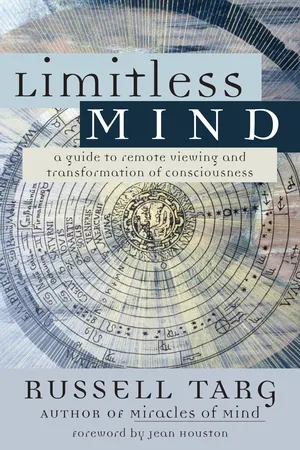
Limitless Mind
A Guide to Remote Viewing and Transformation of Consciousness
- 239 pages
- English
- ePUB (mobile friendly)
- Available on iOS & Android
eBook - ePub
About this book
Information
Topic
Personal DevelopmentSubtopic
Self ImprovementCHAPTER ONE
our limitless
mind
LIVING IN A NONLOCAL UNIVERSE
To see a World in a Grain of Sand And a Heaven in a Wild Flower, Hold Infinity in the palm of your hand And eternity in an hour.
— William Blake
All of life begins on the edge. The first cellular membranes began at the ocean’s edge, drying out and being covered with foam, cooling and warming. The edge is a place of opportunity, whether it be a seacoast or an airport. In remote viewing experiments, we find that edges — where land meets water, for instance — are among the easiest locations to see psychically.
The edge further represents a place of change and spaciousness. Port cities at the water’s edge have always been a source of information, excitement, and new possibilities. I am grateful to live near beautiful San Francisco, on the far edge of the continent. The mystic, however, knows that he or she is always on the edge (or any other place of his or her choosing) — in consciousness. It doesn’t matter where one’s physical body happens to be; when we find ourselves truly on the edge, there is an opportunity for an event, a spiritual teacher, or a friend to pry loose the fingers of limitation one by one and set us free.
In this book, I describe remote viewing in detail — a process in which you can quiet your mind and inflow information from anywhere in the world. I also discuss distant healing, in which you can outflow your intentions to heal or relieve the pain of a distant person.
We begin at that still place — on the edge — between the inflow and the outflow. This is a quiet mental place where nothing at all is happening except the experience of loving awareness in the present moment, in the now. This archetypal feeling of non-separation from all of humanity and nature is what Jesus called “the peace that passeth understanding.” Although I have successfully used ESP to spy on the Soviets during the Cold War — even to forecast changes in the silver commodity market — it is exploring states of peaceful, loving awareness that makes the study of psychic abilities interesting to me today. As a physicist, I am also deeply interested in our nonlocal nature.
Sir Arthur Eddington was one of the premier astrophysicists in the early twentieth century. He wrote extensively about both the origin of the cosmos and his personal journeys into the peaceful, meditative realms — what he describes as “glimpses of transcendent reality.” Sir Arthur writes:
If I were to try to put into words the essential truth revealed by the mystic experience, it would be that our minds are not apart from the world; and the feelings that we have of gladness and melancholy and our other deeper feelings are not of ourselves alone, but are glimpses of reality transcending the narrow limits of our particular consciousness....1
This is a message from a man of limitless mind, who invites us to visit the nonlocal existence beyond space and time.
WHAT WE MEAN BY NONLOCALITY
We live in a “nonlocal” reality, which is to say that we can be affected by events that are distant from our ordinary awareness. This is an alarming idea for an experimental physicist, because it means that laboratory experiments are subject to outside influences that may be beyond the scientist’s control or knowledge. In fact, the data from precognition research strongly suggest that an experiment could, in principle, be affected by a signal sent from the future! So a short answer to the question, “How is it that I can psychically describe a distant object?” is that the object is not as distant as it appears. To me, these data suggest that all of space-time is available to your consciousness, right where you are. You are always on the edge.
Nonlocality is a property of both time and space. In a vivid example of nonlocality, studies of identical twins who were separated at birth and reared apart show that the twins share striking similarities in their tastes, interests, spouses, experiences, and professions, beyond what one could reasonably ascribe to their common DNA. One famous set of twins reared far apart were both named Jim by their adoptive parents. Although they never communicated, each twin married a woman named Betty, divorced her, and then married a woman named Linda. They were both firemen, and each had felt a compulsion to build a circular white bench around a tree in his backyard just before coming to their first meeting at the University of Minnesota. I can believe that there might be fireman genes, or music genes, but I don’t believe that there are Linda genes, Betty genes, or white bench genes. This looks to me like a nonlocal telepathic connection — inexplicable, but real.2
The physics of nonlocality is fundamental to quantum theory. The most exciting research in physics today is the investigation of what physicist David Bohm calls “quantum interconnectedness,” or nonlocal correlations. This idea was first proposed in 1935 in a paper by Einstein, Podolsky, and Rosen (EPR) as evidence of a “defect” in quantum theory. In this paper, Einstein called non-local correlation a “ghostly” action at a distance.3 The seeming paradox of EPR was later formulated as a mathematical proof by J. S. Bell.4 It has now been repeatedly demonstrated that two quanta of light, given off from a single source and traveling at the speed of light in opposite directions, can maintain their connection to one another. We find that such photons are affected by what happens to their twins, even many miles away. John Clauser (with Stuart Freedman) at the University of California at Berkeley, was the first to demonstrate nonlocality in the laboratory. He recently described to me his impressions of these experiments, saying, “Quantum experiments have been carried out with twin photons, electrons, atoms, and even large atomic structures such as 60-carbon-atom Bucky balls. It may be impossible to keep anything in a box anymore.”5
Bell further emphasizes: “No theory of reality compatible with quantum theory can require spatially separate events to be independent.” That is to say, the measurement of the polarization of one photon determines the polarization of the other photon at its distant measurement site. This surprising coherence between distant entities is called “nonlocality” by Bell, Bohm, Clauser, and others. Physicist Henry Stapp of the University of California at Berkeley states that these quantum connections could be the “most profound discovery in all of science.”6
Einstein, of course, was correct in saying that there was a correlation between photons receding from each other at the speed of light. It seems, however, that he was mistaken in his concern about the correlation violating relativity theory, because so far it appears that it does not. That is, there is no faster-than-light signaling. EPR analysis from the 1930s, together with contemporary experiments, gives scientific support to the current view of nonlocal connectedness. My colleagues and I do not believe, however, that EPR-type correlations are, in themselves, the explanation for mind-to-mind connections, but we do think that they are an unequivocal laboratory example of the nonlocal nature of our universe. And it is this nonlocality that makes these EPR and ESP connections possible.
Data from dream research also provide convincing evidence that our minds have access to events occurring in distant places — and even into the future. The latter was demonstrated by W. Dunne’s An Experiment with Time,7 in which he recorded, verified, and published his precognitive dreams, as well as by remote-viewing research performed at SRI and Princeton University. The Princeton research showed conclusively that remote viewing exists, with a departure from chance expectation of 10-10 (odds of one in ten billion). They found, from 277 formal remote viewing trials, that there is no evidence for a decrease in accuracy or reliability when looking days into the future or thousands of miles into the distance. That is, it is no harder to describe tomorrow’s remote viewing target location than it is to describe today’s.8
Immanuel Kant states that space and time are but modes of human perception, not attributes of the physical world. These modes are powerful filters of our own invention, and they often serve to limit our experience.
I know, based on experimental data from psi research in my laboratory at SRI, that a viewer can focus attention at a specific location anywhere on the planet (or off of it) and often describe what is there. The SRI experiments showed that the viewer is not bound by present time. In contemporary physics, we call this ability to focus attention on distant points in space-time “nonlocal awareness.” Data from the past twenty-five years have shown that a remote viewer can answer any question about events anywhere in the past, present, or future, and be correct more than two-thirds of the time. For an experienced viewer, the rate of correct answers can be much higher.
Physicist David Bohm argues that we greatly misunderstand the illusion of separation in space and time. In his textbook, The Undivided Universe, he defuses the illusion of separation as he writes about quantum interconnectedness: “The essential features of the implicate order are that the whole universe is in some way enfolded in everything, and that each thing is enfolded in the whole.”9
This fundamental statement describes the metaphor of the holographic ordering of the universe. It says that, like a hologram, each region of space-time contains information about every other point in space-time. This information is readily available to our awareness. In the holographic universe of David Bohm, there is a unity of consciousness — a “greater collective mind” — with no boundaries of space or time.
From the current paradigm of modern physics, there is no contradiction between the data of remote viewing and the experienced oneness of consciousness. Nobel-prizewinning physicist Eugene Wigner has written, “The laws of quantum mechanics cannot be formulated without recourse to the concept of consciousness.”10
THE PHYSICS OF MIRACLES
The most satisfactory physical description of psi phenomena that I have examined (with theoretical physicist Elizabeth Rauscher) is a nonlocal mathematical model of space-time known as “complex Minkowski space.”11 Herman Minkowski invented the four-dimensional space-time that Einstein used to describe his special relativity. Ordinary Minkowski space consists of three real space dimensions (x, y, z) and one imaginary time dimension (ict), in which “i” is the square root of –1, “c” is the speed of light, and “t” is time. This model is consistent with the foundations of quantum mechanics, Maxwell’s formalism for electromagnetism, and the theory of relativity. It is very important that any model constructed to describe psi must not at the same time generate weird or incorrect physics.
The complex Minkowski space is a purely geometrical model formulated in terms of space and time coordinates, in which each of the familiar three spatial (distance) and one temporal (time) coordinates is expanded by two into their real and imaginary parts — making a total of six spatial and two temporal coordinates. There are now three real and three imaginary spatial coordinates, together with the real and imaginary time coordinate.
The metric (the standard of how we measure distance and time) of this complex eight-space is a measure of the structure of space-time where we live. Within this structure, we can define the manner in which one physically or psychically moves along a space-time path referred to as a “world line.” This movement can be as mundane as meeting a friend tomorrow at 4:00 P.M. on the corner of 42nd Street and Broadway, or as cosmic as experiencing oneness with the universe. Essentially, real-time remote viewing — or any psychic experience — demands that the awareness of the individual is not separate from (or is “contiguous with”) a specific target at a distant location. This ability to nonlocally access information that is blocked from ordinary perception can be described as the result of an apparent zero-separation between the viewer and the target. Similarly, in order for precognition to occur, one must be contiguous in awareness with the future event that is sensed. The complex eight-space model can always provide a path (the “world line”) in space and time that connects the viewer to a remote target so that the viewer experiences zero spatial and/or temporal distance in the metric.
It appears that, in the realm of consciousness, there may or may not be a separation, depending on one’s intention. It is evident to Dr. Rauscher and me that remote-viewing abilities are fundamental to our understanding of consciousness itself. In fact, psi functioning may be the means that consciousness uses to make itself known in the internal and external physical world.
Dr. Rauscher and I recognize that every theory of being is perishable, and that one day it may be found that complex Minkowski space is not the best model for psi. We are confident, however, that two factors will remain: (1) that these phenomena are not a result of an energetic transmission, and (2) that they are, rather, an interaction of our awareness with a nonlocal, hyperdimensional space-time in which we live.
How does consciousness access this nonlocal space? We believe it does so through the process of intentionality, which is fundamental to any goal-oriented process including retrieval of memory. In fact, the universality of nonlocality is simply there, existing as the fundamental nature of space and time. That is, it is not a physical thing, but it is available to be accessed at will.
It now seems clear that ordinary people can access nonlocal space. We have seen remarkable results in hundreds of remote-viewing trials with hundreds of viewers, in the laboratory and in public workshops all over the ...
Table of contents
- Cover
- Title
- Copyright
- Dedication
- Contents
- Acknowledgment
- Athor’s preface
- Foreword by Jean Houston
- Introduction: The Unknowable End of Science
- Chapter One: Our Limitless Mind: Living in a Nonlocal Universe
- Chapter Two: On a Clear Day We Can See Forever: What We Know about Remote Viewing
- Chapter Three: For Your Viewing Pleasure: How You Can Practice Remote Viewing
- Chapter Four: Precognition: There’s No Time Like the Future — or the Past
- Chapter Five: Intuitive Medical Diagnosis: Things to Do Before the Doctor Arrives
- Chapter Six: Distant Healing: Is It My Mind over Your Matter?
- Chapter Seven: Why Bother with ESP?: Discovering That You Are the Love You Seek
- Afterword: Elisabeth’s Story
- Notes
- Biblography
- Index
- About the Author
Trusted by 375,005 students
Access to over 1.5 million titles for a fair monthly price.
Study more efficiently using our study tools.
Frequently asked questions
Yes, you can cancel anytime from the Subscription tab in your account settings on the Perlego website. Your subscription will stay active until the end of your current billing period. Learn how to cancel your subscription
No, books cannot be downloaded as external files, such as PDFs, for use outside of Perlego. However, you can download books within the Perlego app for offline reading on mobile or tablet. Learn how to download books offline
Perlego offers two plans: Essential and Complete
- Essential is ideal for learners and professionals who enjoy exploring a wide range of subjects. Access the Essential Library with 800,000+ trusted titles and best-sellers across business, personal growth, and the humanities. Includes unlimited reading time and Standard Read Aloud voice.
- Complete: Perfect for advanced learners and researchers needing full, unrestricted access. Unlock 1.5M+ books across hundreds of subjects, including academic and specialized titles. The Complete Plan also includes advanced features like Premium Read Aloud and Research Assistant.
We are an online textbook subscription service, where you can get access to an entire online library for less than the price of a single book per month. With over 1.5 million books across 990+ topics, we’ve got you covered! Learn about our mission
Look out for the read-aloud symbol on your next book to see if you can listen to it. The read-aloud tool reads text aloud for you, highlighting the text as it is being read. You can pause it, speed it up and slow it down. Learn more about Read Aloud
Yes! You can use the Perlego app on both iOS and Android devices to read anytime, anywhere — even offline. Perfect for commutes or when you’re on the go.
Please note we cannot support devices running on iOS 13 and Android 7 or earlier. Learn more about using the app
Please note we cannot support devices running on iOS 13 and Android 7 or earlier. Learn more about using the app
Yes, you can access Limitless Mind by Russell Targ in PDF and/or ePUB format, as well as other popular books in Personal Development & Self Improvement. We have over 1.5 million books available in our catalogue for you to explore.