eBook - ePub
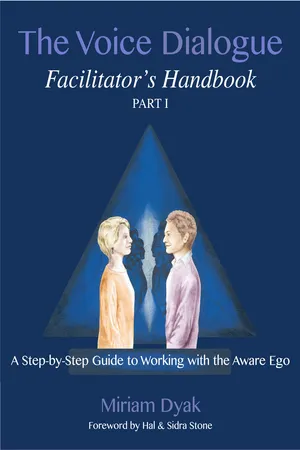
The Voice Dialogue Facilitator's Handbook, Part 1
A Step-by-Step Guide to Working with the Aware Ego
- 312 pages
- English
- ePUB (mobile friendly)
- Available on iOS & Android
eBook - ePub
The Voice Dialogue Facilitator's Handbook, Part 1
A Step-by-Step Guide to Working with the Aware Ego
About this book
The first textbook written for learning Voice Dialogue facilitation, a method for working with consciousness created by Drs. Hal and Sidra Stone, authors of "Embracing Our Selves," "Embracing Each Other," "Embracing Your Inner Critic," and "The Shadow King." This Handbook is designed to make Voice Dialogue facilitation easy and rewarding. Every part of a Voice Dialogue session is described in detail with lots of sample facilitations that explore the energetic dynamics between a facilitator and his/her client.
Information
Print ISBN
9780966839005
Subtopic
Mental Health & WellbeingIntroduction to Section Three
Now that we know the ground rules and have explored energetics (the hidden ingredient that makes facilitation powerful and effective), we’re ready to look at a Voice Dialogue session in detail and begin to use what we know.
Every Voice Dialogue session is different. Some sessions may include working with several selves, other times the facilitator will stay with one self for the whole facilitation. In some sessions the major focus will be on energy work (for example channeling the energies of the selves through the Aware Ego), and in another session the focus might be almost entirely on dreams. The work is always changing and is rich in possibility – it is open for imagination and creativity on the part of both facilitator and subject.
However, just as there are ground rules for all Voice Dialogue work, there are also basic elements that are foundational for each Voice Dialogue session. When the facilitator is familiar and comfortable with these basics, she can improvise freely. To make sure that we know what these basics are, Section Three takes us through all the foundational components of a Voice Dialogue session so that we can see and understand the structure of the facilitation process. Whether you have just begun facilitating or have been doing this work for a long time, you may find looking at a Voice Dialogue session in this way to be a real eye-opener. I know that I gained a great deal more awareness of myself as a facilitator by breaking the work down into all its fundamental parts and observing the internal logic of what I have been doing for so many years. Even if you’re an “old hand” at facilitating, I invite you to do the same.
We will be moving through a Voice Dialogue session from beginning to end, but please don’t hesitate to read and use the material here in the order that best suits you. For instance, you may want to jump ahead to a particular part of facilitating where you have the most unanswered questions. If you are entirely new to this work, I encourage you to take it easy, focus on one step of the process at a time, and allow yourself to relax and enjoy what you are learning. Of course, in an actual facilitation, it’s unlikely that you’ll think about all these separate steps as you work with your subject. Remember learning how to drive? You had to pay attention to your hands and feet, your peripheral vision, the gears, the other cars on the road, etc. until dealing with the demands of driving became second nature and you could relax and enjoy the journey instead of always thinking of how to operate your vehicle. You can expect facilitation to be much the same. The more you facilitate, the more the process will seem as natural as a conversation that just comfortably flows along, and the less conscious attention you’ll need to give to the structure and dynamics of the work.
The chapters in this section are full of opportunities for you to participate in the facilitation process. In particular, with each of the facilitation examples there are questions followed by “discussion” rather than by “answers.” The questions invite you to think about what you have read and to create your own approach to the various facilitation situations. You may want to take the time to think through your own answers before going on to the discussion which follows. The discussions in each chapter address some (but not all) of the questions. Rather than giving definitive answers, the discussions are intended to initiate an exploration of ideas and facilitation approaches that you can continue on your own or with your colleagues.
One final note before we begin: If you have not already read “A word about grammar” at the beginning of The Handbook, this would be an excellent time to do so. In order to help sort out the subject from the facilitator and the subject from the selves, I have taken certain liberties with conventional grammar, such as using the plural pronouns “they” and “their” to refer to a singular subject which helps to distinguish the people being facilitated from the facilitators who are referred to as “he’s” and “she’s.” I have done this so that you can more easily follow who is who and won’t end up floundering in a sea of pronouns. Also for simplicity’s sake, selves are universally referred to as “it,” even though in a live facilitation the facilitator would probably point to the place where a particular self was sitting and say “she felt angry about…” or “he doesn’t like…” etc. On paper, without the benefit of gesture, it’s much harder to keep track of who or what is being referred to, harder to know if a “he” or “she” refers to the subject, to one of their selves or to the facilitator. It’s a good reminder, too, for the facilitator not to jump to identifying selves by the gender of the person she is working with – both men and women have opposite gender and non-gender selves.
Beginning the session inside of yourself…
Beginning at the Beginning
Where does a Voice Dialogue session begin? Does it start when the person being facilitated moves over and the facilitator begins to speak with one of their* selves? Or does it start earlier, when the person first walks in the door? Is the conversation between the facilitator and the subject also part of Voice Dialogue work? What about before the subject arrives – does the work begin with the facilitator?
We already know that the ground rules say facilitation actually begins with the facilitator being facilitated. Unless the facilitator has initiated her own Aware Ego process the work will consist of one group of primary selves (the facilitator’s operating ego) trying to facilitate more of the same. If you have not yet begun the process of separating from your own primary selves, another difficulty is that your inner critic, pusher, and perfectionist may make facilitating quite a trial and tribulation for you! After all, how much attention can you give to the subtle changes in someone else’s conversation if you have voices in your own head judging your every move as a facilitator? There really is no better way to prepare for facilitating someone else than by being facilitated yourself.
Familiarity with the work builds confidence. There are other advantages to being facilitated on a regular basis. One is that it makes you accustomed to noticing changes in yourself and in other people. This in turn makes it much easier to identify the different selves that emerge in the course of a conversation with the person you facilitate. You’ll actually be able to notice “who you are” before they walk in, and then quickly and easily pick up on “who is talking to you” once you greet them and sit down together.
Take time to become aware of yourself before you start the session. Being aware of how you’re feeling, where your energy is, will help you avoid unpleasant surprises in the middle of the session such as “spacing out,” or going off into one of your own selves, “going into voice.” Take care of your own needs first! If you’ve been in the habit of functioning in high gear on a mental level, take the time to slow down and get centered in your body. Remember it’s the mind that is capable of taking off at top speed, leaving the body and the energy field behind – sort of like someone who gets in the car and drives off without checking to see if all his passengers are actually with him. Notice your breath and how deep it is. Pay attention to the sensations in your body, how you are feeling and what you are feeling.
It’s also possible to call in a “facilitator self” before you begin the session. Facilitators are all so different from each other – some of us find facilitating completely natural as if we had always been doing it and others need to overcome anxiety about doing something that feels a bit strange and unfamiliar at first. One approach that many people have used with success is to get in touch with a facilitator self in their own Voice Dialogue work. They then bring in the energy of this facilitator self through their Aware Ego before beginning a session. One might think of this approach as a stabilizing technique that becomes less necessary as we become more practiced and at ease with facilitation over time.
SUMMARY
A Voice Dialogue session begins with the facilitator’s own work and internal preparation, being aware of his own selves and ready to observe and connect energetically with someone else’s.
“Warm-ups” for the facilitator
The following are a few suggest...
Table of contents
- Cover
- Title Page
- Dedication
- Contents
- Acknowledgments
- Foreword
- Introduction
- How to Get the Most out of This Book
- A Word about Grammar
- Section One
- Section Two
- Section Three
- Section Four
- Reading & Resources
- The Team
- How you can contribute to The Handbook
Trusted by 375,005 students
Access to over 1.5 million titles for a fair monthly price.
Study more efficiently using our study tools.
Frequently asked questions
Yes, you can cancel anytime from the Subscription tab in your account settings on the Perlego website. Your subscription will stay active until the end of your current billing period. Learn how to cancel your subscription
No, books cannot be downloaded as external files, such as PDFs, for use outside of Perlego. However, you can download books within the Perlego app for offline reading on mobile or tablet. Learn how to download books offline
Perlego offers two plans: Essential and Complete
- Essential is ideal for learners and professionals who enjoy exploring a wide range of subjects. Access the Essential Library with 800,000+ trusted titles and best-sellers across business, personal growth, and the humanities. Includes unlimited reading time and Standard Read Aloud voice.
- Complete: Perfect for advanced learners and researchers needing full, unrestricted access. Unlock 1.5M+ books across hundreds of subjects, including academic and specialized titles. The Complete Plan also includes advanced features like Premium Read Aloud and Research Assistant.
We are an online textbook subscription service, where you can get access to an entire online library for less than the price of a single book per month. With over 1.5 million books across 990+ topics, we’ve got you covered! Learn about our mission
Look out for the read-aloud symbol on your next book to see if you can listen to it. The read-aloud tool reads text aloud for you, highlighting the text as it is being read. You can pause it, speed it up and slow it down. Learn more about Read Aloud
Yes! You can use the Perlego app on both iOS and Android devices to read anytime, anywhere — even offline. Perfect for commutes or when you’re on the go.
Please note we cannot support devices running on iOS 13 and Android 7 or earlier. Learn more about using the app
Please note we cannot support devices running on iOS 13 and Android 7 or earlier. Learn more about using the app
Yes, you can access The Voice Dialogue Facilitator's Handbook, Part 1 by Miriam Dyak in PDF and/or ePUB format. We have over 1.5 million books available in our catalogue for you to explore.