- 132 pages
- English
- ePUB (mobile friendly)
- Available on iOS & Android
eBook - ePub
About this book
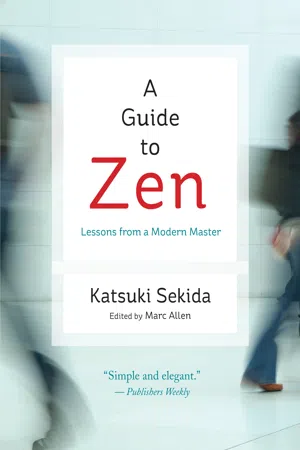
Very few masters of Zen have been writers; very few writers about Zen have been masters. Katsuki Sekida was both. His finest work, Zen Training, remains one of the most comprehensive books on Zen ever written in English. In A Guide to Zen, Marc Allen, a former student of Sekida, presents selections of the original work to produce a beautifully readable, brilliant guide to Zen meditation. Includes a summary of Zen and a complete course in Zen meditation, with specific practices and commentaries on higher states of consciousness and on a classic series of Zen pictures.
Information
Topic
Theology & ReligionSubtopic
Eastern PhilosophyCHAPTER ONE
A Summary at the

Beginning
Zen is not, in my view, philosophy or mysticism.
It is simply a practice of readjustment of
nervous activity. That is, it restores the distorted
nervous system to its normal functioning.
IN STUDYING ZEN, WE START WITH PRACTICE
Now, it is true that Zen is concerned with the problem of the nature of mind, so it necessarily includes an element of philosophical speculation. However, while most philosophy relies mainly on speculation and reason, in Zen we are never separated from our personal practice, which we carry out with our body and mind.
The basic kind of Zen practice is called zazen (sitting Zen), and in zazen we attain samadhi. In this state the activity of consciousness is stopped and we cease to be aware of time, space, and causation. It may at first sight seem to be nothing more than mere being, or existence, but if you really attain this state you will find it to be a remarkable thing.
We reach a state in which absolute silence and stillness reign, bathed in a pure, serene light. But it is not a vacuum or mere nothingness. There is a definite wakefulness in it. It recalls the impressive silence and stillness that we experience in the heart of the mountains.
IN ORDINARY DAILY LIFE our consciousness works ceaselessly to protect and maintain our interests. It has acquired the habit of “utilitarian thinking” — looking upon the things in the world as so many tools, looking at objects in the light of how they can be made use of. We call this attitude the habitual way of consciousness. This way of looking at things is the origin of our distorted view of the world.
We come to see ourselves, too, as objects to be made use of, and we fail to see into our own true nature. This way of treating oneself and the world leads to a mechanical way of thinking, which is the cause of so much of our suffering. Zen aims at overthrowing this distorted view of the world, and zazen is the means of doing it.
On coming out of samadhi it can happen that one becomes fully aware of one’s being in its pure form; that is, one experiences pure existence. This experience of the pure existence of one’s being, associated with the recovery of pure consciousness in samadhi, leads us to the recognition of pure existence in the external world too.
To look at oneself and the objects of the external world in the context of pure existence is kensho, or realization. And this has been achieved, since Buddha himself did so, by men and women of every generation, who bear witness to its reality.
This experience is attained by the training of body and mind. Reason comes later and illuminates the experience.
IF YOU GO CLIMBING IN THE MOUNTAINS, you were probably led to do so in the first place by the beauty of the mountains. When you start to climb, however, you find it is a matter of working one’s way along patiently, step by step, progressing with great care and caution. Some knowledge of climbing technique is essential.
It is the same with Zen. We take it up in the search of the meaning of life, or in the hope of solving the problems of our existence, but once we actually start, we find we have to look down at our feet, and we are faced with practice followed by more practice.
Our aim in practicing zazen is to enter the state of samadhi, in which, as we have said, the normal activity of our consciousness is stopped. This is not something that comes easily to us.
Beginners in Zen will usually be told to start by practicing counting their breaths — that is, to count each exhalation up to ten, and then start again.
Try this for yourself. You may think you can do it without difficulty, but when you start you will soon find that wandering thoughts come into your head, perhaps when you have reached about “five” or “six,” and the thread of counting is broken. The next moment you come to yourself and can’t remember where you left off. You have to start again, saying “one” and so on.
How can we prevent our thoughts from wandering? How can we learn to focus our attention on one thing? The answer is that we cannot do it with our brain alone; the brain cannot control its thoughts by itself. The power to control the activity of our mind comes from the body, and it depends critically (as we see later) on posture and breathing.
WITH REGARD TO POSTURE, we need only say at this stage that stillness of body engenders stillness of mind. Immobility is a first essential. Traditionally, and for good reasons, we sit down to practice, because (among other reasons) it is in this position that we can keep our body still but our minds wakeful.
Immobility results in a diminution of the stimuli reaching the brain, until eventually there are almost none. This gives rise, in due course, to a condition in which you cease to be aware of the position of your body. It is not a state of numbness, for you can move your limbs and body if you want. But if you keep your body still, it is not felt.
We call this condition “off-sensation.” In this state the activity of the cortex of the brain becomes steadily less and less, and this is preliminary to entering samadhi.
We continue to breathe, of course, as we sit, and find that our ability to concentrate our attention, to remain wakeful, and ultimately to enter samadhi depends on our method of breathing.
Even those who have not practiced zazen know that it is possible to control the mind by manipulating the breathing. Quiet breathing brings about a quiet state of mind.
In zazen, we breathe almost entirely by means of our abdominal muscles and diaphragm. If the lower abdomen is allowed to fill out, the diaphragm is lowered, the thoracic cavity (between the neck and abdomen) is enlarged, and air is taken into the lungs. When the abdominal muscles contract, the diaphragm is pushed up, expelling air from the lungs.
The slow, sustained exhalation that we adopt in zazen is produced by keeping the diaphragm contracted so that it opposes the action of the abdominal muscles, which are trying to push air out of the lungs. This opposition generates a state of tension in the abdominal muscles, and the maintenance of this state of tension is of utmost importance in the practice of zazen.
All other parts of the body are motionless, and their muscles are either relaxed or in a state of constant, moderate tension. Only the abdominal muscles are active. As we explain later, this activity is a vital part of the mechanism by which concentration and wakefulness of the brain are maintained.
Traditionally, in the East, the lower part of the abdomen (called the tanden) has been regarded as the seat of human spiritual power. Correct zazen ensures that the weight of the body is concentrated there, producing a strong tension.
The essential point we want to make is that it is the correct manipulation of the lower abdomen, as we sit and breathe, that enables us to control the activity of our mind. Posture and breathing are a key to concentration, to stilling the activity of the mind, and to entering samadhi.
When we put it so briefly, our conclusions may seem far-fetched. If they do not seem convincing on the page, the reader should experiment for him-or herself along the lines we indicate. Zen is above all a matter of personal experience. Students are asked to accept nothing as the truth that they cannot demonstrate for themselves, with their own mind and body.
IN THE STATE OF “OFF-SENSATION,” we lose the sense of the whereabouts of our body. Subsequently, by stilling the activity of the mind, a state is reached in which time, space, and causation, which constitute the framework of consciousness, drop away. We call this condition “body and mind fallen off.”
In ordinary mental activity the cerebral cortex takes the major role, but in this state, it is hardly active at all. “Body and mind fallen off” may seem to be nothing but a condition of mere being, but this mere being is accompanied by a remarkable mental power, which we may characterize as a condition of extreme wakefulness.
To those who have not experienced it, this description may seem strange, yet the condition really does occur in samadhi. At the time, however, we are not aware of it, because there is no reflecting activity of consciousness, and so it is hard to describe. If we try to describe it, however, it would be as an extraordinary mental stillness. In this stillness, or emptiness, the source of all kinds of activity is latent. It is this state that we call pure existence.
IF YOU CATCH HOLD OF THIS STATE OF PURE EXISTENCE, and then come back into the actual world of conscious activity, you will find that Being itself appears transformed. This is why Being is said to be “veiled in darkness” to the eyes of those who have not experienced pure existence. When mature in the practice of zazen, Being is seen with one’s own eyes.
However, just as energy can be used for many different purposes, so can pure existence be experienced in relation to any phase of life — anger, hatred, or jealousy as well as love and beauty. Every human action must be carried on through the ego, which plays a role comparable to that of a pipe or channel through which energy is conducted for different uses. We usually think of the ego as a kind of constant, unchanging entity. In fact, however, it is simply a succession of physical and mental events or pressures that appear momentarily and as quickly pass away.
So long as our mind operates subjectively, however, there must be a subject that functions as the ego. As there is normally no cessation of subjective activity, there can normally be no state in which we are devoid of an ego. However, the nature of this ego can change. Every time we succeed in banishing a mean or restricted ego — a petty ego — another ego with a broader outlook appears in its place, and eventually what we may call an “egoless ego” makes its appearance.
When you have acquired an egoless ego, there is no hatred, no jealousy, no fear; you experience a state in which you see everything in its true aspect. In this state you cling to or adhere to nothing. It is not that you are without desires, but that while desiring and adhering to things you are at the same time unattached to them.
The Diamond Sutra says, “Abiding nowhere, let the mind work.” This means: Do not let your mind be bound by your desire, and let your desire occur in your mind. True freedom is freedom from your own desires.
When you have once experienced pure existence, you undergo a complete about-face in your view of the world. But unfortunately, as long as we are human beings, we cannot escape from the inevitability of living as individuals. We cannot leave the world of differentiation. And so we are placed in a new dilemma, one that we did not encounter before. Inevitably, this involves a certain internal conflict, and may cause much distress. To deal with this, further training of the mind has to be undertaken to learn how, while living in the world of differentiation, we can avoid discrimination.
We have to learn how to exercise the mind of nonattachment while working in attachment. This is called training after the attainment of realization, or cultivation of Holy Buddhahood, which constitutes an essential part of Zen.
There is a Zen saying, “Differentia...
Table of contents
- Cover
- Title
- Copyright
- Contents
- Editor’s Introduction
- Chapter One: A Summary at the Beginning
- Chapter Two: Zazen Posture
- Chapter Three: Breathing in Zazen
- Chapter Four: Samadhi
- Chapter Five: Pure Existence
- Chapter Six: Stages in Zen Training
- Afterword
- Glossary
- Notes
- Index
- About the Author
Trusted by 375,005 students
Access to over 1.5 million titles for a fair monthly price.
Study more efficiently using our study tools.
Frequently asked questions
Yes, you can cancel anytime from the Subscription tab in your account settings on the Perlego website. Your subscription will stay active until the end of your current billing period. Learn how to cancel your subscription
No, books cannot be downloaded as external files, such as PDFs, for use outside of Perlego. However, you can download books within the Perlego app for offline reading on mobile or tablet. Learn how to download books offline
Perlego offers two plans: Essential and Complete
- Essential is ideal for learners and professionals who enjoy exploring a wide range of subjects. Access the Essential Library with 800,000+ trusted titles and best-sellers across business, personal growth, and the humanities. Includes unlimited reading time and Standard Read Aloud voice.
- Complete: Perfect for advanced learners and researchers needing full, unrestricted access. Unlock 1.5M+ books across hundreds of subjects, including academic and specialized titles. The Complete Plan also includes advanced features like Premium Read Aloud and Research Assistant.
We are an online textbook subscription service, where you can get access to an entire online library for less than the price of a single book per month. With over 1.5 million books across 990+ topics, we’ve got you covered! Learn about our mission
Look out for the read-aloud symbol on your next book to see if you can listen to it. The read-aloud tool reads text aloud for you, highlighting the text as it is being read. You can pause it, speed it up and slow it down. Learn more about Read Aloud
Yes! You can use the Perlego app on both iOS and Android devices to read anytime, anywhere — even offline. Perfect for commutes or when you’re on the go.
Please note we cannot support devices running on iOS 13 and Android 7 or earlier. Learn more about using the app
Please note we cannot support devices running on iOS 13 and Android 7 or earlier. Learn more about using the app
Yes, you can access A Guide to Zen by Katsuki Sekida in PDF and/or ePUB format, as well as other popular books in Theology & Religion & Eastern Philosophy. We have over 1.5 million books available in our catalogue for you to explore.