- 310 pages
- English
- ePUB (mobile friendly)
- Available on iOS & Android
eBook - ePub
About this book
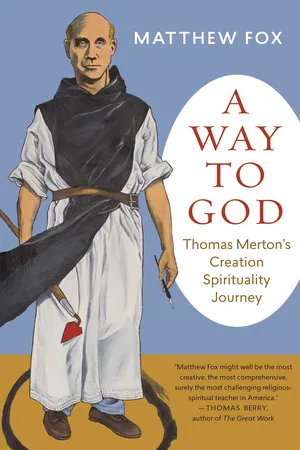
This unique reflection was prompted by an invitation Matthew Fox received to speak on the centennial of Thomas Merton's birth. Fox says that much of the trouble he's gotten into — such as being excommunicated in 1993 from the Dominican Order by Cardinal Ratzinger (who later became Pope Benedict) — was because of Thomas Merton, who sent Fox to Paris to complete a doctoral program in philosophy. Fox found that Merton's journals, poetry, and religious writings revealed a deeply ecumenical philosophy and a contemplative life experience similar to that of Meister Eckhart, the fourteenth-century mystic/theologian who inspired Fox's own "creation spirituality." It is little surprise to find Fox and Merton to be kindred spirits, but the intersections Fox finds with Eckhart are intellectually profound, spiritually enlightening, and delightfully engaging.
Information
Topic
Theology & ReligionSubtopic
Christian DenominationsCHAPTER ONE
“The sign of Paris is on me, indelibly!”
It is important to have seen the jagged outline of the towers of Carcassonne against the evening sky. To have smelled the sun and the dust in the streets of Toulouse or Narbonne. There are times when I am mortally homesick for the South of France, where I was born.… The high roofs of Strasbourg, Tauler’s city. Streets known to Eckhart.
— THOMAS MERTON
Like many young Catholic men growing up in the fifties and looking at a possible vocation in the religious arena, I was moved to read Merton’s autobiography, The Seven Storey Mountain. I was then a teenager attending my local public high school, West High School, in Madison, Wisconsin. I remember sitting down with the vocational director of the Dominican Order in the Midwest, Father Gilbert Graham, who told me that “portions” of Merton’s autobiography were “quite immature” but “it was a good book to read anyway.” I did find it uplifting and expansive, exciting and full of derring-do and adventure, which appealed to my budding religious manhood. The book was heralded as a classic, and no doubt it brought many people into the Trappist Order, which is a very ancient and strict order. It held special appeal to the postwar generation, many of whom had seen so much suffering and death in World War II (and often developed what we now call post-traumatic stress disorder) that they sought a more contemplative and peaceful life such as the Trappists offered.
While Merton’s autobiography did not entice me to join the Trappists, his vocational treatise set my goals for the contemplative side of religious life quite high when I joined the Dominican Order. During my youthful days, the vocation that I sensed growing in me was to embody both contemplation and action together, and I took the Dominican Order at its word that these need not be antagonists.
In many ways, Tolstoy most influenced my vocation. Reading War and Peace during the summer between my junior and senior years of high school, I had what can only be called a mystical experience (I had no vocabulary for that at the time). I told a friend that “it blew my soul wide open,” and I wanted to pursue what happened to me. Later, I was struck by Charles du Bos’s comment on War and Peace: “Life would speak thus if life could speak.” That mystical experience was at the heart of my joining the Dominican Order, and no doubt it has been core to my entire vocation or calling since. It could readily be said that all of my books are about that experience in one way or another — that and how to relate it to social justice action. This combined perspective grew during the sixties with the civil rights movement and the anti-Vietnam movement, and in the seventies with the ecology movement, the women’s movement, and the gay movement as well.
Another early intersection with Father Thomas Merton and myself emerged during my training as a Dominican. That training included two years at Loras College in Dubuque, Iowa, where aspiring Dominicans lived together in a dorm called Smith Hall under the supervision of two Dominican priests; then a year of novitiate training in Winona, Minnesota; and then three intense years in philosophy school in River Forest, Illinois. This was followed by solemn vows and a move to the Aquinas Institute of Theology in Dubuque, Iowa (today both schools are located in St. Louis, Missouri). The spiritual experiences I underwent along the way were powerful and meaningful, and during my last year in River Forest, when I took them to my confessor, he said to me: “You should consider becoming a hermit.”
This was not at all on my radar. I considered myself quite an extrovert, whether I was relating to my other Dominican brothers or playing sports or in my aspirations to teach and to preach. But the advice kept eating away at me, and by the time I landed in theology school in Dubuque, I was entertaining at least the possibility of checking out a hermetical life. After some research, I found a colony of hermits on Vancouver Island overseen by a former Belgian abbot and biblical scholar named Dom Winandy. I went to my superiors and asked for permission to visit the place in the summer. They were not particularly supportive — indeed, Father Gilbert Graham, who was by now provincial of my province, told me, “That is a crazy thing to do. The only ones from the province who have done such a thing in the past went off the deep end. If you do this, I cannot guarantee you will be ordained a priest.” I responded that that was okay with me, but I had to pursue this option. After all, it had not been my idea but that of my priestly confessor.
So Father Graham relented and allowed me to journey from Dubuque to Vancouver Island for the summer of 1965, though he told me I was to tell no one on my return (a promise I kept). In a similar way, Father Thomas Merton also had to fight with his superiors to be allowed to have his own hermitage on monastery grounds. It was not an easy battle, lasting for about six years, but he did eventually win out. As it turned out, both Merton and I were both living in our respective hermitages the same year (1965). Merton remained in his hermitage from 1965 until his final journey to Asia in 1968. In January 1967, Merton wrote to me, saying he had “found what he was looking for” in his hermitage, and he told me that he knew Father Winandy. This was yet another intersection. In January 1960, Merton wrote in his journal about how an article written by Winandy on the canonical situation of hermits “reopened everything” for him. “The big wound bleeds. I think certainly I have been unjustly treated. But what can I do?” This fed Merton’s efforts to create his own hermitage. Later, in 1967, Merton spoke at some length about Winandy’s hermit community to a group of contemplative nuns. In this way, Merton and I were also both indebted to the vision of Dom Winandy.
I found the summer I spent in the Vancouver Island hermitage to be a profound and energizing experience — indeed, I told a friend later that I ran on that energy for twenty-five years. It was utterly “simple living”; my room consisted of a mattress on the bare wood floor, a candle, and a small table. No electricity, no shower, and so on. I remember on the last day there I took a bar of soap into the nearby river and bathed that way. About half a dozen hermits lived there, and they were not allowed to speak to one another, though they could speak to me, an outsider. I appreciated learning their interesting stories. A couple were ex-Trappists; one worked during the year atop a tower in the Canadian woods as a forest ranger, so he was hermit-like both in the hermitage and in his work. I kept a journal, and the abbot asked me to read it toward the end of my stay. He then advised me to return to the more “active” life of the Dominicans but to remain true to my contemplative vocation at the same time. He said to me, “One day you will be a hermit while living in a great city.” So he was advising me to turn my back on a rural vocation as much as the hermetical vocation. More than once since, whether living in Paris or in Oakland, those words have echoed back to me.
I returned to Dubuque very much energized. Among other things, I was given the responsibility to “bury” our philosophical magazine with the modest title Reality and start up a new magazine, which I called Listening. This became a very successful publication during the sixties, when so much was happening in Catholic and ecumenical theology due to the Second Vatican Council then in progress in Rome. When we launched Listening magazine, I chose the name deliberately as a reference to Martin Heidegger, who says: “Being-with develops in listening to one another.” Merton read Heidegger with appreciation also, and he once tartly criticized the lost art of listening: “Since language has become a medium in which we are totally immersed, there is no longer any need to say anything. The saying says itself all around us. No one need attend. Listening is obsolete. So is silence.”
With the help of able-bodied Dominican brothers living and studying with me, we put out a publication that soon became the pride of the province. We published Hans Küng, Yves Congar, M. D. Chenu, Edward Schillebeeckx, and many others who were key thinkers and movers and shakers at the council. Perhaps the most impactful piece for me was Chenu’s article “The End of the Constantinian Era,” which we published in the autumn 1967 issue. Little did I imagine that I would be studying with him one year later. His article put the Vatican Council in historic perspective, tracing the detour that Christianity had been making for centuries, and it traced the walls of lies (the spurious “Donation of Constantine”) and obfuscation that had been erected to defend an empire. I was not the only one affected by Chenu’s historical criticism on the history of empire and religion. Merton, too, was very approving of Chenu’s teachings, and on reading one of his books, he was struck to comment in his journals:
How much we have done to lead ourselves astray with theories about ages of the world, and extrapolations from prophecies of Daniel about the Roman Empire — to Charlemagne — to Barbarism and what not. This was the contribution of a Cistercian, Otto of Freising. We have never given up thinking in such terms. No one, however, has yet formulated anything about the “Western” realm of America being the heir of the Holy Roman Empire — or perhaps some Spaniard did. Yet that is how we think, still, and it is built in to our Christianity as a permanent delusion.
So also the delusion of Holy Russia.
There are too damn many holy empires with archimandrites to shower them in holy water.
But there is, I learned while doing my thesis in Paris, a quasi teaching of America being the heir to the Holy Roman Empire — and it was promulgated by none other than the media genius Henry Luce and the Luce media empire (which has been followed by other media empires). Luce called America the nation “most chosen by God” since the Israelites to lead the world, and he called for a “Pax Americana.” Merton was alert to Luce and alluded often in unflattering ways to Time and Life magazines on several occasions.
Two days later in his journal, Merton continued his reflection on empire and religion that was inspired by Chenu.
Otto of Friesing was so convinced that Constantine had finally inaugurated the Kingdom of God, that he spoke at last only of one city in his history of the “Two Cities.” When the Emperor became Catholic, the Christendom = the Kingdom of God, i.e. the Christian politico-religious world is the kingdom of God.
Hence there is no more to be done, but to preserve the status quo of the kingdom, if necessary by violent repression, coercion rather than apostolate. The apostolate of united coercion!!
Here we see the profound impact on Merton of Pere Chenu’s understanding of history and the “End of the Constantinian Era.” The lesson Merton drew from Chenu’s insights was this: “The true responsibility — to receive the Holy Spirit and cooperate with His transforming work in time now.”
In the third issue of Listening (autumn 1966), I devoted much of the editorial to Thomas Merton’s decision to live as a hermit, calling it “noteworthy” that “one of the men who spearheaded American Catholicism’s coming of age has chosen to live as a hermit. Because we know Thomas Merton from his words and outspoken stands on war, civil rights, the role of the Orient, his decision strikes a jarring note into the melee of political, educational and ecumenical revolutions which so occupy our attention today.” I pointed out how we need to respect “those who will experiment in the Church — experimentation not only with new forms but perhaps with some of the oldest as well.”
One Dominican priest teaching in our theology school who followed the birth of our new magazine told me one day, “Listening magazine is the biggest political coup in the history of the province.” All I know in retrospect is that I enjoyed doing it, and we found good work for lots of my fellow brothers in training, and I think it benefited many who were following the radical changes in the church in the wake of Vatican II. The circulation reached about thirty-six thousand readers, and they were avid, judging from the correspondence that came our way. I honed skills of many kinds, and it was a project that others could take pride in. And my energy to do that task as well as my studies in theology and the priesthood came from my visit to the Vancouver Island hermitage. The fact that I risked losing the priesthood before I even entered into it enabled me to get my priorities straight, and it served me well long after I was ordained.
Years later I learned that my provincial, Father Gilbert Graham, had sent Abbot Winandy a letter when I set out to join him that more or less threatened him. It said something like, “This is one of my best prospects and you must not steal him from me or you will pay.” Did this influence Abbot Winandy to direct me to return to the Dominicans? I guess I will never know. Then again, under Father Graham, I was first sent to Paris to study spiritual theology and study with Pere Chenu and get my doctorate at the Institut Catholique de Paris. Father Graham told at least one brother that he “sent me out of the country to get rid of me,” since he felt I might emerge as a political force in the province (a second “political coup”?). Here, too, Thomas Merton enters the picture in a big and direct way.
In the midsixties I pestered my Dominican superiors about the need to hire a person with a degree in spirituality to teach on the faculty. We had no courses on spirituality as such, and though we underwent lots of spiritual practices on a daily basis — from fasting to vegetarianism and meditation and rosaries (mantras) and celibacy and voluntary poverty — there was little or no discussion of the meaning behind it all. When I would go to priests about the spiritual experiences I was undergoing, I got little or no help. Finally, a younger priest in the house said to me, “What you are experiencing I don’t think any priest around here knows anything about. You have to get used to the idea that you are on your own.” This sort of obse...
Table of contents
- Cover
- Title
- Copyright
- Dedication
- Contents
- Introduction
- Chapter One. “The sign of Paris is on me, indelibly!”: My Intersection with Thomas Merton
- Chapter Two. “The first place that comes to my mind”: Merton’s 1967 Correspondence with Me
- Chapter Three. “Eckhart is my lifeboat”: Merton Encounters Meister Eckhart
- Chapter Four. “Contemplation…is spiritual wonder”: Merton and the Via Positiva
- Chapter Five. “I shall certainly have solitude…beyond all ‘where’ ”: Merton and the Via Negativa
- Chapter Six. “Something in my nature”: Merton and the Via Creativa
- Chapter Seven. “The prophetic struggle with the world”: Merton and the Via Transformativa
- Chapter Eight. “A readable theologian is dangerous”: Merton on the “Heresies” of Feminism
- Chapter Nine. “Every non two-legged creature is a saint”: Merton on Original Blessing and Other So-Called Heresies
- Chapter Ten. “The greatest orgy of idolatry the world has ever known”: Merton on Religion, Fundamentalism, and Empires
- Chapter Eleven. “Everything That Is, Is Holy”: Merton on the Cosmic Christ and Love in Action
- Conclusion. A Way to God and the “Perfect Circle” of Merton’s Spiritual Journey
- Acknowledgments
- Permission Acknowledgments
- Endnotes
- Select Bibliography
- Index
- About the Author
Trusted by 375,005 students
Access to over 1.5 million titles for a fair monthly price.
Study more efficiently using our study tools.
Frequently asked questions
Yes, you can cancel anytime from the Subscription tab in your account settings on the Perlego website. Your subscription will stay active until the end of your current billing period. Learn how to cancel your subscription
No, books cannot be downloaded as external files, such as PDFs, for use outside of Perlego. However, you can download books within the Perlego app for offline reading on mobile or tablet. Learn how to download books offline
We are an online textbook subscription service, where you can get access to an entire online library for less than the price of a single book per month. With over 1.5 million books across 990+ topics, we’ve got you covered! Learn about our mission
Look out for the read-aloud symbol on your next book to see if you can listen to it. The read-aloud tool reads text aloud for you, highlighting the text as it is being read. You can pause it, speed it up and slow it down. Learn more about Read Aloud
Yes! You can use the Perlego app on both iOS and Android devices to read anytime, anywhere — even offline. Perfect for commutes or when you’re on the go.
Please note we cannot support devices running on iOS 13 and Android 7 or earlier. Learn more about using the app
Please note we cannot support devices running on iOS 13 and Android 7 or earlier. Learn more about using the app
Yes, you can access A Way to God by Matthew Fox in PDF and/or ePUB format, as well as other popular books in Theology & Religion & Christian Denominations. We have over 1.5 million books available in our catalogue for you to explore.