![]()
1
Writing the Self
Approaching the Biographies of Laura Ingalls Wilder and Rose Wilder Lane
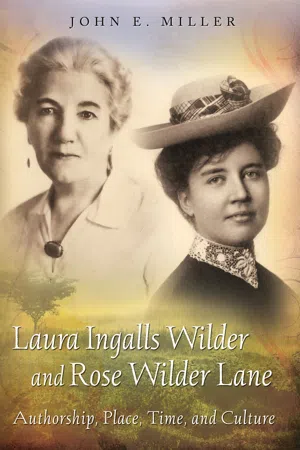
When I told a friend of mine that I was writing another book about Laura Ingalls Wilder, a surprised expression came over her face. “What?” she asked wonderingly. “Is there anything else we need to know about her?” I tried to explain to her what it was I was planning to do, but I wonder now whether what I told her sounded very convincing. That there is plenty of room for further study of one of the twentieth century’s most popular children’s authors, however, is a given. Adding to that is the success of her daughter, Rose Wilder Lane, as a novelist, short-story writer, and literary journalist and her crucial assistance to Wilder in the production of her Little House novels. As I argue in the next chapter, future studies of Wilder’s literary output will have to be conducted with full recognition of the close collaboration that occurred between mother and daughter in the writing of the books, and therefore it makes eminent sense to treat the two in tandem, which is what I have done in this book.
Although Lane had worked previously with her mother on several writing projects and had attempted to tutor her in the writing of articles for national magazines, it was only in 1930 that an intense collaboration began between the two as they set to work to produce autobiographical novels of the frontier aimed at children’s audiences. Wilder’s original autobiography, “Pioneer Girl,” never found a publisher, but it served as a resource for seven of the eight Little House books, which appeared regularly between 1932 and 1943 (Farmer Boy, the second in the series, was based upon the boyhood experiences of Wilder’s husband). The decade of the thirties, which witnessed the publication of Wilder’s first five books as well as of Lane’s two most important novels, was a time of tremendous social, political, and cultural ferment and conflict, and most of the chapters in this book grapple with issues emerging out of this creative and conflicted environment.
Lane not only collaborated with her mother on the texts of all of the Little House books, but also actually lived at Rocky Ridge farm in a house just a few hundred yards away from her parents until the middle of 1935. While the two were in essential agreement in their views about politics, which found expression to varying degrees in the books of both, they frequently found themselves enervated by the intense, multisided, and contradictory mother-daughter relationship that simultaneously drew them together and drove them apart. Both of them, while highly individualistic and creative in their own ways, were very much products of their times, so any analysis of Wilder and Lane as authors must be, in part at least, a discussion of the depression decade and the powerful cultural and political forces that coursed through it.
The Stock Market Crash of 1929, while not directly causing the economic debacle of the thirties, set in motion a series of events that collectively brought into being the worst economic calamity in American history. Not only was capitalism in crisis, but also American democracy appeared to be in danger. Wilder’s Little House books and much of Lane’s writing during the 1930s were, to one degree or another, responses to the challenges that people all around the United States were experiencing. Ironically, the man in the White House, Franklin D. Roosevelt, elicited Wilder and Lane’s scorn and ire, although he, more than anyone else, was responsible for saving capitalism at a time when extremists of the right and left, not to mention totalitarians, were taking over in other parts of the world. In Lane’s case, the hatred the president inspired in her was close to pathological.
Added to their growing political concerns were constant worries about money. Lane, in addition, seemed to be going through a prolonged midlife crisis, unsure of where to concentrate her writing talents, haunted by the effects of the aging process, uncertain about her identity, and beset by philosophical anxieties. Psychologists suggest that people commonly respond to anxiety by resorting to various defense mechanisms, such as regression, repression, identification, and projection. Lane longed to escape from Rocky Ridge and from the confining embrace of her mother, which she finally managed to do in 1935 at age forty-eight. Beyond that, she was looking for a comfortable philosophical home, one she eventually discovered in extreme right-wing libertarian politics. Her relationship with her parents, her writing career, and her psychological and philosophical needs, thus, were all bound up together.
Wilder’s personality, while much less tortured and complex than her daughter’s, was likewise highly charged and ambitious. With regard to her political and social views, she too sought to find a home of a sort that resembled the treasured farmhouse at Rocky Ridge that she and her husband, Almanzo, had so energetically and lovingly built and expanded over a period of almost two decades. She had no desire to leave Mansfield, the small town in Missouri where she had resided since 1894, but she also was able to find an intellectual refuge during a time of troubles. In her case, that was the remembered frontier of her childhood, imagined through the lens of memory as she tried to reconstruct scenes that had occurred five or six decades earlier. Lane’s two frontier novels written during the period—Let the Hurricane Roar and Free Land—also hearkened back to frontier history to relate tales of heroic individualism and fierce courage in the face of unremitting hardship and challenge. Wilder’s and Lane’s responses to the thirties, in other words, involved both physical escape and metaphorical escape into the safe havens of libertarian political philosophy and mythologized history.
If mother and daughter were writing a kind of history as they constructed their fictional accounts, they also engaged in two other major literary genres during their writing careers: biography and autobiography. Lane, a basically self-trained journalist and writer of fiction, advanced her career as a writer for the San Francisco Bulletin and then as a freelancer by writing biographical sketches as well as full-scale biographical treatments of Henry Ford, Herbert Hoover, and Jack London. In 1919, she also wrote a thinly veiled autobiographical novel, Diverging Roads, which was based loosely upon her life in California as a career woman during the teens. It was she who in 1930 got her mother going on writing her autobiography, which they hoped to serialize in a national magazine. When that project failed and a children’s book editor suggested that Wilder draw upon some of her stories to write a fictionalized account for children, her career as a children’s novelist was born.
The appeals of biography and autobiography for readers are apparent in any bookstore or library in America, where long shelves and whole sections bulge with the incredibly large and varied output of authors who have chosen to write about their own lives or those of others. We cannot seem to get our fill of reading about other people’s experiences, and increasing numbers of us seem compelled to write about our own. Literary critics and scholars have not been so convinced of the allure and benefits of the genres. Post-structuralist theorists, beginning in the late 1960s, proclaimed “the death of the author,” and they and postmodernists argued that there are no stable identities to be discovered, no grand narratives to relate, no essential realities to pass on to others. Postmodernist theories from the seventies onward, with their notions of the self as fragmented, discontinuous, and ephemeral, challenged the assumptions of traditional biography. Earlier, during the reign of the New Critics in the forties and fifties, the connection between author and text was severed, and later efforts by New Historicists and others to reinject historical context and biographical information into the analysis of literature did not fully satisfy those who believe that knowledge about an author’s background and intentions in writing a text may be highly relevant to interpreting it.
I, as a historian, am biased toward treating historical context and personal history with care and consideration. But, like others of my ilk, I am constantly aware of the difficulties, ambiguities, lacunae, false leads, misimpressions, slanted assumptions, and downright errors that often inject themselves into the process and crop up in the historical and biographical record. Historians do not need to be reminded of their own weaknesses and failures and those of other researchers in their attempts to ferret out the evidence, apply correct theoretical concepts and assumptions, and make judicious interpretations. While aiming at the truth, we realize that we often fall short of it. Most of us are not yet ready to abandon the notion of correspondence between “what happened” and the records we produce of it. What we are willing to admit is that our reconstructions of the past are always imperfect and subject to revision, as new evidence, methods, conceptual schemes, and interpretive tools are advanced. We recognize that many different stories can be told about the same phenomenon, but we also know in our bones that some stories are better (that is, more accurate, more truthful, or productive of warranted assertable belief) than others and that some are so far off the mark that they don’t deserve anybody’s time or energy.
“Biography is apparently prosperous,” literary critic Catherine Peters writes, “but it is also uneasy. Modern critical theory, we know, is scornful of the idea that the text can be related to its author’s life in any useful or significant way.” Weighing in from the writer’s point of view, John Updike opines, “The main question concerning literary biography is, surely, Why do we need it at all? When an author has devoted his life to expressing himself, and, if a poet or a writer of fiction, has used the sensations and critical events of his life as his basic material, what of significance can a biographer add to the record? Most writers lead quiet lives or, even if they don’t, are of interest to us because of the words they set down in what had to be quiet moments.”1
But avid consumers are not put off by such comments or by warnings that such works can be misleading, untrue, basely motivated, or just plain dull. “Biographers can only be unauthentic, can only get it wrong, can only lie, can only substitute their own story for the story of their announced subject,” cautions literary critic Stanley Fish. Readers of biographies, in turn, take their lumps from Elizabeth Hardwick, who chides “the contemporary appetite for tawdry revelation.” Going one step further, Joyce Carol Oates attaches the label “pathography” to works intended to tear down their subjects, usually dead and unable to answer back.2
The biographer’s task is never a simple one. Arnold Rampersad, a practitioner of the craft, admits that “all aspects of biography are problematical, with biography itself being problematical in that it purports to do something—recover a life—that is patently impossible to do.” Attempting to understand other times and cultures, searching for elusive facts, remaining unaware of many if not most of the people, places, and events that structured their subjects’ lives, lacking access to the interior recesses of their minds, usually lacking expertise in psychological theory and practice, and limited in the space available to them to tell their stories, biographers necessarily have to settle for something less than “the truth, the whole truth, and nothing but the truth.” Furthermore, as Jay Parini, author of several literary biographies, notes, “I know I do bring my own perception of reality, my own prejudices and predilections, my deepest fears and fondest hopes, to bear on my subject.” None of that, he asserts, has distorted the truth of his work.3 I am not sure how he can be certain of that, but at least if a biographer is aware of the dangers and pitfalls surrounding the task, he or she has a better chance of transcending them and arriving at an approximation of the truth.
Autobiography poses its own special difficulties. While the autobiographer does have the advantage of writing about his or her own life, which should be as well known to the person as to anybody else, imperfect memories, failure to pay attention all the time, inability to understand the social forces operating and the social contexts in which one was living, as well as self-interested motives, dreams, delusions, and the urge to wreak revenge on one’s enemies constitute a few of the impediments to truth-telling. “Because the autobiographer often dresses up in fictions and disguises himself in slanted fact,” cautions Herbert Leibowitz, “the reader must pass like a secret agent across the borders of actuality and myth, following its winding trail of hallowed lies and profane truths.” Even for memoirists intent on telling the truth, memory falters. Rather than consisting of a stable, static record of the past, it constantly undergoes unconscious revision, being constructed, as well as behaving like a mirror on the past.4
Thus, although many readers may come to autobiography assuming that authors are simply presenting verifiable facts of a life, by now we should have learned the lesson that fictions are inextricably intertwined with facts in any autobiographical presentation. “Obviously, then, there is no such thing as a ‘uniquely’ true, correct, or even faithful autobiography,” observes psychologist Jerome Bruner. Such writings can never be simple statements about a “life as lived,” for no such thing exists, he asserts. A life, rather, is always constructed or construed by the act of autobiography: “Construal and reconstrual are interpretive. Like all forms of interpretation, how we construe our lives is subject to our intentions, to the interpretive conventions available to us, and to the meanings imposed upon us by the usages of our culture and language.”5
Women’s autobiography entails its own challenges. While men’s lives tend to be focused outward, where records are external and public, women’s lives traditionally were directed more inwardly, where less can be known about how they interacted with their fellow human beings or how they made a direct impact upon society.6 Ultimately, the difference resolves into a matter of power, for in most cultures throughout most of human history men have managed to maintain domination through a wide variety of means, mostly with the complicity of women, forced or unforced. Writing an autobiography makes one vulnerable, especially when the author goes beyond stating bare facts. “Psychologically painful experiences and elusive truths are difficult matters to expose to strangers,” writes Estelle C. Jelinek, who goes on to note that when the autobiographer is a woman, it causes even greater trepidation. Women came to sense that they were different from, other than, or outside of the maledominated world, thus making them a poor fit for it. “This sense of alienation from the male world is very real,” Jelinek goes on, “but there also exists the positive delineation of a female culture, a women’s world.”7 It is this women’s culture that stands out in Wilder’s Little House books and much of Lane’s fiction, but both of them also devoted a significant amount of their attention to the more social and political aspects of the outside world, thus establishing a link between the two realms.
A particular hazard in trying to say anything about Laura Ingalls Wilder is the strong sense of attachment that so many of her readers develop toward her. Not content to read her books through once, they often reread them many times, devour anything else about her that they can, visit the sites where she lived, get on Internet chat lines to talk about her, even name daughters after her or have doll collections representing characters in her books. They often develop very firm opinions about how it was living on the frontier and are endlessly curious about the actual figures behind the fictional characters and about facts regarding people who are introduced in the books. Many of them are heartbroken to discover that some of the people mentioned in the books did not exist, that names have sometimes been changed, and that episodes have been reconstructed or totally fabricated. Many especially resist having to learn that Wilder’s daughter, Rose, played a crucial role in manufacturing the manuscripts that became the books. The phenomenon resembles the never-ending debate among a wide variety of groups who have an investment in Shakespeare’s identity and literary output. As Peter Holland notes, “Shakespeare’s biography has long been annexed by special-interest groups for their version of the person, for their creation of the Shakespeare that best appeals to them.” This temptation for readers to expect and demand certain renditions of their hero’s life applies with special force to many fans of Laura Ingalls Wilder. Norman White puts it well when he states, “What often gets in the way of telling truths about someone’s life is not the biographer’s distortions or myopia, but the reader’s preconceptions about what should be there, the way it should be told, and the conclusions which should be drawn.”8
When it comes to Laura Ingalls Wilder, the chief drawback to achieving a full and penetrating picture of her life is the paucity of sources available informing us about what she was really thinking and feeling. Ironically, her daughter wrote and saved diaries and journals and sent friends and associates hundreds of long, often highly revealing letters over the course of her life. We can indeed ascertain a great deal about the specific traumas, exhilarations, joys, sorrows, challenges, and triumphs that helped make her such a fascinating, complex, and contradictory character. Relatively little of this sort of material is available for Wilder. Included are a few letters, some journals kept during journeys that she took, reports of friends and neighbors, scattered jottings, and notes that have been preserved. Much of what we know about her ideas, values, and personal inclinations must be inferred from her books and other writings. To me, her semimonthly columns published in the Missouri Ruralist during the late teens and early twenties are especially revealing. Beyond that, the best information available derives from letters, journals, and diaries of her daughter, Rose, which must be read with a certain amount of care, taking account of their biases and point of view. Clearly, the single most important relationship for each person was that between mother and daughter, so any discussion of either’s personality must be one that takes account of both of them.
Biography traditionally formed the backbone of history and was closely allied with it. To Thomas Carlyle, Ralph Waldo Emerson, and others of their persuasion, history was, in essence, biography—especially the biography of “great men.” Eventually, biography seemed to sever its traditional umbilical cord to history, asserting its independence as an independent genre, but history has never, on that account, been willing to proceed without maintaining an important place for biography within its purview. With the rise of the New Social History during the 1970s, it appeared that biography might be squeezed out by quantifiers, social science theorists, and other cutting-edge scholars, many of whom denigrated the claims of individual biography. But, to paraphrase Mark Twain, reports of biography’s demise were greatly exaggerated, and history and biography remain firmly entwined as complementary approaches to seeking the truth about the past.
Historical study during the past several decades has felt the same intellectual winds that have blown across all the humanities and social sciences. In the same spirit as literary critic Terry Eagleton, whose book After Theory does not propose to bury theory but argues rather for its central and continuing importance in cultural studies...