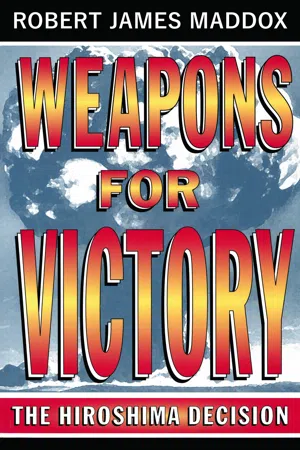
The highly acclaimed Weapons for Victory originally appeared in 1995, the fiftieth anniversary of the end of World War II. Now, in this paperback edition, Robert James Maddox provides a new introduction about the ongoing controversy related to the decision to bomb Hiroshima.
- English
- ePUB (mobile friendly)
- Available on iOS & Android
eBook - ePub
About this book
Information
CHAPTER 1
The Legacy of Unconditional Surrender
President Franklin D. Roosevelt and British Prime Minister Winston S. Churchill met at Casablanca, French Morocco, in January 1943. They and their staffs discussed matters such as the administration of North Africa and future operations against the Axis powers. The meeting concluded on January 24 with an outdoor press conference. In his opening remarks, Roosevelt stated, “The elimination of German, Japanese and Italian war power means the unconditional surrender by Germany, Italy, and Japan.” This did not imply the “destruction” of the populations of these nations, he continued, but rather of the “philosophies . . . based on conquest and the subjugation of other people.” He went on to say that the conference should be called “the ‘Unconditional Surrender’ meeting,” to which Churchill at his side responded “Hear! Hear!” Thus was launched one of the most controversial policies of the war.1
Roosevelt later explained that the phrase had occurred to him just a few minutes earlier when he had persuaded two rival French leaders to shake hands in front of photographers. “We had so much trouble getting these two French generals together that I thought to myself that this was as difficult as arranging the meeting of [Ulysses S.] Grant and [Robert E.] Lee,” he said, “and then suddenly the press conference was on, and Winston and I had no time to prepare for it, and the thought popped into my mind that they had called Grant ‘Old Unconditional Surrender’ and the next thing I knew, I had said it.”2
Why Roosevelt felt compelled to pretend that the idea had just “popped” into his mind can only be guessed. Eight months earlier he had indicated his agreement with a State Department advisory group’s conclusion that the war against Germany and Japan should be waged until they surrendered unconditionally. “We are fighting this war,” as one of the group members put it, “because we did not have an unconditional surrender at the end of the last one.”3 Shortly before he left for Casablanca, Roosevelt had informed the Joint Chiefs of Staff that he intended to discuss with Churchill the advisability of notifying Stalin that the United States and Great Britain meant to fight “until they reached Berlin, and that their only terms would be unconditional surrender.” At the press conference, moreover, he spoke from notes that referred to unconditional surrender three times.4 He did ad lib mention of Grant’s nickname, which appears to be the only accurate part of his recollection.
Churchill’s memory proved equally faulty—or self-serving—when he said after the war that Roosevelt had made the statement “without consultation with me,” and that he had supported it only because “working with great, loyal, and powerful friends from across the ocean, we had to accommodate ourselves.”5 That is false. On January 19 Churchill had cabled the British War Cabinet for its view on announcing Anglo-American determination to prosecute the war against Germany and Japan until unconditional surrender was achieved. The cabinet not only responded favorably, but recommended the inclusion of Italy.6
When reminded of this exchange of cables, Churchill admitted his error but then claimed that he had been surprised by Roosevelt’s decision to reveal the policy at the press conference. Actually, Churchill himself had suggested to FDR at a meeting with the Combined Chiefs of Staff that they include a statement on unconditional surrender in the official press release. And he had added the word “Italy” in his own hand to the original draft of the release.7 Possibly Roosevelt made the announcement orally because he thought it would receive more attention that way, but this was a matter of procedure only. And Churchill, at the end of his own remarks to the press, had defined the Allied goal as “the unconditional surrender of the criminal forces that have plunged the world in sorrow and ruin.”8 Churchill’s postwar efforts to distance himself from the doctrine should not be permitted to conceal the fact that at the time Roosevelt with good reason believed the British supported it.
Critics have denounced unconditional surrender as a colossal error; one referred to it as “perhaps the biggest political mistake of the war.”9 German and Japanese propagandists used it to promote the belief that the Allies meant to destroy their societies, some have pointed out, thereby bolstering the will to persevere. Failure to hold out prospects of a negotiated peace also undermined those Germans who otherwise would have been encouraged to overthrow Hitler. This, in turn, might have resulted in German capitulation before Soviet armies penetrated into the heart of Europe. The formula also weakened the position of Japanese peace advocates, who might have ended the Pacific conflict months earlier had assurances been given that their emperor could be retained.
Defenders of unconditional surrender emphasize how speculative such criticisms necessarily are. Propagandists in the Axis powers controlled the media, and unconditional surrender merely provided them with additional grist for their contention that national survival was at stake. Besides, through countless radio broadcasts and other means, the Allies repeatedly declared—as FDR had in his original announcement—that the formula did not mean social destruction and enslavement. Potential conspirators against Hitler and the Japanese moderates most certainly were aware of these promises.
Even more important, the armies of both nations held effective power and without their support no group could have entered negotiations for peace. Not only were the militarists’ own hands stained by complicity in bringing on the war and in the commission of widespread atrocities, but also the terms they would have insisted on to salvage their own status would have been unacceptable. In short, there is no way of telling whether the doctrine prolonged the war in any way.
The value of the unconditional surrender formula, advocates argue, far outweighed any drawbacks. It offered an uncomplicated, inspirational slogan for popular consumption. It served as a pledge to suspicious Soviet leaders that the United States and Great Britain would make no separate peace. Most important, it provided the lowest common denominator of war aims among the Allies, thereby preventing divisive disputes before victory was attained. “Frankly, I do not like the idea of [tripartite] conversations to define the term ‘unconditional surrender,’” Roosevelt wrote on one occasion. “Whatever words we might agree on would probably have to be modified or changed the first time some nation wanted to surrender.”10
No doubt Roosevelt did value the phrase as a slogan, by which he often set great store. Throughout the war he considered American morale a delicate commodity and often made significant concessions to it. He had agreed to the invasion of North Africa against the advice of his top military advisers in part because he believed it was imperative for public opinion that the United States go on the offensive against Germany as quickly as possible. “It is of the highest importance,” he told his advisers, “that U.S. ground troops be brought into action against the enemy in 1942.”11
Events surrounding the North African landings in November of that year provided additional reasons for promulgating the doctrine. French officials and troops in Morocco, Tunisia, and Algeria were at least nominally loyal to the so-called Vichy government, a quasi-fascist, collaborationist regime established after German victory in 1940. Resistance by some 120,000 French soldiers in North Africa might imperil operations being carried out by mostly inexperienced invasion forces. To avoid this potential catastrophe, Allied commander Dwight D. Eisenhower negotiated an armistice with a high-level Vichy official, Admiral Jean Darlan, who happened to be in Algiers at the time. Eisenhower also had Darlan installed as commander in chief of French military forces and as head of the civil government in North Africa. What became known as the “Darlan Deal” aroused great furor in the United States because it struck many as a perversion of what the war was supposed to be about.
Roosevelt, intimidated by the public outcry, for several days refused to support what Eisenhower had done. Only strong protests by FDR’s personal chief of staff, Admiral William D. Leahy; Army Chief of Staff George C. Marshall; and Secretary of War Henry L. Stimson prodded him into defending Eisenhower’s actions. He tried to placate critics by announcing that negotiations for an armistice had been motivated by the understandable desire to save lives, and that military and civil arrangements were temporary expedients “justified by the stress of battle.” Darlan’s assassination in December and the subsequent inclusion of Free French leader General Charles De Gaulle in the North African government helped to defuse the situation, but doubts remained. Unconditional surrender served notice that there would be no more such questionable “deals” in the future.12
The Darlan episode also had bearing on relations with the Soviet Union. Numerous reports had reached Washington and London of Soviet-German contacts in Sweden and elsewhere. If Joseph Stalin believed that the United States and Great Britain might be willing to strike a bargain with Germany, as they had with Darlan, would this not influence him to seek his own accommodation? Anglo-American failure to meet Soviet demands for a second front in Europe made this scenario more plausible. Roosevelt rashly had led Stalin to believe that such an operation would be mounted in 1942. The decision at Casablanca to postpone an invasion yet another year could only deepen the latter’s suspicions that his allies were willing to see the Soviets and Germans tear each other apart while they waited to make advantageous settlements at little cost to themselves. Words were poor substitutes for action, but Roosevelt hoped to prevent a separate Nazi-Soviet peace by committing the United States and Great Britain to total victory.
FDR’s devotion to the formula went well beyond such tactical considerations, important though they were. Noted for his vacillation on many issues, he rejected numerous subsequent requests to “clarify” the doctrine, thereby rendering it less ominous to the enemy in hopes of weakening resistance. Such requests, at various times, came from the British, the Combined Chiefs of Staff, the American Joint Chiefs of Staff, and the State, Navy, and War departments. Roosevelt occasionally wavered, but in the end spurned such pleas because he believed unconditional surrender was a prerequisite for achieving a lasting peace.
His familiarity with the concept had more recent application than General Grant’s nickname. Toward the end of World War I, a heated debate had arisen in the press and in Congress over the terms that should be extended to Germany. “Unconditional surrender” became a popular phrase. Several Senate resolutions employed it as the only acceptable basis on which the war should end. War hero General John J. Pershing, commander of the Allied Expeditionary Force in France, supported it, as did Theodore Roosevelt. Franklin, in his capacity as Assistant Secretary of the Navy, could not speak to the issue openly but his conduct suggests that he was closer to his cousin’s point of view than to President Woodrow Wilson’s “Peace Without Victory.” In a debate over disposition of the German navy, FDR as acting secretary urged the president to demand surrender rather than internment of the fleet, despite protests that the Germans would balk at such harsh treatment.13
Roosevelt later became well aware of the use Adolf Hitler and others had made of the “stab in the back” thesis: that Germany had not lost the war militarily but had been betrayed by Jews and marxists at home. He was determined that there be no repetition. When asked at a press conference in July 1944 whether unconditional surrender “still stands,” he replied: “Yes. Practically all Germans deny the fact that they surrendered during the last war, but this time they are going to know it. And so are the Japs.” Two weeks later he told reporters that the peace he envisioned would be “nothing like last time. That is out. That was a gift from God and General Foch.”14
Reluctant to be specific about the formula, FDR often relied on a story about General Grant’s conduct at Appomattox Courthouse at the end of the Civil War. There, he said, Grant refused to discuss Lee’s repeated appeals for conditions. Finally, only after Lee agreed to unconditional surrender, Grant showed himself generous in providing food to hungry soldiers and permitting officers to keep their horses for the spring planting.15 No one, apparently, informed Roosevelt that his version of history was fictitious. Grant had acquired his nickname years earlier during a campaign in the western theater. No exchange such as Roosevelt imagined ever took place between the two generals.
FDR wrote and spoke more often about his intentions toward the Germans than the Japanese. He regarded Germany as by far the greater threat, which is why he gave the European theater highest priority. As time went on, particularly after the successful Allied invasion of France in June 1944, it became obvious that Germany would be defeated long before Japan. Finally, treatment of Germany involved issues requiring agreement with the Soviet Union, which had not yet gone to war with Japan by the time of Roosevelt’s death.
He was less benign toward the German people in private than his public allusions to Grant’s generosity suggested. “We have got to be tough with Germany,” he told Secretary of the Treasury Henry J. Morgenthau in August 1944, “and I mean the German people not just the Nazis. We either have to castrate the German people or you have got to treat them in such manner so they can’t just go on reproducing people who want to continue the way they have in the past.” A few weeks later he spoke in the same vein to Secretary of War Stimson. Too many Americans and British believed that “only a few Nazi leaders” were responsible for what had happened, he said, and that “is not based on fact. The German people as a whole must have it driven home to them that the whole nation had been engaged in an unlawful conspiracy.”16 His subsequent flirtation with Morgenthau’s drastic plan to convert Germany into an agrarian nation provides another example of his attitude.
There is little reason to suppose that he felt much differently about how Japan should be treated, as indicated by his “And so are the Japs” statement cited above. That would have been implausible considering Japanese atrocities in China during the 1930s and their attack on Pearl Harbor. In April 1943, when he learned that the Japanese had executed several American aviators captured after an air raid on Tokyo a year earlier, he wrote Secretary of State Cordell Hull that he was “deeply stirred and horrified,” and approved a note to the Japanese government stating that the United States intended to punish those officials responsible for “such uncivilized and inhuman acts.”17 As the Americans had been sentenced at public trials held in Tokyo, it was obvious that approval had come from the highest levels of government. Reports of the Bataan Death March reached Washington a few months later. Roosevelt withheld announcement until early 1944, at which time he told newsmen he thought the affair “gives us a pretty good slant . . . on the mentality of the Japanese.”18
Roosevelt had provided no intimation of relenting on unconditional surrender for Japan by the time of his death on April 12, 1945. Churchill had made such a suggestion at the Yalta Conference in February. Why not invite the Soviet Union to join the United States, Great Britain, and China in issuing a declaration calling upon Japan to surrender unconditionally? Confronted with such great-power unity, Churchill went on, the Japanese might ask “what mitigation of the full rigor of unconditional surrender would be extended to her if she accepted the ultimatum.” He said it would be up to the United States to decide, but “there was no doubt that some mitigation would be worth while if it led to the saving of a year or a year and a half of a war in which so much blood and treasures would be poured out.”
FDR was unenthusiastic. He said the matter might be discussed with Stalin, but doubted an ultimatum would have much effect on the Japanese “who still seemed to think that they might get a satisfactory compromise.” He told Churchill he doubted that they would “wake up” until all their islands had “felt the full weight of air attack.”19 Instead of suggesting a four-power declaration, Roosevelt negotiated an agreement with Stalin to join in the war against Japan after the defeat of Germany in return for concessions in Manchuria and elsewhere.
Roosevelt reported on the Yalta meeting before a joint session of Congress on March 1. Agreements reached with Stalin and Churchill, already published in the conference communiqué, enabled him to be more specific than before as to what would be done with Germany: occupation, destruction of Nazism and militarism, punishment of war criminals, disarmament, and the extraction of reparations. Further along in his speech he indicated that something resembling such treatment awaited the Japanese, whose unconditional surrender “is as essential as the defeat of Germany.” This “is especially true if our plans for world peace are to succeed. For Japanese militarism must be wiped out as thoroughly as German militarism.”20
The Cairo Declaration of November 1943 already had committed the United States to severe treatment of Japan with regard to territorial possessions. At their meeting in Egypt, FDR, Churchill, and Chinese leader Chiang Kai-shek had agreed to force Japan to return Manchuria and Formosa (Taiwan) to China, evacuate Korea as a prelude to its eventual independence, relinquish all Pacific islands acquired since World War I, and “be expelled from all other territories which she has taken by violence and greed.” In short, as one historian put it, the goal of the Cairo Declaration was “to squeeze the Japanese genie back into the pre-Perry bottle.” To secure these objectives, the declaration concluded, the signatories would prosecute the war until “the unconditional surrender of Japan.”21
Four days after Roosevelt’s death, new president Harry S. Truman addressed a joint session of Congress. He called upon all Americans to support him in carrying out the ideals “for which Franklin Delano Roosevelt lived and died.” The first of these was unconditional surrender. “So that there can be no possible misunderstanding,” Truman stated, “both Germany and Japan can be certain, beyond any shadow of a doubt, that America will continue the fight for freedom until no ves...
Table of contents
- Cover Page
- Half Title Page
- Title Page
- Copyright Page
- Contents
- Acknowledgments
- Introduction to the Paperback Edition
- Introduction
- 1. The Legacy of Unconditional Surrender
- 2. Taking Control
- 3. Consideration of the Bomb and Preparations for the Summit
- 4. Advice and Dissent
- 5. Countdown
- 6. Potsdam: Nearing Armageddon
- 7. Japan Unbowed
- 8. Atom Bombs and the End of the War
- 9. A Retrospect
- Notes
- Selected Bibliography
- Index
- About the Author
Trusted by 375,005 students
Access to over 1.5 million titles for a fair monthly price.
Study more efficiently using our study tools.
Frequently asked questions
Yes, you can cancel anytime from the Subscription tab in your account settings on the Perlego website. Your subscription will stay active until the end of your current billing period. Learn how to cancel your subscription
No, books cannot be downloaded as external files, such as PDFs, for use outside of Perlego. However, you can download books within the Perlego app for offline reading on mobile or tablet. Learn how to download books offline
Perlego offers two plans: Essential and Complete
- Essential is ideal for learners and professionals who enjoy exploring a wide range of subjects. Access the Essential Library with 800,000+ trusted titles and best-sellers across business, personal growth, and the humanities. Includes unlimited reading time and Standard Read Aloud voice.
- Complete: Perfect for advanced learners and researchers needing full, unrestricted access. Unlock 1.5M+ books across hundreds of subjects, including academic and specialized titles. The Complete Plan also includes advanced features like Premium Read Aloud and Research Assistant.
We are an online textbook subscription service, where you can get access to an entire online library for less than the price of a single book per month. With over 1.5 million books across 990+ topics, we’ve got you covered! Learn about our mission
Look out for the read-aloud symbol on your next book to see if you can listen to it. The read-aloud tool reads text aloud for you, highlighting the text as it is being read. You can pause it, speed it up and slow it down. Learn more about Read Aloud
Yes! You can use the Perlego app on both iOS and Android devices to read anytime, anywhere — even offline. Perfect for commutes or when you’re on the go.
Please note we cannot support devices running on iOS 13 and Android 7 or earlier. Learn more about using the app
Please note we cannot support devices running on iOS 13 and Android 7 or earlier. Learn more about using the app
Yes, you can access Weapons for Victory by Robert James Maddox in PDF and/or ePUB format, as well as other popular books in History & Military & Maritime History. We have over 1.5 million books available in our catalogue for you to explore.