![]()
1. A Culture of Criticism
The Limitations of the American Newsroom and the Societal Role of Press Criticism
In 1974, media scholar James W. Carey published an essay in the academic journal The Review of Politics, in which he lamented the state of American press criticism heading in the last quarter of the twentieth century. Carey, who was then a professor at the University of Illinois, found himself perplexed by what he saw as a glaring absence in the public discourse of the time: the lack of what he called a “tradition of sustained, systematic, and intellectually sound criticism of the press.”1 In his opening paragraph, Carey notes that the press, despite being an institution that affects the lives of everyone in a representative democracy, received less critical scrutiny than baseball and only slightly more than soccer. Carey set out “to demonstrate that a tradition of press criticism does not exist in the United States, that a critical tradition is indispensable to the operation of democratic institutions, and that journalism criticism, properly conceived, is the criticism of language.”2
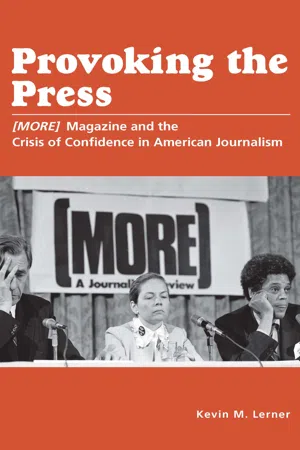
While there had been sporadic instances of press criticism before the 1970s, Carey was right that no consistent critical discourse about the press—one that regularly attempted to interact with a critical public and bring change to the norms of journalism from the outside—had taken hold. And it is not a coincidence that Carey wrote when he did. The structural, cultural, and institutional factors that could support a culture of press criticism were falling into place from the 1960s up through the time of Carey’s writing. What Carey, writing in the midst of cultural and structural changes in both the United States and its organized press, may not have seen while being immersed in that cultural ferment was that 1974 actually represented the last great moment for American press criticism and a chance for the kind of critical culture he advocated in his essay to take hold. All of the conditions for a critical culture were present, except for a sustainable business model to support it and the technology to distribute this kind of press criticism to a broad, general audience. This was something of a golden age for press criticism, one that was born of a crisis of confidence in American journalism, and a moment for press criticism that would not be equaled until another major crisis of confidence in the mid–2010s. The prime embodiment of this moment in American journalism criticism was a monthly journalism review called (MORE), which Carey does not name in his essay but which he alludes to as one of “the new reviews that have sprung up in many cities.”3 (MORE) made the best attempt to bring regular critical examination of the mainstream news media to a general audience. Carey also names the Columbia Journalism Review and the “coteries of professionals and students that queue up before the Chicago Journalism Review.”4 The two CJRs—Columbia and Chicago—were important influences on (MORE), one as a foil, one as an inspiration, as will be described in chapter 2.
(MORE) did something different from the press criticism that came before it. For one thing, it attempted to reach as broad an audience as possible, not limiting itself to being a professional journal read only by working journalists or newsroom managers, but attempting to speak to the interested public who might have an interest in the performance of the press in its various roles as watchdog, gatekeeper, or just as a chronicle of turbulent times. For its entire run, from 1971 to 1978, (MORE) had a moderate circulation, never getting above about twenty thousand readers, and never reaching too far beyond the world of working journalists in the United States and Canada, but within that world, it had an outsize influence. One other difference between (MORE) and the press criticism that preceded it was that it took a very different worldview from publications such as the Columbia Journalism Review, which generally maintained institutional and professional norms supported by the managers and editors of the papers. Rather than maintaining norms, (MORE) sought to question them, and in many cases, overturn them. The vast bulk of press criticism prior to 1971 worked toward establishing the objective voice in American journalism, which had been developing on a haphazard path since the time of the penny press.5 While (MORE) did not reject objectivity outright as one of many valid norms for the practice of journalism, its editors and writers saw the institutionalized voice of objectivity and detachment as too limiting a way for journalism to describe the world, and they sought a broader understanding of what American journalism could and should be doing to accurately reflect the culture and to serve the public.
Carey had something larger in mind though, imagining that a large, omnibus newspaper such as the New York Times would endeavor to print criticism of the press that followed the template of all of the other institutions of American culture that the paper regularly subjected to analysis: “In its pages,” he wrote, “particularly the Sunday edition, one finds information, analysis, criticism of every contemporary institution. It treats art, architecture, literature, education, politics, business, religion finance, film, and so forth.” This work, Carey argues, attempts to describe and ascribe meaning to human existence. But the Times did not, as of his writing in 1974, devote much space at all to criticism of the press. Carey compares the body of critical writing on Plato to that of Homer Bigart (a Times reporter whom he employs as an archetype), and finds it remarkable that “most of us” read far more words written by semi-anonymous reporters such as Bigart than we do of Plato, but that volumes of critical analysis of Plato continue to be published two and a half millennia after his death while nothing at all had been published on the work of Bigart. “It is an anomalous fact,” Carey wrote, “that all of us consume more words by journalists than any other group and yet our largest and most important literary diet is never given close critical scrutiny in any systematic way.”6
As it happens, the first issue of (MORE), which had been published in the summer of 1971, three years before Carey’s writing, included a piece on Homer Bigart and how his “interpretive reporting” had been turned into a bland objective statement by the editors of the New York Times.7 In it, the staff of (MORE) juxtaposed Bigart’s submitted draft of an article with the published, institutional, “objective” version. It is exactly the sort of “criticism of language” that Carey called for.8 The only problem was that (MORE) just wasn’t able to reach a general audience—though as the following chapters will demonstrate, (MORE) did reach an audience of elite journalists who would filter through the world of American journalism, bringing many of (MORE)’s ideas with them into the mainstream press.
That (MORE) eventually failed tells us about the financially and intellectually draining demands of running a small publication that has no clearly defined audience for advertisers. (MORE)’s failure also says something about the limits of public interest in press criticism and about the anti-intellectualism and general bullheadedness of the press, which despite the prodding of (MORE) and its successors, remains a singularly intractable collection of institutions.
Many of the cultural divides that roiled the late 1960s and early 1970s are coming to the surface again, and so too is the opportunity to establish Carey’s critical tradition. This chapter traces American press criticism from its earliest days to the moment that (MORE) entered the conversation, and describes the cultural conditions that allowed it to take root and flourish, intellectually if not financially, for seven raucous and consequential years.
The Proto-History of Press Criticism and Attempts at Definition
The American press has never lacked for attackers, though as Carey notes, “attack is not criticism.”9 Halfway through his second term, Thomas Jefferson received a letter from an eighteen-year-old man named John Norvell (who would go on to be a newspaper editor and one of the first United States senators from Michigan). Norvell wanted to know what Jefferson thought of newspapers. “It is a melancholy truth, that a suppression of the press could not more compleatly deprive the nation of it’s benefits, than is done by it’s abandoned prostitution to falsehood,” Jefferson wrote in his reply.
Nothing can now be believed which is seen in a newspaper. Truth itself becomes suspicious by being put into that polluted vehicle. The real extent of this state of misinformation is known only to those who are in situations to confront facts within their knolege with the lies of the day. I really look with commiseration over the great body of my fellow citizens, who, reading newspapers, live & die in the belief, that they have known something of what has been passing in the world in their time; whereas the accounts they have read in newspapers are just as true a history of any other period of the world as of the present, except that the real names of the day are affixed to their fables.10
Jefferson’s assessment reads like the exasperated lament of a man who had been attacked ruthlessly by a press whose attacks his predecessor, John Adams, had silenced by signing a law making criticism of the president and Congress a crime punishable by fines and prison time. Likely contributing to Jefferson’s frustration, the Sedition Act of 1798 explicitly omitted criticism of the vice president (Jefferson, at the time), and the acts were set to expire on the day that Adams would step down as president, since it was widely assumed that Jefferson, his political rival, would succeed him.11
There are resonances in Jefferson’s frustration more than two centuries later, as President Donald Trump attacks the press on social media with regularity. There are, of course, vast differences. Jefferson predicated his criticisms on his own prodigious reading, and many of his complaints were justified. Early nineteenth-century newspapers did not have a commitment to truth or the sort of objectivity that would emerge as the norm for American journalism by the early twentieth century, and many of the attacks on Jefferson were scurrilous lies. But newspapers also exposed the fact that Jefferson was having an affair with Sally Hemings, one of his slaves—and Jefferson denied this inconvenient truth as fake news, centuries before the current attacks on the credibility of the press flared up.
But while Jeffersonian-style attacks on the press have been a regular feature of discourse about the press since the earliest days of the American republic, James Carey–style press criticism, “an active and continuous response in terms of factual detail, unemotional language and articulate values” has largely been absent. One of the earliest works of press criticism was Lambert A. Wilmer’s 1859 book Our Press Gang, or a Complete Exposition of the Corruptions and Crimes of the American Newspapers.12 Wilmer had been an editor at a variety of American newspapers before undertaking his volume of criticism, which teeters back and forth between attack and what Wilmer argues to be constructive criticism of the institution of American newspapers. As the book’s subtitle suggests, it was mostly an exposé of blatantly biased, semi-fictional “news” that the American press had been publishing. Writing about a quarter century after the advent of the first mass-market newspapers in the United States—the penny press, as it is usually called—Wilmer actually seems justified in most of his critiques, if we apply the norms of twentieth-century journalism. In that sense, Wilmer may have been ahead of his time as a critic. He also echoes Jefferson’s lament that readers of newspapers are hardly well informed about the truly important affairs of the day. “In a country where the newspapers are the principal sources of information,” he writes, “it is almost impossible to obtain a strictly-correct account of any thing . . .”13 A close reading of Wilmer also suggests, however, that there was already a defense for newspapers—that in a market system, newspapers are only giving the public what they demand. Wilmer saw something more pernicious, though:
I have endeavored to expose the sophistical pretense, that “newspapers are not accountable for their own misconduct, because they are obliged to mould themselves to suit the requirements of the public.” I deny that the press of the United States is what the public demands. Instead of adapting themselves to the tastes and requirements of the people, our newspapers endeavor to innoculate the public with their own morbid humors and purulent morality.14
But the important point here is that Wilmer’s book, while it might have been one of the earliest surviving examples of published press criticism, was already responding to an ongoing conversation about the press, even if he only puts that conversation into the mouth of a straw man. But even if this conversation was happening, the fact that Our Press Gang stands out demonstrates the rarity of published works of press criticism and the complete lack of regularly published press criticism. Marion Tuttle Marzolf, in her survey of press criticism between 1880 and the middle of the twentieth century, found much the same thing to be true.15 In order to trace the critical conversation about journalism, Marzolf had to scour popular magazines, professional publications, and scholarly journals—but no regularly published press criticism. Even the New Yorker press critic A. J. Liebling, who began his Wayward Press column toward the end of the period Marzolf studied, published only occasionally (as Jack Shafer also noted). Still, Marzolf found that this nascent discourse about journalistic standards had a civilizing effect on a press that would otherwise have given itself over entirely to the rapacious influences of technology and commerce. “Without the critics—inside and outside the press—the impersonal market forces would have had complete control,” Marzolf writes.16 If indeed Wilmer’s Our Press Gang was the first published work of press criticism in the United States, the writers who form the basis of Marzolf’s study continue the conversation it started about separating the liberal democratic responsibility of a free press from the free market imperatives of a commercial press. That’s not to say that the former was always in the interest of the entire society. The main sources of press criticism from 1880 to 1950 were members of the elite classes, and that led to an elitist vision of the press ideal.17 One other important aspect of Marzolf’s survey is her tracing of the first mentions of objectivity as an ideal in American journalism, which she pegs to the 1930s.18 While that ideal had been developing since the middle of the nineteenth century, it is important to know that it only became an agreed-upon ideal about four decades before the press critics at (MORE) would begin to critique its limitations.
Hazel Dicken-Garcia and Yasmine Tarek Dabbous are the only other historians of the press who give much thought to press criticism before World War I.19 Adding some credence to the claim that pre–twentieth-century press criticism has been s...