eBook - ePub
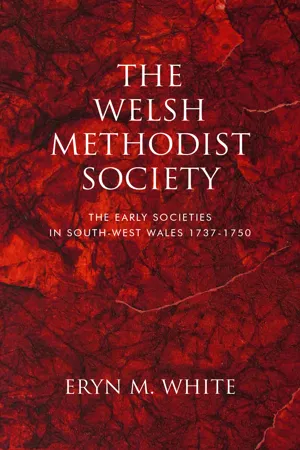
The Welsh Methodist Society
The Early Societies in South-west Wales 1737-1750
- 352 pages
- English
- ePUB (mobile friendly)
- Available on iOS & Android
eBook - ePub
The Welsh Methodist Society
The Early Societies in South-west Wales 1737-1750
About this book
The evangelical or Methodist revival had a major impact on Welsh religion, society and culture, leading to the unprecedented growth of Nonconformity by the nineteenth century, which established a very clear difference between Wales and England in religious terms. Since the Welsh Calvinistic Methodist movement did not split from the Church to form a separate denomination until 1811, it existed in its early years solely as a collection of local society meetings. By focusing on the early societies in south-west Wales, this study examines the grass roots of the eighteenth-century Methodist movement, identifying the features that led to its subsequent remarkable success. At the heart of the book lie the experiences of the men and women who were members of the societies, along with their social and economic background and the factors that attracted them to the Methodist cause.
Information
CHAPTER 1
‘No part of the Nation more inclin’d to be Religious’?1 The Religious Context in South-west Wales
The three counties of south-west Wales lay within the financially and administratively challenged diocese of St Davids. It was by far the largest of the four Welsh dioceses, comprising not just Cardiganshire, Carmarthenshire and Pembrokeshire, but also Breconshire and Radnorshire as well as part of west Glamorgan and a handful of parishes in Monmouthshire and Herefordshire. It therefore spread across the breadth of south Wales, yet its cathedral church was located on the west coast of Pembrokeshire in St David’s itself, although the bishop’s palace had been relocated to Abergwili, near Carmarthen. Despite its size, it was institutionally poor, as a result of alienation of property during the Reformation period and the lay impropriation of a substantial proportion of its tithes with the dissolution of the monasteries. The diocese and its benefices were impoverished as a result of the loss of 58 per cent of its income from tithe to lay impropriators, with the result that clerical incomes rose at a much slower rate than in England.2 All the Welsh dioceses were amongst the poorest in the province of Canterbury, but the two southern dioceses of St Davids and Llandaff had historically suffered most from lay impropriation, so that clerical incomes there compared unfavourably with the northern sees of Bangor and St Asaph. It is estimated that the annual worth of St Davids was only £450 at the start of the eighteenth century, although this seems to have increased to around £900 by 1762.3 At that time, Llandaff was reckoned to be worth £500 a year and Bangor and St Asaph both worth £1,400.4
Despite the abiding issue of poverty and its associated problems of pluralism and absenteeism, there is little sign of popular dissatisfaction with the Church in the early eighteenth century. The initial cool reception given in the sixteenth century to the imposition of a Protestant faith from outside the country had warmed over time with the introduction of Welsh services to correspond with the translation of the Bible and Book of Common Prayer. The Anglican Protestant Church was effectively rebranded as the ‘British’ or ‘Welsh’ faith, with an interpretation of history linking it to the nation and its language as a revived version of the old Celtic Church.5 The Church had clearly succeeded in building on these developments to win public loyalty by the mid-seventeenth century, when the changes imposed under the Commonwealth regime were demonstrably not welcomed by the majority of people, who hankered after the liturgy and traditions of the Church.6 There was little initial interest in the new Puritan movement which, like sixteenth-century Protestantism, struggled in its early stages to overcome the hurdle of language. Protestant Dissent remained very much a minority movement into the Restoration period and after Toleration was granted in 1689. The results of the Compton Census in 1676 for St Davids suggest there were 2,401 Nonconformists compared to 69,972 conforming Anglicans and 218 Catholics out of a total population of 72,591.7 These figures may not be wholly accurate, and may understate the total number of Dissenters, but the overall picture is unlikely to be radically different. The vast majority of the population were at least nominally adherents of the Anglican Church by the early eighteenth century, even if they did not all by any means attend regularly. The local parish church was the focal point for the community where for generations they had baptised their children and buried their dead, as well as congregated to celebrate on holidays. Forces of tradition and loyalty predating the Reformation therefore bound them to the Church in large numbers. As the eighteenth century dawned, the Established Church seemed in a comfortable position of predominance with little to fear from any competition.
Welsh Methodism certainly did not set out to become that competition since it was by no means a protest against the Established Church. The fact that the movement did not officially separate from the Church until 1811 demonstrates the depth of abiding loyalty felt, especially by the leadership, the first generation of whom were mostly ordained Anglican clergy. Howel Harris remained a layman not out of choice but because he was refused ordination as a result of his Methodist activities. Harris constantly argued in favour of remaining within the Church whenever the subject arose. After a monthly association in 1745 he noted in his diary: ‘I spoke home too of not giving offence to the clergy &c as much as possible as we are in the Established Church & as it bore with us more than any Church would.’8 However, it must be said that there was at times a passive aggressive tone to his argument that the Methodists should not leave of their own volition, but should wait to see if they were turned out.9 Discussions at Glanyrafonddu Association meeting in October 1743 apparently turned on the question of ‘whether did the Christians leave the Jewish Church were they turned out & so the Protestants the Popish Church & we found they declared against that which was erroneous in the Church & for that were turned out but did not turn themselves out & we are guilty of none of the evils in our Church as having all born our Testimony against them’.10 The Methodists often sought guidance from their perception of the early Christians and the sixteenth-century reformers and here they seemed to find precedents for remaining within a Church whilst conscientiously pointing to its failings. Yet there remained the implication that separation was the inevitable outcome even if not initiated by the Methodists themselves. Whilst Harris defended the Church on several occasions, he also described it as a ‘poor, benighted Church’ acutely in need of prayer for its renewal.11 At times also he feared the clergy were ‘blind guides’ doing little to enlighten their most ignorant parishioners.12 He was particularly moved in January 1742 by Bishop Nicholas Claggett’s seeming opposition to Daniel Rowland and wondered whether God meant to ‘utterly remove Thy Candlestick from this dark benighted Church of this Nation’. He felt inclined:
to write for Brother Rowlands to the Bishop feeling Power to tell him home how he employs all the vilest men & is now against God’s work how will this tear him in the last Day. Had Power in me to tell him & that though he should excommunicate me yet I must go though I should go to Death to feed the lambs that starve for want of food.13
The harshest contemporary attacks on the Church came not from the Methodists but from Anglican clergy unmoved by the revival. Ieuan Gwynedd Jones perceptively commented that critics from within the Church attributed its problems to the bureaucratic failings arising from its poverty, whilst Methodist critics came to dwell on a lack of zeal and fervour.14 Many of the criticisms of the Church at the time and subsequently have centred on two major themes: that the Church was too impoverished to provide adequate spiritual provision and that it was an anglicised institution with little respect for the Welsh language. By the nineteenth century the Church was considered by Nonconformist commentators to have failed in its spiritual duty to the Welsh people. The Nonconformists had become accustomed to a home-grown leadership who could communicate with them naturally through the medium of Welsh, which may have well have hardened their attitude to the very idea that non-Welsh-speaking spiritual leaders could adequately serve the people of Wales. The bishops in particular were frequently accused of being indifferent to their Welsh dioceses at best, and hostile to the language at worst. Jaundiced views of the pre-revival establishment and clergy have drawn on the remarks of one of the internal critics of the Church’s bureaucratic failings, Erasmus Saunders in his A View of the State of Religion in the Diocese of St. Davids (1721). The Pembrokeshire-born Saunders was educated at Jesus College, Oxford, ultimately graduating as a Doctor in Divinity. Although initially appointed to a benefice in England, he was prebendary of Brecon from 1709 until his death in 1724, so maintained a connection with St Davids diocese.15 It may be that his comments were aimed at provoking measures to improve the financial state of the diocese, in the same way that John Penry’s barbed criticism in the sixteenth century had possibly prompted Archbishop John Whitgift to ensure funding for the printing of William Morgan’s translation of the Bible.16 It has also been suggested that he exaggerated the parlous conditions he described because he was disappointed not to have been promoted to a bishopric despite his qualifications.17 It is important to bear this in mind when using his evidence, but his emphasis on the problems arising from the loss of tithe income means that he fits squarely into Ieuan Gwynedd Jones’s first category of critics.
The most bitter contemporary critic was Evan Evans, or Ieuan Fardd, whose vehemently worded essay on the failings of the anglicised bishops of Wales was probably regarded as too sweeping to be published when written around 1764–5. Evans was in a position to compare conditions in Wales with those in parts of England, having served as a curate in Kent and several parishes in north Wales before returning as curate to his native parish of Lledrod in north Cardiganshire.18 Acknowledged as one of the greatest Welsh scholars of the period,19 he failed to distinguish himself in the Church and remained a curate throughout his career. This may well have been a factor leading to his condemnation of the Esgyb Eingl or ‘Anglo-bishops’ as utterly unsuited to their office. He was incensed by their inability to communicate with their flocks through the medium of the only language the majority of the Welsh people understood. He also bemoaned the fact that there was no hope for promotion for any Welsh-speaking clergy as their abilities went unnoticed and unappreciated. In doing so, he probably forfeited any remaining chance of preferment himself, but that would sadly have been a remote possibility in any case, given his lapses into drink and depression. By the time Evans was writing, Methodism was gaining ground sufficiently to be viewed as an increasing threat to the Church. Evans did not hesitate to attribute its growth to the bishops’ neglect of the native tongue, which he claimed:
peri i’r gwerinos druain orphwyllo, a myned o’r Eglwys i ganlyn y goleuadau newyddion annaturiol ag y mae Methodyddion yn ymffrostio o’u plegid.20
caused the poor people to become distracted, and leave the Church to follow the unnatural new lights in which Methodists take pride.
Evans’s anger was shared by other leading figures in Welsh culture, such as the Morris brothers. William Morris expressed his contempt in a letter to his brothers:
Wala, wfft i’r fath esgobion! O na bai Ddewi yn gwybod par fath gymdeithion sydd yn eistedd yn ei drŵn, ac yntau Elwy, a’i ddylynawr Rhisiart Davies yn gweled par fath goegyn sydd yn llenwi eu cadair!21
Well, fie on such bishops! O that David knew what sort of fellows sit on his throne, and that St Asaph, and his successor Richard Davies saw what a wretch fills their chair!
Such hostility was not voiced by contemporary Methodists, who showed little sign of inciting a rebellion against the Anglican Church. However, it is apparent that the Church faced a number of challenges in trying to minister effectively throughout Wales, a situation which is likely to have furthered the Methodist cause.
The Diocese of St Davids
During the first half of the eighteenth century, eight individuals served successively as bishop of St Davids. None proved anywhere near as controversial as their predecessor Thomas Watson, who was dismissed for simony in 1699, with the see left vacant until 1705 whilst Watson launched several unsuccessful appeals.22 His Jacobite sympathies laid him open to suspicion, and he met with concerted opposition from within the diocese, particularly from the registrar, Robert Lucy, son of one of his predecessors as bishop, William Lucy. Archbishop Thomas Tenison oversaw the diocese in the meantime, but this was not a propitious start to the century, and it may have led to a tendency to play safe by selecting bishops whose political loyalties were regarded as more circumspect than Watson’s. The fact that most of the bishops appointed were previously archdeacons, deans, canons or prebendaries in other dioceses confirms the suggestion that the diocese was regarded as most suitable for first or trial appointments to the episcopal bench.23 In more affluent dioceses, bishops might be tempted from another see, but this did not happen in eighteenth-century St Davids. On the contrary, bishops tended to move on to a position higher up the ecclesiastical ladder, including Phillip Bisse (1710–13) to Hereford, Richard Smallbrooke (1723–31) to Lichfield and Coventry, Nicholas Claggett (1731–42) to Exeter and Richard Trevor (1743–52) to Durham. In some cases, this could happen extremely quickly if another, more attractive, prospect became available; Elias Sydall was translated to Gloucester within months of his installation in 1731, and Edward Willes translated to Bath and Wells having completed less than a year at St Davids between January and December 1743. Unusually, George Bull (1705–10) was already 71 years old when finally promoted to the episcopal bench as bishop of St Davids.24 Despite his age and frailty, he was resident and active in his see until his death five years after his election. The other bishop to die in office during the first half of the eighteenth century was Adam Ottley, who was fifty-eight when elected in 1713 and served for ten years until his death.25 Ottley and Claggett were the only two bishops in the first half of the century to fulfil ten years of service in the diocese. For most bishops, the diocese was not appealing for a protracted stay because the poor endowment meant a struggle to maintain a suitable lifestyle. Ottley, who was himself to die in debt, was warned upon his election by the widow of Bishop George Bull that her husband had never received more than £300 a year during his time and that the costs of his consecration year had amounted to £900.26 Faced with such balance sheets, Welsh bishops often acquired additional livings in order to supplement the inadequate endowments of the dioceses.
During this period, bishops were chiefly selected for their political loyalties in order to support the government in the House of Lords. The ability to communicate with and offer spiritual leadership to the people in their diocese was therefore not a priority in their appointment. As a result of their political role they were expected to be on hand to vote in favour of the government in Parliament while it was in session. Failure to do so could have repercussions for their future careers. It was suspected that the rebellious Richard Watson was allowed to remain in Llandaff for thirty-four years, between 1782 and 1816, as a punishment for not complying with the wishes of his political masters.27 This imperative to remain in London for much of the year meant that the bishops were generally only summer migrants to south Wales. Given the dreadful state of the roads, the journey could frequently be hazardous. Having arrived, travelling within the diocese by coach was also often fraught with difficulties. Bishop Claggett’s coach came to grief during a journey from Brecon to the bishop’s palace at Abergwili in 1733.28 Even towards the close of the century, conditions remained so bad that it took Bishop Samuel Horsley five and a half hours to travel from Cardigan to Aberaeron in 1791, a distance of twenty-three miles.29 There were exceptions to this pattern of absenteeism, including the elderly George Bull and also Adam Ottley, who resolved to be a resident bishop. Ottley took up residence at the bishop’s palace at Abergwili, which was centrally placed for the diocese...
Table of contents
- Cover
- Title Page
- Copyright Page
- Contents
- List of illustrations
- Introduction
- Chapter 1: ‘No part of the Nation more inclin’d to be Religious’? The Religious Context
- Chapter 2: ‘The Young Striplings’: Leaders and Exhorters
- Chapter 3: ‘The Lord’s Peculiar Dwelling Place’: The Location of the Societies
- Chapter 4: ‘The Great Shepherd’s Little Flock’: The Membership of the Societies
- Chapter 5: ‘Iron Sharpens Iron’: The Appeal of the Societies
- Chapter 6: ‘The World, the Flesh and the Devil’: Order and Discipline
- Chapter 7: ‘This Furnace of Affliction’: Trials and Tribulations
- Conclusion
- Appendix: List of societies
- Bibliography
- Notes
Trusted by 375,005 students
Access to over 1.5 million titles for a fair monthly price.
Study more efficiently using our study tools.
Frequently asked questions
Yes, you can cancel anytime from the Subscription tab in your account settings on the Perlego website. Your subscription will stay active until the end of your current billing period. Learn how to cancel your subscription
No, books cannot be downloaded as external files, such as PDFs, for use outside of Perlego. However, you can download books within the Perlego app for offline reading on mobile or tablet. Learn how to download books offline
Perlego offers two plans: Essential and Complete
- Essential is ideal for learners and professionals who enjoy exploring a wide range of subjects. Access the Essential Library with 800,000+ trusted titles and best-sellers across business, personal growth, and the humanities. Includes unlimited reading time and Standard Read Aloud voice.
- Complete: Perfect for advanced learners and researchers needing full, unrestricted access. Unlock 1.5M+ books across hundreds of subjects, including academic and specialized titles. The Complete Plan also includes advanced features like Premium Read Aloud and Research Assistant.
We are an online textbook subscription service, where you can get access to an entire online library for less than the price of a single book per month. With over 1.5 million books across 990+ topics, we’ve got you covered! Learn about our mission
Look out for the read-aloud symbol on your next book to see if you can listen to it. The read-aloud tool reads text aloud for you, highlighting the text as it is being read. You can pause it, speed it up and slow it down. Learn more about Read Aloud
Yes! You can use the Perlego app on both iOS and Android devices to read anytime, anywhere — even offline. Perfect for commutes or when you’re on the go.
Please note we cannot support devices running on iOS 13 and Android 7 or earlier. Learn more about using the app
Please note we cannot support devices running on iOS 13 and Android 7 or earlier. Learn more about using the app
Yes, you can access The Welsh Methodist Society by Eryn M. White,Eryn Mant White in PDF and/or ePUB format, as well as other popular books in History & British History. We have over 1.5 million books available in our catalogue for you to explore.