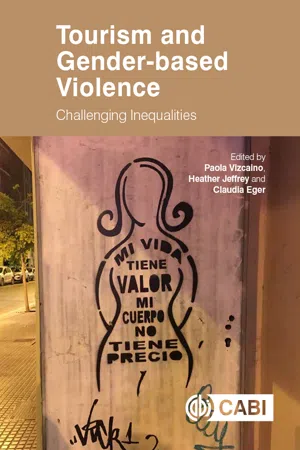
Gender based violence (GBV) in travel and tourism is embedded within wider social structures of gender inequalities and discrimination. This book focuses on the multiple and interconnected manifestations of violence that women and girls encounter in tourism consumption and production, such as physical, sexual, emotional or socio-economic abuse. The book adopts a multidisciplinary perspective in its critical examination of the theoretical landscape of GBV, and its engagement with case studies on GBV and sexual harassment. It draws on feminist, intersectional and post-colonial frameworks, bringing together contributions from academics and practitioners across the globe. This book: Provides a critical approach to gender-based violence as part of broader social structures of inequality and discrimination in the tourism and hospitality industries. Draws on a range of disciplinary approaches, includinggender studies, geography, international relations, law, sociology and tourism studies. Brings together work by scholars who are engaging with the concept of gender-based violence in a wide range of tourism settings and practices. Includes profiles of organisations and initiatives that are attempting to tackle GBV in tourism, hospitality and beyond. Exploring an important topic of current times, this book will be of interest to researchers and practitioners in the areas of tourism, hospitality, gender studies, international relations, law, geography and sociology.
eBook - ePub
Tourism and Gender-based Violence
Challenging Inequalities
- 184 pages
- English
- ePUB (mobile friendly)
- Available on iOS & Android
eBook - ePub
Tourism and Gender-based Violence
Challenging Inequalities
About this book
Information
1 Introducing Critical Debates on Gender-Based Violence in Tourism
1Copenhagen Business School, Copenhagen, Denmark
2Bournemouth University, Poole, UK
3Middlesex University, Dubai, United Arab Emirates
*Corresponding author: [email protected]
Let’s think of all the things that women can’t do, in all the places we can’t go, do you think that is equality? Gender-based violence, sexual harassment, femicide and rape build imaginary barriers, delimit those places where women ‘can’t go’.
(Ruiz-Navarro, 2016)
In her weekly column in the online newspaper El Espectador, Colombian-Caribbean feminist activist and journalist Catalina Ruiz-Navarro writes about contemporary feminist movements and women’s rights in Latin America. We chose to start this introduction with a quote from the column ‘Por que tan Solitas?’ [Why so Alone?], published on 2 March 2016 in response to news of the murder of two young Argentinian tourists who were spending their holidays in the surfing town of Montañita, Ecuador. The news of this double femicide was widely reported by Latin American sources and commented on by readers from across the region. The overtones of victim-blaming, including the statement of an Argentinian psychiatrist who labelled the choice of backpacking as a ‘high risk activity’ that contributed to the heinous crime (BigBang, 2016), led to a heated online discussion on women’s freedom of movement and the right to travel without fear of sexual or gender-based violence (GBV) (see the Twitter hashtag #viajosola, which means ‘I travel alone’). At the time, we not only empathized with young women’s desire to travel freely and overcome gender inequalities in Latin America and other regions of the world, but as gender and tourism scholars, we reflected on the need to examine the multiple dimensions and manifestations under which GBV or violence directed against a person on the basis of gender (UN General Assembly, 1993) is enacted in tourism contexts, and to explicitly engage with GBV as a theoretical framework.
To fulfil this purpose, we organized a session at the Royal Geographical Society and the Institute of British Geographers’ Annual International Conference in August 2018. The session was co-sponsored by the Geographies of Leisure and Tourism Research Group (GLTRG) and the Gender and Feminist Geographies Research Group (GFGRG). Through an exploration of the dynamic transnational landscapes of violence, which ‘respect[s] no geographic or cultural boundaries’ (Pritchard, 2014, p. 319), the session presenters discussed some of the most salient issues around GBV in tourism, including sexual harassment in the tourism and hospitality industries, violence against female travellers and sex trafficking in global tourism. Our call for chapters for this book allowed us to expand the scope of relevant topics and receive meaningful contributions from emerging and established scholars interested in this crucial yet under-researched phenomenon in the tourism academy. Even though all the submissions discursively work within binary categorizations of gender, they provide a critical examination of asymmetric power relations and gender inequalities that either facilitate or legitimize GBV in different tourism contexts.
While it is assumed that enhancing gender equality supports the struggle against gendered forms of violence, the evidence is inconclusive (Merry, 2011). When bringing tourism into the equation, the multiple power geometries characterizing tourism production and consumption intersect to further complicate the interrelationship between violence and gendered societies and cultures. To capture the inherent complexity of GBV, this introduction first engages with the concept of violence and explores its intersections with gender from different disciplinary angles. Second, it exposes the silences surrounding landscapes of GBV in tourism and the power imbalances that constitute the reification of GBV in its potentially most pronounced example in tourism, namely sex tourism. Third, it examines sexual harassment, which is a key constituent of GBV and has a long tradition in the hospitality and tourism industry. This is followed by an outline of the book’s structure.
1.1 Disciplinary Perspectives on Gendered Violence
In the social sciences, the dominant approach is to account for violence through its equation with physical force taken against human life (Matthews et al., 2013). While this allows for the quantification of physical violence using, for example, rape or homicide rates, it does not account for the diverse character of violence, which encompasses physical, sexual, emotional, material, structural and symbolic forms. Conceptions of moral superiority often prevail, when considering the patriarchal roots of violence. Patriarchy refers in its original sense to the ‘rule of fathers over their families’ (Bowden and Mummery, 2009). By extension, this is understood as the different constellations of societal and familial frameworks in which men have predominant power (Merry, 2011). Individuals who endorse patriarchal norms, are more prone to engage in sexually harassing behaviour compared with those who do not (Berdahl, 2007). However, patriarchy alone does not suffice to explain the persistence of GBV. While it often plays an enabling function, legitimizing GBV in different contexts, it does not elucidate the underlying inequality-producing mechanisms. A patriarchal lens further supports a heteronormative perspective, which often misses other differences, such as violence in lesbian and gay relations, or considerations of classism, racism and ableism (Merry, 2011). Transcending these binaries is key to advance our understanding of the complex intersectional politics of gender and violence.
Violence can further be studied from different actor perspectives. Psychological studies have engaged with the psychology of the violator and the violated. There exists no typical harasser. Rather, understanding violence requires an engagement with the ways in which enacted values and roles have become institutionalized through history, shaping power relations that encode and evaluate gender. ‘[A]ll societies tend to confer a higher social value on men than women and a range of norms and powers derive from this’ (Jewkes et al., 2015, p. 1581). In the relatively few studies centred on violence against women in travel and tourism, there is a tendency to focus on individual risk perceptions (e.g. Yang et al., 2018). However, the wider psychology of violence is rooted both in individual experiences and risk perceptions, as well as in the social structures of gender inequality. For example, individuals’ exposure to violence influences their proneness to engage in violence themselves – providing insights into both the psychology of the violated and the violator (Jewkes et al., 2015).
On the other hand, women’s risk perceptions are significantly shaped by the wider cultural milieu that (re)produces specific gender norms establishing the boundaries of what is perceived to be gender-conforming behaviour (Eger et al., 2018). This is illustrated in the study by Isis Arlene Díaz-Carrión (see Chapter 8), where women outline a range of coping strategies to ‘protect’ themselves from the perceived gendered risk factors of engaging in mountain bike tourism in Mexico. The author develops a schematic depiction, which shows how women adjust their use of public space based on their risk perceptions, especially with regard to sexual harassment and assault. Also in this volume, Siân Stephen discusses the expectation that when on holiday you must enjoy yourself and you must be respectful of the local culture even if that culture is not respectful of you. Siân minimizes the sexual harassment she experiences by utilizing a liberal mental schema whereby she in effect blames herself for not behaving properly for the local context, but also understands that she too is entitled to her human rights, which creates moments of almost cognitive dissonance (see Chapter 9).
The law and legal studies often provide form-giving definitions of ‘slippery’ concepts such as GBV. The Convention on the Elimination of All Forms of Discrimination Against Women (CEDAW) represents a form of international bill of rights for women. It provides a general definition of GBV as violence directed against a person on the basis of gender (UN General Assembly, 1993). Its prevailing form is violence against women and girls, which represents any act ‘that results in, or is likely to result in, physical, sexual or psychological harm or suffering to women, including threats of such acts, coercion or arbitrary deprivations of liberty, whether occurring in public or in private life’ (UN General Assembly, 1993, p. 2). The Istanbul Convention recognizes violence against women as a human rights violation and it is ‘the first international treaty to contain a definition of gender as “a socially constructed category” that defines “women” and “men” according to socially assigned roles, behaviours, activities and attributes. It firmly establishes the link between achieving gender equality and the eradication of violence against women’ (UN, 2018, p. 1). However, different countries have different legal systems and follow different gender ideologies. Also, as Tenia Kyriazi points out, different regulatory schemes apply when comparing domestic violence with violence in the workplace (see Chapter 7). Many national legislations define GBV exclusively in terms of intimate partner violence (e.g. Organic Law 1/2004 in Spain, discussed by Alberto Rodríguez-Darias and Laura Aguilara-Ávila in Chapter 10), which excludes many other forms of gendered violence such as trafficking of women and sexual violence. This highlights the complexity of naming a phenomenon that is characterized by different structural configurations and arguably structural disfigurations.
1.2 The Politics of Naming Violence and Gender in Tourism
Violence in tourism contexts is described as a slippery concept (Salazar, 2017), which often passes unnoticed, due to the routinization and normalization of acts of violence and the use of euphemisms that ‘sanitize’ violence, such as sex tourism (Jeffreys, 1999). Violence is often conceptualized as happening ‘elsewhere’ in tourism (Lozanski, 2014). This obfuscates the ways in which violence has become embedded in local systems of power through the colonial legacy (Merry, 2011), which continues to develop in neo-colonial fashion (Salazar, 2017). Violence in other places becomes more visible due to media coverage and the attribution of violence as intrinsic to particular cultural norms and practices (see e.g. Lozanski, 2007). On the other hand, tourism imaginaries often draw on the disassociation from the indeterminate Other, which characterizes the concealment of violence in tourism advertising campaigns, products and practices (Devine and Ojeda, 2017). In one of the first edited collections on tourism and violence, Andrews (2014, p. 2) notes that the ‘violent underpinnings of tourism [are] infrequently expressed with words’. In the Encyclopaedia of Tourism, violence is not indexed but dark tourism and warfare tourism are, which Salazar (2017) terms violence-as-tourism.
Globally, one out of three women has experienced GBV (World Health Organization, 2013), revealing a wider culture of sexism and patriarchal power that is often obfuscated for the sake of a well-functioning tourism system (Chambers and Rakić, 2018). GBV has a long history of being silenced within the traditionally male-dominated social sciences (Walby et al., 2017). While the politics of naming violence in tourism is highly complex (Andrews, 2014; Büscher and Fletcher, 2017; Salazar, 2017), naming violence emerges as a crucial political and ethical task that cannot be reduced to an analysis of the positive and negative repercussions of violence in tourism. According to gender role theory, violence and harassment punishes gender-role deviances (West and Zimmerman, 1987; Berdahl, 2007). In line with Jocelyn Finniear, Nigel Morgan, Donna Chambers and Ana María Munar’s argument (see Chapter 3), the accompanying silence will not protect women from violence, echoing the words of Audre Lorde (2017). There is no empowering form of silence when considering gendered violence, and, while most victims of GBV are women, men, boys and sexual minorities (LGBT) also suffer from GBV, due to the pervasiveness of heteronormative and Western-centric constructions of violence (Meyer, 2015).
In 2017, women around the world marched against gender inequality and GBV under the banners of various movements such as #niunamenos and #MeToo. These movements have not only highlighted the pervasive nature of violence against women, but have also contributed to generating new forms of resisting GBV, through naming violence, sharing personal stories and voicing collective concerns. Elaine Chiao Ling Yang, Yaxin Chen and Ching-Hua Ho provide an original analysis of the #MeToo movement describing hashtag activism as part of a new emerging form of fourth-wave feminism (see Chapter 11). Similarly, the organizations profiled in this volume have adopted innovative strategies to address gender inequality and name all forms of gender violence (e.g. Guerrilla Girls, Las Kellys).
1.3 Sex Tourism and the Nexus Between Tourism and Human Trafficking
A diverse body of research has explored the commodification of children, women and men in the global sex trade (e.g. Kempadoo, 1999; Jeffreys, 2008; Kibicho, 2016; Sanders-McDonagh, 2016). Tourism plays a key role in the globalization of sexual exploitation (Jeffreys, 1999; Enloe, 2000), with tourism bodies failing to adopt adequate measures against sexual exploitation and human trafficking (Pritchard, 2014). Tourism has ‘given the sex industry new means of exploiting, marketing and supplying women and children as commodities to buyers’ (Equations, 2007, p. 70 cited in Pritchard, 2014), emphasizing the twin dynamics of violence and commodification (cf. Büscher and Fletcher, 2017). The undignified ‘trading’ of human beings reflects the wider inhumane power geometries of commercial sex based on the treatment of women as objects, with women representing 85% of the victims of trafficking for sexual exploitation (womenlobby.org). Prostitution has been described as sexual violence in and of itself, with the most common forms being unwanted sexual intercourse and sexual harassment (Jeffreys, 1999). These forms of sexual violence are often accompanied by deep traumatic experiences of abuse and denigration, with prostitutes frequently suffering from post-traumatic stress disorders (PTSD) and having a significantly higher rate of suicide compared with the average population in the USA. Prostitution tourism (Jeffreys, 1999) has contributed to the growth and internationalization of these inhumane practices that severely undermine the equal dignity of each human b...
Table of contents
- Cover
- Half-title Page
- Title Page
- Copyright
- Foreword
- Acknowledgements
- Contents
- Contributors
- 1 Introducing Critical Debates on Gender-Based Violence in Tourism
- 2 Gender-Based Violence: A Systematic Review of Causes and Intersections with Tourism
- 3 Gender-Based Harassment in Tourism Academia: Organizational Collusion, Coercion and Compliance
- Organization Profile 1. Guerrilla Girls Fight Against Discrimination in the Arts and Beyond. Author: Sara Ali Abdelghani
- 4 The Silenced Phenomenon: Sexual Harassment in the Hospitality and Tourism Workplace
- 5 Labour Force Participation and Violence: A Study of Female Tourism Workers in Turkey
- 6 Sexual Harassment and Wellbeing in Tourism Workplaces: The Perspectives of Female Tour Guides
- Organization Profile 2. Las Kellys Demand Fair Treatment and Respect for Hotel Housekeepers in Spain. Author: Sara Ali Abdelghani
- 7 Trafficking in Human Beings in the Tourism Industry: Trends and Approaches
- Organization Profile 3. SASANE Support Survivors of Human Trafficking in Nepal. Author: Sara Ali Abdelghani
- 8 Embodying Gender and Risk: Mountain Bike Tourism in Mexico
- 9 An Autoethnography of Respectful Tourism: The Double-Bind of a Female Traveller in Morocco
- Organization Profile 4. Orange Together: A Campaign to Address Transgressive Behaviour at Denmark’s Roskilde Festival. Author: Jannick Friis Christensen
- 10 ‘Danger Men’ – Effects of a Post-Chauvinism Campaign Aimed at Tourists in Spain
- 11 #MeToo: A Feminist Hashtag Analysis of Gender-Based Violence Against Solo Female Travellers
- Organization Profile 5. Ni Una Menos: A Collective Cry Against Machismo Violence. Author: Sara Ali Abdelghani
- 12 Conclusion
- Index
- Backcover
Trusted by 375,005 students
Access to over 1.5 million titles for a fair monthly price.
Study more efficiently using our study tools.
Frequently asked questions
Yes, you can cancel anytime from the Subscription tab in your account settings on the Perlego website. Your subscription will stay active until the end of your current billing period. Learn how to cancel your subscription
No, books cannot be downloaded as external files, such as PDFs, for use outside of Perlego. However, you can download books within the Perlego app for offline reading on mobile or tablet. Learn how to download books offline
Perlego offers two plans: Essential and Complete
- Essential is ideal for learners and professionals who enjoy exploring a wide range of subjects. Access the Essential Library with 800,000+ trusted titles and best-sellers across business, personal growth, and the humanities. Includes unlimited reading time and Standard Read Aloud voice.
- Complete: Perfect for advanced learners and researchers needing full, unrestricted access. Unlock 1.5M+ books across hundreds of subjects, including academic and specialized titles. The Complete Plan also includes advanced features like Premium Read Aloud and Research Assistant.
We are an online textbook subscription service, where you can get access to an entire online library for less than the price of a single book per month. With over 1.5 million books across 990+ topics, we’ve got you covered! Learn about our mission
Look out for the read-aloud symbol on your next book to see if you can listen to it. The read-aloud tool reads text aloud for you, highlighting the text as it is being read. You can pause it, speed it up and slow it down. Learn more about Read Aloud
Yes! You can use the Perlego app on both iOS and Android devices to read anytime, anywhere — even offline. Perfect for commutes or when you’re on the go.
Please note we cannot support devices running on iOS 13 and Android 7 or earlier. Learn more about using the app
Please note we cannot support devices running on iOS 13 and Android 7 or earlier. Learn more about using the app
Yes, you can access Tourism and Gender-based Violence by Paola Vizcaino-Suárez, Heather Jeffrey, Claudia Eger, Paola Vizcaino-Suárez,Heather Jeffrey,Claudia Eger in PDF and/or ePUB format, as well as other popular books in Business & Hospitality, Travel & Tourism Industry. We have over 1.5 million books available in our catalogue for you to explore.