eBook - ePub
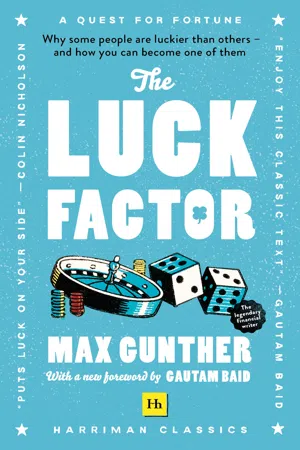
The Luck Factor (Harriman Classics)
Why some people are luckier than others and how you can become one of them
- English
- ePUB (mobile friendly)
- Available on iOS & Android
eBook - ePub
The Luck Factor (Harriman Classics)
Why some people are luckier than others and how you can become one of them
About this book
Max Gunther's classic text with a new foreword by Gautam Baid.
Luck. We can't see it, or touch it, but we can feel it. We all know it when we experience it. But does it go deeper than this? And if it goes deeper, does it do so in any way which we can harness to our own and others' advantage?
Taking us on a fascinating tour through the more popular theories and histories of luck - from pseudoscience to paganism, mathematicians to magicians - Max Gunther arrives at a careful set of scientific conclusions as to the true nature of luck, and the possibility of managing it.
Drawing out the logical truths hidden in some examples of outrageous fortune (and some of the seemingly absurd theories of its origins), he presents readers with the concise formulae that make up what he calls the 'Luck Factor' - the five traits that lucky people have in common - and shows how anyone can improve their luck.
Information
Topic
Personal DevelopmentSubtopic
CareersPart
One
One
The Breaks
Chapter 1
The Blessed and the Cursed
Some people are luckier than others. That is a statement with which few would argue. But the statement is like thin soup eaten before a meal. By itself it doesn’t satisfy. More must follow, and that is when the arguments begin.
Why are some people luckier than others? This is a question of enormous size, for it probes into people’s fundamental beliefs about themselves, their lives, and their destinies. There is no agreement on this question, never has been, perhaps never will be. Some think they know the reasons for good and bad luck. Others agree that reasons may exist but doubt they can be known. Still others doubt that there are any reasons at all.
And so the debate begins.
Eric Leek, barber and hair stylist. He has done a lot of thinking about luck in recent months, for luck has blundered into his life and radically altered its course. Anxious to hear his philosophy, I seek him out at his home in North Arlington, New Jersey. I have an address, but it isn’t quite adequate. It is the address of a walkup apartment above some stores on an old, decaying street. Next to a drugstore I find a dim, unmarked doorway that I surmise is Eric Leek’s address. The dented metal mailbox in the hallway has no name on it. Up a flight of creaky wooden stairs I find another unmarked door. Hoping I have come to the right place, I knock.
Eric Leek lets me in. He is a tall, lean, handsome man of 26, with light-brown hair and mustache. The apartment is old but lovingly maintained. Leek introduces me to his friend, Tillie Caldas, who insists on bringing me a bottle of beer because, she says, it makes her uncomfortable to see a guest sitting with nothing. A third member of the household is a small, friendly, ginger-and-white cat who is introduced to me as Keel – Leek spelled backward. Eric Leek remarks that his entire name spelled backward is Cire Keel, and he says he believes there was a medieval sorcerer of that name. He thinks it possible that he is Cire Keel’s reincarnation.
We turn to the subject of luck. “It worries me to talk about luck,” says Leek, “because when I do, some people think I’m weird. My views on it are primarily religious – or mystical, if you prefer. I believe good luck comes to people who are ready for it and will use it unselfishly, to help others. I don’t believe it often comes to the greedy. As a general rule, the greediest people I know are also the unluckiest.”
Leek will have ample opportunity in years ahead to demonstrate his sincerity. On January 27, 1976, this obscure young man abruptly became stunningly wealthy. He won a special Bicentennial Year lottery conducted by the state of New Jersey, and his prize was the richest ever awarded in any lottery in the nation’s history – $1,776 a week, or slightly over $92,000 a year, for life. He and his heirs, if he dies unexpectedly early, are guaranteed a total of at least $1.8 million.
His winning ticket, which cost him a dollar, was one of 63 million in the drawing. “I know what the question is,” he says. “The question is, why did that one ticket win? Out of all those people, why me? I don’t think it was just something that happened at random. There’s a reason for everything that happens, even if we can’t always see the reason. There are patterns… there’s something that guides our lives.”
He has always been lucky, he says. “I’ve never done much worrying about the future because, for me, it always seemed to take care of itself. That’s one reason why I’ve never ‘settled down’, as the phrase goes.” He has been at various times a singer and actor (which shows in his smooth, precise way of talking), a taxi driver, a construction laborer, a barber. “I always had a strong feeling some big change would happen in my life at about this age. I wasn’t in any hurry to find myself because I knew something would happen to change everything, and out of that change would come guidance.”
“You felt you knew the future?” I ask.
“In a vague way, yes. Tillie and I are both semi-clairvoyant.”
“That’s right,” says Tillie. “A few weeks before all this happened, I dreamt I was with a light-haired man who won a fantastic amount of money. It’s funny, though: I didn’t connect the dream with Eric at first. That came later. Just before the drawing I suddenly found I was sure he would win.”
“I got sure at the end too,” says Leek. He recalls that the adventure began with no precognitive hint of its outcome. “I didn’t really think about the possibility of winning anything. The proceeds from the lottery were earmarked for a state education fund, and I bought tickets because that seemed like a good cause. I bought maybe 40 of them over a span of months, whenever I had a spare dollar. The lottery was set up so that 45 finalists would be picked for the big drawing. One day I read in the newspaper that the finalists’ names would be announced the next day, and I said to a friend, ‘My name will be on that list.’ It was a gag but not a gag, if that makes any sense. I kind of thought it was true. And of course it was.”
Then the number 10 entered the story. Leek regards 10 as his lucky number. “I was born on the tenth hour of the tenth day of the tenth month. Most good things that happen to me have a ten in the picture somewhere. I met Tillie on the tenth, for instance.” One good omen lay in the date of the final lottery drawing: January 27. The three digits of that date, 1/27, add up to 10. Another numerical omen turned up during the drawing itself. The drawing was held in a college auditorium with most of the finalists present. It was a theatrical and complicated procedure, studiously protracted to heighten the suspense. At one stage of this long process, Leek’s name arrived at a “post position” marked 10. That, he says, was when he knew he would win.
What will he do with the money? His major plan at the moment is to open a youth center in North Arlington, “to help kids in trouble. My good luck, you see, is going to be turned into good luck for some kids I haven’t met yet.”
Does he feel he will continue to enjoy good luck? So far, so good. He took Tillie to Acapulco not long after the drawing, and a hotel unknowingly assigned him to just the room he might have asked for: 1010. Back in New Jersey a few weeks later, he attended a barbers’ union meeting. A lottery was held. Since Leek was locally famous by that time, he was asked to pick the winner’s name from an urn held over his head. The name he picked was his own.
Jeanette Mallinson, unemployed clerk-typist, in her late thirties, slightly overweight but attractive. She has brown hair and blue eyes. We meet at a drugstore lunch counter in Washington, D.C. Next to her coffee cup is a newspaper in which she has been studying the help-wanted ads.
She says, “I’m always finding myself out of work, it seems.” There is no whine of self-pity in her voice, however. On the contrary, she seems unaccountably cheerful. “I read something by a psychologist once, saying people make their own bad luck. But in my case that isn’t true – not the whole truth, anyhow. I’ve had a lot of bad luck in my life, much more than my share, I think. When I say bad luck, I mean things beyond my control. I think it’s destiny. Some people are singled out to have bad luck for a time. But it doesn’t have to last forever. In my case things will get better next year – and the year after that, at last, everything will go my way.”
“How do you know that?”
“My horoscope says so. Maybe that sounds like superstition to you, but listen, when you’ve had as much hard luck as I have, you begin to wonder what it’s all about. I tried religion, but that didn’t give me any good answers. Finally a friend got me interested in astrology, and I was amazed by how accurate it is. See, my sun sign is Scorpio, but I’ve got Saturn and Mars in the wrong places and a lot of other problems. Nearly forty years of problems from the day I was born. But it’s nearly over now, so instead of worrying about this year, I’m looking forward to next year. I’ll make it through this year somehow. I always have made it through…”
The first piece of notable bad luck she can recall, she says, struck when she was a child in Maryland. Somebody tried to start a picnic fire with gasoline, and in the resulting flare-up her left cheek was badly burned. She has since had the damaged skin replaced by plastic surgery, and the only traces visible today are some tiny scars. “But plastic surgery wasn’t all that advanced when I was a kid, and anyway my parents didn’t have the money. So I went through my teens with this big, ugly red patch on my cheek. You know how sensitive a teenage girl is. The patch wasn’t all that disfiguring, but I thought I was too hideous to be seen. I stayed home by myself, didn’t go on dates or anything. I became a hermit. They say character makes luck, but with me it was the other way around. Destiny made my character. That burned cheek made me a loner, too shy to look anybody in the face.”
Out of high school, Jeanette moved to Washington and went to work as a government clerk. “All my life, I’ve never held any job longer than three years. Something would always happen to push me back out in the street. Maybe some of the problems were partly my doing, but – well, take my very first job. Somebody stole a bunch of money from petty cash. Who did they accuse? Me, of course. It was just my bad luck that somebody had seen me coming back to the office after hours. I came back to get some shampoo I’d bought and left in my desk drawer, but it looked like I was sneaking in to steal the lousy money. That’s how it goes with me. Or take my last job, the reason I’m looking at these help-wanted ads right now. I was going along fine in that job, when what happens? The office manager quits, and the new person they move in is a real witch of a woman. Nobody likes her and she doesn’t like anybody, but for some reason she makes me her main target. I don’t know why. I’ve gone over it and over it in my mind, and I honestly can’t think of anything I said or did to make an enemy of her. It was just one of those things, two personalities that struck sparks, plain bad luck. Anyway, she made things so unbearable for me that it was either quit or land in a mental hospital.”
There have been several relationships with men and all have turned out badly. She was married at age 22. After three years her husband deserted her, leaving her with two small boys. In her late twenties she met another man named Gene. He seemed, she says, “just right… a perfect relationship.” He was charmed rather than put off by her two sons and wanted to marry her. A week before the scheduled wedding her mother became seriously ill, and Jeanette had to postpone all her plans and take care of the older woman for several months. It eventually became clear that the mother was going to be an invalid for the rest of her life and would need to live with Jeanette or in a nursing home. The prospect of living with Jeanette’s mother or footing nursing home bills seemed to dampen Gene’s enthusiasm. Jeanette talked with him about the problem for several weeks and helped prop up his sagging enthusiasm. He began to talk about rescheduling the wedding....
Table of contents
- Contents
- Part One
- The Breaks
- Part Two
- Part Three
- Part Four
Trusted by 375,005 students
Access to over 1.5 million titles for a fair monthly price.
Study more efficiently using our study tools.
Frequently asked questions
Yes, you can cancel anytime from the Subscription tab in your account settings on the Perlego website. Your subscription will stay active until the end of your current billing period. Learn how to cancel your subscription
No, books cannot be downloaded as external files, such as PDFs, for use outside of Perlego. However, you can download books within the Perlego app for offline reading on mobile or tablet. Learn how to download books offline
Perlego offers two plans: Essential and Complete
- Essential is ideal for learners and professionals who enjoy exploring a wide range of subjects. Access the Essential Library with 800,000+ trusted titles and best-sellers across business, personal growth, and the humanities. Includes unlimited reading time and Standard Read Aloud voice.
- Complete: Perfect for advanced learners and researchers needing full, unrestricted access. Unlock 1.5M+ books across hundreds of subjects, including academic and specialized titles. The Complete Plan also includes advanced features like Premium Read Aloud and Research Assistant.
We are an online textbook subscription service, where you can get access to an entire online library for less than the price of a single book per month. With over 1.5 million books across 990+ topics, we’ve got you covered! Learn about our mission
Look out for the read-aloud symbol on your next book to see if you can listen to it. The read-aloud tool reads text aloud for you, highlighting the text as it is being read. You can pause it, speed it up and slow it down. Learn more about Read Aloud
Yes! You can use the Perlego app on both iOS and Android devices to read anytime, anywhere — even offline. Perfect for commutes or when you’re on the go.
Please note we cannot support devices running on iOS 13 and Android 7 or earlier. Learn more about using the app
Please note we cannot support devices running on iOS 13 and Android 7 or earlier. Learn more about using the app
Yes, you can access The Luck Factor (Harriman Classics) by Max Gunther in PDF and/or ePUB format, as well as other popular books in Personal Development & Careers. We have over 1.5 million books available in our catalogue for you to explore.