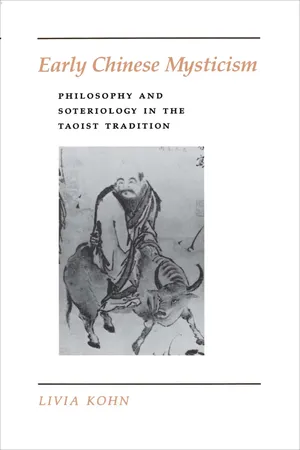
Did Chinese mysticism vanish after its first appearance in ancient Taoist philosophy, to surface only after a thousand years had passed, when the Chinese had adapted Buddhism to their own culture? This first integrated survey of the mystical dimension of Taoism disputes the commonly accepted idea of such a hiatus. Covering the period from the Daode jing to the end of the Tang, Livia Kohn reveals an often misunderstood Chinese mystical tradition that continued through the ages. Influenced by but ultimately independent of Buddhism, it took forms more various than the quietistic withdrawal of Laozi or the sudden enlightenment of the Chan Buddhists. On the basis of a new theoretical evaluation of mysticism, this study analyzes the relationship between philosophical and religious Taoism and between Buddhism and the native Chinese tradition. Kohn shows how the quietistic and socially oriented Daode jing was combined with the ecstatic and individualistic mysticism of the Zhuangzi, with immortality beliefs and practices, and with Buddhist insight meditation, mind analysis, and doctrines of karma and retribution. She goes on to demonstrate that Chinese mysticism, a complex synthesis by the late Six Dynasties, reached its zenith in the Tang, laying the foundations for later developments in the Song traditions of Inner Alchemy, Chan Buddhism, and Neo-Confucianism.
- 236 pages
- English
- PDF
- Available on iOS & Android
eBook - PDF
About this book
Information
Publisher
Princeton University PressYear
2020Print ISBN
9780691020655
9780691073811
eBook ISBN
9781400844463
Topic
Teología y religiónSubtopic
Religiones asiáticasTable of contents
- Cover Page
- Half-title Page
- Title Page
- Copyright Page
- Contents
- Preface and Acknowledgments
- Introducation: Mysticism: The Chinese Case
- Chapter One: Mysticism: Experience, Practice, and Philosophy
- Chapter Two: The Foundations of Chinese Mysticism
- Chapter Three: Developments in Commentary Literature
- Chapter Four: The Immortalization of Philosophical Taoism
- Chapter Five: Ecstatic Explorations of the Otherworld
- Chapter Six: The Impact of Buddhism
- Chapter Seven: The Tang Synthesis
- Conclusion: Early Chinese Mysticism: An Evaluation
- Notes
- Glossary
- Bibliography
- Index
Trusted by 375,005 students
Access to over 1.5 million titles for a fair monthly price.
Study more efficiently using our study tools.
Frequently asked questions
Yes, you can cancel anytime from the Subscription tab in your account settings on the Perlego website. Your subscription will stay active until the end of your current billing period. Learn how to cancel your subscription
No, books cannot be downloaded as external files, such as PDFs, for use outside of Perlego. However, you can download books within the Perlego app for offline reading on mobile or tablet. Learn how to download books offline
Perlego offers two plans: Essential and Complete
- Essential is ideal for learners and professionals who enjoy exploring a wide range of subjects. Access the Essential Library with 800,000+ trusted titles and best-sellers across business, personal growth, and the humanities. Includes unlimited reading time and Standard Read Aloud voice.
- Complete: Perfect for advanced learners and researchers needing full, unrestricted access. Unlock 1.5M+ books across hundreds of subjects, including academic and specialized titles. The Complete Plan also includes advanced features like Premium Read Aloud and Research Assistant.
We are an online textbook subscription service, where you can get access to an entire online library for less than the price of a single book per month. With over 1.5 million books across 990+ topics, we’ve got you covered! Learn about our mission
Look out for the read-aloud symbol on your next book to see if you can listen to it. The read-aloud tool reads text aloud for you, highlighting the text as it is being read. You can pause it, speed it up and slow it down. Learn more about Read Aloud
Yes! You can use the Perlego app on both iOS and Android devices to read anytime, anywhere — even offline. Perfect for commutes or when you’re on the go.
Please note we cannot support devices running on iOS 13 and Android 7 or earlier. Learn more about using the app
Please note we cannot support devices running on iOS 13 and Android 7 or earlier. Learn more about using the app
Yes, you can access Early Chinese Mysticism by Livia Kohn in PDF and/or ePUB format, as well as other popular books in Teología y religión & Religiones asiáticas. We have over 1.5 million books available in our catalogue for you to explore.