- 361 pages
- English
- ePUB (mobile friendly)
- Available on iOS & Android
eBook - ePub
About this book
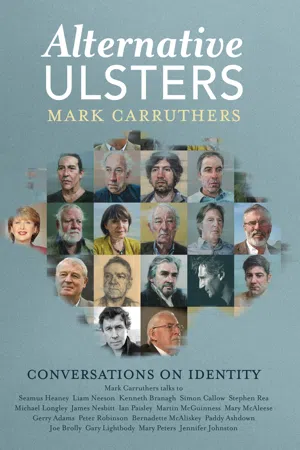
Excellent. Thought-provoking. A must-read' - Belfast Telegraph 'Fascinating' - Irish Times 'Mark Carruthers has done something remarkably clever and refreshing . . . A very important book' - Belfast News Letter 'The best political book of the year' - Alex Kane Ulster is an ambiguous and complex place. With six of its nine counties in Northern Ireland and three in the Republic of Ireland, it is perhaps most readily associated with the Troubles of the past four decades. It is also, however, a place with a rich literary, musical and sporting heritage. Its people represent a surprising mix of cultural identities, religious ideologies and political allegiances. There is no one settled Ulster identity but as this collection of conversations bears out, there are many areas where experiences and beliefs overlap - even though people come from very different backgrounds and traditions. In Alternative Ulsters, the broadcaster Mark Carruthers interviews a wide range of high-profile writers, actors, journalists and politicians, each of them with an enduring Ulster connection. He uses his finely tuned skills as an interviewer to draw each contributor into a personal reflection on identity. The stories and experiences that helped shape and influence each of the thirty-six interviewees are presented here in a series of colourful, lively, and at times deeply moving exchanges. Together, these conversations with those who know the place best explore Ulster in the twenty-first century, revealing a freshness of thought and a richness of culture that rarely make the headlines.
Information
SEAMUS HEANEY
Seamus Heaney was born in rural County Derry in 1939. He attended St Columb’s College in Derry and went to Queen’s University Belfast to study English in 1957. In 1966 Faber & Faber published his first volume of poetry, Death of a Naturalist, to considerable critical acclaim. He published thirteen volumes of original poetry alongside many translations, plays and critical essays. A Nobel laureate and Professor of Poetry at both Oxford and Harvard, he was regarded as one of the finest English language poets of his generation and the most important Irish poet since Yeats. He personally prized the critic Karl Miller’s description of him as ‘a poet to be grateful for’. His sudden death on 30th August 2013 bore that out, prompting a great sense of loss and appreciation locally, nationally and internationally.
We met over lunch in his Dublin home.
Seamus Heaney:
For a long time the name Ulster was used by people of a unionist persuasion as a kind of signal that for them, Ulster was British. Ulster in that case stood not so much for the six counties bounded by the border, but for a Northern Ireland affiliated to the UK. l remember, for example, Joseph Tomelty’s ironical parting shot to me when I’d be leaving his company, was always ‘And don’t forget you’re British!’ So nationalists had a standoff from that usage. At that time, if I described myself as an Ulsterman I’d have thought I was selling a bit of my birthright because I’d be subscribing to the ‘Ulster will fight and Ulster will be right’ tradition, and that was a different Ulster from the one that I was in, which was basically SDLP before the SDLP were invented – a nationalist, apolitical background, but with a kind of northern nationalism, I’d probably have said, rather than Ulster identity.
Mark Carruthers:
Did you feel that even pre-Troubles? Obviously as you grew older the word Ulster came to be used in a very political sense, but even as a younger man did it still have that connotation for you?
When I was in my teens there was a strong sense of the divide in our community, but there was also in my own case and in my family’s case, and in the milieu I was in around home in County Derry, a very easy and well maintained relationship and friendships between, as they say, both sides of the house – farmers and so on. There was a lot of standoff from Stormont to put it mildly, but at a micro-local level everything was fine and continued to be so, despite a lot of things, with our own neighbour friends around there.
And was that very important for you – that sense of good neighbourliness in rural Ulster in the ’50s and early ’60s?
Well that was the life I knew there and I wrote about it. I wasn’t at the time, I suppose, thinking about Ulster identity. In fact even though I declared my passport was green on one famous occasion, I had a British passport for the first while in my life and that is typical of the bind and the contradictions. I was going to Lourdes on a pilgrimage and I was getting a British passport – not that that should matter. I remember Ben Kiely saying that if you were living in the Republic of Ireland you didn’t need a passport to go to Lourdes because it was part of the jurisdiction!
I was intrigued when I read that you had a British passport before you had an Irish passport. Do you think the notion of your northern-ness was awakened when you left the North?
I don’t think so, no.
It was already there.
Yes. I remember in particular in the Irish class that we had in Derry at school in St Columb’s picking out the Northern writers – Peadar Ó Doirnín, Cathal Buí Mac Giolla Gunna, Art Mac Cumhaigh – and hearing a different note, I thought, in them. Maybe it was only because I knew the actual Irish language better, but the sense of a Northern Irish identity was certainly there, as was the sense then of being a subject within a different North, one with a very different ethos. If I say subject, I am overstating it, I’m just using a technical term.
So if you were aware then as a young boy of your Irishness and your identity through your family, through your church, through your …
Gaelic football.
Through football – were you also aware that there was another identity, another community, living cheek by jowl who were different, but also there and part of the bigger community?
Oh yeah. Well there were of course the arches around the Twelfth which reminded you, around Castledawson, that there was a different community with different flags and emblems, as they say. All that was there, of course – but I should say that my family were kind of dormant in political terms. My mother was more alive to the overall political situation than my father. My father was brought up really by uncles – his mother and father died when they were quite young – and these were old bachelor guys and I think they lived in the world of the late 19th century. And he went backwards and forwards to England with cattle and so on, so I think he was indifferent to politics, but he was at ease. It wasn’t an interest of his and so, for example, 1916 which was taken to mean so much, had very little purchase for me. I knew about it as a famous date, but to go back to Northern things, 1798 [the year of the United Irishmen’s failed rebellion against British rule in Ireland] had much more sense of legend, drama, in placeness about it. l know that too much is probably made of that golden moment, but the memory of it was in the air as an imagining of a shared Ulster identity.
And that was a time when Catholic, Protestant and Dissenter were together on that issue and when Ulstermen were very much at the forefront.
That’s right, and David Hammond used to sing the Henry Joy song – ‘An Ulsterman I’m proud to be …’ – so all that was there. The idea of an enlightenment Belfast was with me early on. And also in the folk life that I was part of, things like ‘The man from God knows where …’, that recitation about Thomas Russell coming up North, things like that were imbibed and imbued. And there were nights at home when elders gathered around Easter time, when there would be a party with songs and recitations and music – not party tunes, just tunes for a party.
Did the onset of the Troubles in the late ’60s change your view of what you needed to be doing as a poet? Did your poetry knowingly shift from the rural, observational poetry to a more political commentary?
On the whole I didn’t know how to handle the response, how to maintain a fidelity, if you like, to my own mythos – and at the same time to envisage a society where ethnic groups, religious groups, political groups would find a way of living a civic life. Actually, in 1972, which was four years after the Troubles started, a book came out called Wintering Out, and there is a poem there which looks back to the 1780s and ’90s and it says ‘take a last turn in reasonable light’. So the Troubles politicised me to the extent that when on the Wednesday after the turmoil started on the 5th of October 1968 with the baton charge in Derry, there was a big march of students at Queen’s University where I was a young lecturer, I joined the march – which was a very unusual thing for me to do. We marched down towards Linenhall Street and the RUC had a barrier of themselves across the street and the Reverend Ian [Paisley] was in Donegall Square with supporters. So the police were kind of blocking or separating the two sides, I suppose, and I remember a couple of people wanting to run the barriers or crash the barriers – Bernadette [Devlin] and, I think, Michael Farrell and a couple of other people – but this young lecturer went up and said, ‘Calm down’. I was being as mollifying as I could be. Eventually then they turned back and went to the Students’ Union and that was the night that People’s Democracy was formed. The next Saturday I went to Derry and there was a meeting there in the Guildhall Square and I wrote something for the BBC’s ‘The Listener’ called Derry’s Walls and that was the start of engagement, but actually I didn’t go marching much after that.
So you were there mollifying, observing, trying to keep a lid on things – but that subsequently was perhaps misconstrued, was it? I’m thinking about some of what you wrote – The Ministry of Fear, Act of Union, Requiem for the Croppies. Do people look at those poems in isolation and conclude, wrongly, he’s a nationalist poet – he’s a republican?
There is no doubt you can’t do anything with Requiem for the Croppies which was written in 1966, fifty years after 1916 – and again it was out of my dream life. It was pre-Troubles entirely and I didn’t read it during the Troubles – but it was part of the ’98 dream life. Actually I remember in 1968 when David Hammond, Michael Longley and myself did the tour called ‘Room to Rhyme’, I read that poem in different milieus. There would have been a very Official Unionist audience in Armagh Library, for example, and I felt I was opening a space for this kind of identity within their Ulster, as it were, and that was certainly the thinking in choosing to read it then. That was the point.
Do you remember how it was received?
It was received perfectly all right. Now these were people – it was a self-selecting audience – people coming for the poetry and song and so on, so they would be fairly cultivated and fairly well mannered.
But there were those who were critical of some of what you wrote. Did that sadden you? Did it annoy you?
I wasn’t that aware of it. Artistically maybe ‘The Singing School’ – which is the Derry, St Columb’s stuff – is maybe that kind of partisan utterance all right, but it’s based on experience. Conor Cruise O’Brien rebuked it, of course. But then there is one about the visit of the RUC man, you see, which I think is ok whichever side of the house you come from. It’s called ‘A Constable Calls’. There is one coarseness about ‘the boot of the law’ – but apart from that …
It’s about filling out an agricultural form and it was the local constable who did that.
It was and he was well enough known. He was Constable Crawford from Castledawson Barracks.
But that wasn’t the strong arm of the law. That was what we now call neighbourhood policing?
Exactly, yeah – but at the same time a slight frisson would occur. I remember his shiny baton case and the stitches on it. He had a revolver and so on. Just as with a doctor coming to the house, or a priest, in those days it was an occasion.
And do you remember feeling part of what is referred to as the minority community, which was separate from law and order and separate from policing? Because, of course, there weren’t many Catholics in the RUC at the time.
Oh definitely you felt separate from that, definitely.
Did you feel vulnerable?
No I didn’t feel vulnerable. I think we, the family anyway, didn’t feel that. There was no, if you like, republican background in either my mother’s family or my father’s.
Do you think the fact that it was the ‘Royal Ulster Constabulary’ helped to distance you from that notion of Ulster?
I don’t know. It wasn’t particularly the Ulster that was the unease; it was the sense of the partisanship of the force. That was the thing that was most decisive in the standoff.
Did you feel as a poet that you had to speak up for the minority community – to ask those questions that don’t get asked in newspapers or in current affairs programmes? Is that the challenge you and your contemporaries within the world of poetry set yourselves?
We weren’t as clear as that about it, I don’t think. I wasn’t as clear anyway, but there is one poem which was meant to say something about how things were and how things could be, called ‘The Other Side’. It was based upon a man called Junkin who was an elder – probably an elder of the Presbyterian Church too – but he was, like all our surrounding neighbours, the Steeles and the McIntyres, the Junkins, actual...
Table of contents
- Cover
- Title Page
- Dedication
- AN ULSTERMAN
- CONTENTS
- ACKNOWLEDGEMENTS
- PHOTOGRAPHIC ACKNOWLEDGEMENTS
- INTRODUCTION
- GERRY ADAMS
- LORD ASHDOWN
- PROFESSOR SIR GEORGE BAIN
- LORD BANNSIDE
- BARONESS BLOOD
- SIR KENNETH BRANAGH
- JOE BROLLY
- SIMON CALLOW
- WILLIAM CRAWLEY
- PROFESSOR GERALD DAWE
- BARRY DOUGLAS
- ADRIAN DUNBAR
- SEAMUS HEANEY
- CIARÁN HINDS
- JENNIFER JOHNSTON
- MARIE JONES
- BRIAN KENNEDY
- GARY LIGHTBODY
- ANNA LO
- MICHAEL LONGLEY
- MARY McALEESE
- BERNADETTE McALISKEY
- EAMONN McCANN
- JACKIE McDONALD
- MARTIN McGINLEY
- MARTIN McGUINNESS
- DENIS MURRAY
- LIAM NEESON
- JAMES NESBITT
- FRANK ORMSBY
- GLENN PATTERSON
- DAME MARY PETERS
- PAUL RANKIN
- STEPHEN REA
- PETER ROBINSON
- PETER TAYLOR
- Copyright
Trusted by 375,005 students
Access to over 1.5 million titles for a fair monthly price.
Study more efficiently using our study tools.
Frequently asked questions
Yes, you can cancel anytime from the Subscription tab in your account settings on the Perlego website. Your subscription will stay active until the end of your current billing period. Learn how to cancel your subscription
No, books cannot be downloaded as external files, such as PDFs, for use outside of Perlego. However, you can download books within the Perlego app for offline reading on mobile or tablet. Learn how to download books offline
Perlego offers two plans: Essential and Complete
- Essential is ideal for learners and professionals who enjoy exploring a wide range of subjects. Access the Essential Library with 800,000+ trusted titles and best-sellers across business, personal growth, and the humanities. Includes unlimited reading time and Standard Read Aloud voice.
- Complete: Perfect for advanced learners and researchers needing full, unrestricted access. Unlock 1.5M+ books across hundreds of subjects, including academic and specialized titles. The Complete Plan also includes advanced features like Premium Read Aloud and Research Assistant.
We are an online textbook subscription service, where you can get access to an entire online library for less than the price of a single book per month. With over 1.5 million books across 990+ topics, we’ve got you covered! Learn about our mission
Look out for the read-aloud symbol on your next book to see if you can listen to it. The read-aloud tool reads text aloud for you, highlighting the text as it is being read. You can pause it, speed it up and slow it down. Learn more about Read Aloud
Yes! You can use the Perlego app on both iOS and Android devices to read anytime, anywhere — even offline. Perfect for commutes or when you’re on the go.
Please note we cannot support devices running on iOS 13 and Android 7 or earlier. Learn more about using the app
Please note we cannot support devices running on iOS 13 and Android 7 or earlier. Learn more about using the app
Yes, you can access Alternative Ulsters by Mark Carruthers in PDF and/or ePUB format, as well as other popular books in Social Sciences & Regional Studies. We have over 1.5 million books available in our catalogue for you to explore.