- 487 pages
- English
- ePUB (mobile friendly)
- Available on iOS & Android
eBook - ePub
About this book
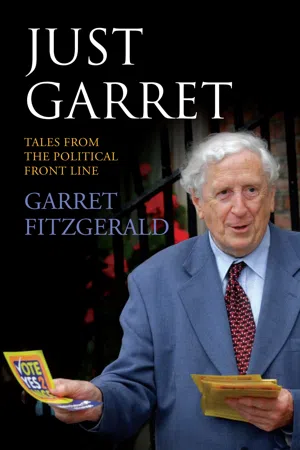
InJust Garret, Dr. FitzGerald writes frankly about his upbringing, his parents, his involvement in the Independence movement, their disagreements about the Treaty, his early years in school and college and his gradual entry into politics. He reflects honestly on his time as minister for Foreign Affairs, and later on his tenure as Taoiseach.The book includes new material and opinion on key figures such as Charles Haughey, Margaret Thatcher and John Major, as well as his role in the emerging peace in Northern Ireland, Ireland's role in the EU and Garret's advocacy in the referendas on the European Union also feature. His memoir gently lifts the layers of his public life back to reveal a much-cherished family life and the huge influence his wife Joan had on his career, rendering a portrait of an informal, humane and witty person who was an ever compelling voice in Irish public affairs right up until his passing in May, 2011.
Information
Print ISBN
9781905483686
Subtopic
Political Biographies1
Early Childhood
When I was two my mother, with the aid of some inheritance from her father, purchased a nineteenth-century house, Fairy Hill, just south of Bray. The house was set in several acres of gardens and lawns, and surrounded on three sides by fields, with two small woods and a complex of stables and outbuildings. The dwelling itself was a substantial two-storeyed building with a bewildering and eccentric internal plan involving five different levels on the ground floor and three on the first floor. The front hall, entered through a double hall door, gave on the right to the living room, which was called ‘the study’. On the other side of the hall was a little-used sitting room, opening on to a space used by my eldest brother Desmond as a workroom.
Halfway up the main staircase from the back hall was a spacious drawing room that opened, through a conservatory, on to a balcony, with steps down to the walled flower garden at the back of the house. Continuing up another flight of the main stairs, one reached a large landing serving four bedrooms, and a door into the nursery corridor, which had two more bedrooms, as well as the solitary bathroom.
The back hall also gave access to a cloakroom and, up some steps, on the right, to a large dining room, at the end of which was a pantry and a side door to the garden and, on the left, down a couple more steps, the kitchen quarters. The indoor staff comprised a cook and a maid.
Outside the back door from the kitchen was a vegetable and fruit garden, and beside it the stables, with their lofts and mangers and numerous outbuildings, including a cow-shed and a hen-house. The entrance to the house was up a drive running parallel to the road from the gate at the bottom of the hill, with a side gate for pedestrians nearer to the house. The drive widened in front of the house and then swept on up the hill to the stables. Lawns, broken by borders with rose bushes, sloped down in front of the house to a tennis court, which also served as a croquet lawn; below this was a meadow, and beyond that a small but mysterious wood. Through a carefully maintained gap in the trees was a dramatic view of the great houses of Sorrento Terrace on the sea at Dalkey, four miles away.
Between the house and the road, overlooked by the drawing-room windows, was a smaller lawn, surrounded by herbaceous borders, which was used for clock-golf. The path between it and the house, leading through a gate into the walled flower garden, was used as the tradesmen’s entrance: otherwise, it would have been necessary to circumnavigate the entire house to reach the kitchen door. All the groceries, and the milk – which came in a huge milk-can, delivered by pony and trap – were delivered through a window into our playroom beside the kitchen.
Weekend meat arrived by post, with a tenpenny stamp I think, from Carlingford, County Louth. Three decades later, I found myself canvassing a vote there for the Senate from the butcher, who had become a county councillor. Later, his son, an elderly parish priest, wrote to tell me how, as a young man, he had brought this and other meat parcels to the post office each week.
On the far side of the house, the drive curving up to the stables was crossed by a wide path, which, from the top of some log steps outside the study window, stretched between yew trees to a gate and stile overlooking the fields and offering a view of the Dublin and Wicklow hills. The Yew Walk, as we called it, was a favourite stroll, with the added attraction for a child that it gave access to the hen-run. The hen-house door in turn provided an easy route to the roofs of the stables, in the valleys of which cigarettes could be safely smoked – as my brother Fergus taught me to do when I was seven. Thereafter for some years I faced the difficult choice between deploying my threepenny pocket money in its entirety on five Players, or reserving a penny for other purposes by slumming it with five Woodbines – until much later, at the age of fourteen, I took a rational decision to divert this expenditure, undertaken only because of peer pressure, into more enjoyable items such as chocolate and ice cream.
In the earlier years, the loft of the stables – no longer used for horses at that time, of course – still housed hay, saved each summer in the meadow below the house. The hay-making was a great occasion each year, and the hay-filled loft was a playground thereafter, so long as the hay lasted. We also at one period raised chickens and ducks for our own consumption, but this experiment ended abruptly after all two-score fowl were killed one night by a marauding fox. I still recall the morning scene of devastation, viewed from the nursery window.
The two small woods offered great scope for Fergus and myself – huts to be built, and trees to be climbed – as did the surrounding fields, rented to local farmers, who grazed sheep and lambs in the early years, and later cows. The cows provided suitably large and immobile targets for bow-and-arrow practice. At one period, the fields also served as a makeshift children’s golf course, developed by Fergus.
The gardens and lawns, and their surroundings, gave ample scope for my mother’s gardening skills – an enthusiasm which she deployed with the aid of a gardener who lived in the gate-lodge and who, in the early years, when my father still enjoyed a ministerial income, was aided by an under-gardener. Flowers were in profusion: every conceivable shade of sweet pea across the centre of the flower garden, new varieties of violets in a special border in one corner, and roses everywhere. In the neighbouring vegetable garden, fruit and vegetables were grown in quantity: strawberries, raspberries, gooseberries, currants, Japanese wineberries plums and greengages, peaches and – in a greenhouse (and never very successfully) – grapes from an ancient vine.
An orchard, established by my mother in part of the field beside the vegetable and fruit garden, provided apples and pears in abundance. But soft fruit was the predominant crop – ‘crop’ being the operative word, for in addition to supplying immediate domestic needs, swollen by relatives from London and Belfast, and sometimes from North America, as well as by large numbers of my parents’ and my elder brothers’ friends at weekends, the garden provided the raw material for hundreds of pounds of jam and jelly which my mother produced each summer – principally strawberry and raspberry jam, but also plum, damson and greengage jam and raspberry, loganberry, redcurrant and apply jelly. Picking the fruit was less laborious when, especially at weekends, there were many helpers.
Only one thing was lacking from a child’s viewpoint: water. Efforts to divine a well near the garage proved fruitless, and there was nowhere to dabble feet or to sail boats – although, of course, the sea at Bray was only a mile or so away. Because my elder brothers were a good deal older than me, they left me much to my own devices, but my next brother, Fergus, faced with having brothers six years older and six years younger than himself, made the best he could of the company of a much younger sibling. He was a romantic and imaginative child. Under his guidance, I learnt how to look after white mice and a grass snake; played cowboys and Indians; re-enacted the legends of King Arthur and the fall of the Bastille; turned the garden paths into a simulacrum of the French railway system; studied astronomy; learned Egyptian hieroglyphics; played airships, with a clothes basket suspended by a rope from the branch of a tree; and made quantities of toffee (trays of which, dyed bright pink with cochineal, tended to be left gathering dust on top of and underneath cupboards).
We also devised and acted out plays. One of these was based on Longellow’s ‘King Robert of Sicily’; another was a detective drama written by Fergus. Performances were given after Christmas to an invited audience which included Edward and Christine Longford of the Gate Theatre. One such performance had to be postponed because, for reasons I now forget, I went on strike.
Fergus taught me to type with two fingers and a thumb – an art I have never lost, and never improved upon. At the age of thirteen, he had gained access to the National Library, where he copied out in a red notebook the grammar, syntax and vocabulary (but only to the letter ‘B’) of the Quechua language of the Incas of Peru. Wanting a fair copy of this material, and feeling that he had done his share, he required me at the age of seven to type out his notes.
Both my parents typed as well as having shorthand (my father’s shorthand notes of the 1930 Imperial Conference remain to be deciphered) and, as they changed typewriters every fifteen years or so, they passed on their older models to their children – with the oldest typewriter going to the youngest child. Thus, I undertook Fergus’s task on my mother’s first typewriter – a very early model indeed, on which the letters came down from above. My mother had purchased it second-hand around 1908. Later I graduated to an early-twentieth-century portable Royal typewriter, which in the late 1950s the makers enthusiastically received as a trade-in, apparently regarding it as a valuable antique needed for their museum. My first typewriter must have been thrown out before I realised its potential worth.
Fergus thus provided me with a wide-ranging supplementary education and rudimentary secretarial training. Other skills – playing bridge and poker, the ability to walk up to seven miles, and the courage to trespass on all surrounding properties – were learnt from an afternoon ‘governess’, Miss Cuddy, then in her late fifties. By the time I was five, and going to school, Miss Cuddy had replaced an earlier Nurse O’Neill; she remained with me until I went for a year to Coláiste na Rinne at the age of nine.
This somewhat Victorian nursery-type upbringing partly reflected the fact that my mother did not feel able, in her forties and early fifties, to undertake the task of looking after a child full-time. She had spent the previous fifteen years bringing up my three elder brothers – the first ten years having been complicated by her revolutionary activities and by my father’s frequent absences in jail, as well as by lack of money. Her health never fully recovered from the physical and nervous illness that followed my birth, although few outsiders realised she had health problems because of the restless energy with which she tackled the running of a large house and garden, the organisation of endless parties, and incessant letter-writing to relatives and friends around the world, not to speak of skiing and ice skating – until she had a bad fall at the age of fifty-five – as well as occasional tennis.
That my upbringing would be adult-orientated rather than child-orientated became clear to me on my fifth birthday. I was to start school in a couple of months’ time, and Nurse was leaving. Mother took me for a walk around the neighbouring lanes; halting at a quiet spot where we sat down on a bank beside the road, she produced some sandwiches, explaining that this was my birthday tea and that I was now too old to have parties on future birthdays. I accepted this philosophically: I wasn’t accustomed to seeing much of other children anyway and was delighted with the generosity and imagination my parents showed at birthday times and Christmas. I think it was on that birthday that I woke to find erected on the nursery floor a zinc-and-wood playhouse that survived until my children’s time. Another gift – at Christmas that year, I think – was a rocking horse, which, after being renovated, is still going strong.
My mother was the product of a middle-class Victorian environment which involved extensive supplementation of parental care by nurses and governesses. She had never been able to afford such luxuries when my elder brothers were young, and it seemed natural to her to take advantage of the recent inheritance from her father by trying to give me the kind of childhood she had herself enjoyed. In fact, she devoted a lot of time to my education, both before and after I went to school. She was a gifted teacher – as I found to my benefit right up to the point where, many years later, I secured, as a result of her tuition, a university entrance scholarship, with first place in English – a result which neither my school career nor my performance in examinations had suggested would ever be possible.
She also took on the whole burden of my religious education, despite the fact that she was not then a Roman Catholic and that my father was a devout and highly intellectual, as well as orthodox, member of the Catholic Church. Her remarkable commitment to teaching me a faith to which she herself did not then adhere, backed by my father’s undemonstrative piety, provided me with a religious foundation that saw me through into early middle age; only then did I begin to understand what religious doubt means, and by then I was better equipped to cope with such problems.
My reading as a child was in some degree Victorian or, at latest, Edwardian. English and American children’s books, the names of which are for the most part unknown today, featured strongly: Dora’s Dolls House, Helen’s Babies and Other People’s Children, the Elsie Dinsmore stories, Bashful Fifteen and Little Lord Fauntleroy. The Gem and the Magnet magazines (some of them copies going back to the early twenties) introduced me to Billy Bunter, Harry Wharton et al. Later there was Rider Haggard, Andrew Lang, Jules Verne and Talbot Baines Reed. More modern works included Richmal Crompton’s Just William books, Hugh Lofting’s Dr Dolittle stories, and Arthur Ransome’s Swallows and Amazons series.
My father made his own contribution to my literary education in two ways: first, by reading aloud to me in the evenings both his own unpublished fairy stories and works by authors like Dickens, and, second, by placing in 1937 a standing order at a bookshop for early editions of the Boy’s Own Paper, which, evidently, he had himself read avidly as a child in London. Eventually, all the issues from 1879 to 1897 came my way, bringing with them the authentic aura of late-nineteenth-century British imperialism – which had as little impact on me as it had had on my father.
I suppose this literary diet may seem a slightly eccentric one for the child of two Irish nationalist revolutionaries. But despite my mother’s assurance to Bernard Shaw (for whom she had acted as secretary temporarily in 1909) in one of her letters in 1914 that she would bring my eldest brother Dem up to hate the English, and despite the fact that she remained until shortly after my birth a committed republican, neither she nor my father was capable of sustaining a narrow anglophobia. Dedicated Irish patriots all their lives, they nevertheless had a deep love of English literature which they had acquired during their very different childhoods in Belfast and east London of the late Victorian era. Moreover, their moral roots lay deeply embedded in the values of the Victorian period. It would have been inconceivable for either of them to have failed to pass on to their children these values, and the riches of English literature, in parallel with their passionate commitment to Ireland, to Irish nationalism, and to Gaelic culture. They saw no contradiction in transmitting to their children the whole of this rich and varied heritage. Thus my father’s readings from Dickens were accompanied unselfconsciously by encouragement to speak Irish with him – especially after I had acquired what turned out to be a temporary fluency in that language at Ring College when I was nine to ten years old; by the instilling of a veneration for the ancient culture of Gaelic Ireland and by a wealth of anecdotes about the revolutionary period which were no less inspiring for being presented almost always in a humorous vein: my father never failed to see the funny side of everything with which he had ever been engaged.
Moreover, respect for the great figures of the national movement was something which my brothers and I imbibed from our earliest years – in my case all the more profoundly because by the time I became conscious of such issues, those whom my father had most admired and loved were all tragically dead – the O’Rahilly, killed within minutes of parting from my father in the GPO in 1916; Arthur Griffith, dead of a broken heart, it was said, in the midst of the Civil War (it was actually a stroke); Michael Collins, shot by a tragic chance in an ambush ten days later; Kevin O’Higgins, assassinated by a breakaway IRA group when I was a baby; and Patrick Hogan, killed in a car crash in the mid-1930s.
This rich cultural background was further enhanced by my father’s classical education and his deep involvement with and intimate knowledge of French literature and philosophy – although these latter influences reached me only later on, in my teens.
There were vigorous family debates. In 1997, I met Arthur Griffith’s daughter at a dinner commemorating the foundation of the Cumann na nGaedheal party in 1923. She told me that my oldest brother Dem had described to her a political debate between my father and his four children during which I was sent to bed at 6.30 – which meant that I was aged six. A quarter of an hour later, I reopened the door, announced that I disagreed with all of them, and then returned to bed! It was, I think, my argumentativeness that led my father later to propose that I become a barrister.
After Easter 193l, I was sent to a small private school called St Brigid’s, run by a Miss Lucy Brayden in a large house in Duncairn Terrace, Bray. I recall my first day at school, sitting on the floor, making words out of letters, as Mother had already taught me. Before long, I found myself in a class of eight or nine children, which after a year or two ceased to have amongst its members any boy other than myself. For a boy with three brothers and no sisters, the experience was a strange but not unattractive one. True, the girls tended to gang up against the single boy in their midst – which soon developed my instincts of self-preservation. But I also learned quite early in life that on their own, girls could be gentle and affectionate. By the age of eight, I had reached the conclusion that the right way to deal with ‘the girl question’ was to select one and marry her as soon as possible. I made my selection then and persisted with this choice until my second year at university, when it became clear that the affections of the girl in question were engaged elsewhere. But that is to anticipate.
My interest in international affairs also derives from this experience of an otherwise all-female class. One day in October 1934, when we were changing rooms in mid-morning, our teacher, Miss FitzGerald (no relation), referred to the assassination in Marseilles of King Alexander of Yugoslavia and Foreign Minister Barthou of France on the previous day. It was obvious to me that a number of the girls had already heard this news, and I felt that it must have been clear to all of them that I hadn’t. I decided never to risk such a humiliation again; thereafter, for the rest of my life, I have read the newspapers assiduously every day and have thus avoided any repetition of this shaming experience.
School was a morning affair. In the afternoon, I went for long, trespassing walks with Miss Cuddy. Even when we went to Bray beach in summer, we took a direct route through the grounds of Loreto Convent. Sometimes we dropped in to a house about three miles away in Shankill. This was the home of Dr Michael Tierney, professor of Greek at UCD (and later its president), who from 1927 to 1932 had been a member of the Dáil and was later to be vice-chairman of the Senate, and whose wife, Eibhlin, was a daughter of Eoin MacNeill.
The Tierneys were friends of my parents, and the two eldest children, girls, were at school with me. I spent many happy hours at their house, the more so because in those years it was one of only two houses that I visited regularly – the other being that of Seán and Eileen Ó Faoláin, whose daughter Julie was a couple of years younger than me.
Until 1927, ministers had availed of state transport only for official journeys to rural areas. My father, who never owned a car, travelled to and from his ministry by tram, even in the later stages of, and immediately after, the Civil War. But after Kevin O’Higgins’s assassination in July 1927, the army insisted on guarding ministers. From early childhood, therefore, I had been accustomed to accompanying my father in an army-owned saloon car, driven by a soldier and followed by a guard car with three other soldiers. Each car was, I believe, fitted with two sub-machine guns, and each of the four soldiers carried a rifle, two revolvers and a bag of ammunition.
The ar...
Table of contents
- Cover
- Title Page
- Dedication
- Contents
- Acknowledgements
- The Way, The Truth and The Life
- Introduction
- 1: Early Childhood
- 2: Secondary School Years
- 3: University and Marriage 1943–47
- 4: Aer Lingus and Journalism 1947–58
- 5: Preparation for Politics
- 6: The Senate in Opposition 1965–69
- 7: The Dáil 1969–73
- 8: Meeting the Challenges of Coalition
- 9: My First Year in Foreign Affairs
- 10: Irish Presidency of the EC
- 11: Protecting Irish Interests in the EC
- 12: Relations with Countries Outside the Community, and Development Aid
- 13: Sunningdale
- 14: Northern Ireland 1974–77
- 15: Leading the Opposition
- 16: Revolving-door Taoiseach
- 17: Second Term: Picking Up the Pieces
- 18: New Ireland Forum and the Anglo-Irish Agreement
- 19: Final Years in Politics
- 20: Retirement
- Postscript: Joan
- Epilogue
- Appendix 1: The Good Statesman
- Appendix 2: Address at the Memorial Service for Christopher Ewart-Biggs
- Appendix 3: Career Map
- Index
- Copyright
Trusted by 375,005 students
Access to over 1.5 million titles for a fair monthly price.
Study more efficiently using our study tools.
Frequently asked questions
Yes, you can cancel anytime from the Subscription tab in your account settings on the Perlego website. Your subscription will stay active until the end of your current billing period. Learn how to cancel your subscription
No, books cannot be downloaded as external files, such as PDFs, for use outside of Perlego. However, you can download books within the Perlego app for offline reading on mobile or tablet. Learn how to download books offline
Perlego offers two plans: Essential and Complete
- Essential is ideal for learners and professionals who enjoy exploring a wide range of subjects. Access the Essential Library with 800,000+ trusted titles and best-sellers across business, personal growth, and the humanities. Includes unlimited reading time and Standard Read Aloud voice.
- Complete: Perfect for advanced learners and researchers needing full, unrestricted access. Unlock 1.5M+ books across hundreds of subjects, including academic and specialized titles. The Complete Plan also includes advanced features like Premium Read Aloud and Research Assistant.
We are an online textbook subscription service, where you can get access to an entire online library for less than the price of a single book per month. With over 1.5 million books across 990+ topics, we’ve got you covered! Learn about our mission
Look out for the read-aloud symbol on your next book to see if you can listen to it. The read-aloud tool reads text aloud for you, highlighting the text as it is being read. You can pause it, speed it up and slow it down. Learn more about Read Aloud
Yes! You can use the Perlego app on both iOS and Android devices to read anytime, anywhere — even offline. Perfect for commutes or when you’re on the go.
Please note we cannot support devices running on iOS 13 and Android 7 or earlier. Learn more about using the app
Please note we cannot support devices running on iOS 13 and Android 7 or earlier. Learn more about using the app
Yes, you can access Just Garret by Garret FitzGerald in PDF and/or ePUB format. We have over 1.5 million books available in our catalogue for you to explore.