- 778 pages
- English
- PDF
- Available on iOS & Android
eBook - PDF
Elements of Numerical Analysis
About this book
Numerical analysis deals with the manipulation of numbers to solve a particular problem. This book discusses in detail the creation, analysis and implementation of algorithms to solve the problems of continuous mathematics. An input is provided in the form of numerical data or it is generated as required by the system to solve a mathematical problem. Subsequently, this input is processed through arithmetic operations together with logical operations in a systematic manner and an output is produced in the form of numbers. Covering the fundamentals of numerical analysis and its applications in one volume, this book offers detailed discussion on relevant topics including difference equations, Fourier series, discrete Fourier transforms and finite element methods. In addition, the important concepts of integral equations, Chebyshev Approximation and Eigen Values of Symmetric Matrices are elaborated upon in separate chapters. The book will serve as a suitable textbook for undergraduate students in science and engineering.
Information
2
•
Elements
of
Numerical
Analysis
as
‘normalised
floating
point’
and
when
1
≤
p
<
10,
the
form
is
called
‘scientific
notation’.
A
few
examples
of
floating
point
representation,
fl
(
x
)
of
number
x
are
given
as
follows:
x
fl
(
x
)
Mantissa
(
p
)
Exponent
(
q
)
2
.
0456
0
.
20456
×
10
1
0
.
20456
1
-
32
.
7652
-
0
.
327652
×
10
2
-
0
.
327652
2
0
.
00234
0
.
234
×
10
-
2
0
.
234
-
2
0
.
000000034
0
.
34
×
10
-
7
0
.
34
-
7
34000000
0
.
34
×
10
8
0
.
34
8
1.3
Binary
Numbers
The
decimal
numbers
(radix
10)
are
converted
to
binary
form
with
digits
0
and
1
(radix
2)
in
the
computer.
An
integer
decimal
number,
may
be
converted
to
binary
equivalent
by
following
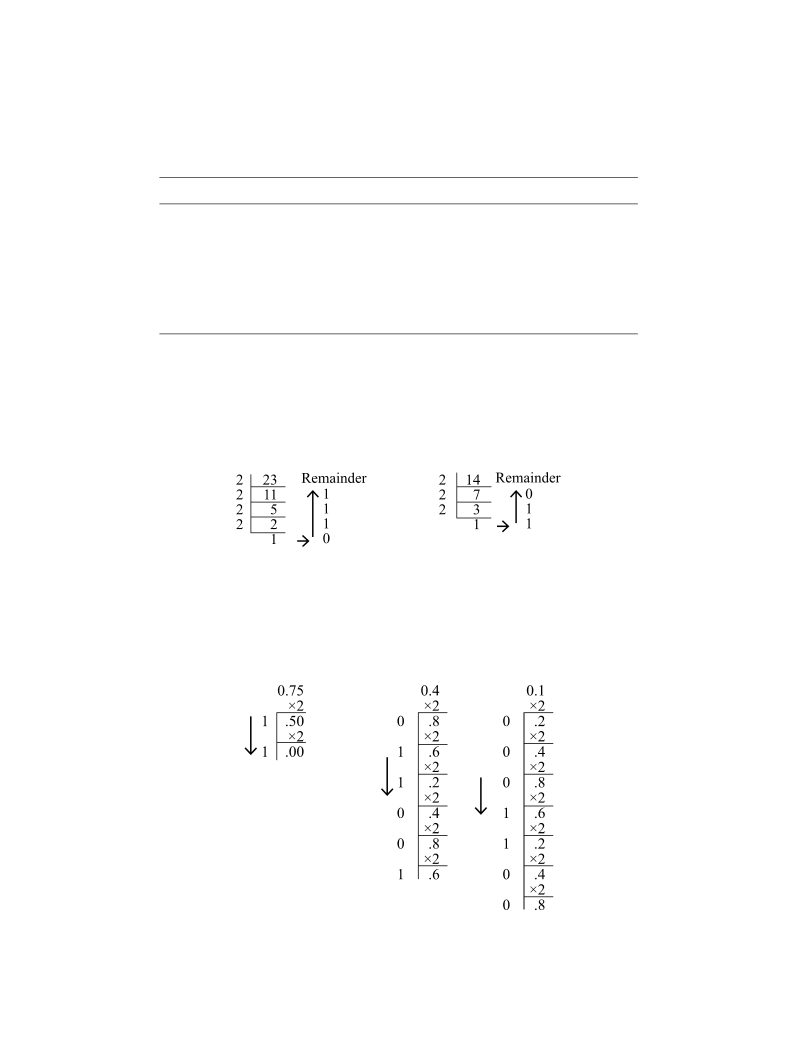
procedure:
Divide
repeatedly
by
2
until
last
quotient
is
1,
keeping
the
remainder
against
the
quotient;
read
the
binary
digits
in
the
direction
of
arrow.
Thus
we
get,
23
=
10111;
14
=
1110
.
The
fractional
decimal
number
is
converted
to
binary
form
in
the
following
manner:
Table of contents
- Cover
- Title
- Copyright
- Dedication
- Contents
- Preface
- 1 Errors in Computation
- 2 Linear Equations and Eigenvalue Problem
- 3 Nonlinear Equations
- 4 Interpolation
- 5 Numerical Differentiation
- 6 Numerical Integration
- 7 Ordinary Differential Equations
- 8 Splines and their Applications
- 9 Method of Least Squares and Chebyshev Approximation
- 10 Eigenvalues of Symmetric Matrices
- 11 Partial Differential Equations
- 12 Finite Element Method
- 13 Integral Equations
- 14 Difference Equations
- 15 Fourier Series, Discrete Fourier Transform and Fast Fourier Transform
- 16 Free and Moving Boundary Problems: A Brief Introduction
- Appendices
- Answers to Exercises
- Index
Trusted by 375,005 students
Access to over 1.5 million titles for a fair monthly price.
Study more efficiently using our study tools.
Frequently asked questions
Yes, you can cancel anytime from the Subscription tab in your account settings on the Perlego website. Your subscription will stay active until the end of your current billing period. Learn how to cancel your subscription
No, books cannot be downloaded as external files, such as PDFs, for use outside of Perlego. However, you can download books within the Perlego app for offline reading on mobile or tablet. Learn how to download books offline
Perlego offers two plans: Essential and Complete
- Essential is ideal for learners and professionals who enjoy exploring a wide range of subjects. Access the Essential Library with 800,000+ trusted titles and best-sellers across business, personal growth, and the humanities. Includes unlimited reading time and Standard Read Aloud voice.
- Complete: Perfect for advanced learners and researchers needing full, unrestricted access. Unlock 1.5M+ books across hundreds of subjects, including academic and specialized titles. The Complete Plan also includes advanced features like Premium Read Aloud and Research Assistant.
We are an online textbook subscription service, where you can get access to an entire online library for less than the price of a single book per month. With over 1.5 million books across 990+ topics, we’ve got you covered! Learn about our mission
Look out for the read-aloud symbol on your next book to see if you can listen to it. The read-aloud tool reads text aloud for you, highlighting the text as it is being read. You can pause it, speed it up and slow it down. Learn more about Read Aloud
Yes! You can use the Perlego app on both iOS and Android devices to read anytime, anywhere — even offline. Perfect for commutes or when you’re on the go.
Please note we cannot support devices running on iOS 13 and Android 7 or earlier. Learn more about using the app
Please note we cannot support devices running on iOS 13 and Android 7 or earlier. Learn more about using the app
Yes, you can access Elements of Numerical Analysis by Radhey S. Gupta in PDF and/or ePUB format, as well as other popular books in Mathematics & Mathematical Analysis. We have over 1.5 million books available in our catalogue for you to explore.