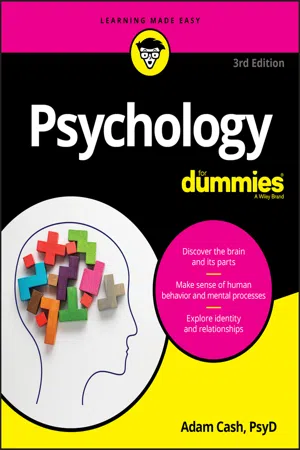
Psychology For Dummies takes you on the challenging and thrilling adventure into the astonishing science of why we do the things we do. Along the way you'll find out how psychology helps us improve our relationships, make better decisions, be more effective in our careers, and avoid stress and mental illness in difficult times.
In a friendly, jargon-free style, clinical psychologist and teacher Adam Cash uses practical examples to delve deep into the maze of the human mind: from the basic hardware, software, and "wetware" of our brains to the mysteries of consciousness and the murkier reaches of abnormal behavior. He also provides profound insights into our wants and needs, the differences between psychological approaches, and how positive psychology can help you lead the "good life" that fulfills you most.
Gain insights into identity and the self
Cope with stress and illness
Maintain psychological health
Make informed choices when seeking counseling
Whether you're new to the unconscious or an established devotee of Freud and pharmacology, Psychology For Dummies is your essential guide to the examined life—and what can make it even more worth living!
Trusted by 375,005 students
Access to over 1 million titles for a fair monthly price.
Understand what psychology is and get an overview of the field.
Get in touch with your inner armchair psychologist by exploring the concept that we are all “acting” psychologists, analyzing and assessing human behavior every day.
Find out about the professional practice of psychology with an introduction to its scientific nature and the different approaches psychologists use to investigate and understand people.
Get to know the ethical guidelines that psychologists are expected to follow during treatment and in applied psychology.
Chapter 1
The Purpose of Psychology
IN THIS CHAPTER
Defining psychology
Understanding how people work
Figuring out how psychology can help
What is the purpose of psychology?
To gain knowledge of human minds and behavior through scientific study and research
To apply that knowledge for the benefit of society, and to improve lives of people by using scientific methods
To communicate and teach that knowledge and application to others
And what's the purpose of this book?
Well, to fulfill those three goals above, of course! I wrote it to educate, teach, and to be helpful. Honestly, I am a serious psychology nerd. I see psychology as an extremely interesting subject, a set of useful methods, and a great opportunity to learn more about people. I geek out on this stuff. I used to wander the psychology stacks of my university library just looking for something interesting, something that caught my eye, to discover something, to learn more. In essence, this book is a cumulation of my effortful curiosity. I hope to stimulate and fuel yours.
We’re all psychologists really. Some of us just happen to be “professional" psychologists. The difference between a professional psychologist and a non-professional psychologist is really a matter of degree (get it?), separated by focus, time spent, materials consumed, and methods used. Over the years, I have been asked (sometimes respectfully and nicely, sometimes not) these questions: “What makes you better at this than me? What do you know that I don’t?” Well, I believe it’s really a matter of degree, perspective, and the psychologist tools I use to see and do the “psychologist thing.” Professionals in any field seem to immerse themselves in it. Again, it's a matter of degree. We all occupy the space of a “psychologist” to one degree or another. Psychologists just spend more time engaged in conscious and deliberate effort to stay in that space and look at the world from that viewpoint. We spend our time and careers occupying that space and doing the “psychologist thing,” occasionally coming out of the trance to share what we have seen, think, and found to be objectively true, at least as far as science allows us. But ultimately, psychology is only one way of looking at people and the world they interact with.
Is psychology “right” about people? It may or may not be, but in an attempt to live up to that challenge, psychology uses the standards of science to do so, and if conducting and practicing psychological science lends itself to some use, exposes someone to one new idea or way of thinking, and helps just one person live a better life, then it has served a valuable role in the world. It is not privileged per se. It cannot explain everything about being human. Come on, that would just pompous and downright impossible.
Humbly, psychologists go about their business and hope to offer something to the world. One psychologist “figuring it all out” isn't the goal. I have countless more bad ideas than good ones, so I need to be part of a community of thinkers, other psychologists, and other scientists. I can put my ideas to the empirical test, share what I find, allow corrective feedback, and revise as I move forward conducting psychological science. Doing psychology is a thinking, doing, and communicating endeavor. I hope to do that with this book.
Before I give you a definition, I’m going to engage in a therapy cliché: Tell me what you think? Tell me how you feel? (There’s an old joke about psychologists: How many psychologists does it take to screw in a light bulb? Two! One to do it and the other one to ask, “How does that make you feel?") What are some of the ideas that come to mind when people think about the topic of psychology? It depends on whom you ask. Sometimes, I imagine myself as a guest on a television talk show. I’m bombarded by questions from the audience that I can’t answer. My heart starts to pound. I begin to sweat. I start to stand up so that I can run off the set, but then something comes to me that keeps me in my seat. I imagine asking the people in the audience what they think psychology is and why they think a psychologist can answer questions about people.
Whys, Whats, and Hows of People
Before I provide a definition of psychology, I want you to take a few minutes to jot down some of your ideas on what psychology is.
Why did this book catch your eye?
Are you looking for answers? Looking for advice?
How are you going to get those answers?
These are the three main questions that psychology is concerned with as well:
Why do people do what they do?”
What are the component parts of why and how?
How do people do what they do?
Here are some “Why?” questions:
Why am I happy?
Why can’t I stop feeling sad?
Why did she break up with me?
Why didn’t I say that? (as I walk away from an argument)
Why did I just say that? (as I get into an argument)
Here are some “What?” questions:
What are emotions?
What is mental illness?
What is intelligence?
What are thoughts?
Here are some “How?” questions:
How can I remember more?
How can I get my 2-year-old to stop throwing tantrums?
How does the mind work?
How does language develop?
These why, what, how questions comprise the intellectual and philosophical core of psychology.
So it’s finally time to define it: Psychology is thescientific study of human behavior and mental processes. Psychology attempts to uncover what people do along with why, what, and how they do it.
A useful metaphor: Building a person
Metaphors abound in psychology. They are used to provide extremely oversimplified and overarching “explanatory” models of people. Psychologists Dedre Gentner and Jonathan Grudin conducted a review of the metaphors used in psychology and identified 256! Over the years, people have been likened to “hairless apes,” computers, machines, nervous systems, and a host of others. However, remember that people are not “models,” but the models can be helpful in understanding people!
Now I’m going to enter into the fray with my own metaphor for better or worse. I don’t think this metaphor is particularly unique, however, and there’s likely chance that I borrowed it from someone else. But I think it’s a good one, so here it is:
When I try to imagine all the reasons people do what they do, what they use to do it, and how they do it, I often run with a “mad-scientist” approach. I’ve always thought that one of the best ways to answer the why, what, and how questions would be to think about building a person and then set that person out performing the tasks of personhood, doing what persons do. Well, I'm not talking about actually building one like Dr. Frankenstein did — out of parts and brains and electricity — but creating a blueprint of a person’s mind and behavior, performing functions, embedded in context, like a “performance space” of sorts, in the way that basketball players play basketball, singers give performances, and people do people stuff.
In therapy, when people try to explain a particular behavior or situation to me, I often say, “Can you make it happen now? Can you show me?” For example, a parent may be telling me how his child hits him when he tells the child to do something. And I’ll say, “Show me. Make it happen.” (I can assure you that everyone is kept safe and this is done ethically!) The most common response is a puzzled or disturbed look on the parent’s face.
The point is, if they can cause it to happen, then they can un-cause it to happen, too. And that means they understand why and how it’s happening. This is a type of reverse psychological engineering for figuring out the why, what, and how questions of human behavior. (It’s also a good example of an empirical approach in as much as the process is observable and testable.)
There may be a day when psychology reaches a pinnacle of knowing and understanding all the determinants of behavior, all the ingredients of the human mind, and all the processes. Maybe the field can figure it all out through that reverse engineering process mentioned earlier. Or, at the very least, maybe psychology will figure out people, and all the information that experts gather can be stored or formulated into an algorithm or “recipe” for “making” people that, one day, a super-intelligent robotic life form can utilize to re-create the human species thousands of years after it becomes extinct. I did say that I sometimes think like a mad scientist, right?
Yes, this is the kind of blueprint or overlay I like to use to understand what psychology is: Why do the parts and processes do it? What are the parts or ingredients of a person? How do we go about performing functions using those parts and ingredients to achieve the why?
So I guess my metaphor is Frankenstein's Monster. Maybe think about it as “Frankenstein’s Machine” or “Dr. Cash’s Machine” or maybe even a “Monster Machine.”
Why?
A first principle of my mad-scientist vision of psychology is that building a human requires you to know what the person’s function is. After all, engineers don’t build things without knowing what they’re supposed to do. Only with a purpose in mind can you know what to materials are necessary and how they work together.
The foundations of this function approach are built on a philosophy know as functionalism, which is the notion that the mind, mental processes, and behavior are “tools” for adaptive functioning that lead to a human functioning most effectively in his or her environment (survival and perpetuation of the species).
Like all other carbon-based living organisms on planet Earth, human beings are “staying alive” machines. I’m not saying there is no meaning to life. Quite the contrary; I’m saying that the function of life is to be alive, to stay alive, and to perpetuate life. But there’s got to be more than that, right? Wrong book. Try Philosophy For Dummies or Re...
Table of contents
Cover
Table of Contents
Introduction
Part 1: Getting Started with Psychology
Part 2: Picking Your Brain (and Body)
Part 3: Thinking and Feeling and Acting
Part 4: Me, You, and Everything in Between
Part 5: Adapting and Struggling
Part 6: Repairing, Healing, and Thriving
Part 7: The Part of Tens
Index
About the Author
Connect with Dummies
End User License Agreement
Frequently asked questions
Yes, you can cancel anytime from the Subscription tab in your account settings on the Perlego website. Your subscription will stay active until the end of your current billing period. Learn how to cancel your subscription
No, books cannot be downloaded as external files, such as PDFs, for use outside of Perlego. However, you can download books within the Perlego app for offline reading on mobile or tablet. Learn how to download books offline
Perlego offers two plans: Essential and Complete
Essential is ideal for learners and professionals who enjoy exploring a wide range of subjects. Access the Essential Library with 800,000+ trusted titles and best-sellers across business, personal growth, and the humanities. Includes unlimited reading time and Standard Read Aloud voice.
Complete: Perfect for advanced learners and researchers needing full, unrestricted access. Unlock 1.4M+ books across hundreds of subjects, including academic and specialized titles. The Complete Plan also includes advanced features like Premium Read Aloud and Research Assistant.
Both plans are available with monthly, semester, or annual billing cycles.
We are an online textbook subscription service, where you can get access to an entire online library for less than the price of a single book per month. With over 1 million books across 990+ topics, we’ve got you covered! Learn about our mission
Look out for the read-aloud symbol on your next book to see if you can listen to it. The read-aloud tool reads text aloud for you, highlighting the text as it is being read. You can pause it, speed it up and slow it down. Learn more about Read Aloud
Yes! You can use the Perlego app on both iOS and Android devices to read anytime, anywhere — even offline. Perfect for commutes or when you’re on the go. Please note we cannot support devices running on iOS 13 and Android 7 or earlier. Learn more about using the app
Yes, you can access Psychology For Dummies by Adam Cash in PDF and/or ePUB format, as well as other popular books in Psychology & History & Theory in Psychology. We have over one million books available in our catalogue for you to explore.