eBook - ePub
Third Cinema, World Cinema and Marxism
- 304 pages
- English
- ePUB (mobile friendly)
- Available on iOS & Android
eBook - ePub
Third Cinema, World Cinema and Marxism
About this book
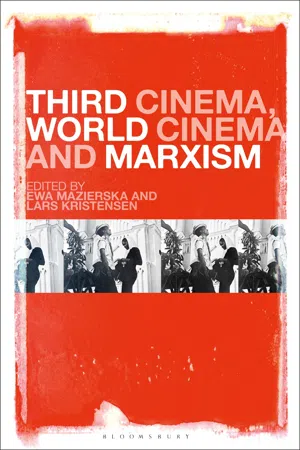
Third Cinema, World Cinema and Marxism offers an analysis of Third Cinema and World Cinema from the perspective of Marxism. Its starting point is an observation that of all cinematic phenomena none is as intimately related to Marxism as Third Cinema, which decries neoliberalism, the capitalist system, and the Hollywood model of cinema as mere entertainment to make money. This is largely to do with the fact that both Marxism and Third Cinema are preoccupied with inequalities resulting from capital accumulation, of which colonialism is the most extreme manifestation. Third Cinema also defines cinematic modes in terms of representing interest of different classes, with First Cinema expressing imperialist, capitalist, bourgeois ideas, Second Cinema the aspirations of the middle stratum, the petit bourgeoisie and Third Cinema is a democratic, popular cinema.
Trusted by 375,005 students
Access to over 1.5 million titles for a fair monthly price.
Study more efficiently using our study tools.
Information
PART ONE
Revisiting films
1
Exporting cinemarxism in the 1960s: The case of Soy Cuba
Mikhail Kalatozov’s Soy Cuba (I Am Cuba 1964), a Soviet-Cuban cinematic rendition of several human interest stories, put together to explain why the 1959 Cuban revolution had to happen, is largely recognized today as ‘one of the masterpieces of world cinema’ (Gott 2005). Co-scripted by Enrique Pineda Barnet and Evgeny Evtushenko, it consists of four novellas, linked by partially overlapping characters, a female voiceover and a build-up of protest emotions, resulting in a triumphant procession of rebellious masses to the tune of the Cuban national anthem. The first two stories – those of the Havana dweller Maria/Betty, prostituting herself to rich foreigners, and the tenant farmer Pedro, deprived of his livelihood by his landowner – can be called the novellas of abuse, while the last two – those of the freedom fighters Enrique (a student) and Mariano (a peasant) – the novellas of countering the abuse.1
Complete with the scenes featuring abject poverty, exuberant luxury, heroic deeds and tragic deaths, Soy Cuba’s fragmentary mini-plots feel rather clichéd in both their melodramatic form and their propagandistic content.2 As one Western critic put it, ‘the police are shown to be book-burners and killers. The common man is always decent, and students are on the side of the angels’ (Nangle 2001: 28). A Soviet critic’s opinion was not much different: ‘Take, for example, the film’s first novella. This is a banal… story, often told in diverse films and novels, about a nice virtuous woman, who is in love with a nice virtuous man but has to turn to prostitution – and what a drama ensues! Evtushenko has not added anything new to this set of literary circumstances’ (the film critic Georgy Kapralov in ‘Ia – Kuba’ 1965: 30).
It was mainly owing to Kalatozov and the extraordinary vision of his cameraman Sergei Urusevsky that Soy Cuba became ‘an epic and poetic account that transcends its subject matter’ (Gott 2005) and possibly ‘one of the top three best-photographed films ever made’ (Hudson 2006: 28).3 According to Alexander Calzatti, Urusevsky’s chief camera operator on Soy Cuba, ‘it was really a cameraman’s film because everything was orchestrated for the camera’ (Turner 1995). As Sergio Corrieri, a Soy Cuba actor, put it, ‘light was the main protagonist in this film’ (Soy Cuba, o Mamute siberiano 2005: 00:48:19–00:48:22). Soy Cuba was mostly shot with a handheld Éclaire CM3 Camiflex, often passed on from one assistant to another to ensure the fluidity and continuity of movement, as well as constant changes of the points of view (together representing an omnipresent and protean perpetuum mobile).4 Urusevsky’s much preferred 9.8mm lens ‘afforded him enormous opportunities, such as enhanced sharpness and easy transition from closeups to general view’ (the cameraman Nikolai Prozorovsky in ‘Ia – Kuba’ 1965: 28). The infrared stock, used in several sequences, occasionally inverted the black-and-white colour scheme (ideal for portraying both the struggle between good and evil5 and the racial harmony on the island), so that ‘beauty and foreboding [were] conveyed in about equal measure’ (Turner 1995). In Calzatti’s opinion, Cuba has never looked so spectacular on the screen (Turner 1995).
It is therefore all the more surprising that, despite the initial big interest and warm welcome at the opening nights in Santiago de Cuba and Havana on 24, 26 and 30 July 1964 (to coincide with the eleventh anniversary of Castro’s attack on the Moncada Barracks),6 the film gained only a week-long distribution in Cuba and a rather mixed response from the Cuban critics. While Teresa Ruiz in the newspaper Revoluciоn claimed that ‘the film has much of Urusevsky and Kalatozov but little of Cuba’ (quoted in Espinosa Domínguez 2012: 111), Josefina Ruiz in the magazine Verde Olivo insisted that ‘for the first time we have seen a real Cuban cinema that has paradoxically been produced by foreigners’ (quoted in Galt 2011: 216–17).7 The reception in the USSR, where the film was premiered simultaneously, was not altogether dissimilar. During the discussion of Soy Cuba by Soviet industry professionals, the cameraman Sergei Poluianov succinctly expressed a widely held opinion: ‘I am thinking of how this was filmed…. [Yet] I have not learned anything about the people of Cuba. When a house is burning [in the novella about Pedro], I am interested in the aesthetic effect of the flames but am not touched by the plight of the person who is forced to set his house on fire’ (‘Ia – Kuba’ 1965: 27).8 By contrast, the journalist Aleksandr Isbakh’s impressions after a Moscow screening were perhaps closer to what Kalatozov and Urusevsky had aspired to achieve: ‘A history of the Cuban people’s struggle for life, happiness and freedom has passed before us on the screen… The film has touched me’ (Isbakh 1964: 9). Still, in Soviet Russia, Soy Cuba did not stay in circulation for too long either and more or less disappeared off the radar until its surprise re-emergence at the Telluride and San Francisco film festivals almost thirty years later. Subsequently released on video and DVD under the auspices of Francis Ford Coppola and Martin Scorsese, it is now admired even by many of those who disagree with its political message, and features regularly in the academic discourse and on the film school curriculum.
Why was Soy Cuba deemed contentious enough by the Cuban and Soviet authorities to consign it to oblivion (if not for an outright ban)? And, being a major co-production with a well-established partner at an early stage in the development of post-1959 Cuban film industry, which role, if any, did it play in the formation of the so-called ‘imperfect cinema’ (the Cuban variety of Third Cinema, see Chanan 2005: 245) as a concept and a practice? There appears to be a number of possible answers to both questions. I will group such answers, some of which have already been suggested before, under five categories (the financial, the aesthetic, the ideological, the postcolonial and the co-productional) in order to undertake a critical appraisal of all the principal explanations that I am aware of and to identify the most convincing ones, while at the same time trying to separate Soy Cuba’s intentions and accomplishments from the way these intentions and accomplishments were perceived.
For my main theoretical framework, I have chosen the theory of accelerated cultural development by Georgi Gachev, a Soviet philosopher of Bulgarian origin. According to him, an accelerated ‘development of a nation (country) is conditioned by a neighbouring nation or nations, which have already gone a long way in accumulating a substantial experience of social and cultural development’ (Gachev 1989: 15). The word ‘neighbouring’ should not of course be understood strictly in the sense of one nation or country sharing a territory or a border with another. A colonial rule, no matter how far the distance is from a colony to a metropole, can arguably serve, up to a point, as an example of a condition for acceleration. So can a nation or country that has become a world leader in a particular aspect of a widely and obviously useful social and cultural know-how, and therefore a natural model to follow by other nations or countries. Accelerated development can simultaneously involve many sides of life in the affected country or nation but can also be, at least initially, confined to just one feature.
Gachev’s book is not at all about Cuba, but its early version was written in the late 1950s and early 1960s, when Cuba was often front-page news and Castro’s coming under the Soviet patronage (partly to ensure the implementation and lasting effect of his rapid socio-economic reforms) was seen by many as beneficial.9 Besides, Cuba had already been through phases of accelerated development in the past, which has been testified to by the Cuban anthropologist Fernando Ortiz.10 This makes the application of Gachev’s theory to the situation in the 1960s’ Cuba fully legitimate, especially as far as the post-1959 Cuban film industry is concerned. Filmmaking under Castro began from a fairly low starting point only to become, a few years later, ‘one of the strongest… in Latin America, thanks to… the great help from socialist countries’ (Julio Garcia Espinosa in Kozin 1964: 19). Co-productions were used as an instrument of accelerated development. In addition to Soy Cuba, a 1963 Czechoslovak-Cuban (For Whom Havana Dances) and a 1964 GDR-Cuban (Preludio 11) feature films should be singled out. These and other relevant examples – including several Cuban films of the period and Third Cinema-related theoretical publications by Cuban directors – will be referred to throughout the chapter, as and when appropriate.
Soy Cuba’s excessive production costs
Instituto Cubano del Arte e Industria Cinematograficos, or ICAIC, founded in March 1959, comprised ‘everything, from film studios and cinemas to domestic and international distribution’ (Kozin 1964: 19), as well as ‘a state committee for filmmaking, a filmmakers union and an educational establishment’ (‘17 dnei na Kube’ 1964: 3). Meant to monopolize under the state ownership whatever was related to cinema production and consumption, it also received annual state funding to the tune of 7 million US dollars, which included salaries for c. 1,000 employees and production costs for c. forty documentaries, five to ten animated cartoons, four to six feature films and fifty-two weekly newsreels (see Burton 1997: 134). For 1964 – the year of Soy Cuba’s release – eight feature films, sixty documentaries and twelve animations were planned, and in the five years since the revolution, a total of eighteen features were made (see Kozin 1964: 19).
These figures look reasonably impressive, given that most if not all of the film industry professionals plying their trade in Cuba before 195911 left the country fairly soon after the revolution and had to be replaced with a largely inexperienced staff who subsequently learnt their métier on the job.12 However, to put the statistics into perspective, the biggest Latin American film industry (Mexican) produced ‘about seventy [feature] films a year’ at the time (Brook 1961: 78), while ICAIC’s entire annual budget amounted to ‘less than the cost of a single big-budget movie in Hollywood’ (Chanan 2004: 89).
It was in this atmosphere of financial frugality13 and comparative amateurishness that the highly qualified Soviet members of the Soy Cuba crew14 arrived on the island to make the film, commanding seemingly unlimited resources.15 The Soviets stayed for a total of twenty months,16 if one includes the fact-finding period, when many audio interviews with Cubans (and Fidel Castro himself) were recorded (see ‘Ia – Kuba’ 1964a: 1; and Iordanova 1997: 125). In the opinion of Raul Garcia (Soy Cuba’s sound assistant, who was also cast as Enrique), ‘it was the longest shooting for a feature film in Cuba’ (Soy Cuba, o Mamute siberiano 2005: 00:31:41–00:31:46), where the average filming period in those days lasted from eight to twelve weeks. Kalatozov laid the blame for shooting delays on Hurricane Flora (see ‘Ia – Kuba’ 1964b: 4), which ravaged Cuba’s western provinces in October 1963.17 Yet it is undeniable that in their pursuit of perfection as they understood it, the Soy Cuba crew – consisting of sixteen Russians and, by different accounts, fifty to seventy Cubans, all working hard, for up to sixteen hours a day and seven days a week (see ‘Ia – Kuba’ 1964a: 1; Turner 1995; and Iordanova 1997: 125) – did take their time on the sets, which, to make matters even worse, were occasionally inundated with a high number of additional participants. Thus, one famous ‘nearly three-minute complex opening shot on the hotel roof required seventeen takes and involved around one hundred extras’ (Iordanova 1997: 126). For the closing scene, 5,000 Cuban army soldiers had to be moved from the Oriente province to Havana on the orders of Raul Castro (Espinosa Dominguez 2012: 114), which left the province unprotected. The infrared film stock (then manufactured solely for the use of the Soviet Army) did not make things go any faster. Calzatti recalls: ‘We had no infrared meter, and no infrared marks on the lens, so many times the results were unpredictable… What you see in the film is okay, but we shot much footage to select from. Each scene was done 15 or 20 times, so it never was filmed spontaneously’ (Turner 1995). Urusevsky’s peculiar aesthetic preferences did not speed the shooting process up either. Once he stopped filming ‘for almost three days waiting for clouds to show up’ because he thought that ‘a sky without clouds [was] uninteresting’ (Soy Cuba’s construction chief Juan Varona in Soy Cuba, o Mamute siberiano 2005: 00:49:31–00:49:36, 00:49:53–00:49:54).
Even though ‘the Cubans considered it a matter of honour to help the picture’ (Kalatozov in ‘Ia – Kuba’ 1964a: 1), many of them must have thought that Soy Cuba was an unaffordable luxury.18 The ICAIC founder and first president Alfredo Guevara diplomatically ...
Table of contents
- Cover
- Halftitle Page
- Title Page
- Contents
- List of Figures
- Defining Third Cinema and World Cinema
- Part 1 Revisiting films
- Part 2 Comparative readings
- Part 3 Third Cinema versus World Cinema
- Index
- Imprint
Frequently asked questions
Yes, you can cancel anytime from the Subscription tab in your account settings on the Perlego website. Your subscription will stay active until the end of your current billing period. Learn how to cancel your subscription
No, books cannot be downloaded as external files, such as PDFs, for use outside of Perlego. However, you can download books within the Perlego app for offline reading on mobile or tablet. Learn how to download books offline
Perlego offers two plans: Essential and Complete
- Essential is ideal for learners and professionals who enjoy exploring a wide range of subjects. Access the Essential Library with 800,000+ trusted titles and best-sellers across business, personal growth, and the humanities. Includes unlimited reading time and Standard Read Aloud voice.
- Complete: Perfect for advanced learners and researchers needing full, unrestricted access. Unlock 1.5M+ books across hundreds of subjects, including academic and specialized titles. The Complete Plan also includes advanced features like Premium Read Aloud and Research Assistant.
We are an online textbook subscription service, where you can get access to an entire online library for less than the price of a single book per month. With over 1.5 million books across 990+ topics, we’ve got you covered! Learn about our mission
Look out for the read-aloud symbol on your next book to see if you can listen to it. The read-aloud tool reads text aloud for you, highlighting the text as it is being read. You can pause it, speed it up and slow it down. Learn more about Read Aloud
Yes! You can use the Perlego app on both iOS and Android devices to read anytime, anywhere — even offline. Perfect for commutes or when you’re on the go.
Please note we cannot support devices running on iOS 13 and Android 7 or earlier. Learn more about using the app
Please note we cannot support devices running on iOS 13 and Android 7 or earlier. Learn more about using the app
Yes, you can access Third Cinema, World Cinema and Marxism by Ewa Mazierska, Lars Kristensen, Ewa Mazierska,Lars Kristensen in PDF and/or ePUB format, as well as other popular books in Media & Performing Arts & Film History & Criticism. We have over 1.5 million books available in our catalogue for you to explore.