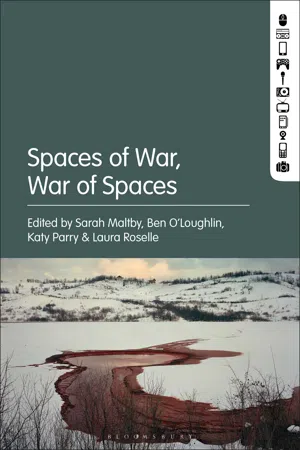
eBook - ePub
Spaces of War, War of Spaces
- 256 pages
- English
- ePUB (mobile friendly)
- Available on iOS & Android
eBook - ePub
Spaces of War, War of Spaces
About this book
Spaces of War, War of Spaces provides a rich, international and multi-disciplinary engagement with the convergence of war and media through the conceptual lens of 'space'. 'Space' offers a profound, challenging and original framework through which notions of communication, embodiment, enactment, memory and power are interrogated not only in terms of how media spaces (traditional, digital, cultural, aesthetic, embodied, mnemonic) transform the conduct, outcomes and consequences of war for all involved, but how 'war' actors (political, military, survivors, victims) recreate space in a manner that is transformative across political, social, cultural and personal spheres. Foregrounding the work of artists, activists and practitioners alongside more traditional scholarly approaches Spaces of War, War of Spaces engages with the 'messiness' of war and media through the convergence of practice and theory, where showing and embodying is made explicit.
Trusted by 375,005 students
Access to over 1.5 million titles for a fair monthly price.
Study more efficiently using our study tools.
Information
PART ONE
Spaces of War
Introduction
This volume is an intervention, not a handbook. It is motivated by a feeling that the ambition to provide broad perspectives on the transformation of war in new media environments, ecosystems and ecologies is distracting us from the richness of detailed work being conducted on specific cases. We feel an unease that macro-theorizations are flattening or ignoring the variety and intricacies of spaces. We worry that the insights from innovative thinking about space beyond the field of war and media have not found their way into this field. We also fear a dichotomy between ‘grand’ strategy of warfare on the one hand, and the everyday, the quotidian and the local on the other is obscuring a whole series of meso-level spaces and architectures of communication and conflict. This book is the first attempt to explicitly consider these concerns and the ways in which war is produced, enacted, negotiated, remembered and ‘felt’ in, through and with media spaces, and vice versa.
In fact, space has been under-theorized in the field of war and media while time and temporality have been absolutely central concerns. In the first decade of the twenty-first century, a body of research was published examining how the then ‘new media’ were affecting experience of acceleration and stasis, continuity and rupture, in the war on terror and through Western wars of intervention. Some work did examine how new forms of connectivity were shaping feelings of distance and proximity (Gillespie 2006; Silvestri 2015). Hoskins and O’Loughlin (2010) claimed war had ‘diffused’ across societies. But this work did not take the next step and seek to offer substantive theorizations that explain the mechanisms through which spaces of war were produced, sustained or challenged. This is a shame, because scales, mobilities and vectors were central to work on global political economy and how, for instance, sociotechnical systems that manage domains such as energy and transport are assembled and adapted (Eriksen 2016; Urry 2014).
And yet such studies of connectivity and war did provide a platform for enriching our understanding of space. Furthermore, since 2010 a decade of research on visibility and warfare has provided us with analytical tools to study how lines of sight and perspective and how layering and landscaping make space (Bousquet 2018; Galai 2017). Technologies such as drones and wearables transform experiences of proximity and the riskiness of spaces and our bodies in spaces. We have also seen focus on the air as a site of conflict and risk (Sloterdijk 2009). For instance, the Airspace Tribunal initiative in the UK seeks ‘recognition of a new human right to protect the freedom to exist without physical or psychological threat from above’ (Illingworth et al. 2018: 1). That initiative rests on a conception of the human being in the world, vulnerable and always perceiving possible risks, and a conception of military actors weaponizing that space that humans exist within. It connects to actors’ use of media technologies as a means to target or hide, to de- or re-materialize in order to kill or stay alive (Bousquet 2018). At the same time, other trajectories of research renew the importance of space in other ways. The study of war and memory continues to place a focus on sites of memory rather than spaces (following important work by Maltby 2016; Nora 1989; Pshenychnykh, 2019; Winter 1995). Altogether, these theoretical resources can be used to bring much richer theorization of how the relations and practices of war and media are conditioned by space and create space.
Motivations: Why look at space?
Space matters to us for three reasons. First, it had become abundantly clear that, in matters of war and conflict, geographical space can help determine outcomes. Take radicalization, considered to be driven to a large extent by diffuse online dynamics. Following alarm that young British Muslims were travelling to Syria to fight for Islamic State in 2015, an anonymous intelligence officer told one of our editorial team that their agency believed nearly all those travelling came from three towns in Britain. If young people were being radicalized online then the geographical distribution would have been different. The social networks of particular situated communities mattered. For students of political communication this will come as no surprise: the reception of any individual to ‘influence’ by political narratives is explained to a large extent by the relationships they inhabit, and those relationships are still mostly local (Brown 2017). We must confront this. This is both an analytical and political task. ‘Space has been replaced by time as the main ordering principle’, Bruno Latour (2005: no page) writes; ‘We can get rid of nothing and no one,’ so the question becomes ‘What should now be simultaneously present?’ (ibid.). What practices and beliefs, what people and attachments? These are questions that drive antagonisms and create the conditions for war and conflict. How can spaces of war become spaces of cohabitation? How can shared vulnerabilities and dependencies be articulated in ways that can form stronger relations rather than drive insecurities (Cavavero 2009: 20–4)? What role can media technologies and media institutions play in that?
Second, and related, the humanities and social sciences have produced a lot of work on conceptual or metaphorical spaces: the gendered space, the stratified space, the securitized space, the racialized space and so on (Bodenheimer 2012). This presents an opportunity in the field of war and media because such conceptual spaces provide a normative benchmark for a type of space we either desire or reject. Do we want to encourage ‘dialogic spaces’ to encourage communication and possible diplomatic progress across enemy lines? Do we object to ‘securitized spaces’, in which certain people are classified primarily as security threats who must be stopped, because this leads to racial profiling, or do we genuinely think those being securitized are trying to kill us and securitization is justified?
Third, we wanted to push back on the primacy of time over space in studies of war and media. At the time satellite television became able to allow us to see live into distant spaces twenty-five years ago, the sociologist Barbara Adam argued: ‘The traditional conceptual tools need to be supplemented and to some extent displaced by simultaneity, instantaneity, uncertainty and implication, all key features of global time, if social science is to become adequate to its contemporary subject matter’ (Adam 1995: 9). All of that is true, and much of that work has been done (for an overview of the treatment of temporality in this field see Hoskins and O’Loughlin (2007)). However, we want to put back on the table the spatialities that have emerged alongside Adam’s temporalities. We contend that it is of equal importance to ask questions about how experiences of presence, connectivity and relationships across spatial axes are developing and how these play a role in the perception of war and conflict. A decade ago research was exploring how individuals used traditional news media to construct senses of distance and proximity; how the ‘closeness’ or ‘presence’ of topographically distant ‘things’ (Weibel and Latour 2005) was felt topologically – that is, their closeness is understood not geometrically but affectively (Gillespie and O’Loughlin 2009). In the passing decade, in which we have witnessed widespread use of social media including encrypted apps like Whatsapp, do we understand how perceptions of distance and proximity function now to shape engagement with war and conflict? Given the increasing number of people displaced by war in recent years (BBC News 2019), and the continued moral concern that publics do not sufficiently care to help those suffering in war and conflict, these questions about how space operates are vital.
Lastly, a focus on space and spaces allows us to move away from a tendency in much scholarship in the field of media and war to focus on the West and its interactions with the non-West. The period of the war on terror extended this tendency, as the United States, UK and other Western nation states renewed their commitment to global surveillance, policing and punishment under a new narrative. Many scholars documented and critiqued the imaginaries and policies that enabled this global outreach; many critiques extended previous critical analysis of imperial and orientalist policy and press complicity but explained the new developments through new concepts too – for instance, securitization, mediatization, militarization among others – providing a new vocabulary to illuminate how power was exercised across space and through the management of spaces. Given that the war on terror reached into most if not all regions of the world, this was an opportunity to document the multiplicity of experiences and perspectives in that range of places. However, having surveyed the balance of scholarship throughout this period as editors of Media, War & Conflict there has been an absence of research exploring the perspectives of those ‘on the receiving end’ of the war on terror – those for whom the war on terror came looming over the horizon, whether silently and invisibly or through shock and awe tactics. Certainly this is partly because of an imbalance in resources and access to publication for scholars in those environments. And certainly there was a steady trickle of research on other, non-war on terror wars and conflicts that did expose readers to a wider set of spaces, experiences and perspectives. Ultimately, however, the multiple and varied textures of terrains and contexts in the world of war and media remained relatively cloaked.
While we embrace and seek out heterogeneity and multiplicity and all we can learn from that, this book is an opportunity to resist and refute the commonplace distinction that any local place is a site of authentic, desirable, ‘real’ life, while scaling up to global spaces brings a terrain that is abstract, cold and alienating or flat, borderless, seamlessly connective, and topological. We must resist this tendency, one that geographer Doreen Massey calls a ‘retreat to place’ (Massey 2005: 5). That axis is too simplistic. Latour (2018) has recently tried to reconceptualize the global as ‘the terrestrial’ in order to show how – in the context of addressing the climate emergency – this scale or space can be a place of normatively desirable action by actual people and communities still bound to the earth and its ecosystem. Equally, cold and alienating processes occur in local sites. This move negates any ‘withdrawal’ to the local (Massey 2005: 5).
A further challenge is how to analyse both material and non-material dimensions of spaces. The emergence of digital spaces has generated a proliferation of mapping, a mapping boom even (Oates and Gray 2019; Wilson et al. 2018). Again the figure of the forced refugee is central here. We know from studies of media and war that media play a world-making role for humans, creating visions of self and other on an international scale, positioning conflicts as ‘distant’ or ‘close to home’, and this is intensively the case for those moving countries (Georgiou 2006). Research has also established that for diasporic communities exiled by war or conflict, media are essential for surviving their forced journeys, for learning about their new destination and home and for staying in touch with news and personal ties in the place they were forced from (Gillespie et al. 2018). The materiality and availability of batteries, generators and phone chargers can play a critical role in the ability of refugees to keep moving in a safe and informed way and avoid illegal smugglers or border agents as they form their own trajectories and spaces.
Two concepts: Spaces of War, War of Spaces
We use ‘Space’ as a conceptual lens in order to consider, evaluate and reflect upon the convergence of war and media through two framing themes: Spaces of War and War of Spaces. The implications of this approach are threefold. First, it allows us to showcase cutting-edge scholarly and artistic work while also taking stock of how the field has developed and to identify the emerging challenges we face. Second, it allows us to foreground artistic work as part of this endeavour, particularly through the work of visual scholars and photographers. This is a unique quality of the book that brings a distinctly humanities approach to the subject matter, an issue that has gone previously unrecognized alongside more traditionally focused media, politics, memory work. Third, it allows for a distinctly multidisciplinary approach to the subject. This volume is split into two parts, one on spaces of war and another on war of spaces. We encourage readers to think about how each conceptual approach can be developed, but also to think beyond this distinction and consider how else we can think about the relation between space and war.
Spaces of War
In our first part, Spaces of War, our contributors analyse how media spaces (traditional, digital, cultural, aesthetic, embodied, mnemonic) are used to position wars in space and time in a manner that transforms the conduct, outcomes and consequences of war for all involved. The volume thereby poses questions about the normative and empirical validity of a distinction between online spaces and physical ones.
Here, we present research exploring how actors use media to generate feelings and responses to conflict occurring in distance places. Media spaces are used to position a war for an audience. Quinn’s (Chapter 1) examination of ways artists seek to engage audiences who are numbed by ubiquitous but distant conflicts separates a real, physical space of war from a detached public sphere geographically far away. The artists’ use of digital technologies creates a different kind of public sphere, one marked by formats and techniques from journalism, art and cinema that inter-pollinate. But it remains in the West, far from war. Similarly, Barsdorf-Liebchen (Chapter 2) provides a radically alternative vision of the political-administrative space in which war is envisaged. She takes the term ‘cadastral’ space from town planning to explain how space is the product of technical, bureaucratic and practical procedures through which buildings and land are managed. She uses this concept to explore how post-photographic war imagery presents locations such as torture sites that are in many respects mundane, cadastral and even abstract. She asks what type of engagement is demanded of the audiences of such images. This becomes significant as these images become more widespread in twenty-first-century media culture.
In a slightly different framing of space, Crilley and Chatterje-Doody (Chapter 3) explore how an international news broadcaster, RT, presents the Syria conflict to distant audiences and how those audiences engage with RT’s online space to register their comments and perspectives on that distant conflict. Like Quinn, the authors pay attention to the sometimes-creative representational practices made possible by these digitized environments.
We also present studies of communication in one space about another. Culloty (Chapter 4) provides an understanding of how rumours about actual physical events can mobilize and circulate transnationally through the internet. Foster’s analysis (Chapter 5) indicates how efforts to undermine an enemy’s military morale through online communication could bring advantages on the physical battlefield. Here, the ...
Table of contents
- Cover
- Halftitle Page
- Title Page
- Contents
- List of Illustrations
- Acknowledgements
- Part I: Spaces of War
- Part II: War of Spaces
- Conclusion: Where war inhabits Sarah Maltby and Katy Parry
- Editor and contributor biographies in alphabetical order
- Index
- Imprint
Frequently asked questions
Yes, you can cancel anytime from the Subscription tab in your account settings on the Perlego website. Your subscription will stay active until the end of your current billing period. Learn how to cancel your subscription
No, books cannot be downloaded as external files, such as PDFs, for use outside of Perlego. However, you can download books within the Perlego app for offline reading on mobile or tablet. Learn how to download books offline
Perlego offers two plans: Essential and Complete
- Essential is ideal for learners and professionals who enjoy exploring a wide range of subjects. Access the Essential Library with 800,000+ trusted titles and best-sellers across business, personal growth, and the humanities. Includes unlimited reading time and Standard Read Aloud voice.
- Complete: Perfect for advanced learners and researchers needing full, unrestricted access. Unlock 1.5M+ books across hundreds of subjects, including academic and specialized titles. The Complete Plan also includes advanced features like Premium Read Aloud and Research Assistant.
We are an online textbook subscription service, where you can get access to an entire online library for less than the price of a single book per month. With over 1.5 million books across 990+ topics, we’ve got you covered! Learn about our mission
Look out for the read-aloud symbol on your next book to see if you can listen to it. The read-aloud tool reads text aloud for you, highlighting the text as it is being read. You can pause it, speed it up and slow it down. Learn more about Read Aloud
Yes! You can use the Perlego app on both iOS and Android devices to read anytime, anywhere — even offline. Perfect for commutes or when you’re on the go.
Please note we cannot support devices running on iOS 13 and Android 7 or earlier. Learn more about using the app
Please note we cannot support devices running on iOS 13 and Android 7 or earlier. Learn more about using the app
Yes, you can access Spaces of War, War of Spaces by Sarah Maltby, Ben O'Loughlin, Katy Parry, Laura Roselle, Sarah Maltby,Ben O'Loughlin,Katy Parry,Laura Roselle in PDF and/or ePUB format, as well as other popular books in History & Film & Video. We have over 1.5 million books available in our catalogue for you to explore.