In his prose fiction, memoirs, poetry, and drama, Thomas Bernhard (1931-1989)--one of the 20th century's most uniquely gifted writers--created a new and radical style, seemingly out of thin air. His books never "tell a story" in the received sense. Instead, he rages on the page, he rants and spews vitriol about the moral failures of his homeland, Austria, in the long amnesiac aftermath of the Second World War.
Yet this furious prose, seemingly shapeless but composed with unparalleled musicality, and taxing by conventional standards, has been powerfully echoed in many writers since Bernhard's death in 1989. These explorers have found in Bernhard's singular accomplishment new paths for the expression of life and truth.
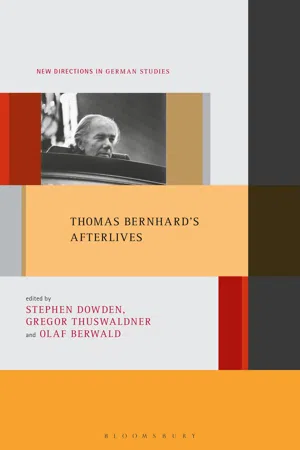
Thomas Bernhard's Afterlives examines the international mobilization of Bernhard's style. Writers in Italian, German, Spanish, Hungarian, English, and French have succeeded in making Bernhard's Austrian vision an international vision. This book tells that story.
eBook - ePub
Thomas Bernhard's Afterlives
- 264 pages
- English
- ePUB (mobile friendly)
- Available on iOS & Android
eBook - ePub
Thomas Bernhard's Afterlives
About this book
Information
One The Afterlife of Thomas Bernhard in Contemporary Austrian Literature
More than three decades after his death, Thomas Bernhard remains a powerful presence in the German-language literary landscape. This can be observed in the new posthumously published works from his literary estate,1 as well as several recent compendia of Bernhard quotations and text extracts, detailing, for example, Bernhard’s most vicious insults in a collection entitled Bernhard für Boshafte (Bernhard for the vicious), his views on marriage in Die Ehehölle (Marital hell), or his infamous Städtebeschimpfungen (City insults).2 Arguably, these compendia, presenting text extracts taken out of context, reduce the anger and rage that permeates Bernhard’s work to a mere gesture of revolt. Such compendia serve to sanitize Bernhard, making his work into a commodity, suitable to be given as presents. However, during Bernhard’s lifetime, his publisher Siegfried Unseld famously chastised him for naming his second novel Verstörung (literally “Disturbance,” published as Gargoyles in English): “(es sind 90% aller Bücherkäufer), die Bücher zu Geschenkzwecken kaufen. Diese Leute wollen eben keinen Titel, der ‘Verstörung’ heißt” ([90% of all book buyers] buy books for the purpose of giving them as gifts. These people certainly don’t want a book called “Disturbance”).3 Glossy photobooks of Bernhard portraits, the writer’s houses, and the places he wrote about testify to Bernhard’s continuing presence, as author and biographical person, on the Austrian literary market. His plays are regularly staged, with even the originally explosive Heldenplatz performed in culturally conservative theaters such as Vienna’s Theater in der Josefstadt.4
In addition, more than three decades after his death, the shadow of Bernhard continues to loom large over contemporary Austrian literature. This chapter analyzes four recent examples in Austrian fiction, which use both the biographical figure of Bernhard and/or Bernhard’s works for different purposes, whether for utilizing his voice to undertake a critique of a seemingly timeless Vienna and its institutions, revisiting the period of protest and revolt that characterized the Waldheim era in Austria, satirizing the culture industry, or illustrating what an enduring influence Bernhard remains for a new generation of (male) writers (Thomas Mulitzer and Alexander Schimmelbusch). The chapter will examine works by established Austrian writers and Bernhard contemporaries Gerhard Roth and Robert Schindel, as well as by Thomas Mulitzer and Alexander Schimmelbusch, who represent a younger generation of authors.
Roth and Schindel, in their epic novels Der Kalte (The cold one, 2013) and Orkus (Orcus, 2011) respectively, return in fiction to a time when Bernhard was still alive, interweaving episodes featuring the biographical figure of Bernhard in a wider sociocultural critique. While in Roth’s and Schindel’s novels Bernhard’s presence is episodic, in Alexander Schimmelbusch’s and Thomas Mulitzer’s novels, Bernhard dominates the narrative. Schimmelbusch’s Die Murau Identität (The Murau identity, 2014), set in the second decade of the twenty-first century, affords Bernhard both literary and physical immortality, with the narrative centered around the premise that the author faked his own death in 1989 and is, in fact, still alive. Thomas Mulitzer’s Tau (Thaw, 2017) emulates the detective work undertaken by the narrator in Thomas Bernhard’s debut novel Frost with a student narrator who embarks on a fact-finding mission in his home village of Weng, which Bernhard immortalized in Frost. While three of the four novels listed above (Der Kalte, Die Murau Identität, Tau) were identified in the 2018 Bernhard Handbuch’s list of literary works that engage with the Bernhard legacy, under a concise subsection entitled “Bernhard lebt” (Bernhard lives),5 this precise constellation of these recent works has not hitherto been examined together. Through the analysis of these diverse texts, I will trace how Bernhard is represented, what function he serves in the narrative, and how the various authors engage with Bernhard’s literary image and legacy. Ultimately, this chapter argues that these recent literary engagements with Bernhard attest to his indispensability to Austrian cultural history, and to literature itself.
I
Robert Schindel’s Der Kalte (2013),6 part of his planned trilogy focusing on the legacy of the Second World War and the Holocaust in Austria,7 may be called a roman à clef (although Schindel himself has contested this label) about the Waldheim affair of 1986–1988. In this epic novel, which Joseph Moser has described as constituting part of the writer’s comédie humaine,8 Schindel fictionalizes the events surrounding the candidacy and election to the Austrian presidency of former UN Secretary-General Kurt Waldheim, who was found to have lied about the extent of his involvement in the Nazi war machine. Schindel reconstructs the scandal, which was instrumental in facilitating a long-overdue discussion about Austrian complicity in the crimes of Nazism, and the emergence of a civil society through the movement that protested Waldheim’s candidacy and election. In doing so, Schindel highlights the crucial role that Bernhard occupied in Austrian cultural life at this time, when the country’s self-image with regard to its National Socialist past was undergoing a significant shift. Schindel identifies three “Kulturkämpfe” (culture wars) in total that were happening at this time: the Waldheim affair itself, the unveiling of Alfred Hrdlicka’s controversial and problematic Mahnmal gegen Krieg und Faschismus (Monument against war and fascism) in November 1988,9 and the premiere of Thomas Bernhard’s play Heldenplatz in the same month, nearly to the day, as the fiftieth anniversary of the November pogroms.
In Schindel’s depiction of his home city of Vienna, where the theater has traditionally been held in great esteem,10 the various goings-on at the Burgtheater, Vienna’s national stage, are afforded as much importance in Schindel’s novel as the events unfolding around the character of Johann Wais (modeled on Kurt Waldheim). Here we encounter Dietger Schönn (unmistakably recognizable as legendary theater director, Claus Peymann), who stages a number of plays intended to draw the audience’s attention to the country’s political situation. As details of Wais’s (Waldheim’s) military record emerge, Dietger Schönn decides to visit the writer Raimund Muthesius in Upper Austria in order to commission a “Vergangenheitsbewältigungsstück” (reckoning-with-the-past play).11 The figure of Muthesius is, again, a thinly veiled depiction of Thomas Bernhard, identifiable as such both from biographical features such as his predilection for living in rural isolation in the Austrian countryside, but also through the clear thematic similarities in the subject matter of Muthesius’s and Bernhard’s plays. Muthesius decides to write a play, entitled “Vom Balkon” (From the balcony), from the perspective of an exiled violinist, who returns to Austria after many years. This is strongly reminiscent of Bernhard’s last play, Heldenplatz (1988), which centers upon a Viennese Jewish family, the Schusters, who emigrated to England in 1938 and then returned to Vienna in the 1960s. Throughout the play (set in March 1988), the Schuster family is coming to terms with the suicide of Josef Schuster, which takes place around the fiftieth anniversary of Hitler proclaiming the Nazi annexation of Austria on the Heldenplatz on March 15, 1938. The scandal that the premiere of Heldenplatz provoked is very faithfully reconstructed in Der Kalte, as is the censure previously levelled at Bernhard, and his reaction to it by writing ever more polemical works:
Ein widerliches Zeug über dieses widerliche Land. Es käme zum sogenannten Bedenkjahr zurecht, übrigens eine lächerliche Bezeichnung für die Hirnarbeit von Hohlkopfen, aus denen sich die alpenländische Politkaste seit je rekrutierte. Seit ihm ein Unterrichtsminister habe ausrichten lassen, er, Muthesius, gehöre zum Psychiater […], seine Texte erleichterten die Psychiatrisierung seiner Person, auf der Bühne hätten sie nichts verloren, seither glückte ihm die Überzeichnung der österreichischen Seele auf besondere Weise.
(A disgusting thing about this disgusting country. That would be just right for the so-called year of reflection, incidentally a ridiculous term for the cognitive work of blockheads, from which the Alpine political caste has recruited itself since time immemorial. Ever since a Minister of Education had let it be known to him that, he, Muthesius, needs a psychiatrist […], his texts facilitated the psychiatricization of his person, they had no business on the stage, since then his exaggerations of the Austrian soul came especially easily to him.)12
By reconstructing the biographical details of Bernhard’s life so faithfully—including an allusion to Education Minister Herbert Moritz pointedly suggesting in 1985 that Bernhard was “ein Fall für die Wissenschaft” (worthy of scientific attention)13—Schindel reflects on the crucial role that Bernhard came to occupy in Austrian cultural life, particularly by the late 1980s. By this point, Bernhard’s reputation as an “established outsider”14 had become cemented through instances such as his infamous speech on accepting the Österreichischer Staatspreis für Literatur (Austrian state prize for literature) in 1968,15 and the seizure by the Austrian police of his 1984 novel Holzfällen (Woodcutters) following a libel suit against Bernhard by his erstwhile friend Gerhard Lampersberg. Additionally, the above-cited quotation echoes sentiments expressed in Bernhard’s Heldenplatz, for example, regarding the prevalence of “nurmehr noch den alpenländischen Schwachsinn” (only Alpine idiocy now) in Austria.16
Ultimately, there are only minor reworkings of the scandal surrounding the premiere of Bernhard’s last play in Der Kalte, while other events surrounding the Waldheim affair do undergo interventions and reworkings by Schindel in his fictionalization.17 Such interventions frequently constitute wish fulfilments in Schindel’s novel, as in the case of his treatment of Alfred Hrdlicka’s controversial Mahnmal gegen Krieg und Faschismus (Monument against War and Fascism), to which a temporary amendment of jeering Viennese onlookers is added to the figure of the “Straßenwaschender Jude” (Street-washing Jew), depicting anti- Semitic violence following the Anschluss.18 It is clearly the case that any major literary reworkings or interventions in the historical chronology and unfolding of the Heldenplatz scandal are deemed unnecessary by Schindel. The date of the premiere of “Vom Balkon” (From the balcony) in Der Kalte is amended to November 9, 1988 (rather than November 4, as was the case with Heldenplatz), the exact anniversary of the 1938 November pogroms, to further underline the play’s attention to the resonances of the past in the present. However, no missed opportunities are identified, as in the case of the Hrdlicka memorial.
In his portrait of Thomas Bernhard in Der Kalte, Schindel reaffirms Bernhard’s position as one of the most significant Austrian postwar writers. As a figure of revolt, Bernhard’s sprechende Name (descriptive name) in the novel is Muthesius, evoking associations with courage ...
Table of contents
- Cover
- Title Page
- Contents
- Introduction: The Master of Understatement, or Remembering Schermaier
- 1 The Afterlife of Thomas Bernhard in Contemporary Austrian Literature
- 2 Writing Failure: Geoff Dyer,Thomas Bernhard, and the Inability to Begin
- 3 Bernhard, Sebald, and Photography in Holocaust Memory
- 4 Radical Style: Bernhard, Sontag, Kertész
- 5 The Stains of Cultural Inheritance: Thomas Bernhard and Philip Roth
- 6 Gaddis before Bernhard before Gaddis
- 7 Thomas Bernhard, a Writer for Spain
- 8 Immersions into Bernhard’s Works in Recent Francophone Literature
- 9 Thomas Bernhard’s Influence on Gabriel Josipovici’s Monologue Novels
- 10 Thomas Bernhard, Italo Calvino, Elena Ferrante, and Claudio Magris: From Postmodernism to Anti-Semitism
- 11 Thomas Bernhard’s Extinction: Variations/Variazioni/Variaciones
- Bibliography
- Notes on Contributors
- Index
- Imprint
Trusted by 375,005 students
Access to over 1.5 million titles for a fair monthly price.
Study more efficiently using our study tools.
Frequently asked questions
Yes, you can cancel anytime from the Subscription tab in your account settings on the Perlego website. Your subscription will stay active until the end of your current billing period. Learn how to cancel your subscription
No, books cannot be downloaded as external files, such as PDFs, for use outside of Perlego. However, you can download books within the Perlego app for offline reading on mobile or tablet. Learn how to download books offline
Perlego offers two plans: Essential and Complete
- Essential is ideal for learners and professionals who enjoy exploring a wide range of subjects. Access the Essential Library with 800,000+ trusted titles and best-sellers across business, personal growth, and the humanities. Includes unlimited reading time and Standard Read Aloud voice.
- Complete: Perfect for advanced learners and researchers needing full, unrestricted access. Unlock 1.5M+ books across hundreds of subjects, including academic and specialized titles. The Complete Plan also includes advanced features like Premium Read Aloud and Research Assistant.
We are an online textbook subscription service, where you can get access to an entire online library for less than the price of a single book per month. With over 1.5 million books across 990+ topics, we’ve got you covered! Learn about our mission
Look out for the read-aloud symbol on your next book to see if you can listen to it. The read-aloud tool reads text aloud for you, highlighting the text as it is being read. You can pause it, speed it up and slow it down. Learn more about Read Aloud
Yes! You can use the Perlego app on both iOS and Android devices to read anytime, anywhere — even offline. Perfect for commutes or when you’re on the go.
Please note we cannot support devices running on iOS 13 and Android 7 or earlier. Learn more about using the app
Please note we cannot support devices running on iOS 13 and Android 7 or earlier. Learn more about using the app
Yes, you can access Thomas Bernhard's Afterlives by Olaf Berwald, Stephen D. Dowden, Gregor Thuswaldner, Olaf Berwald,Stephen D. Dowden,Gregor Thuswaldner in PDF and/or ePUB format, as well as other popular books in Literature & German Literary Criticism. We have over 1.5 million books available in our catalogue for you to explore.